

Enhanced Grid Resilience through AGM Battery Technologies
AUG 7, 202510 MIN READ
Generate Your Research Report Instantly with AI Agent
PatSnap Eureka helps you evaluate technical feasibility & market potential.
AGM Battery Evolution and Grid Resilience Objectives
Absorbed Glass Mat (AGM) battery technology has undergone significant evolution since its inception in the 1980s, originally developed for military aircraft applications. This progression has led to its widespread adoption in various sectors, including automotive, telecommunications, and energy storage systems. The primary objective of integrating AGM batteries into grid resilience strategies is to enhance the stability, reliability, and efficiency of power distribution networks.
AGM batteries offer several advantages that make them particularly suitable for grid resilience applications. Their sealed design eliminates the need for regular maintenance, reduces the risk of electrolyte leakage, and allows for flexible installation orientations. These characteristics enable AGM batteries to be deployed in diverse environments, from urban substations to remote rural areas, contributing to a more robust and adaptable power infrastructure.
The evolution of AGM technology has focused on improving key performance metrics such as cycle life, depth of discharge, and charge acceptance rates. Recent advancements have led to the development of AGM batteries with enhanced thermal management capabilities, crucial for maintaining optimal performance under varying environmental conditions. This progress aligns with the grid resilience objective of ensuring consistent power supply during extreme weather events or other challenging scenarios.
Another significant aspect of AGM battery evolution is the increase in energy density and power output. Modern AGM batteries can store more energy in a smaller footprint, making them ideal for applications where space is at a premium. This characteristic is particularly valuable in urban grid infrastructure, where the integration of energy storage solutions often faces spatial constraints.
The integration of AGM batteries into smart grid systems represents a key objective in enhancing grid resilience. These batteries can provide rapid response times for frequency regulation and voltage support, contributing to the overall stability of the power network. Additionally, AGM batteries play a crucial role in peak shaving and load leveling applications, helping to balance supply and demand fluctuations and reduce strain on the grid during high-demand periods.
As renewable energy sources become increasingly prevalent, AGM batteries are being utilized to address the intermittency challenges associated with solar and wind power. By storing excess energy during peak production periods and releasing it during low production or high demand times, AGM batteries contribute to a more stable and reliable renewable energy integration into the grid.
Looking forward, the objectives for AGM battery technology in grid resilience applications include further improvements in cycle life, faster charging capabilities, and enhanced integration with advanced energy management systems. These goals aim to create a more responsive, efficient, and resilient power distribution network capable of meeting the evolving demands of modern energy consumption patterns and withstanding various environmental and operational challenges.
AGM batteries offer several advantages that make them particularly suitable for grid resilience applications. Their sealed design eliminates the need for regular maintenance, reduces the risk of electrolyte leakage, and allows for flexible installation orientations. These characteristics enable AGM batteries to be deployed in diverse environments, from urban substations to remote rural areas, contributing to a more robust and adaptable power infrastructure.
The evolution of AGM technology has focused on improving key performance metrics such as cycle life, depth of discharge, and charge acceptance rates. Recent advancements have led to the development of AGM batteries with enhanced thermal management capabilities, crucial for maintaining optimal performance under varying environmental conditions. This progress aligns with the grid resilience objective of ensuring consistent power supply during extreme weather events or other challenging scenarios.
Another significant aspect of AGM battery evolution is the increase in energy density and power output. Modern AGM batteries can store more energy in a smaller footprint, making them ideal for applications where space is at a premium. This characteristic is particularly valuable in urban grid infrastructure, where the integration of energy storage solutions often faces spatial constraints.
The integration of AGM batteries into smart grid systems represents a key objective in enhancing grid resilience. These batteries can provide rapid response times for frequency regulation and voltage support, contributing to the overall stability of the power network. Additionally, AGM batteries play a crucial role in peak shaving and load leveling applications, helping to balance supply and demand fluctuations and reduce strain on the grid during high-demand periods.
As renewable energy sources become increasingly prevalent, AGM batteries are being utilized to address the intermittency challenges associated with solar and wind power. By storing excess energy during peak production periods and releasing it during low production or high demand times, AGM batteries contribute to a more stable and reliable renewable energy integration into the grid.
Looking forward, the objectives for AGM battery technology in grid resilience applications include further improvements in cycle life, faster charging capabilities, and enhanced integration with advanced energy management systems. These goals aim to create a more responsive, efficient, and resilient power distribution network capable of meeting the evolving demands of modern energy consumption patterns and withstanding various environmental and operational challenges.
Market Analysis for AGM Battery in Grid Applications
The market for AGM (Absorbent Glass Mat) batteries in grid applications has been experiencing significant growth in recent years, driven by the increasing demand for reliable and efficient energy storage solutions. As power grids worldwide face challenges related to aging infrastructure, integration of renewable energy sources, and the need for improved resilience, AGM batteries have emerged as a promising technology to address these issues.
The global market for AGM batteries in grid applications is projected to expand at a compound annual growth rate (CAGR) of over 5% from 2021 to 2026. This growth is primarily attributed to the rising adoption of renewable energy sources, such as solar and wind power, which require efficient energy storage systems to manage intermittency and ensure grid stability. Additionally, the increasing focus on grid modernization and smart grid initiatives in developed and developing countries is further fueling the demand for advanced battery technologies like AGM.
In terms of regional market dynamics, North America and Europe currently lead the adoption of AGM batteries for grid applications. These regions have well-established power infrastructures and are actively investing in grid modernization projects. The Asia-Pacific region, particularly countries like China and India, is expected to witness the fastest growth in the coming years due to rapid industrialization, urbanization, and government initiatives to improve power distribution networks.
The market for AGM batteries in grid applications can be segmented based on various factors, including capacity, application, and end-user. Large-scale grid storage systems for utility companies represent a significant portion of the market, while smaller-scale applications for commercial and industrial users are also gaining traction. The telecommunications sector, in particular, has been a key adopter of AGM batteries for backup power solutions in cell towers and data centers.
Key drivers of market growth include the increasing need for grid stability and reliability, rising energy demand, and the growing adoption of electric vehicles, which is putting additional strain on power grids. Furthermore, the declining costs of battery technologies and improvements in energy density and cycle life are making AGM batteries more attractive for grid applications.
However, the market also faces certain challenges. Competition from other energy storage technologies, such as lithium-ion batteries and flow batteries, is intensifying. Additionally, concerns about the environmental impact of lead-acid batteries, including AGM batteries, may influence market dynamics in the long term. Despite these challenges, ongoing research and development efforts are focused on improving the performance and sustainability of AGM batteries, which is expected to maintain their relevance in the grid applications market.
The global market for AGM batteries in grid applications is projected to expand at a compound annual growth rate (CAGR) of over 5% from 2021 to 2026. This growth is primarily attributed to the rising adoption of renewable energy sources, such as solar and wind power, which require efficient energy storage systems to manage intermittency and ensure grid stability. Additionally, the increasing focus on grid modernization and smart grid initiatives in developed and developing countries is further fueling the demand for advanced battery technologies like AGM.
In terms of regional market dynamics, North America and Europe currently lead the adoption of AGM batteries for grid applications. These regions have well-established power infrastructures and are actively investing in grid modernization projects. The Asia-Pacific region, particularly countries like China and India, is expected to witness the fastest growth in the coming years due to rapid industrialization, urbanization, and government initiatives to improve power distribution networks.
The market for AGM batteries in grid applications can be segmented based on various factors, including capacity, application, and end-user. Large-scale grid storage systems for utility companies represent a significant portion of the market, while smaller-scale applications for commercial and industrial users are also gaining traction. The telecommunications sector, in particular, has been a key adopter of AGM batteries for backup power solutions in cell towers and data centers.
Key drivers of market growth include the increasing need for grid stability and reliability, rising energy demand, and the growing adoption of electric vehicles, which is putting additional strain on power grids. Furthermore, the declining costs of battery technologies and improvements in energy density and cycle life are making AGM batteries more attractive for grid applications.
However, the market also faces certain challenges. Competition from other energy storage technologies, such as lithium-ion batteries and flow batteries, is intensifying. Additionally, concerns about the environmental impact of lead-acid batteries, including AGM batteries, may influence market dynamics in the long term. Despite these challenges, ongoing research and development efforts are focused on improving the performance and sustainability of AGM batteries, which is expected to maintain their relevance in the grid applications market.
Current Challenges in AGM Battery Grid Integration
The integration of AGM (Absorbent Glass Mat) battery technologies into the power grid presents several significant challenges that need to be addressed to enhance grid resilience effectively. One of the primary obstacles is the limited energy density of AGM batteries compared to other advanced battery technologies. This constraint affects the overall storage capacity and the ability to provide sustained power during extended grid outages or peak demand periods.
Another critical challenge lies in the thermal management of AGM batteries when integrated into large-scale grid applications. As these batteries charge and discharge, they generate heat, which can impact their performance and lifespan if not properly managed. Developing efficient cooling systems and optimizing battery placement within grid infrastructure are essential considerations for successful integration.
The charging and discharging characteristics of AGM batteries also pose challenges for grid operators. The relatively slow charging rate of AGM batteries compared to some other energy storage technologies can limit their responsiveness to rapid fluctuations in grid demand. This limitation may require careful planning and integration of complementary fast-response systems to maintain grid stability.
Scalability is another significant hurdle in AGM battery grid integration. While AGM batteries have proven effective in smaller-scale applications, scaling up to meet the demands of large power grids introduces complexities in system design, control, and maintenance. Ensuring uniform performance across a vast network of interconnected AGM batteries requires sophisticated management systems and robust communication protocols.
The long-term durability and cycle life of AGM batteries in grid applications also present challenges. Grid-scale energy storage systems are expected to operate reliably for many years, and the degradation of AGM batteries over time can impact their effectiveness and economic viability. Developing strategies to extend battery life and implement predictive maintenance protocols are crucial for sustainable grid integration.
Furthermore, the environmental impact and end-of-life management of AGM batteries must be considered. As these batteries reach the end of their operational life, proper recycling and disposal processes need to be established to minimize environmental harm and recover valuable materials. Developing efficient recycling technologies and implementing responsible disposal practices are essential components of sustainable grid integration strategies.
Lastly, the economic feasibility of large-scale AGM battery integration remains a challenge. The initial capital costs, ongoing maintenance expenses, and potential replacement costs must be carefully evaluated against the benefits of enhanced grid resilience. Developing cost-effective manufacturing processes, improving battery performance, and creating innovative business models are necessary to make AGM battery grid integration economically viable on a large scale.
Another critical challenge lies in the thermal management of AGM batteries when integrated into large-scale grid applications. As these batteries charge and discharge, they generate heat, which can impact their performance and lifespan if not properly managed. Developing efficient cooling systems and optimizing battery placement within grid infrastructure are essential considerations for successful integration.
The charging and discharging characteristics of AGM batteries also pose challenges for grid operators. The relatively slow charging rate of AGM batteries compared to some other energy storage technologies can limit their responsiveness to rapid fluctuations in grid demand. This limitation may require careful planning and integration of complementary fast-response systems to maintain grid stability.
Scalability is another significant hurdle in AGM battery grid integration. While AGM batteries have proven effective in smaller-scale applications, scaling up to meet the demands of large power grids introduces complexities in system design, control, and maintenance. Ensuring uniform performance across a vast network of interconnected AGM batteries requires sophisticated management systems and robust communication protocols.
The long-term durability and cycle life of AGM batteries in grid applications also present challenges. Grid-scale energy storage systems are expected to operate reliably for many years, and the degradation of AGM batteries over time can impact their effectiveness and economic viability. Developing strategies to extend battery life and implement predictive maintenance protocols are crucial for sustainable grid integration.
Furthermore, the environmental impact and end-of-life management of AGM batteries must be considered. As these batteries reach the end of their operational life, proper recycling and disposal processes need to be established to minimize environmental harm and recover valuable materials. Developing efficient recycling technologies and implementing responsible disposal practices are essential components of sustainable grid integration strategies.
Lastly, the economic feasibility of large-scale AGM battery integration remains a challenge. The initial capital costs, ongoing maintenance expenses, and potential replacement costs must be carefully evaluated against the benefits of enhanced grid resilience. Developing cost-effective manufacturing processes, improving battery performance, and creating innovative business models are necessary to make AGM battery grid integration economically viable on a large scale.
Existing AGM Battery Solutions for Grid Stability
01 AGM battery design for grid resilience
Advanced AGM (Absorbent Glass Mat) battery designs are being developed to enhance grid resilience. These batteries feature improved electrolyte absorption, better charge acceptance, and longer cycle life, making them suitable for grid-scale energy storage applications. The designs focus on optimizing the internal structure and materials to withstand frequent charge-discharge cycles and provide stable power output during grid fluctuations.- AGM battery design for grid resilience: Advanced AGM (Absorbent Glass Mat) battery designs are being developed to enhance grid resilience. These batteries feature improved electrolyte absorption, higher charge acceptance rates, and better cycle life, making them suitable for grid-scale energy storage applications. The designs focus on optimizing the internal structure and materials to withstand frequent charge-discharge cycles and provide stable power output during grid fluctuations.
- Integration of AGM batteries in smart grid systems: AGM batteries are being integrated into smart grid systems to improve overall grid resilience. This integration involves advanced battery management systems, real-time monitoring, and control algorithms that enable efficient energy distribution and storage. The smart integration allows for better load balancing, peak shaving, and rapid response to grid instabilities, enhancing the overall reliability and resilience of the power grid.
- Thermal management solutions for AGM batteries in grid applications: Innovative thermal management solutions are being developed for AGM batteries used in grid applications. These solutions aim to maintain optimal operating temperatures, extend battery life, and ensure consistent performance under various environmental conditions. Advanced cooling systems, heat dissipation materials, and temperature control algorithms are employed to enhance the reliability and efficiency of AGM batteries in grid resilience applications.
- Hybrid energy storage systems incorporating AGM batteries: Hybrid energy storage systems that combine AGM batteries with other storage technologies are being developed to enhance grid resilience. These systems leverage the strengths of different storage technologies to provide a more versatile and robust energy storage solution. The integration of AGM batteries with supercapacitors, flow batteries, or other complementary technologies allows for improved power quality, faster response times, and increased overall system reliability.
- Advanced monitoring and diagnostics for AGM batteries in grid applications: Sophisticated monitoring and diagnostic systems are being developed for AGM batteries used in grid resilience applications. These systems employ advanced sensors, data analytics, and machine learning algorithms to continuously assess battery health, predict potential failures, and optimize performance. Real-time monitoring and predictive maintenance strategies help prevent unexpected outages and ensure the long-term reliability of AGM batteries in supporting grid resilience.
02 Integration of AGM batteries in smart grid systems
AGM batteries are being integrated into smart grid systems to improve overall grid resilience. This integration involves advanced battery management systems, real-time monitoring, and control algorithms that enable efficient energy distribution and storage. The smart integration allows for better load balancing, peak shaving, and rapid response to grid instabilities, enhancing the overall reliability and resilience of the power grid.Expand Specific Solutions03 Thermal management and safety features for AGM batteries
Innovations in thermal management and safety features are being implemented in AGM batteries to enhance their reliability in grid applications. These advancements include improved heat dissipation mechanisms, fire-resistant materials, and advanced safety circuits. Such features ensure stable battery performance under various environmental conditions and prevent thermal runaway, contributing to increased grid resilience.Expand Specific Solutions04 Hybrid AGM battery systems for enhanced grid stability
Hybrid AGM battery systems are being developed to combine the advantages of AGM technology with other energy storage solutions. These hybrid systems may integrate AGM batteries with supercapacitors, lithium-ion batteries, or other storage technologies to provide a more versatile and resilient energy storage solution for grid applications. The hybrid approach allows for optimized performance in both short-term power delivery and long-term energy storage.Expand Specific Solutions05 Advanced charging and discharging strategies for AGM batteries
Innovative charging and discharging strategies are being implemented to maximize the efficiency and lifespan of AGM batteries in grid applications. These strategies include pulse charging techniques, adaptive charging algorithms, and intelligent load management systems. By optimizing the charge-discharge cycles, these advancements help maintain battery health, improve energy efficiency, and enhance the overall resilience of the grid energy storage system.Expand Specific Solutions
Key Players in AGM Battery and Grid Resilience
The market for enhanced grid resilience through AGM battery technologies is in a growth phase, driven by increasing demand for reliable power supply and renewable energy integration. The global market size is expanding, with projections indicating significant growth in the coming years. Technologically, AGM batteries are mature, but ongoing innovations are pushing the boundaries of their capabilities. Key players like Johnson Controls, BYD, and Clarios are leading the charge, with companies such as Tianneng Battery Group and Chaowei Power Group also making significant contributions. These firms are investing heavily in R&D to improve battery performance, longevity, and cost-effectiveness, indicating a competitive and dynamic market landscape.
Johnson Controls, Inc.
Technical Solution: Johnson Controls has developed advanced AGM (Absorbent Glass Mat) battery technologies to enhance grid resilience. Their PowerFrame® grid technology improves corrosion resistance and electrical flow, increasing battery life by up to 70% compared to traditional designs[1]. They've also implemented a patented grid stamping process that reduces electrical resistance, enhancing power delivery and charge acceptance[2]. Johnson Controls' AGM batteries feature a valve-regulated design that prevents acid spills and allows for flexible installation orientations, crucial for diverse grid applications[3]. The company has invested in smart battery management systems that optimize charging and discharging cycles, extending battery lifespan and improving overall grid stability[4].
Strengths: Long-lasting batteries, improved power delivery, flexible installation, and smart management systems. Weaknesses: Higher initial cost compared to traditional lead-acid batteries, and potential for overheating in extreme conditions.
BYD Co., Ltd.
Technical Solution: BYD has developed innovative AGM battery technologies for grid resilience applications. Their Blade Battery, while primarily designed for electric vehicles, has been adapted for stationary energy storage systems to support grid stability[1]. This LFP-based technology offers exceptional safety and longevity, crucial for grid applications. BYD's AGM batteries feature a unique cell-to-pack design that increases energy density by up to 50% compared to traditional configurations[2]. They've also implemented advanced thermal management systems in their AGM batteries, ensuring stable performance under various environmental conditions[3]. BYD's batteries incorporate smart BMS (Battery Management System) technology that allows for precise control of charging and discharging processes, optimizing battery life and grid integration[4].
Strengths: High energy density, exceptional safety features, advanced thermal management, and smart control systems. Weaknesses: Relatively new to grid-scale applications, potentially higher costs due to advanced technology.
Innovative AGM Battery Designs for Grid Resilience
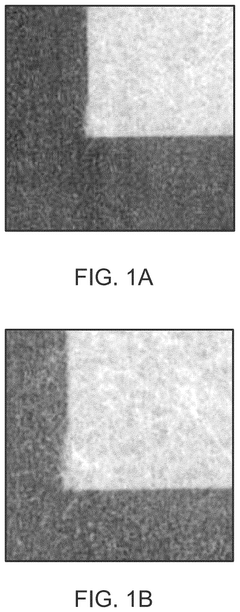
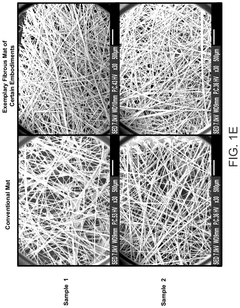
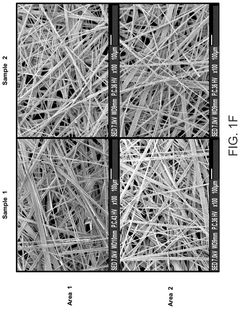
Separators with fibrous mat, lead acid batteries using the same, and methods and systems associated therewith
PatentActiveUS12113237B2
Innovation
- A porous membrane separator with a fibrous mat and ribbed structure is used, incorporating performance-enhancing additives and coatings, increased porosity, and higher silanol group silica to improve retention of active material and reduce electrical resistance, thereby preventing acid stratification and shedding.

Method for Charging a Battery Having a Plurality of Battery Cells
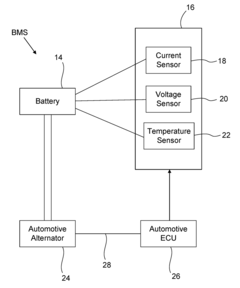
PatentActiveUS20180134168A1
Innovation
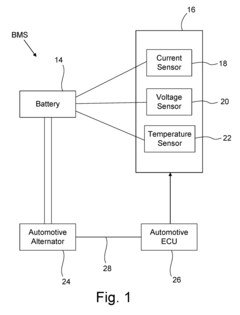
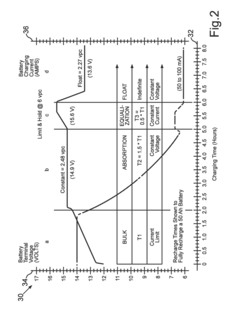
- A battery management system (BMS) that dynamically controls the charging process using sensors for real-time monitoring of battery current, voltage, and temperature, implementing a multi-stage charging strategy including bulk charging, absorption, equalization, and float phases, with adaptive voltage and current adjustments to optimize charging efficiency and prevent overcharging and undercharging.
Environmental Impact of AGM Batteries in Grid Systems
The environmental impact of AGM (Absorbent Glass Mat) batteries in grid systems is a critical consideration as these technologies become increasingly prevalent in enhancing grid resilience. AGM batteries offer several environmental advantages over traditional lead-acid batteries, primarily due to their sealed design and improved efficiency. This design significantly reduces the risk of acid spills and hydrogen gas emissions, making them safer for both the environment and human health.
One of the key environmental benefits of AGM batteries is their longer lifespan compared to conventional batteries. This extended durability translates to fewer replacements over time, reducing the overall environmental footprint associated with battery production and disposal. Additionally, AGM batteries have a higher charge efficiency, which means they require less energy input during the charging process, potentially lowering the overall energy consumption of grid systems.
The recyclability of AGM batteries is another crucial factor in their environmental profile. These batteries are highly recyclable, with up to 99% of their components being recoverable and reusable. This high recycling rate helps to conserve natural resources and minimize waste, contributing to a more circular economy in the energy storage sector.
However, the environmental impact of AGM batteries is not without challenges. The production process still involves the use of lead and other potentially harmful materials. While the sealed design mitigates many risks during use, proper handling and disposal procedures are essential to prevent environmental contamination. The energy-intensive manufacturing process of AGM batteries also contributes to their overall carbon footprint, although this is often offset by their improved efficiency and longevity in grid applications.
In grid systems, the use of AGM batteries can indirectly contribute to environmental benefits by enabling greater integration of renewable energy sources. Their ability to provide reliable backup power and smooth out fluctuations in energy supply makes them valuable components in systems that incorporate intermittent renewable sources like solar and wind. This capability supports the transition to cleaner energy grids, potentially reducing reliance on fossil fuel-based power generation.
The scalability of AGM battery installations in grid systems also presents both opportunities and challenges from an environmental perspective. While larger installations can provide more significant benefits in terms of grid stability and renewable energy integration, they also require careful consideration of land use and potential habitat disruption. Proper site selection and environmental impact assessments are crucial to mitigate these concerns.
As the adoption of AGM batteries in grid systems continues to grow, ongoing research and development efforts are focused on further improving their environmental performance. This includes exploring alternative materials to reduce reliance on lead, enhancing energy density to improve efficiency, and developing more sustainable manufacturing processes. These advancements will be crucial in ensuring that the environmental benefits of AGM batteries in grid resilience continue to outweigh their impacts as their deployment expands.
One of the key environmental benefits of AGM batteries is their longer lifespan compared to conventional batteries. This extended durability translates to fewer replacements over time, reducing the overall environmental footprint associated with battery production and disposal. Additionally, AGM batteries have a higher charge efficiency, which means they require less energy input during the charging process, potentially lowering the overall energy consumption of grid systems.
The recyclability of AGM batteries is another crucial factor in their environmental profile. These batteries are highly recyclable, with up to 99% of their components being recoverable and reusable. This high recycling rate helps to conserve natural resources and minimize waste, contributing to a more circular economy in the energy storage sector.
However, the environmental impact of AGM batteries is not without challenges. The production process still involves the use of lead and other potentially harmful materials. While the sealed design mitigates many risks during use, proper handling and disposal procedures are essential to prevent environmental contamination. The energy-intensive manufacturing process of AGM batteries also contributes to their overall carbon footprint, although this is often offset by their improved efficiency and longevity in grid applications.
In grid systems, the use of AGM batteries can indirectly contribute to environmental benefits by enabling greater integration of renewable energy sources. Their ability to provide reliable backup power and smooth out fluctuations in energy supply makes them valuable components in systems that incorporate intermittent renewable sources like solar and wind. This capability supports the transition to cleaner energy grids, potentially reducing reliance on fossil fuel-based power generation.
The scalability of AGM battery installations in grid systems also presents both opportunities and challenges from an environmental perspective. While larger installations can provide more significant benefits in terms of grid stability and renewable energy integration, they also require careful consideration of land use and potential habitat disruption. Proper site selection and environmental impact assessments are crucial to mitigate these concerns.
As the adoption of AGM batteries in grid systems continues to grow, ongoing research and development efforts are focused on further improving their environmental performance. This includes exploring alternative materials to reduce reliance on lead, enhancing energy density to improve efficiency, and developing more sustainable manufacturing processes. These advancements will be crucial in ensuring that the environmental benefits of AGM batteries in grid resilience continue to outweigh their impacts as their deployment expands.
Regulatory Framework for Grid-Scale Battery Storage
The regulatory framework for grid-scale battery storage plays a crucial role in shaping the adoption and implementation of AGM battery technologies for enhanced grid resilience. As the energy landscape evolves, policymakers and regulatory bodies are developing comprehensive guidelines to ensure the safe, efficient, and sustainable integration of large-scale battery systems into the power grid.
At the federal level, the Federal Energy Regulatory Commission (FERC) has issued several orders to facilitate the participation of energy storage resources in wholesale electricity markets. Order 841, in particular, requires regional transmission organizations and independent system operators to establish market rules that recognize the unique characteristics of energy storage resources, including AGM batteries. This order has been instrumental in creating a more level playing field for battery storage technologies to compete with traditional generation sources.
State-level regulations also significantly impact the deployment of grid-scale AGM battery storage. Many states have implemented energy storage targets and incentives to promote the adoption of these technologies. For instance, California's AB 2514 mandated utilities to procure 1.3 GW of energy storage by 2020, while New York's target aims for 3 GW by 2030. These policies have driven investment and innovation in battery storage technologies, including AGM batteries.
Safety standards and codes are another critical aspect of the regulatory framework. Organizations such as the National Fire Protection Association (NFPA) and Underwriters Laboratories (UL) have developed specific guidelines for the installation and operation of large-scale battery systems. These standards address fire safety, thermal runaway prevention, and emergency response procedures, ensuring that AGM battery installations meet rigorous safety requirements.
Environmental regulations also play a role in shaping the adoption of AGM battery technologies. The Environmental Protection Agency (EPA) has established guidelines for the proper disposal and recycling of lead-acid batteries, including AGM batteries, to minimize environmental impact. Additionally, some jurisdictions have implemented carbon pricing mechanisms or clean energy standards that indirectly benefit battery storage technologies by incentivizing grid decarbonization.
Interconnection standards and grid codes are being updated to accommodate the unique characteristics of battery storage systems. These regulations define the technical requirements for connecting battery systems to the grid, ensuring compatibility and reliability. The Institute of Electrical and Electronics Engineers (IEEE) has developed standards such as IEEE 1547 for the interconnection of distributed energy resources, including battery storage systems.
As the regulatory landscape continues to evolve, policymakers are addressing challenges such as double taxation of energy storage resources and defining the role of utilities in owning and operating battery storage assets. These ongoing discussions and policy developments will shape the future of AGM battery technologies and their contribution to grid resilience.
At the federal level, the Federal Energy Regulatory Commission (FERC) has issued several orders to facilitate the participation of energy storage resources in wholesale electricity markets. Order 841, in particular, requires regional transmission organizations and independent system operators to establish market rules that recognize the unique characteristics of energy storage resources, including AGM batteries. This order has been instrumental in creating a more level playing field for battery storage technologies to compete with traditional generation sources.
State-level regulations also significantly impact the deployment of grid-scale AGM battery storage. Many states have implemented energy storage targets and incentives to promote the adoption of these technologies. For instance, California's AB 2514 mandated utilities to procure 1.3 GW of energy storage by 2020, while New York's target aims for 3 GW by 2030. These policies have driven investment and innovation in battery storage technologies, including AGM batteries.
Safety standards and codes are another critical aspect of the regulatory framework. Organizations such as the National Fire Protection Association (NFPA) and Underwriters Laboratories (UL) have developed specific guidelines for the installation and operation of large-scale battery systems. These standards address fire safety, thermal runaway prevention, and emergency response procedures, ensuring that AGM battery installations meet rigorous safety requirements.
Environmental regulations also play a role in shaping the adoption of AGM battery technologies. The Environmental Protection Agency (EPA) has established guidelines for the proper disposal and recycling of lead-acid batteries, including AGM batteries, to minimize environmental impact. Additionally, some jurisdictions have implemented carbon pricing mechanisms or clean energy standards that indirectly benefit battery storage technologies by incentivizing grid decarbonization.
Interconnection standards and grid codes are being updated to accommodate the unique characteristics of battery storage systems. These regulations define the technical requirements for connecting battery systems to the grid, ensuring compatibility and reliability. The Institute of Electrical and Electronics Engineers (IEEE) has developed standards such as IEEE 1547 for the interconnection of distributed energy resources, including battery storage systems.
As the regulatory landscape continues to evolve, policymakers are addressing challenges such as double taxation of energy storage resources and defining the role of utilities in owning and operating battery storage assets. These ongoing discussions and policy developments will shape the future of AGM battery technologies and their contribution to grid resilience.
Unlock deeper insights with PatSnap Eureka Quick Research — get a full tech report to explore trends and direct your research. Try now!
Generate Your Research Report Instantly with AI Agent
Supercharge your innovation with PatSnap Eureka AI Agent Platform!