

Evaluating Intelligent Message Filters Against Industry Benchmarks
MAR 2, 20269 MIN READ
Generate Your Research Report Instantly with AI Agent
PatSnap Eureka helps you evaluate technical feasibility & market potential.
Intelligent Message Filter Technology Background and Objectives
Intelligent message filtering technology has emerged as a critical component in modern communication systems, evolving from simple rule-based filters to sophisticated AI-driven solutions. The technology's development trajectory spans over three decades, beginning with basic keyword matching systems in the 1990s and progressing through statistical methods, machine learning approaches, and contemporary deep learning implementations. This evolution reflects the increasing complexity of digital communication threats and the growing volume of message traffic across various platforms.
The foundational principles of intelligent message filtering rest on pattern recognition, content analysis, and behavioral modeling. Early systems relied heavily on predefined rules and blacklists, which proved inadequate against evolving spam techniques and social engineering attacks. The introduction of Bayesian filtering marked a significant advancement, enabling probabilistic classification based on message content characteristics. Subsequently, machine learning algorithms such as Support Vector Machines and Random Forests enhanced detection accuracy by learning from large datasets of legitimate and malicious messages.
Contemporary intelligent message filters integrate multiple detection layers, combining natural language processing, image recognition, and network analysis capabilities. These systems analyze message metadata, sender reputation, content semantics, and embedded media to make filtering decisions. Advanced implementations leverage neural networks and transformer architectures to understand context, detect subtle manipulation techniques, and adapt to emerging threat patterns in real-time.
The primary objectives of modern intelligent message filtering systems encompass comprehensive threat detection, minimal false positive rates, and adaptive learning capabilities. Organizations seek solutions that can effectively identify spam, phishing attempts, malware distribution, and social engineering attacks while maintaining legitimate message flow. Performance benchmarks typically focus on detection accuracy, processing speed, scalability, and resource efficiency across diverse deployment environments.
Industry evaluation standards emphasize the importance of testing against standardized datasets and real-world scenarios. Benchmark frameworks assess filter performance across multiple dimensions including precision, recall, F1-scores, and processing latency. The technology aims to achieve detection rates exceeding 99% while maintaining false positive rates below 0.1%, ensuring robust protection without disrupting legitimate communications.
The foundational principles of intelligent message filtering rest on pattern recognition, content analysis, and behavioral modeling. Early systems relied heavily on predefined rules and blacklists, which proved inadequate against evolving spam techniques and social engineering attacks. The introduction of Bayesian filtering marked a significant advancement, enabling probabilistic classification based on message content characteristics. Subsequently, machine learning algorithms such as Support Vector Machines and Random Forests enhanced detection accuracy by learning from large datasets of legitimate and malicious messages.
Contemporary intelligent message filters integrate multiple detection layers, combining natural language processing, image recognition, and network analysis capabilities. These systems analyze message metadata, sender reputation, content semantics, and embedded media to make filtering decisions. Advanced implementations leverage neural networks and transformer architectures to understand context, detect subtle manipulation techniques, and adapt to emerging threat patterns in real-time.
The primary objectives of modern intelligent message filtering systems encompass comprehensive threat detection, minimal false positive rates, and adaptive learning capabilities. Organizations seek solutions that can effectively identify spam, phishing attempts, malware distribution, and social engineering attacks while maintaining legitimate message flow. Performance benchmarks typically focus on detection accuracy, processing speed, scalability, and resource efficiency across diverse deployment environments.
Industry evaluation standards emphasize the importance of testing against standardized datasets and real-world scenarios. Benchmark frameworks assess filter performance across multiple dimensions including precision, recall, F1-scores, and processing latency. The technology aims to achieve detection rates exceeding 99% while maintaining false positive rates below 0.1%, ensuring robust protection without disrupting legitimate communications.
Market Demand Analysis for Advanced Email Security Solutions
The global email security market has experienced substantial growth driven by escalating cyber threats and increasingly sophisticated attack vectors. Organizations across all sectors face mounting pressure to protect their communication infrastructure from malware, phishing attempts, business email compromise, and advanced persistent threats. The proliferation of remote work arrangements and cloud-based email systems has further amplified the demand for robust email security solutions that can adapt to evolving threat landscapes.
Enterprise customers represent the primary demand segment, with large corporations requiring comprehensive email filtering capabilities that can process millions of messages daily while maintaining minimal false positive rates. Mid-market organizations increasingly seek cost-effective solutions that deliver enterprise-grade protection without extensive infrastructure investments. Small businesses, previously underserved in this market, now constitute a rapidly growing segment as they recognize email security as a critical business continuity requirement.
The market demonstrates strong demand for intelligent filtering technologies that leverage machine learning and artificial intelligence to identify previously unknown threats. Organizations prioritize solutions offering real-time threat detection, behavioral analysis capabilities, and integration with existing security ecosystems. Advanced threat intelligence feeds and sandboxing technologies have become essential requirements rather than premium features.
Regulatory compliance requirements significantly influence market demand patterns. Industries such as healthcare, financial services, and government sectors require email security solutions that ensure compliance with regulations including HIPAA, SOX, and GDPR. These compliance mandates create sustained demand for solutions offering comprehensive audit trails, data loss prevention, and encryption capabilities.
Cloud-based deployment models dominate market preferences due to their scalability, reduced maintenance overhead, and rapid deployment capabilities. Organizations increasingly favor security-as-a-service offerings that provide continuous updates and threat intelligence without requiring internal expertise. Hybrid deployment options remain important for organizations with specific data sovereignty or latency requirements.
The market exhibits growing demand for integrated security platforms rather than point solutions. Customers seek email security solutions that seamlessly integrate with broader security information and event management systems, endpoint protection platforms, and identity management solutions. This integration requirement drives demand for solutions offering robust APIs and standardized security frameworks.
Emerging market segments include managed service providers seeking multi-tenant solutions and organizations requiring specialized protection for collaboration platforms beyond traditional email. The increasing adoption of Microsoft 365 and Google Workspace has created specific demand for solutions that enhance native security capabilities while maintaining user experience standards.
Enterprise customers represent the primary demand segment, with large corporations requiring comprehensive email filtering capabilities that can process millions of messages daily while maintaining minimal false positive rates. Mid-market organizations increasingly seek cost-effective solutions that deliver enterprise-grade protection without extensive infrastructure investments. Small businesses, previously underserved in this market, now constitute a rapidly growing segment as they recognize email security as a critical business continuity requirement.
The market demonstrates strong demand for intelligent filtering technologies that leverage machine learning and artificial intelligence to identify previously unknown threats. Organizations prioritize solutions offering real-time threat detection, behavioral analysis capabilities, and integration with existing security ecosystems. Advanced threat intelligence feeds and sandboxing technologies have become essential requirements rather than premium features.
Regulatory compliance requirements significantly influence market demand patterns. Industries such as healthcare, financial services, and government sectors require email security solutions that ensure compliance with regulations including HIPAA, SOX, and GDPR. These compliance mandates create sustained demand for solutions offering comprehensive audit trails, data loss prevention, and encryption capabilities.
Cloud-based deployment models dominate market preferences due to their scalability, reduced maintenance overhead, and rapid deployment capabilities. Organizations increasingly favor security-as-a-service offerings that provide continuous updates and threat intelligence without requiring internal expertise. Hybrid deployment options remain important for organizations with specific data sovereignty or latency requirements.
The market exhibits growing demand for integrated security platforms rather than point solutions. Customers seek email security solutions that seamlessly integrate with broader security information and event management systems, endpoint protection platforms, and identity management solutions. This integration requirement drives demand for solutions offering robust APIs and standardized security frameworks.
Emerging market segments include managed service providers seeking multi-tenant solutions and organizations requiring specialized protection for collaboration platforms beyond traditional email. The increasing adoption of Microsoft 365 and Google Workspace has created specific demand for solutions that enhance native security capabilities while maintaining user experience standards.
Current State and Challenges of Message Filtering Technologies
The current landscape of message filtering technologies presents a complex ecosystem where traditional rule-based systems coexist with advanced machine learning approaches. Legacy spam filters predominantly rely on keyword matching, blacklists, and heuristic rules, which have served as foundational defense mechanisms for decades. However, these conventional methods increasingly struggle against sophisticated attack vectors that employ dynamic content generation, social engineering tactics, and polymorphic messaging techniques.
Modern intelligent filtering systems have evolved to incorporate natural language processing, behavioral analysis, and ensemble learning algorithms. These systems demonstrate superior adaptability by analyzing message context, sender reputation, and communication patterns rather than relying solely on static signatures. Leading implementations now integrate deep learning models that can identify subtle linguistic anomalies and emerging threat patterns in real-time.
Despite technological advances, significant challenges persist across the industry. False positive rates remain a critical concern, particularly in enterprise environments where legitimate business communications may be inadvertently blocked. The balance between security effectiveness and user experience continues to challenge system designers, as overly aggressive filtering can disrupt normal business operations while lenient settings may allow malicious content to penetrate defenses.
Scalability represents another fundamental challenge as message volumes continue to exponentially increase across global communication networks. Processing billions of messages daily while maintaining sub-second response times requires sophisticated infrastructure and optimized algorithms. Many organizations struggle to implement comprehensive filtering solutions that can handle peak loads without compromising detection accuracy or introducing unacceptable latency.
The emergence of adversarial machine learning poses new threats to intelligent filtering systems. Attackers now employ techniques specifically designed to evade AI-based detection mechanisms, including adversarial examples and model poisoning attacks. This arms race between defensive and offensive capabilities necessitates continuous model retraining and adaptation strategies.
Cross-platform compatibility and integration complexity further complicate deployment scenarios. Organizations typically operate heterogeneous communication environments spanning email, instant messaging, social media, and emerging collaboration platforms. Developing unified filtering approaches that maintain consistent protection levels across diverse protocols and data formats remains technically challenging and resource-intensive for most implementations.
Modern intelligent filtering systems have evolved to incorporate natural language processing, behavioral analysis, and ensemble learning algorithms. These systems demonstrate superior adaptability by analyzing message context, sender reputation, and communication patterns rather than relying solely on static signatures. Leading implementations now integrate deep learning models that can identify subtle linguistic anomalies and emerging threat patterns in real-time.
Despite technological advances, significant challenges persist across the industry. False positive rates remain a critical concern, particularly in enterprise environments where legitimate business communications may be inadvertently blocked. The balance between security effectiveness and user experience continues to challenge system designers, as overly aggressive filtering can disrupt normal business operations while lenient settings may allow malicious content to penetrate defenses.
Scalability represents another fundamental challenge as message volumes continue to exponentially increase across global communication networks. Processing billions of messages daily while maintaining sub-second response times requires sophisticated infrastructure and optimized algorithms. Many organizations struggle to implement comprehensive filtering solutions that can handle peak loads without compromising detection accuracy or introducing unacceptable latency.
The emergence of adversarial machine learning poses new threats to intelligent filtering systems. Attackers now employ techniques specifically designed to evade AI-based detection mechanisms, including adversarial examples and model poisoning attacks. This arms race between defensive and offensive capabilities necessitates continuous model retraining and adaptation strategies.
Cross-platform compatibility and integration complexity further complicate deployment scenarios. Organizations typically operate heterogeneous communication environments spanning email, instant messaging, social media, and emerging collaboration platforms. Developing unified filtering approaches that maintain consistent protection levels across diverse protocols and data formats remains technically challenging and resource-intensive for most implementations.
Current Intelligent Message Filtering Technical Solutions
01 Machine learning-based spam and malicious message filtering
Intelligent message filters utilize machine learning algorithms to identify and filter spam, phishing attempts, and malicious content. These systems analyze message characteristics, sender behavior patterns, and content features to classify messages. The filters continuously learn from user feedback and new threat patterns to improve detection accuracy. Advanced implementations incorporate neural networks and deep learning models to adapt to evolving spam techniques and reduce false positives while maintaining high detection rates.- Machine learning-based spam and malicious message filtering: Intelligent message filters utilize machine learning algorithms to identify and filter spam, phishing attempts, and malicious content. These systems analyze message characteristics, sender behavior patterns, and content features to classify messages. The filters continuously learn from user feedback and new threat patterns to improve detection accuracy. Advanced implementations incorporate natural language processing and behavioral analysis to reduce false positives while maintaining high detection rates.
- Adaptive filtering with user feedback mechanisms: Message filtering systems incorporate user feedback loops to dynamically adjust filter parameters and improve performance over time. Users can mark messages as spam or legitimate, allowing the system to refine its classification models. These adaptive mechanisms enable personalized filtering that accounts for individual user preferences and communication patterns. The systems maintain user-specific profiles while also leveraging collective intelligence from multiple users to enhance overall filtering effectiveness.
- Multi-layer filtering architecture for enhanced accuracy: Advanced message filtering employs multi-layer architectures that combine multiple filtering techniques in sequence or parallel. These systems integrate content-based filtering, reputation-based filtering, and heuristic analysis to achieve comprehensive message evaluation. Each layer specializes in detecting specific types of unwanted messages, and the combined results provide more accurate classification. This approach reduces the likelihood of both false positives and false negatives by cross-validating results across different filtering methodologies.
- Real-time performance optimization and resource management: Intelligent filters implement performance optimization techniques to process high volumes of messages with minimal latency. These systems employ efficient data structures, caching mechanisms, and parallel processing to maintain fast filtering speeds. Resource management strategies ensure that filtering operations do not overwhelm system resources while maintaining high throughput. Load balancing and priority queuing mechanisms help manage peak traffic periods without degrading filter performance or user experience.
- Statistical analysis and pattern recognition for filter improvement: Message filtering systems employ statistical analysis and pattern recognition techniques to identify emerging spam trends and attack vectors. These methods analyze large datasets of messages to extract meaningful patterns and anomalies that indicate unwanted content. Statistical models track filter performance metrics such as precision, recall, and false positive rates to guide system tuning. Pattern recognition algorithms identify new spam techniques and automatically update filtering rules to maintain effectiveness against evolving threats.
02 Content-based filtering using natural language processing
Message filtering systems employ natural language processing techniques to analyze message content, including text semantics, keywords, and linguistic patterns. These filters extract features from message bodies, subject lines, and metadata to determine relevance and legitimacy. The technology enables context-aware filtering that understands message intent and can distinguish between legitimate communications and unwanted content. Performance is enhanced through tokenization, sentiment analysis, and semantic understanding of message content.Expand Specific Solutions03 Adaptive filtering with user behavior analysis
Intelligent filters incorporate user interaction patterns and preferences to personalize filtering performance. These systems track user responses to filtered messages, including read rates, deletion patterns, and manual classifications. The filters dynamically adjust their criteria based on individual user behavior and organizational policies. This adaptive approach improves accuracy over time by learning specific user preferences and reducing false positives through continuous feedback loops.Expand Specific Solutions04 Multi-layer filtering architecture for enhanced performance
Advanced message filtering systems implement multi-layer architectures that combine multiple filtering techniques in sequence or parallel. These architectures typically include preliminary header analysis, content scanning, reputation checking, and behavioral analysis layers. Each layer contributes to the overall filtering decision, with different weights assigned based on confidence levels. This approach maximizes detection rates while minimizing processing overhead and latency, ensuring efficient message throughput in high-volume environments.Expand Specific Solutions05 Real-time performance optimization and scalability
Message filtering systems incorporate performance optimization techniques to handle large message volumes with minimal latency. These include distributed processing architectures, caching mechanisms, and efficient indexing strategies. The systems employ load balancing and parallel processing to maintain consistent performance under varying loads. Performance metrics are continuously monitored, and filtering rules are optimized based on computational efficiency and accuracy trade-offs to ensure scalable operation in enterprise environments.Expand Specific Solutions
Major Players in Email Security and Message Filtering Industry
The intelligent message filtering technology landscape is in a mature growth phase, driven by escalating cybersecurity threats and regulatory compliance demands. The market demonstrates substantial scale with established players like Microsoft, IBM, and McAfee leading traditional security solutions, while cloud-native providers such as Zscaler revolutionize delivery models. Technology maturity varies significantly across segments - established firms like Forcepoint and Apple leverage decades of security expertise, whereas emerging players like Tianyi Cloud and Miaozhen Systems focus on AI-driven filtering innovations. Chinese companies including Alibaba, Tencent, and China Mobile represent rapidly advancing regional capabilities, while academic institutions like Harbin Institute of Technology contribute foundational research. The competitive landscape reflects a transition from hardware-based solutions to cloud-delivered, AI-enhanced filtering systems, with market leaders investing heavily in machine learning algorithms and real-time threat intelligence to maintain competitive advantages against increasingly sophisticated messaging threats.
Microsoft Corp.
Technical Solution: Microsoft's intelligent message filtering solution leverages advanced machine learning algorithms integrated within Microsoft Defender for Office 365 and Exchange Online Protection. The system employs multi-layered detection mechanisms including behavioral analysis, reputation-based filtering, and real-time threat intelligence. Their solution utilizes natural language processing to analyze message content, sender reputation scoring, and attachment sandboxing capabilities. The platform processes over 400 billion emails monthly, providing comprehensive protection against phishing, malware, and spam with adaptive learning capabilities that continuously improve detection accuracy based on organizational patterns and global threat intelligence feeds.
Strengths: Comprehensive integration with Office 365 ecosystem, extensive threat intelligence network, high processing volume capability. Weaknesses: Primarily focused on Microsoft environment, potential vendor lock-in concerns, complex configuration requirements.
International Business Machines Corp.
Technical Solution: IBM's intelligent message filtering approach centers on Watson AI-powered security solutions that incorporate cognitive computing for email threat detection. Their system utilizes machine learning models trained on vast datasets to identify sophisticated attack patterns, including advanced persistent threats and zero-day exploits. The solution features natural language understanding capabilities to analyze email context, sentiment analysis for social engineering detection, and integration with IBM QRadar for comprehensive security orchestration. The platform employs federated learning techniques to improve detection models while maintaining data privacy, and provides real-time risk scoring for incoming messages based on multiple threat vectors and behavioral indicators.
Strengths: Advanced AI capabilities with Watson integration, strong enterprise security focus, comprehensive threat analytics. Weaknesses: Higher implementation complexity, significant resource requirements, premium pricing structure.
Core Technologies in AI-Powered Message Classification
Method and system for automated evaluation of spam filters
PatentActiveUS8205264B1
Innovation
- A computer-implemented method and system for automated evaluation of SPAM filters that rates sender-receiver pairs based on traffic information, classifies messages as SPAM or HAM, and generates metrics to calculate evaluation factors such as precision, recall, and accuracy, allowing for continuous and objective assessment of filter performance.


Message profiling systems and methods
PatentInactiveUS8132250B2
Innovation
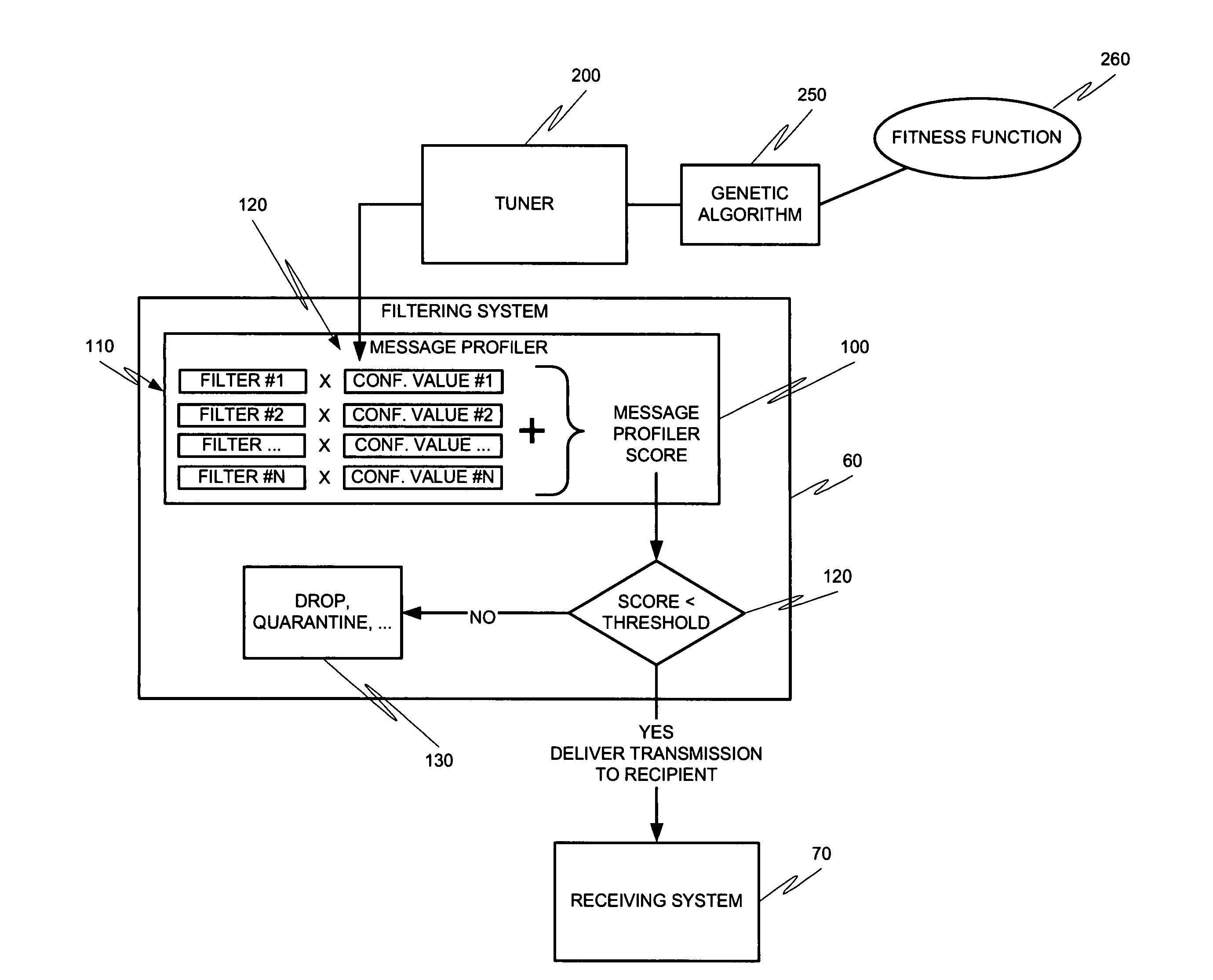
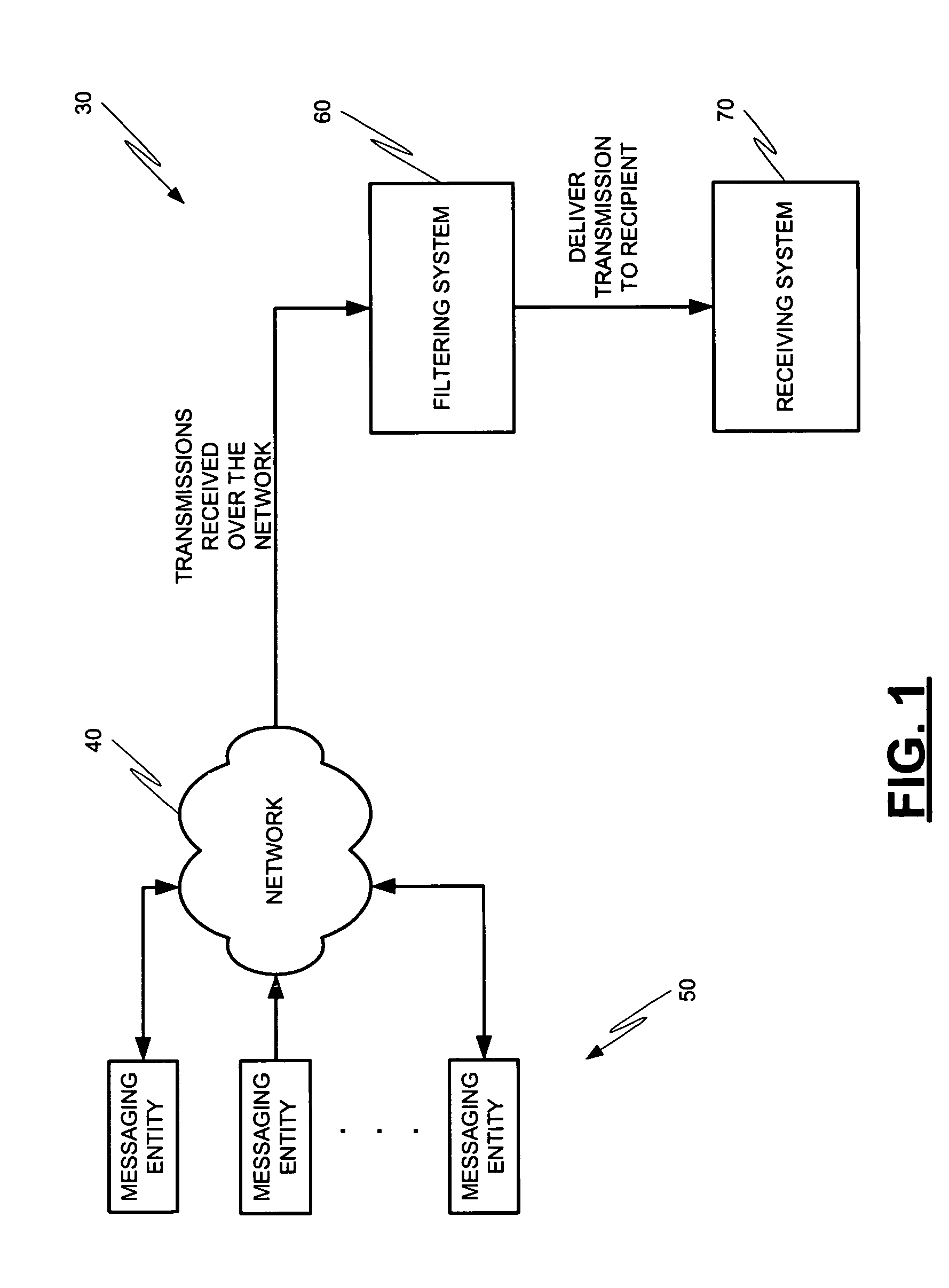
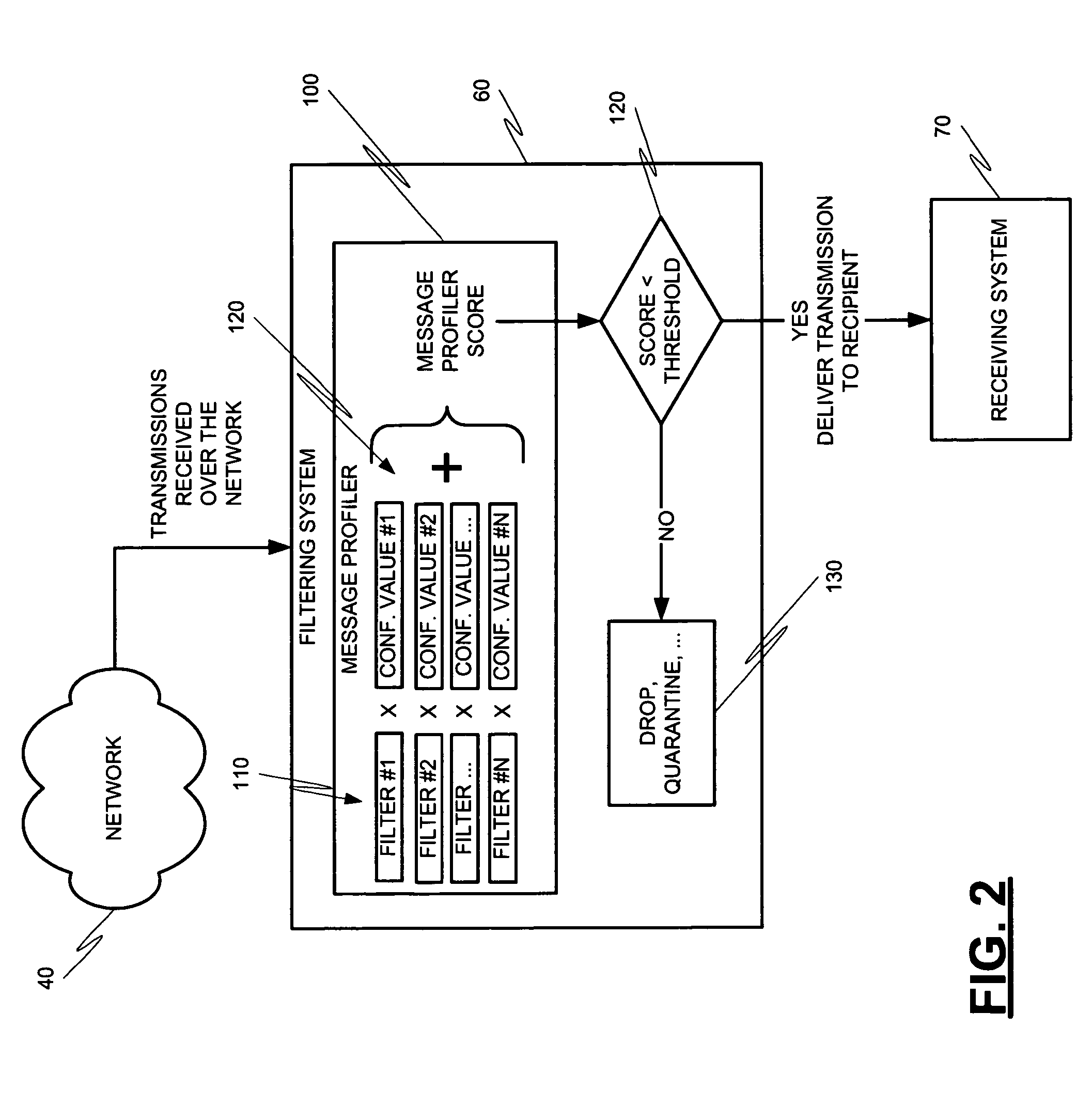
- A system and method that utilize a message profiler program combining multiple classification techniques, such as Reverse DNS, Reputation Server, Bayesian Filtering, and Content Filtering, to generate a message profile score for determining the action to be taken on communications, with a tuner program optimizing classification parameters using genetic algorithms to enhance accuracy.

Industry Benchmark Standards and Evaluation Frameworks
The evaluation of intelligent message filters requires adherence to established industry benchmark standards that provide consistent and reliable assessment methodologies. The most widely recognized framework is the Text REtrieval Conference (TREC) spam filtering track, which has established standardized datasets and evaluation protocols since 2005. This framework emphasizes precision, recall, and F1-score metrics as primary indicators of filter performance, while also incorporating false positive and false negative rates as critical business-oriented measurements.
IEEE standards, particularly IEEE 2857-2021 for privacy engineering in system design, provide comprehensive guidelines for evaluating message filtering systems that handle personal communications. These standards mandate specific privacy preservation requirements and establish baseline performance thresholds that intelligent filters must meet to ensure regulatory compliance across different jurisdictions.
The Anti-Phishing Working Group (APWG) has developed specialized evaluation frameworks specifically targeting phishing detection capabilities within message filtering systems. Their benchmark standards include real-world phishing datasets updated quarterly, providing dynamic evaluation scenarios that reflect current threat landscapes. The framework incorporates time-based performance metrics, measuring filter adaptation speed to emerging phishing techniques.
Commercial evaluation frameworks from organizations like Virus Bulletin and AV-TEST Institute offer independent third-party assessment methodologies. These frameworks utilize large-scale email corpora containing millions of legitimate and malicious messages, providing statistically significant evaluation results. Their testing protocols include multi-language support, various message formats, and diverse attack vectors to ensure comprehensive filter assessment.
Machine learning-specific evaluation frameworks have emerged to address the unique characteristics of AI-powered message filters. The MLPerf benchmark suite includes specialized tracks for natural language processing tasks relevant to message filtering, establishing standardized training datasets and evaluation procedures. These frameworks emphasize model interpretability, bias detection, and adversarial robustness as essential evaluation criteria.
Industry-specific benchmark standards vary significantly across sectors. Financial services follow frameworks established by regulatory bodies like the Financial Industry Regulatory Authority, which mandate specific detection rates for fraudulent communications. Healthcare organizations adhere to HIPAA-compliant evaluation frameworks that prioritize patient data protection while maintaining communication efficiency.
Emerging evaluation frameworks increasingly focus on real-time performance assessment, incorporating latency measurements and throughput capacity as critical benchmarks. These standards recognize that modern message filtering systems must balance accuracy with processing speed to meet user expectations in high-volume communication environments.
IEEE standards, particularly IEEE 2857-2021 for privacy engineering in system design, provide comprehensive guidelines for evaluating message filtering systems that handle personal communications. These standards mandate specific privacy preservation requirements and establish baseline performance thresholds that intelligent filters must meet to ensure regulatory compliance across different jurisdictions.
The Anti-Phishing Working Group (APWG) has developed specialized evaluation frameworks specifically targeting phishing detection capabilities within message filtering systems. Their benchmark standards include real-world phishing datasets updated quarterly, providing dynamic evaluation scenarios that reflect current threat landscapes. The framework incorporates time-based performance metrics, measuring filter adaptation speed to emerging phishing techniques.
Commercial evaluation frameworks from organizations like Virus Bulletin and AV-TEST Institute offer independent third-party assessment methodologies. These frameworks utilize large-scale email corpora containing millions of legitimate and malicious messages, providing statistically significant evaluation results. Their testing protocols include multi-language support, various message formats, and diverse attack vectors to ensure comprehensive filter assessment.
Machine learning-specific evaluation frameworks have emerged to address the unique characteristics of AI-powered message filters. The MLPerf benchmark suite includes specialized tracks for natural language processing tasks relevant to message filtering, establishing standardized training datasets and evaluation procedures. These frameworks emphasize model interpretability, bias detection, and adversarial robustness as essential evaluation criteria.
Industry-specific benchmark standards vary significantly across sectors. Financial services follow frameworks established by regulatory bodies like the Financial Industry Regulatory Authority, which mandate specific detection rates for fraudulent communications. Healthcare organizations adhere to HIPAA-compliant evaluation frameworks that prioritize patient data protection while maintaining communication efficiency.
Emerging evaluation frameworks increasingly focus on real-time performance assessment, incorporating latency measurements and throughput capacity as critical benchmarks. These standards recognize that modern message filtering systems must balance accuracy with processing speed to meet user expectations in high-volume communication environments.
Privacy Regulations Impact on Message Filtering Technologies
The implementation of privacy regulations has fundamentally transformed the landscape of message filtering technologies, creating both constraints and opportunities for intelligent filtering systems. The General Data Protection Regulation (GDPR) in Europe, the California Consumer Privacy Act (CCPA), and similar legislation worldwide have established stringent requirements for data processing, storage, and user consent that directly impact how message filtering algorithms operate.
Privacy regulations mandate explicit user consent for data collection and processing activities, which significantly affects the training and operation of intelligent message filters. Traditional filtering systems that relied on extensive user data collection and behavioral analysis must now implement privacy-by-design principles, incorporating data minimization strategies and purpose limitation requirements. This has led to the development of federated learning approaches and on-device processing capabilities that reduce reliance on centralized data repositories.
The right to data portability and erasure, commonly known as the "right to be forgotten," presents unique challenges for message filtering systems. These requirements necessitate the development of machine learning models that can selectively remove individual user data contributions without compromising overall system performance. Techniques such as differential privacy and homomorphic encryption have become essential components in modern filtering architectures to ensure compliance while maintaining effectiveness.
Cross-border data transfer restrictions have prompted significant architectural changes in global message filtering deployments. Organizations must implement data localization strategies, establishing regional processing centers and ensuring that filtering algorithms can operate effectively within jurisdictional boundaries. This has accelerated the adoption of edge computing solutions and distributed filtering architectures that can process messages locally while maintaining global threat intelligence sharing capabilities.
The transparency requirements embedded in privacy regulations have driven the development of explainable AI techniques within message filtering systems. Users now have the right to understand how automated decisions affect them, requiring filtering systems to provide clear explanations for blocking or flagging decisions. This has led to the integration of interpretable machine learning models and the development of user-friendly interfaces that can communicate filtering rationale effectively.
Compliance monitoring and audit requirements have established new performance metrics beyond traditional accuracy measures. Modern intelligent message filters must demonstrate not only effectiveness in threat detection but also adherence to privacy principles, creating multi-dimensional evaluation frameworks that balance security objectives with regulatory compliance requirements.
Privacy regulations mandate explicit user consent for data collection and processing activities, which significantly affects the training and operation of intelligent message filters. Traditional filtering systems that relied on extensive user data collection and behavioral analysis must now implement privacy-by-design principles, incorporating data minimization strategies and purpose limitation requirements. This has led to the development of federated learning approaches and on-device processing capabilities that reduce reliance on centralized data repositories.
The right to data portability and erasure, commonly known as the "right to be forgotten," presents unique challenges for message filtering systems. These requirements necessitate the development of machine learning models that can selectively remove individual user data contributions without compromising overall system performance. Techniques such as differential privacy and homomorphic encryption have become essential components in modern filtering architectures to ensure compliance while maintaining effectiveness.
Cross-border data transfer restrictions have prompted significant architectural changes in global message filtering deployments. Organizations must implement data localization strategies, establishing regional processing centers and ensuring that filtering algorithms can operate effectively within jurisdictional boundaries. This has accelerated the adoption of edge computing solutions and distributed filtering architectures that can process messages locally while maintaining global threat intelligence sharing capabilities.
The transparency requirements embedded in privacy regulations have driven the development of explainable AI techniques within message filtering systems. Users now have the right to understand how automated decisions affect them, requiring filtering systems to provide clear explanations for blocking or flagging decisions. This has led to the integration of interpretable machine learning models and the development of user-friendly interfaces that can communicate filtering rationale effectively.
Compliance monitoring and audit requirements have established new performance metrics beyond traditional accuracy measures. Modern intelligent message filters must demonstrate not only effectiveness in threat detection but also adherence to privacy principles, creating multi-dimensional evaluation frameworks that balance security objectives with regulatory compliance requirements.
Unlock deeper insights with PatSnap Eureka Quick Research — get a full tech report to explore trends and direct your research. Try now!
Generate Your Research Report Instantly with AI Agent
Supercharge your innovation with PatSnap Eureka AI Agent Platform!