Finite element modeling of composite structural integrity
OCT 15, 20259 MIN READ
Generate Your Research Report Instantly with AI Agent
PatSnap Eureka helps you evaluate technical feasibility & market potential.
Composite Modeling Background and Objectives
Finite element modeling (FEM) has emerged as a cornerstone methodology for analyzing and predicting the structural integrity of composite materials over the past four decades. The evolution of this technology traces back to the 1970s when rudimentary models first attempted to simulate the behavior of fiber-reinforced composites. Since then, the field has undergone remarkable transformation, driven by advances in computational capabilities, material science, and mathematical modeling techniques.
The current trajectory of composite FEM development is characterized by increasing sophistication in multi-scale modeling approaches, which bridge micro, meso, and macro-scale phenomena. This evolution reflects the inherent complexity of composite materials, whose heterogeneous nature presents unique challenges for structural integrity assessment that traditional homogeneous material models cannot adequately address.
Recent technological advancements have enabled more accurate representation of complex failure mechanisms in composites, including delamination, matrix cracking, fiber breakage, and their interactions. The integration of damage mechanics with finite element analysis has significantly enhanced predictive capabilities for progressive failure analysis, a critical aspect for safety-critical applications in aerospace, automotive, and energy sectors.
The primary objective of contemporary finite element modeling for composite structural integrity is to develop robust, computationally efficient frameworks that can accurately predict the initiation and progression of damage under various loading conditions. This includes static, dynamic, impact, fatigue, and environmental factors that influence composite performance throughout their service life.
Another crucial goal is to establish validated modeling methodologies that can reduce the extensive physical testing currently required for composite structure certification. This would substantially decrease development costs and time-to-market for new composite applications, while maintaining or improving safety margins.
The industry is also witnessing a paradigm shift toward digital twin concepts, where real-time FEM simulations are coupled with sensor data from in-service structures to provide continuous structural health monitoring and predictive maintenance capabilities. This represents a frontier in composite modeling that promises to revolutionize lifecycle management of composite structures.
Furthermore, there is growing emphasis on incorporating manufacturing process effects into structural integrity models. This includes residual stresses, fiber waviness, void content, and other process-induced defects that significantly impact the final performance of composite components but have traditionally been difficult to account for in design-stage simulations.
The current trajectory of composite FEM development is characterized by increasing sophistication in multi-scale modeling approaches, which bridge micro, meso, and macro-scale phenomena. This evolution reflects the inherent complexity of composite materials, whose heterogeneous nature presents unique challenges for structural integrity assessment that traditional homogeneous material models cannot adequately address.
Recent technological advancements have enabled more accurate representation of complex failure mechanisms in composites, including delamination, matrix cracking, fiber breakage, and their interactions. The integration of damage mechanics with finite element analysis has significantly enhanced predictive capabilities for progressive failure analysis, a critical aspect for safety-critical applications in aerospace, automotive, and energy sectors.
The primary objective of contemporary finite element modeling for composite structural integrity is to develop robust, computationally efficient frameworks that can accurately predict the initiation and progression of damage under various loading conditions. This includes static, dynamic, impact, fatigue, and environmental factors that influence composite performance throughout their service life.
Another crucial goal is to establish validated modeling methodologies that can reduce the extensive physical testing currently required for composite structure certification. This would substantially decrease development costs and time-to-market for new composite applications, while maintaining or improving safety margins.
The industry is also witnessing a paradigm shift toward digital twin concepts, where real-time FEM simulations are coupled with sensor data from in-service structures to provide continuous structural health monitoring and predictive maintenance capabilities. This represents a frontier in composite modeling that promises to revolutionize lifecycle management of composite structures.
Furthermore, there is growing emphasis on incorporating manufacturing process effects into structural integrity models. This includes residual stresses, fiber waviness, void content, and other process-induced defects that significantly impact the final performance of composite components but have traditionally been difficult to account for in design-stage simulations.
Market Applications for Composite Structural Analysis
The composite materials market has witnessed substantial growth across multiple industries, with the global market value reaching $115 billion in 2022 and projected to exceed $180 billion by 2027, growing at a CAGR of 9.3%. This expansion is primarily driven by the increasing demand for lightweight, high-strength materials that offer superior performance compared to traditional materials.
In the aerospace sector, composite structural analysis plays a critical role in aircraft design and certification. Major manufacturers like Boeing and Airbus have increased composite content in their latest models to over 50% by weight, resulting in 20-25% fuel efficiency improvements. The finite element modeling of composite structural integrity enables precise prediction of failure modes under various flight conditions, significantly reducing the need for costly physical testing while maintaining rigorous safety standards.
The automotive industry represents another significant market for composite structural analysis, particularly as electric vehicles gain market share. Leading manufacturers are implementing carbon fiber reinforced polymers (CFRP) in structural components to extend battery range through weight reduction. Advanced finite element models help optimize crash performance while minimizing material usage, addressing the industry's dual challenges of safety compliance and cost management.
Wind energy generation relies heavily on composite blade technology, with the average turbine blade length increasing from 30 meters to over 100 meters in the past decade. Finite element analysis enables designers to optimize blade structures for maximum energy capture while ensuring structural integrity under extreme weather conditions. This application has directly contributed to reducing the levelized cost of wind energy by approximately 70% since 2009.
The marine industry has embraced composite materials for hull structures, with the recreational boating segment showing particularly strong adoption rates. Finite element modeling allows designers to optimize hull shapes for hydrodynamic efficiency while ensuring structural performance in harsh marine environments. The superyacht sector has seen composite adoption rates increase by 35% over the past five years due to these benefits.
Infrastructure applications represent an emerging market with substantial growth potential. Bridge rehabilitation projects using fiber-reinforced polymer composites have demonstrated 30-40% lower lifecycle costs compared to traditional materials. Finite element modeling enables engineers to accurately predict long-term performance under variable loading conditions, addressing concerns about durability that have historically limited adoption in civil infrastructure.
In the aerospace sector, composite structural analysis plays a critical role in aircraft design and certification. Major manufacturers like Boeing and Airbus have increased composite content in their latest models to over 50% by weight, resulting in 20-25% fuel efficiency improvements. The finite element modeling of composite structural integrity enables precise prediction of failure modes under various flight conditions, significantly reducing the need for costly physical testing while maintaining rigorous safety standards.
The automotive industry represents another significant market for composite structural analysis, particularly as electric vehicles gain market share. Leading manufacturers are implementing carbon fiber reinforced polymers (CFRP) in structural components to extend battery range through weight reduction. Advanced finite element models help optimize crash performance while minimizing material usage, addressing the industry's dual challenges of safety compliance and cost management.
Wind energy generation relies heavily on composite blade technology, with the average turbine blade length increasing from 30 meters to over 100 meters in the past decade. Finite element analysis enables designers to optimize blade structures for maximum energy capture while ensuring structural integrity under extreme weather conditions. This application has directly contributed to reducing the levelized cost of wind energy by approximately 70% since 2009.
The marine industry has embraced composite materials for hull structures, with the recreational boating segment showing particularly strong adoption rates. Finite element modeling allows designers to optimize hull shapes for hydrodynamic efficiency while ensuring structural performance in harsh marine environments. The superyacht sector has seen composite adoption rates increase by 35% over the past five years due to these benefits.
Infrastructure applications represent an emerging market with substantial growth potential. Bridge rehabilitation projects using fiber-reinforced polymer composites have demonstrated 30-40% lower lifecycle costs compared to traditional materials. Finite element modeling enables engineers to accurately predict long-term performance under variable loading conditions, addressing concerns about durability that have historically limited adoption in civil infrastructure.
Current FEM Challenges in Composite Integrity Assessment
Despite significant advancements in finite element modeling (FEM) for composite structures, several critical challenges persist that limit the accuracy and reliability of integrity assessments. One of the most fundamental issues is the multi-scale nature of composite materials, which necessitates modeling across nano, micro, and macro scales simultaneously. Current FEM approaches struggle to efficiently bridge these scales while maintaining computational feasibility, often forcing engineers to make significant simplifications that compromise accuracy.
Material characterization presents another substantial hurdle. Composites exhibit complex anisotropic behavior, with properties varying directionally according to fiber orientation. Additionally, the interface between fibers and matrix materials creates discontinuities that are difficult to model accurately. Current FEM tools often rely on homogenization techniques that fail to capture these critical microstructural details, particularly at stress concentration points where failures typically initiate.
Damage progression modeling remains particularly problematic. Unlike metals, composites fail through multiple concurrent mechanisms including matrix cracking, fiber breakage, delamination, and debonding. Existing FEM approaches struggle to integrate these various failure modes into a unified model, especially when considering their interactive effects. Progressive failure analysis requires complex non-linear solutions that significantly increase computational demands, often making real-time or large-scale analyses impractical.
Environmental factors pose additional modeling challenges. Moisture absorption, temperature fluctuations, and chemical exposure can dramatically alter composite properties over time. Current FEM implementations typically treat material properties as static, failing to account for these environmental degradation mechanisms. This limitation severely impacts the accuracy of long-term structural integrity predictions.
Manufacturing variability introduces further complications. Inconsistencies in fiber volume fraction, void content, and cure cycles create material property variations that are difficult to quantify and incorporate into FEM models. Current approaches often use deterministic values rather than statistical distributions, undermining the reliability of integrity assessments.
Validation methodologies represent another significant challenge. The disconnect between simulation results and experimental data remains problematic, with limited standardized procedures for model verification. Non-destructive evaluation techniques used for validation have their own limitations in detecting and characterizing internal damage in composites.
Computational efficiency continues to constrain practical applications. High-fidelity models incorporating detailed microstructure and damage mechanisms demand enormous computational resources, making them unsuitable for iterative design processes or real-time monitoring applications. Current solver technologies struggle to balance accuracy with reasonable solution times for complex composite structures.
Material characterization presents another substantial hurdle. Composites exhibit complex anisotropic behavior, with properties varying directionally according to fiber orientation. Additionally, the interface between fibers and matrix materials creates discontinuities that are difficult to model accurately. Current FEM tools often rely on homogenization techniques that fail to capture these critical microstructural details, particularly at stress concentration points where failures typically initiate.
Damage progression modeling remains particularly problematic. Unlike metals, composites fail through multiple concurrent mechanisms including matrix cracking, fiber breakage, delamination, and debonding. Existing FEM approaches struggle to integrate these various failure modes into a unified model, especially when considering their interactive effects. Progressive failure analysis requires complex non-linear solutions that significantly increase computational demands, often making real-time or large-scale analyses impractical.
Environmental factors pose additional modeling challenges. Moisture absorption, temperature fluctuations, and chemical exposure can dramatically alter composite properties over time. Current FEM implementations typically treat material properties as static, failing to account for these environmental degradation mechanisms. This limitation severely impacts the accuracy of long-term structural integrity predictions.
Manufacturing variability introduces further complications. Inconsistencies in fiber volume fraction, void content, and cure cycles create material property variations that are difficult to quantify and incorporate into FEM models. Current approaches often use deterministic values rather than statistical distributions, undermining the reliability of integrity assessments.
Validation methodologies represent another significant challenge. The disconnect between simulation results and experimental data remains problematic, with limited standardized procedures for model verification. Non-destructive evaluation techniques used for validation have their own limitations in detecting and characterizing internal damage in composites.
Computational efficiency continues to constrain practical applications. High-fidelity models incorporating detailed microstructure and damage mechanisms demand enormous computational resources, making them unsuitable for iterative design processes or real-time monitoring applications. Current solver technologies struggle to balance accuracy with reasonable solution times for complex composite structures.
State-of-the-Art FEM Solutions for Composites
01 Finite element modeling for structural analysis of engineering components
Finite element modeling techniques are applied to analyze the structural integrity of various engineering components. These methods involve discretizing complex structures into smaller elements to solve differential equations that govern structural behavior. The approach enables engineers to predict stress distributions, deformation patterns, and potential failure modes under different loading conditions, thereby ensuring the structural integrity of components before physical prototyping.- Finite element modeling for structural analysis of engineering components: Finite element modeling techniques are applied to analyze the structural integrity of various engineering components. These methods involve discretizing complex structures into smaller elements to simulate stress distribution, deformation, and potential failure points. Advanced algorithms enable accurate prediction of structural behavior under different loading conditions, helping engineers to optimize designs and ensure safety factors are met before physical prototyping.
- Structural integrity assessment for oil and gas infrastructure: Specialized finite element modeling approaches are developed for evaluating the structural integrity of oil and gas infrastructure, including wellbores, pipelines, and offshore platforms. These models account for unique environmental factors such as high pressure, temperature variations, and corrosive conditions. The simulations help predict potential failure mechanisms, optimize maintenance schedules, and extend the operational lifespan of critical energy infrastructure.
- Dynamic structural integrity modeling for mechanical systems: Dynamic finite element modeling techniques are employed to assess the structural integrity of mechanical systems under varying operational conditions. These models incorporate time-dependent factors such as vibration, fatigue loading, and thermal cycling to predict component lifespan and failure modes. The approach enables engineers to identify critical stress points and optimize designs for improved durability and performance in real-world applications.
- Advanced computational methods for complex structural integrity analysis: Advanced computational methods enhance the capabilities of finite element modeling for structural integrity analysis of complex systems. These approaches include multi-scale modeling, non-linear analysis, and adaptive mesh refinement techniques that improve simulation accuracy while optimizing computational resources. The methods enable more precise prediction of structural behavior in complex geometries and composite materials, supporting innovation in aerospace, automotive, and construction industries.
- Integration of machine learning with finite element modeling for structural integrity prediction: Innovative approaches combine machine learning algorithms with traditional finite element modeling to enhance structural integrity predictions. These hybrid methods leverage historical data and simulation results to develop predictive models that can rapidly assess structural performance under various conditions. The integration enables more efficient design optimization, real-time monitoring of structural health, and improved risk assessment for critical infrastructure and components.
02 Structural integrity assessment for oil and gas infrastructure
Specialized finite element modeling techniques are developed for evaluating the structural integrity of oil and gas infrastructure, including wellbores, pipelines, and offshore platforms. These models account for unique challenges such as high-pressure environments, corrosive conditions, and dynamic loading from fluid flow. The modeling approaches help in predicting potential failure points, optimizing maintenance schedules, and extending the operational life of critical infrastructure.Expand Specific Solutions03 Advanced simulation techniques for complex structural systems
Advanced simulation methodologies incorporate multi-physics approaches to model complex structural systems where mechanical integrity is influenced by thermal, fluid, or electromagnetic factors. These techniques often combine finite element analysis with other computational methods to provide comprehensive structural integrity assessments. The simulations enable engineers to understand complex failure mechanisms and design more resilient structures for challenging applications.Expand Specific Solutions04 Real-time monitoring and predictive modeling for structural health
Integration of sensor data with finite element models enables real-time structural health monitoring and predictive maintenance. These systems continuously update finite element models with actual field measurements to assess structural integrity under operating conditions. The approach allows for early detection of potential structural issues, optimization of inspection schedules, and extension of service life through targeted interventions based on accurate predictive models.Expand Specific Solutions05 Novel computational methods for improving modeling accuracy
Innovative computational techniques are developed to enhance the accuracy and efficiency of finite element modeling for structural integrity assessment. These methods include adaptive meshing algorithms, machine learning approaches for parameter optimization, and novel element formulations for specific structural challenges. The improved computational methods enable more precise prediction of structural behavior, particularly for complex geometries and non-linear material responses under extreme loading conditions.Expand Specific Solutions
Leading Organizations in Composite FEM Development
The finite element modeling of composite structural integrity market is currently in a growth phase, with increasing adoption across aerospace, automotive, and industrial sectors. The market size is expanding due to rising demand for lightweight, high-performance materials in critical applications. Leading the technological development are aerospace giants like The Boeing Co. and Airbus Espana SL, who have established mature modeling capabilities for aircraft components. Academic institutions including Tongji University, Harbin Institute of Technology, and Northwestern Polytechnical University are advancing fundamental research. Industrial players such as Sumitomo Rubber Industries, YAZAKI Corp., and Toyota Motor Corp. are applying these technologies to product development, while software specialists like SIEMENS IND SOFTWARE NV are providing sophisticated simulation tools that bridge theoretical models with practical applications.
The Boeing Co.
Technical Solution: Boeing has developed advanced finite element modeling (FEM) techniques for composite structural integrity analysis in aerospace applications. Their approach integrates multi-scale modeling that bridges microscopic fiber-matrix interactions with macroscopic structural behavior. Boeing's BCOMPFEM (Boeing Composite Finite Element Model) framework incorporates progressive damage models that can predict failure initiation and propagation in complex composite structures under various loading conditions. The company utilizes specialized element formulations that account for interlaminar stresses and delamination growth, critical for predicting damage in layered composites. Boeing has also pioneered the integration of uncertainty quantification methods with FEM to address manufacturing variability in composite structures, allowing for more robust design margins. Their models incorporate environmental effects such as moisture absorption and thermal cycling, which significantly impact long-term composite performance in aerospace applications.
Strengths: Industry-leading validation through extensive physical testing programs; proprietary material models calibrated with decades of in-service data; seamless integration with manufacturing process simulation. Weaknesses: Computationally intensive models requiring specialized hardware; higher implementation complexity compared to conventional FEM approaches; requires extensive material characterization data.
Airbus Espana SL
Technical Solution: Airbus has developed a comprehensive finite element modeling approach for composite structural integrity called COMPASS (Composite Advanced Structural System). This framework integrates multi-scale modeling techniques that connect micromechanical behavior with structural performance. Their methodology incorporates sophisticated damage progression models that can predict failure modes specific to aerospace composites, including fiber breakage, matrix cracking, and delamination. Airbus employs specialized cohesive zone elements to accurately model interlaminar behavior and damage propagation between composite layers. Their Virtual Testing Environment (VTE) allows for simulation of complex loading scenarios including impact, fatigue, and environmental conditions. Airbus has pioneered the integration of manufacturing process simulation with structural analysis, accounting for residual stresses and cure-induced deformations that affect final part performance. Their models incorporate probabilistic methods to address variability in material properties and manufacturing processes, enabling more reliable design margins.
Strengths: Extensive validation through full-scale testing programs; integration with digital twin technology for in-service monitoring; advanced optimization algorithms for weight reduction while maintaining structural integrity. Weaknesses: Models require significant computational resources; complex implementation requiring specialized expertise; challenges in modeling long-term environmental degradation effects.
Key Algorithms for Composite Failure Prediction
Layered finite element analysis of laminated composite structures
PatentInactiveUS20210124808A1
Innovation
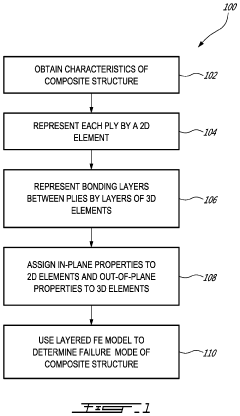
- A computer-implemented method for finite element analysis of composite structures that represents plies as two-dimensional elements and bonding agents as three-dimensional elements, allowing for the association of in-plane and out-of-plane properties to predict delamination by simulating loading conditions and comparing strain limits.


Composite material structure finite element model correction method based on cluster analysis
PatentWO2019011026A1
Innovation
- Using a method based on cluster analysis, the parameters are grouped and corrected by calculating the relative sensitivity matrix of the parameters to be corrected. Dynamic modal experimental technology and hierarchical clustering algorithm are used to construct an objective optimization function to correct the finite characteristics of the composite material structure. metamodel.




Material Characterization Methods for FEM Input
Accurate material characterization is fundamental to the success of finite element modeling for composite structural integrity analysis. The process involves determining the mechanical, thermal, and physical properties of composite materials that serve as critical inputs for FEM simulations. These properties include elastic moduli, Poisson's ratios, strength parameters, and failure criteria that collectively define the material's behavior under various loading conditions.
Traditional characterization methods include tensile, compression, and shear testing according to ASTM or ISO standards. These tests provide basic mechanical properties but often fail to capture the complex anisotropic behavior of composite materials. Advanced techniques such as Digital Image Correlation (DIC) have emerged as powerful tools for measuring full-field strain distributions during mechanical testing, offering insights into local deformation patterns that conventional methods cannot detect.
For laminated composites, specialized tests like the V-notch shear test and open-hole tension test have been developed to characterize interlaminar properties and stress concentrations. These tests are particularly valuable for validating progressive damage models in FEM simulations. Additionally, non-destructive evaluation techniques such as ultrasonic scanning and X-ray computed tomography provide crucial information about internal defects and microstructural features that significantly influence mechanical behavior.
Micromechanical characterization approaches have gained prominence for multi-scale modeling applications. Nanoindentation tests can determine local properties of fibers, matrix, and interfaces, while microscopic observations help quantify fiber volume fractions, orientations, and void content. These microstructural parameters serve as inputs for homogenization techniques that bridge microscale features with macroscale behavior in hierarchical FEM models.
Dynamic mechanical analysis (DMA) and differential scanning calorimetry (DSC) are essential for characterizing viscoelastic properties and glass transition temperatures, particularly important for thermomechanical analyses. For fatigue and time-dependent behavior, specialized cyclic loading tests and creep experiments provide data for developing constitutive models that capture degradation mechanisms over time.
Statistical approaches to material characterization have become increasingly important due to the inherent variability in composite materials. Uncertainty quantification methods help translate experimental scatter into stochastic material parameters for probabilistic FEM analyses. This approach enables more realistic predictions of structural reliability compared to deterministic models based on mean property values.
Recent advances in machine learning techniques have opened new possibilities for efficient material characterization. These methods can identify complex relationships between processing parameters, microstructure, and mechanical properties, potentially reducing the extensive experimental campaigns traditionally required for comprehensive material characterization.
Traditional characterization methods include tensile, compression, and shear testing according to ASTM or ISO standards. These tests provide basic mechanical properties but often fail to capture the complex anisotropic behavior of composite materials. Advanced techniques such as Digital Image Correlation (DIC) have emerged as powerful tools for measuring full-field strain distributions during mechanical testing, offering insights into local deformation patterns that conventional methods cannot detect.
For laminated composites, specialized tests like the V-notch shear test and open-hole tension test have been developed to characterize interlaminar properties and stress concentrations. These tests are particularly valuable for validating progressive damage models in FEM simulations. Additionally, non-destructive evaluation techniques such as ultrasonic scanning and X-ray computed tomography provide crucial information about internal defects and microstructural features that significantly influence mechanical behavior.
Micromechanical characterization approaches have gained prominence for multi-scale modeling applications. Nanoindentation tests can determine local properties of fibers, matrix, and interfaces, while microscopic observations help quantify fiber volume fractions, orientations, and void content. These microstructural parameters serve as inputs for homogenization techniques that bridge microscale features with macroscale behavior in hierarchical FEM models.
Dynamic mechanical analysis (DMA) and differential scanning calorimetry (DSC) are essential for characterizing viscoelastic properties and glass transition temperatures, particularly important for thermomechanical analyses. For fatigue and time-dependent behavior, specialized cyclic loading tests and creep experiments provide data for developing constitutive models that capture degradation mechanisms over time.
Statistical approaches to material characterization have become increasingly important due to the inherent variability in composite materials. Uncertainty quantification methods help translate experimental scatter into stochastic material parameters for probabilistic FEM analyses. This approach enables more realistic predictions of structural reliability compared to deterministic models based on mean property values.
Recent advances in machine learning techniques have opened new possibilities for efficient material characterization. These methods can identify complex relationships between processing parameters, microstructure, and mechanical properties, potentially reducing the extensive experimental campaigns traditionally required for comprehensive material characterization.
Validation Approaches for Composite FEM Models
Validation of composite finite element models requires systematic approaches to ensure model accuracy and reliability. The validation process typically follows a multi-level strategy, beginning with material-level validation where constituent properties and their interactions are verified against experimental data. This fundamental step ensures that the basic material behavior is correctly represented before proceeding to more complex structural analyses.
Component-level validation forms the next critical phase, where substructures are analyzed to verify that the model accurately predicts behavior under various loading conditions. This intermediate step bridges the gap between material characterization and full-scale structural performance, allowing for incremental validation of modeling assumptions and techniques.
Full-scale structural testing represents the most comprehensive validation approach, where complete composite structures are tested under realistic loading conditions. These tests provide the ultimate verification of model accuracy but are often limited by cost and facility constraints. Therefore, they are typically reserved for critical applications or final validation stages.
Non-destructive evaluation (NDE) techniques play an increasingly important role in validation processes. Methods such as ultrasonic scanning, thermography, and digital image correlation provide detailed information about internal defects and deformation patterns without compromising structural integrity. These techniques enable direct comparison between predicted and actual damage progression in composites.
Statistical validation approaches have gained prominence in composite modeling due to the inherent variability in composite materials. Methods such as Monte Carlo simulation and sensitivity analysis help quantify uncertainties in material properties and manufacturing processes, leading to more robust predictions of structural performance and failure probabilities.
Round-robin exercises, where multiple organizations analyze identical composite structures using different modeling approaches, have proven valuable for establishing confidence in FEM methodologies. These collaborative efforts highlight modeling best practices and identify areas where further research is needed to improve prediction accuracy.
Digital twin technology represents an emerging validation approach where physical testing and computational modeling are integrated in real-time. This methodology enables continuous validation and updating of composite models throughout the service life, accounting for environmental effects and damage accumulation that traditional validation approaches might miss.
AI-assisted validation methods are beginning to transform the field by automating the comparison between experimental and computational results. Machine learning algorithms can identify patterns in validation data that might be overlooked by conventional analysis, potentially leading to improved modeling techniques and more efficient validation protocols.
Component-level validation forms the next critical phase, where substructures are analyzed to verify that the model accurately predicts behavior under various loading conditions. This intermediate step bridges the gap between material characterization and full-scale structural performance, allowing for incremental validation of modeling assumptions and techniques.
Full-scale structural testing represents the most comprehensive validation approach, where complete composite structures are tested under realistic loading conditions. These tests provide the ultimate verification of model accuracy but are often limited by cost and facility constraints. Therefore, they are typically reserved for critical applications or final validation stages.
Non-destructive evaluation (NDE) techniques play an increasingly important role in validation processes. Methods such as ultrasonic scanning, thermography, and digital image correlation provide detailed information about internal defects and deformation patterns without compromising structural integrity. These techniques enable direct comparison between predicted and actual damage progression in composites.
Statistical validation approaches have gained prominence in composite modeling due to the inherent variability in composite materials. Methods such as Monte Carlo simulation and sensitivity analysis help quantify uncertainties in material properties and manufacturing processes, leading to more robust predictions of structural performance and failure probabilities.
Round-robin exercises, where multiple organizations analyze identical composite structures using different modeling approaches, have proven valuable for establishing confidence in FEM methodologies. These collaborative efforts highlight modeling best practices and identify areas where further research is needed to improve prediction accuracy.
Digital twin technology represents an emerging validation approach where physical testing and computational modeling are integrated in real-time. This methodology enables continuous validation and updating of composite models throughout the service life, accounting for environmental effects and damage accumulation that traditional validation approaches might miss.
AI-assisted validation methods are beginning to transform the field by automating the comparison between experimental and computational results. Machine learning algorithms can identify patterns in validation data that might be overlooked by conventional analysis, potentially leading to improved modeling techniques and more efficient validation protocols.
Unlock deeper insights with PatSnap Eureka Quick Research — get a full tech report to explore trends and direct your research. Try now!
Generate Your Research Report Instantly with AI Agent
Supercharge your innovation with PatSnap Eureka AI Agent Platform!