
Impact resistance in ultralight composite structures
OCT 15, 202510 MIN READ
Generate Your Research Report Instantly with AI Agent
Patsnap Eureka helps you evaluate technical feasibility & market potential.
Ultralight Composites Impact Resistance Background & Objectives
Ultralight composite structures have emerged as a revolutionary material solution across multiple industries, particularly in aerospace, automotive, and sporting goods sectors. The evolution of these materials can be traced back to the mid-20th century, with significant advancements occurring in the 1960s through the development of carbon fiber reinforced polymers (CFRPs). The subsequent decades witnessed exponential growth in research and application, driven by the increasing demand for fuel-efficient transportation systems and high-performance equipment.
The fundamental appeal of ultralight composites lies in their exceptional strength-to-weight ratio, which substantially exceeds that of traditional materials such as steel or aluminum. This characteristic enables significant weight reduction while maintaining or even enhancing structural integrity. However, a persistent challenge in the widespread adoption of these materials has been their vulnerability to impact damage, which can compromise their structural performance without visible surface indications.
Impact resistance in ultralight composite structures represents a critical technological frontier that balances contradictory requirements: minimizing weight while maximizing durability against various impact scenarios. The technical evolution in this domain has progressed from simple laminate designs to sophisticated multi-functional structures incorporating energy-absorbing mechanisms and self-healing capabilities.
Current global research trends indicate a shift toward bio-inspired designs that mimic natural impact-resistant structures such as seashells, bone, and plant stems. Concurrently, advancements in computational modeling have enabled more accurate prediction of impact behavior, facilitating the development of optimized composite architectures tailored for specific impact conditions.
The primary technical objectives in this field include developing composite structures capable of withstanding high-velocity impacts without catastrophic failure, improving damage visibility for easier inspection, enhancing energy absorption capabilities, and maintaining these properties across varying environmental conditions. Additionally, there is growing emphasis on creating impact-resistant composites that remain environmentally sustainable throughout their lifecycle.
Recent technological breakthroughs have introduced novel approaches such as hierarchical structures, where materials are engineered at multiple scale levels to dissipate impact energy more effectively. The integration of nanomaterials, particularly carbon nanotubes and graphene, has shown promising results in enhancing impact resistance without significant weight penalties.
The trajectory of research in this field is increasingly moving toward multifunctional composites that not only resist impact but also serve additional purposes such as energy storage, sensing, or thermal management. This convergence of functionalities represents the next frontier in ultralight composite development, potentially revolutionizing how we design structures for extreme environments.
The fundamental appeal of ultralight composites lies in their exceptional strength-to-weight ratio, which substantially exceeds that of traditional materials such as steel or aluminum. This characteristic enables significant weight reduction while maintaining or even enhancing structural integrity. However, a persistent challenge in the widespread adoption of these materials has been their vulnerability to impact damage, which can compromise their structural performance without visible surface indications.
Impact resistance in ultralight composite structures represents a critical technological frontier that balances contradictory requirements: minimizing weight while maximizing durability against various impact scenarios. The technical evolution in this domain has progressed from simple laminate designs to sophisticated multi-functional structures incorporating energy-absorbing mechanisms and self-healing capabilities.
Current global research trends indicate a shift toward bio-inspired designs that mimic natural impact-resistant structures such as seashells, bone, and plant stems. Concurrently, advancements in computational modeling have enabled more accurate prediction of impact behavior, facilitating the development of optimized composite architectures tailored for specific impact conditions.
The primary technical objectives in this field include developing composite structures capable of withstanding high-velocity impacts without catastrophic failure, improving damage visibility for easier inspection, enhancing energy absorption capabilities, and maintaining these properties across varying environmental conditions. Additionally, there is growing emphasis on creating impact-resistant composites that remain environmentally sustainable throughout their lifecycle.
Recent technological breakthroughs have introduced novel approaches such as hierarchical structures, where materials are engineered at multiple scale levels to dissipate impact energy more effectively. The integration of nanomaterials, particularly carbon nanotubes and graphene, has shown promising results in enhancing impact resistance without significant weight penalties.
The trajectory of research in this field is increasingly moving toward multifunctional composites that not only resist impact but also serve additional purposes such as energy storage, sensing, or thermal management. This convergence of functionalities represents the next frontier in ultralight composite development, potentially revolutionizing how we design structures for extreme environments.
Market Analysis for Impact-Resistant Lightweight Structures
The market for impact-resistant lightweight structures is experiencing significant growth driven by multiple industries seeking to enhance product performance while reducing weight. The aerospace sector leads demand, with commercial aircraft manufacturers investing heavily in ultralight composite materials that can withstand bird strikes, hail damage, and debris impacts without compromising structural integrity. This segment alone is projected to grow at 7.2% annually through 2030, as fuel efficiency requirements become increasingly stringent.
Automotive applications represent the second largest market, with premium and electric vehicle manufacturers adopting impact-resistant composites for crash structures, body panels, and battery enclosures. The automotive lightweight materials market reached $88.5 billion in 2022 and is expected to surpass $126 billion by 2027. Impact resistance capabilities are becoming a key differentiator as manufacturers balance weight reduction with safety requirements.
The sporting goods industry has emerged as an innovation driver, particularly in high-performance equipment such as helmets, protective gear, and racing components. This sector values the combination of extreme lightness and superior impact absorption, creating a testbed for technologies that later transfer to industrial applications. The premium sports equipment segment utilizing advanced composites grows at 9.3% annually.
Defense applications constitute a smaller but high-value market segment, with military vehicles, body armor, and portable shelters requiring exceptional impact resistance at minimal weight. This sector often pioneers cutting-edge solutions through specialized research programs before commercial adaptation occurs.
Regional analysis reveals North America and Europe currently dominate market share due to their established aerospace and automotive industries, while Asia-Pacific shows the fastest growth rate at 10.1% annually. China and India are rapidly expanding their composite manufacturing capabilities, particularly for automotive and consumer electronics applications.
Customer requirements analysis indicates four primary market drivers: regulatory pressure for fuel efficiency and emissions reduction, increasing safety standards across industries, cost-effectiveness through extended product lifecycles, and enhanced performance characteristics. The price sensitivity varies significantly by application, with aerospace customers willing to pay premium prices for certified solutions, while automotive manufacturers require more cost-competitive options for mass production.
Market barriers include high material costs compared to traditional alternatives, complex manufacturing processes requiring specialized equipment, and challenges in recycling composite materials at end-of-life. These factors currently limit broader adoption in price-sensitive market segments but are being addressed through ongoing research and development efforts.
Automotive applications represent the second largest market, with premium and electric vehicle manufacturers adopting impact-resistant composites for crash structures, body panels, and battery enclosures. The automotive lightweight materials market reached $88.5 billion in 2022 and is expected to surpass $126 billion by 2027. Impact resistance capabilities are becoming a key differentiator as manufacturers balance weight reduction with safety requirements.
The sporting goods industry has emerged as an innovation driver, particularly in high-performance equipment such as helmets, protective gear, and racing components. This sector values the combination of extreme lightness and superior impact absorption, creating a testbed for technologies that later transfer to industrial applications. The premium sports equipment segment utilizing advanced composites grows at 9.3% annually.
Defense applications constitute a smaller but high-value market segment, with military vehicles, body armor, and portable shelters requiring exceptional impact resistance at minimal weight. This sector often pioneers cutting-edge solutions through specialized research programs before commercial adaptation occurs.
Regional analysis reveals North America and Europe currently dominate market share due to their established aerospace and automotive industries, while Asia-Pacific shows the fastest growth rate at 10.1% annually. China and India are rapidly expanding their composite manufacturing capabilities, particularly for automotive and consumer electronics applications.
Customer requirements analysis indicates four primary market drivers: regulatory pressure for fuel efficiency and emissions reduction, increasing safety standards across industries, cost-effectiveness through extended product lifecycles, and enhanced performance characteristics. The price sensitivity varies significantly by application, with aerospace customers willing to pay premium prices for certified solutions, while automotive manufacturers require more cost-competitive options for mass production.
Market barriers include high material costs compared to traditional alternatives, complex manufacturing processes requiring specialized equipment, and challenges in recycling composite materials at end-of-life. These factors currently limit broader adoption in price-sensitive market segments but are being addressed through ongoing research and development efforts.
Current Technical Challenges in Ultralight Composite Impact Resistance
Despite significant advancements in ultralight composite structures, several critical technical challenges persist in achieving optimal impact resistance. The fundamental challenge lies in the inherent trade-off between weight reduction and impact performance. As composite structures become lighter, they typically sacrifice some degree of impact absorption capability, creating a complex engineering dilemma.
Material brittleness represents a major obstacle, particularly in carbon fiber reinforced polymers (CFRPs). While these materials offer exceptional strength-to-weight ratios, they exhibit catastrophic failure modes under impact conditions, with minimal plastic deformation before fracture. This brittle behavior results in poor energy absorption and propagation of damage beyond the impact site.
Delamination remains one of the most prevalent failure mechanisms in layered composites. Impact events create interlaminar stresses that exceed the relatively weak bonding between layers, causing separation that significantly degrades structural integrity while being difficult to detect visually—creating dangerous "barely visible impact damage" (BVID) scenarios in aerospace and automotive applications.
The multi-scale nature of impact damage presents substantial modeling and prediction challenges. Current simulation tools struggle to accurately capture the complex interactions between micro-scale fiber breakage, matrix cracking, and macro-scale structural deformation. This modeling gap hinders the development of optimized designs specifically tailored for impact resistance.
Manufacturing inconsistencies further complicate the situation. Variations in fiber alignment, resin distribution, and cure cycles create unpredictable weak points in the structure that can become failure initiation sites during impact events. These manufacturing challenges are particularly pronounced in complex geometries with varying thicknesses.
Environmental degradation of composite materials presents another significant hurdle. Moisture absorption, UV exposure, and thermal cycling can dramatically alter the impact response of composites over time. Current accelerated aging protocols inadequately predict these long-term effects, creating uncertainty in lifecycle performance predictions.
Testing standardization remains insufficient across the industry. The diversity of impact scenarios (low-velocity, high-velocity, ballistic) and the variety of composite architectures have resulted in fragmented testing methodologies that complicate direct comparisons between different material systems and structural designs.
Cost considerations continue to limit widespread adoption of advanced impact-resistant solutions. High-performance additives, toughened resins, and complex hybrid architectures significantly increase material and manufacturing costs, restricting their implementation to high-value applications where performance justifies the premium.
Material brittleness represents a major obstacle, particularly in carbon fiber reinforced polymers (CFRPs). While these materials offer exceptional strength-to-weight ratios, they exhibit catastrophic failure modes under impact conditions, with minimal plastic deformation before fracture. This brittle behavior results in poor energy absorption and propagation of damage beyond the impact site.
Delamination remains one of the most prevalent failure mechanisms in layered composites. Impact events create interlaminar stresses that exceed the relatively weak bonding between layers, causing separation that significantly degrades structural integrity while being difficult to detect visually—creating dangerous "barely visible impact damage" (BVID) scenarios in aerospace and automotive applications.
The multi-scale nature of impact damage presents substantial modeling and prediction challenges. Current simulation tools struggle to accurately capture the complex interactions between micro-scale fiber breakage, matrix cracking, and macro-scale structural deformation. This modeling gap hinders the development of optimized designs specifically tailored for impact resistance.
Manufacturing inconsistencies further complicate the situation. Variations in fiber alignment, resin distribution, and cure cycles create unpredictable weak points in the structure that can become failure initiation sites during impact events. These manufacturing challenges are particularly pronounced in complex geometries with varying thicknesses.
Environmental degradation of composite materials presents another significant hurdle. Moisture absorption, UV exposure, and thermal cycling can dramatically alter the impact response of composites over time. Current accelerated aging protocols inadequately predict these long-term effects, creating uncertainty in lifecycle performance predictions.
Testing standardization remains insufficient across the industry. The diversity of impact scenarios (low-velocity, high-velocity, ballistic) and the variety of composite architectures have resulted in fragmented testing methodologies that complicate direct comparisons between different material systems and structural designs.
Cost considerations continue to limit widespread adoption of advanced impact-resistant solutions. High-performance additives, toughened resins, and complex hybrid architectures significantly increase material and manufacturing costs, restricting their implementation to high-value applications where performance justifies the premium.
Current Impact Resistance Enhancement Solutions
01 Composite materials with reinforcing fibers
Ultralight composite structures can achieve improved impact resistance through the incorporation of reinforcing fibers. These fibers, such as carbon, glass, aramid, or natural fibers, are embedded in a matrix material to create a lightweight yet strong structure. The orientation, volume fraction, and type of fibers significantly influence the impact resistance properties of the composite. Multi-directional fiber arrangements can distribute impact forces more effectively, preventing localized damage and enhancing overall structural integrity.- Fiber-reinforced composite materials for impact resistance: Fiber-reinforced composite materials are used in ultralight structures to enhance impact resistance. These composites typically incorporate high-strength fibers such as carbon, glass, or aramid embedded in a polymer matrix. The orientation and layering of these fibers can be optimized to absorb and distribute impact energy effectively, making them ideal for applications requiring both lightweight properties and impact protection.
- Sandwich structures with lightweight cores: Sandwich structures consisting of two thin, stiff face sheets bonded to a lightweight core material provide excellent impact resistance while maintaining low weight. Common core materials include honeycomb structures, foam, or corrugated materials. These sandwich configurations distribute impact loads across a larger area, preventing localized damage and improving overall structural integrity while keeping the total weight minimal.
- Nano-enhanced composite materials: Incorporating nanomaterials such as carbon nanotubes, graphene, or nanoparticles into composite structures significantly improves impact resistance properties. These nanomaterials create multiscale reinforcement mechanisms that can absorb and dissipate impact energy more effectively than traditional composites. The nano-enhancement allows for maintaining ultralight weight while substantially improving mechanical properties and impact performance.
- Hybrid material systems for optimized impact performance: Hybrid material systems combine different types of fibers, resins, and reinforcement structures to create ultralight composites with tailored impact resistance. These systems strategically integrate materials with complementary properties to achieve optimal performance under impact conditions. For example, combining stiff carbon fibers with more ductile aramid fibers creates structures that can resist both penetration and delamination during impact events.
- Energy-absorbing design features: Specific design features can be incorporated into ultralight composite structures to enhance impact resistance. These include crush zones, impact-absorbing geometries, and progressive failure mechanisms that control how energy is absorbed during impact. Techniques such as stitching, z-pinning, or incorporating sacrificial elements allow these structures to absorb significant impact energy while protecting critical components and maintaining structural integrity.
02 Sandwich structures for impact absorption
Sandwich structures consisting of lightweight cores (such as honeycomb, foam, or corrugated materials) between composite face sheets provide excellent impact resistance while maintaining ultralight properties. The core materials absorb and dissipate impact energy through controlled deformation, while the face sheets distribute the load across a wider area. This configuration creates a structure with high specific strength and stiffness, making it ideal for applications requiring both lightweight construction and impact resistance.Expand Specific Solutions03 Nano-enhanced composite materials
Incorporating nanomaterials such as carbon nanotubes, graphene, or nanoparticles into composite structures significantly enhances impact resistance while maintaining ultralight properties. These nanomaterials create a hierarchical reinforcement structure that can absorb and dissipate impact energy more effectively than traditional composites. The nano-reinforcements improve interfacial bonding between fibers and matrix, preventing delamination and crack propagation during impact events, thus enhancing the overall durability of the structure.Expand Specific Solutions04 Hybrid composite systems
Hybrid composite systems combine different types of reinforcing materials to achieve optimal impact resistance in ultralight structures. By strategically integrating various fibers, resins, and core materials with complementary properties, these systems can be tailored to specific impact scenarios. For example, combining stiff carbon fibers with more ductile aramid fibers creates a composite that resists both penetration and delamination. This approach allows designers to optimize weight, strength, and impact performance for specific applications.Expand Specific Solutions05 Energy-absorbing structural designs
Innovative structural designs that incorporate energy-absorbing features enhance the impact resistance of ultralight composite structures. These designs include crush zones, corrugated sections, integrated damping elements, and biomimetic structures inspired by natural impact-resistant systems. By controlling how the structure deforms under impact, these designs can absorb and dissipate energy more efficiently than traditional configurations, preventing catastrophic failure while maintaining minimal weight. Computer modeling and optimization techniques help engineers develop these complex geometries for specific impact scenarios.Expand Specific Solutions
Leading Manufacturers and Research Institutions in Composite Structures
The impact resistance in ultralight composite structures market is in a growth phase, with increasing demand across aerospace, automotive, and defense sectors. The market size is expanding rapidly due to the push for fuel-efficient transportation and lightweight military equipment. Technologically, the field shows varying maturity levels, with established players like Boeing, DuPont, and Toray Industries leading commercial applications through advanced material science. Academic institutions such as KAIST and Tongji University are driving fundamental research, while specialized manufacturers like Hexcel Composites and Technical Fibre Products are developing innovative solutions. Companies including Mitsubishi Heavy Industries and ArianeGroup are integrating these technologies into high-performance applications, creating a competitive landscape balanced between material suppliers and end-product manufacturers.
DuPont de Nemours, Inc.
Technical Solution: DuPont has developed a comprehensive approach to impact resistance in ultralight composite structures through their Kevlar® and Nomex® technologies. Their solution integrates aramid fiber reinforcements with specialized matrix systems to create hybrid composites with exceptional energy absorption capabilities. DuPont's proprietary SHIELD-TECH™ technology incorporates discontinuous fiber reinforcement patterns that prevent crack propagation while maintaining structural integrity. Their research has demonstrated that strategic placement of Kevlar® layers within carbon fiber laminates can improve impact resistance by up to 60% with only a 5-8% weight penalty[3]. DuPont has also pioneered gradient-property composites where material composition transitions gradually through the thickness, optimizing both surface hardness and core energy absorption. Their latest innovation includes self-reinforcing polymer composites that leverage molecular orientation to achieve impact performance comparable to fiber-reinforced systems but with enhanced recyclability and simplified manufacturing processes. These technologies have found applications in aerospace, automotive, and personal protection equipment.
Strengths: Exceptional energy absorption capabilities; established manufacturing processes with proven scalability; versatile application across multiple industries. Weaknesses: Higher material costs compared to standard composites; more complex design requirements to optimize hybrid material placement; potential moisture sensitivity in certain aramid-based systems.
Toray Industries, Inc.
Technical Solution: Toray has established itself as a leader in impact-resistant ultralight composites through their TORAYCA® carbon fiber technologies and advanced resin systems. Their approach integrates nano-engineered matrix materials with optimized fiber architectures to create hierarchical structures with enhanced energy absorption capabilities. Toray's T1100G carbon fiber, combined with their proprietary toughened epoxy systems, has demonstrated up to 25% improvement in compression-after-impact strength compared to conventional aerospace-grade materials[5]. Their research has pioneered interleaving technologies where specialized thermoplastic veils are incorporated between carbon fiber plies, creating energy-absorbing zones that prevent delamination during impact events. Toray has also developed hybrid composites that strategically combine carbon fibers with spread-tow thin-ply technologies, allowing for more precise control of failure mechanisms during impact. Their latest innovation includes functionally graded composites where fiber orientation and matrix properties vary continuously through the thickness, optimizing both impact resistance and structural performance while maintaining ultralight characteristics.
Strengths: Comprehensive vertical integration from raw materials to finished composites; extensive material characterization database; established quality control systems ensuring consistent performance. Weaknesses: Premium pricing compared to competitors; conservative approach to new technology implementation; longer qualification cycles for novel material systems.
Key Patents and Innovations in Ultralight Impact-Resistant Materials
Impact and perforation resistant composite structures
PatentInactiveUS5614305A
Innovation
- Incorporating fibers that exhibit martensite phase transformation, such as shape memory alloys (SMAs), into the composite material to dissipate strain energy through reversible martensitic phase transformation, thereby enhancing impact and perforation resistance.


Impact resistant composite structures
PatentInactiveUS8286919B2
Innovation
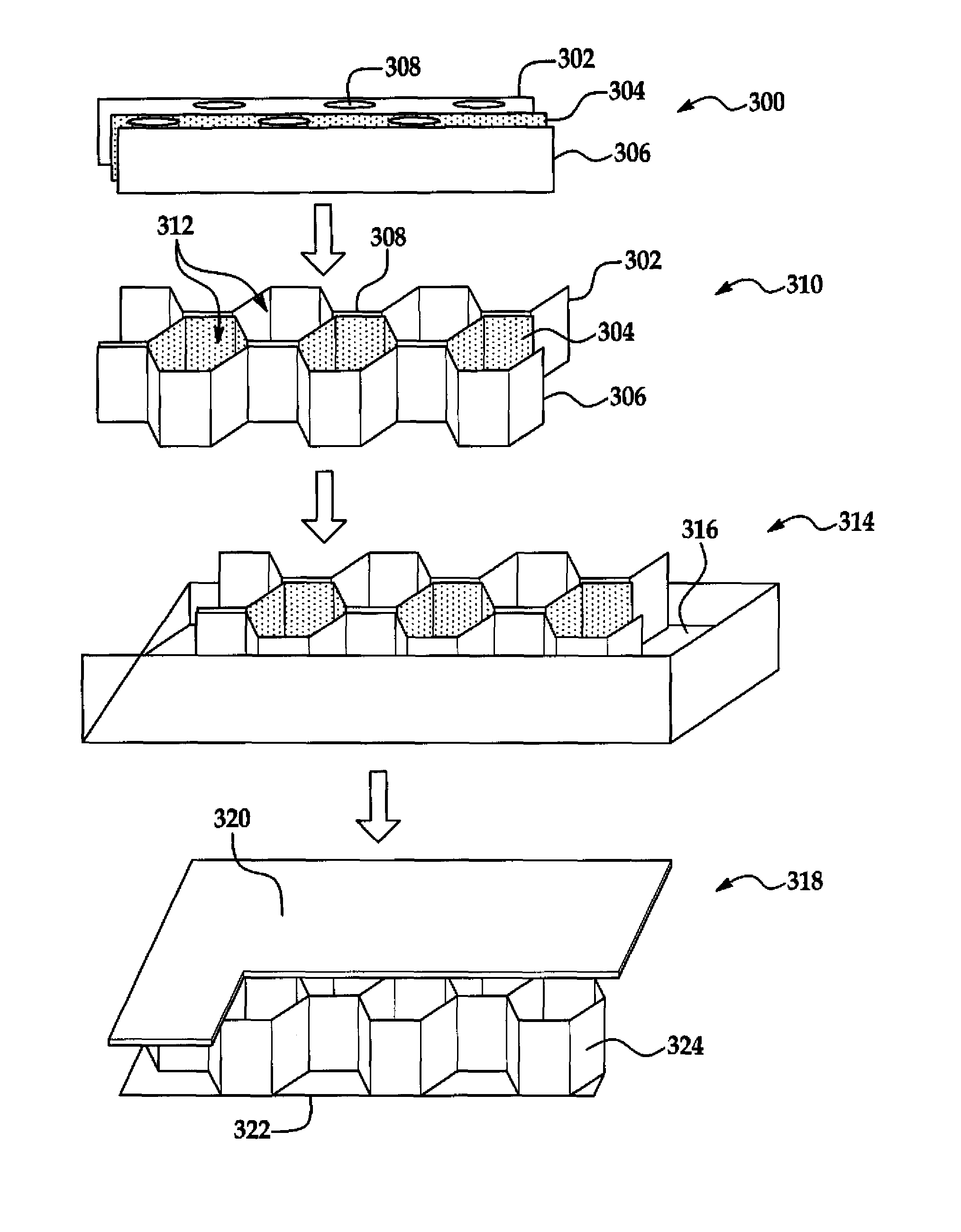
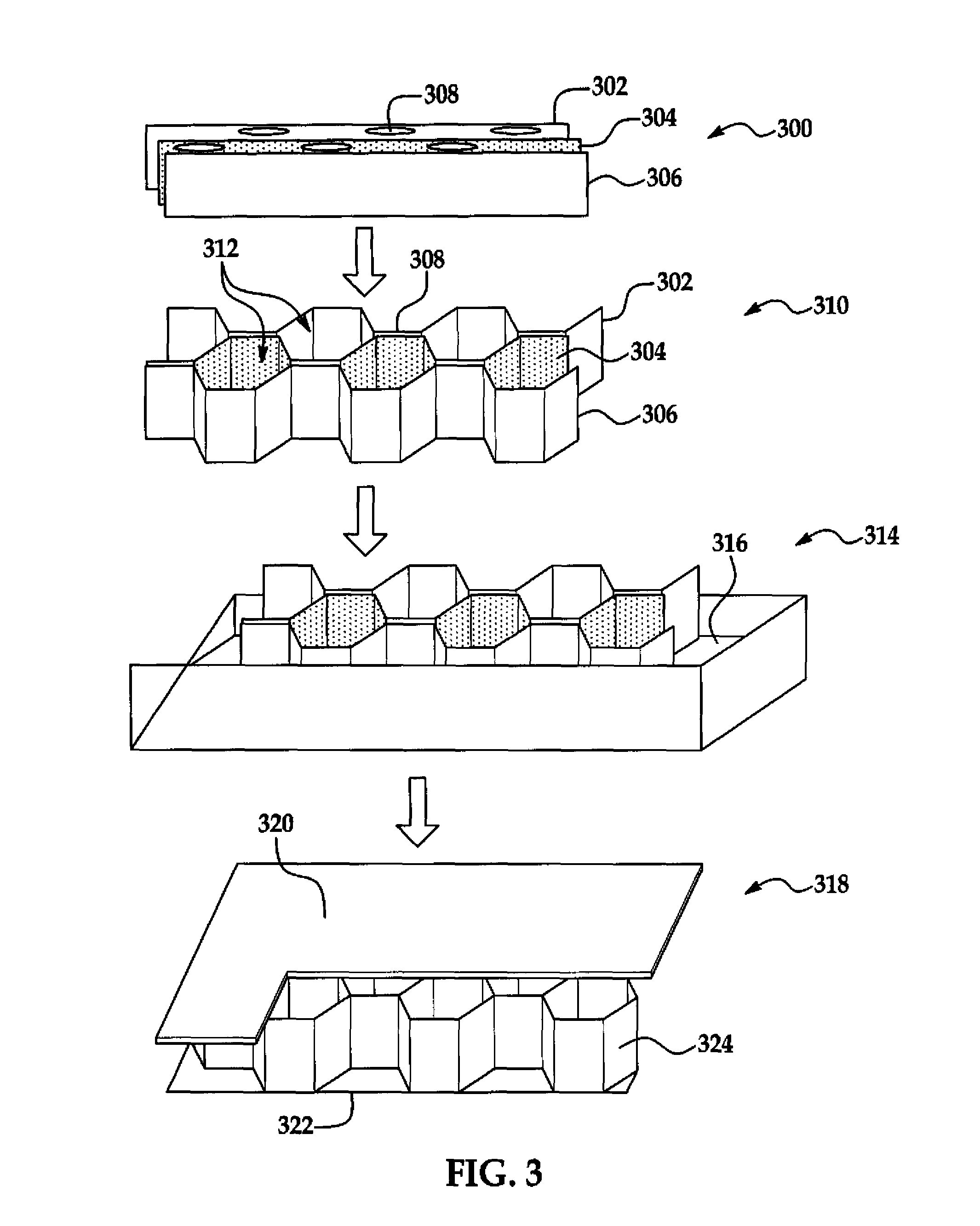
- The development of composite sandwich structures with a core made from non-woven fibers bound by a high strain resin, such as benzoxazine, which provides increased impact resistance and durability, allowing for the use of these structures in primary aircraft components.

Sustainability and Lifecycle Assessment of Composite Materials
The sustainability aspects of ultralight composite structures with enhanced impact resistance present significant environmental considerations throughout their lifecycle. These advanced materials, while offering superior strength-to-weight ratios and impact performance, require comprehensive assessment regarding their environmental footprint. Current lifecycle analyses indicate that manufacturing processes for high-performance composites typically consume substantial energy, particularly during fiber production and matrix polymerization stages, contributing to considerable carbon emissions.
Material selection plays a critical role in sustainability, with bio-based alternatives emerging as promising substitutes for traditional petroleum-derived components. Recent research demonstrates that natural fibers such as flax, hemp, and bamboo can be engineered to provide moderate impact resistance while significantly reducing environmental impact. However, these materials currently face limitations in achieving the extreme performance requirements of aerospace and advanced automotive applications.
End-of-life management represents a particular challenge for impact-resistant composites. The cross-linked thermoset matrices commonly used to achieve superior impact properties are inherently difficult to recycle through conventional methods. Innovative approaches including solvolysis, pyrolysis, and mechanical recycling are being developed, though each presents trade-offs between energy consumption, material recovery rates, and retention of mechanical properties.
The incorporation of self-healing mechanisms and damage-sensing capabilities into impact-resistant composites offers potential lifecycle extensions. These technologies can significantly prolong service life by autonomously repairing minor damage before catastrophic failure occurs, thereby reducing replacement frequency and associated environmental costs. However, the additional complexity introduced by these systems may complicate eventual recycling processes.
Comparative lifecycle assessments between traditional metallic structures and advanced impact-resistant composites reveal complex sustainability trade-offs. While composites typically require more energy-intensive manufacturing, their lightweight properties lead to substantial operational energy savings in transportation applications. Studies indicate that for aerospace applications, the break-even point where composite structures become environmentally advantageous typically occurs within 2-5 years of service.
Future sustainability improvements will likely emerge from circular economy approaches, including design-for-disassembly strategies and the development of reversible cross-linking chemistries that maintain impact resistance while enabling more efficient material recovery. Additionally, advancements in renewable energy integration within manufacturing processes could substantially reduce the carbon footprint associated with high-performance composite production.
Material selection plays a critical role in sustainability, with bio-based alternatives emerging as promising substitutes for traditional petroleum-derived components. Recent research demonstrates that natural fibers such as flax, hemp, and bamboo can be engineered to provide moderate impact resistance while significantly reducing environmental impact. However, these materials currently face limitations in achieving the extreme performance requirements of aerospace and advanced automotive applications.
End-of-life management represents a particular challenge for impact-resistant composites. The cross-linked thermoset matrices commonly used to achieve superior impact properties are inherently difficult to recycle through conventional methods. Innovative approaches including solvolysis, pyrolysis, and mechanical recycling are being developed, though each presents trade-offs between energy consumption, material recovery rates, and retention of mechanical properties.
The incorporation of self-healing mechanisms and damage-sensing capabilities into impact-resistant composites offers potential lifecycle extensions. These technologies can significantly prolong service life by autonomously repairing minor damage before catastrophic failure occurs, thereby reducing replacement frequency and associated environmental costs. However, the additional complexity introduced by these systems may complicate eventual recycling processes.
Comparative lifecycle assessments between traditional metallic structures and advanced impact-resistant composites reveal complex sustainability trade-offs. While composites typically require more energy-intensive manufacturing, their lightweight properties lead to substantial operational energy savings in transportation applications. Studies indicate that for aerospace applications, the break-even point where composite structures become environmentally advantageous typically occurs within 2-5 years of service.
Future sustainability improvements will likely emerge from circular economy approaches, including design-for-disassembly strategies and the development of reversible cross-linking chemistries that maintain impact resistance while enabling more efficient material recovery. Additionally, advancements in renewable energy integration within manufacturing processes could substantially reduce the carbon footprint associated with high-performance composite production.
Aerospace and Defense Applications and Requirements
The aerospace and defense sectors present some of the most demanding environments for structural materials, requiring exceptional performance under extreme conditions. Ultralight composite structures have become increasingly vital in these applications due to their ability to significantly reduce weight while maintaining structural integrity. In aerospace applications, every kilogram saved translates to substantial fuel savings over an aircraft's operational lifetime, while defense applications benefit from enhanced mobility and range.
For commercial aircraft, impact resistance requirements focus primarily on bird strikes, hail damage, runway debris, and maintenance-related impacts. The FAA's Federal Aviation Regulations (FAR 25.571) specifically mandates that aircraft structures must withstand these impact events without catastrophic failure. Military aircraft face additional requirements including resistance to ballistic impacts and blast effects, governed by standards such as MIL-STD-810 for environmental testing.
Spacecraft and satellite structures encounter unique challenges from micrometeoroid and orbital debris (MMOD) impacts, where even tiny particles traveling at hypervelocity (>7 km/s) can cause significant damage. NASA and ESA have developed specific testing protocols to simulate these conditions, requiring composite structures to maintain pressurization and structural integrity after such impacts.
Unmanned aerial vehicles (UAVs) and drones represent a growing application area with distinct requirements. These platforms often operate in austere environments with limited maintenance capabilities, necessitating impact-resistant structures that can withstand rough landings and environmental hazards while maintaining minimal weight profiles.
Defense ground vehicles increasingly utilize composite armor systems that must resist not only ballistic threats but also blast forces from improvised explosive devices (IEDs). Standards such as STANAG 4569 define protection levels for various threat scenarios, driving material development toward multi-functional composites that can absorb and dissipate impact energy effectively.
The missile and munitions sector presents perhaps the most extreme requirements, where structures must withstand severe acceleration forces (>100g) during launch while remaining lightweight enough to maximize range and payload capacity. Additionally, these systems may need to penetrate hardened targets, requiring exceptional structural integrity under extreme impact conditions.
Across all these applications, certification and qualification processes remain rigorous and time-consuming, representing a significant barrier to the adoption of novel composite solutions. Testing must demonstrate not only initial impact resistance but also the ability to maintain performance after damage (damage tolerance) and throughout the expected service life under various environmental conditions.
For commercial aircraft, impact resistance requirements focus primarily on bird strikes, hail damage, runway debris, and maintenance-related impacts. The FAA's Federal Aviation Regulations (FAR 25.571) specifically mandates that aircraft structures must withstand these impact events without catastrophic failure. Military aircraft face additional requirements including resistance to ballistic impacts and blast effects, governed by standards such as MIL-STD-810 for environmental testing.
Spacecraft and satellite structures encounter unique challenges from micrometeoroid and orbital debris (MMOD) impacts, where even tiny particles traveling at hypervelocity (>7 km/s) can cause significant damage. NASA and ESA have developed specific testing protocols to simulate these conditions, requiring composite structures to maintain pressurization and structural integrity after such impacts.
Unmanned aerial vehicles (UAVs) and drones represent a growing application area with distinct requirements. These platforms often operate in austere environments with limited maintenance capabilities, necessitating impact-resistant structures that can withstand rough landings and environmental hazards while maintaining minimal weight profiles.
Defense ground vehicles increasingly utilize composite armor systems that must resist not only ballistic threats but also blast forces from improvised explosive devices (IEDs). Standards such as STANAG 4569 define protection levels for various threat scenarios, driving material development toward multi-functional composites that can absorb and dissipate impact energy effectively.
The missile and munitions sector presents perhaps the most extreme requirements, where structures must withstand severe acceleration forces (>100g) during launch while remaining lightweight enough to maximize range and payload capacity. Additionally, these systems may need to penetrate hardened targets, requiring exceptional structural integrity under extreme impact conditions.
Across all these applications, certification and qualification processes remain rigorous and time-consuming, representing a significant barrier to the adoption of novel composite solutions. Testing must demonstrate not only initial impact resistance but also the ability to maintain performance after damage (damage tolerance) and throughout the expected service life under various environmental conditions.
Unlock deeper insights with Patsnap Eureka Quick Research — get a full tech report to explore trends and direct your research. Try now!
Generate Your Research Report Instantly with AI Agent
Supercharge your innovation with Patsnap Eureka AI Agent Platform!