

HBM Memory vs Flash Memory: Comparative Error Rates
MAY 18, 20268 MIN READ
Generate Your Research Report Instantly with AI Agent
PatSnap Eureka helps you evaluate technical feasibility & market potential.
HBM vs Flash Memory Error Rate Background and Objectives
The evolution of memory technologies has been driven by the relentless demand for higher performance, greater capacity, and improved reliability in computing systems. High Bandwidth Memory (HBM) and Flash Memory represent two distinct paradigms in memory architecture, each serving critical but different roles in modern computing ecosystems. HBM emerged as a revolutionary solution for high-performance computing applications requiring massive bandwidth and low latency, while Flash Memory has dominated the non-volatile storage landscape with its cost-effectiveness and data persistence capabilities.
The fundamental architectural differences between these technologies create inherently different error characteristics and reliability profiles. HBM, as a volatile memory technology, operates at extremely high frequencies with complex 3D stacking architectures, introducing unique error mechanisms related to thermal management, signal integrity, and inter-die communication. Flash Memory, conversely, faces challenges associated with charge retention, program/erase cycling, and wear leveling, resulting in distinctly different error patterns and failure modes.
Understanding the comparative error rates between HBM and Flash Memory has become increasingly critical as system architects design next-generation computing platforms. The integration of these technologies in heterogeneous memory systems requires precise knowledge of their respective reliability characteristics to optimize data placement, implement appropriate error correction strategies, and ensure system-level dependability.
The primary objective of this comparative analysis is to establish a comprehensive framework for evaluating error rates across these disparate memory technologies. This involves quantifying bit error rates, characterizing failure mechanisms, and developing standardized metrics that enable meaningful comparison despite fundamental technological differences. The analysis aims to provide actionable insights for system designers regarding error correction overhead, data integrity requirements, and reliability trade-offs.
Furthermore, this investigation seeks to identify emerging trends in error rate evolution as both technologies advance through successive generations. Understanding how manufacturing process improvements, architectural innovations, and error correction enhancements impact comparative reliability will inform future technology roadmaps and investment decisions in memory subsystem development.
The fundamental architectural differences between these technologies create inherently different error characteristics and reliability profiles. HBM, as a volatile memory technology, operates at extremely high frequencies with complex 3D stacking architectures, introducing unique error mechanisms related to thermal management, signal integrity, and inter-die communication. Flash Memory, conversely, faces challenges associated with charge retention, program/erase cycling, and wear leveling, resulting in distinctly different error patterns and failure modes.
Understanding the comparative error rates between HBM and Flash Memory has become increasingly critical as system architects design next-generation computing platforms. The integration of these technologies in heterogeneous memory systems requires precise knowledge of their respective reliability characteristics to optimize data placement, implement appropriate error correction strategies, and ensure system-level dependability.
The primary objective of this comparative analysis is to establish a comprehensive framework for evaluating error rates across these disparate memory technologies. This involves quantifying bit error rates, characterizing failure mechanisms, and developing standardized metrics that enable meaningful comparison despite fundamental technological differences. The analysis aims to provide actionable insights for system designers regarding error correction overhead, data integrity requirements, and reliability trade-offs.
Furthermore, this investigation seeks to identify emerging trends in error rate evolution as both technologies advance through successive generations. Understanding how manufacturing process improvements, architectural innovations, and error correction enhancements impact comparative reliability will inform future technology roadmaps and investment decisions in memory subsystem development.
Market Demand for High-Reliability Memory Solutions
The global memory market is experiencing unprecedented demand for high-reliability solutions driven by the exponential growth of data-intensive applications across multiple sectors. Enterprise data centers, cloud computing infrastructure, and high-performance computing environments require memory technologies that can maintain data integrity while operating under extreme workloads. The proliferation of artificial intelligence, machine learning, and real-time analytics applications has created a critical need for memory solutions that combine ultra-low error rates with exceptional performance characteristics.
Financial services, healthcare, and aerospace industries represent key market segments where memory reliability directly impacts operational safety and regulatory compliance. These sectors demand memory solutions with error rates measured in parts per billion, as even minor data corruption can result in significant financial losses or safety hazards. The increasing adoption of autonomous systems, from self-driving vehicles to industrial automation, further amplifies the requirement for memory technologies that can guarantee consistent data accuracy across extended operational periods.
The emergence of edge computing and Internet of Things deployments has expanded the reliability requirements beyond traditional data center environments. Memory solutions must now maintain their error performance characteristics across diverse operating conditions, including temperature variations, power fluctuations, and electromagnetic interference. This trend has created substantial market opportunities for memory technologies that can deliver consistent reliability metrics regardless of deployment environment.
Market research indicates strong growth trajectories for high-reliability memory segments, with particular emphasis on applications requiring real-time processing capabilities. The convergence of 5G networks, augmented reality, and industrial digitization initiatives is driving demand for memory solutions that can support both high-bandwidth operations and stringent error rate specifications. Organizations are increasingly willing to invest premium pricing for memory technologies that can demonstrate measurable improvements in data integrity and system reliability.
The competitive landscape reflects this market demand through increased research and development investments focused on error correction mechanisms, advanced manufacturing processes, and innovative memory architectures. Market participants are prioritizing reliability metrics as key differentiators, recognizing that error rate performance has become a critical factor in technology selection decisions across enterprise and industrial applications.
Financial services, healthcare, and aerospace industries represent key market segments where memory reliability directly impacts operational safety and regulatory compliance. These sectors demand memory solutions with error rates measured in parts per billion, as even minor data corruption can result in significant financial losses or safety hazards. The increasing adoption of autonomous systems, from self-driving vehicles to industrial automation, further amplifies the requirement for memory technologies that can guarantee consistent data accuracy across extended operational periods.
The emergence of edge computing and Internet of Things deployments has expanded the reliability requirements beyond traditional data center environments. Memory solutions must now maintain their error performance characteristics across diverse operating conditions, including temperature variations, power fluctuations, and electromagnetic interference. This trend has created substantial market opportunities for memory technologies that can deliver consistent reliability metrics regardless of deployment environment.
Market research indicates strong growth trajectories for high-reliability memory segments, with particular emphasis on applications requiring real-time processing capabilities. The convergence of 5G networks, augmented reality, and industrial digitization initiatives is driving demand for memory solutions that can support both high-bandwidth operations and stringent error rate specifications. Organizations are increasingly willing to invest premium pricing for memory technologies that can demonstrate measurable improvements in data integrity and system reliability.
The competitive landscape reflects this market demand through increased research and development investments focused on error correction mechanisms, advanced manufacturing processes, and innovative memory architectures. Market participants are prioritizing reliability metrics as key differentiators, recognizing that error rate performance has become a critical factor in technology selection decisions across enterprise and industrial applications.
Current Error Rate Challenges in HBM and Flash Technologies
HBM and Flash memory technologies face fundamentally different error rate challenges due to their distinct architectural designs and operational mechanisms. HBM memory, operating as volatile DRAM-based technology, encounters primary error sources including soft errors caused by cosmic radiation, alpha particles, and electromagnetic interference. These transient errors can corrupt data temporarily, with error rates typically ranging from 10^-12 to 10^-15 errors per bit per hour under normal operating conditions.
Flash memory confronts more complex error patterns stemming from its NAND-based non-volatile architecture. Program/erase cycling gradually degrades the oxide layer, leading to charge retention issues and increased bit error rates over time. Raw bit error rates in modern 3D NAND flash can reach 10^-3 to 10^-4 before error correction, significantly higher than HBM's inherent error rates. Additionally, Flash memory suffers from read disturb errors, where repeated read operations on neighboring cells can cause data corruption.
Temperature variations present critical challenges for both technologies but manifest differently. HBM memory experiences increased refresh requirements and potential timing violations at elevated temperatures, while Flash memory faces accelerated charge leakage and reduced data retention capabilities. The compact 3D stacking in both technologies exacerbates thermal management issues, creating localized hot spots that can increase error susceptibility.
Process scaling introduces additional complexity as both technologies migrate to smaller manufacturing nodes. HBM faces increased vulnerability to process variations affecting cell capacitance and refresh timing, while Flash memory encounters challenges with cell-to-cell interference and reduced programming windows. The transition to advanced nodes below 10nm has intensified these scaling-related error mechanisms.
Wear-out mechanisms differ substantially between the technologies. HBM cells can theoretically endure unlimited read cycles but may experience gradual degradation in refresh characteristics over extended periods. Flash memory exhibits finite program/erase endurance, typically ranging from 1,000 to 100,000 cycles depending on the specific NAND type, with error rates increasing exponentially as cells approach their endurance limits.
The integration of advanced error correction codes has become essential for both technologies. HBM implementations increasingly incorporate on-die ECC and advanced RAS features to maintain acceptable error rates, while Flash memory relies on sophisticated LDPC codes and advanced signal processing techniques to manage the inherently higher raw error rates characteristic of NAND-based storage systems.
Flash memory confronts more complex error patterns stemming from its NAND-based non-volatile architecture. Program/erase cycling gradually degrades the oxide layer, leading to charge retention issues and increased bit error rates over time. Raw bit error rates in modern 3D NAND flash can reach 10^-3 to 10^-4 before error correction, significantly higher than HBM's inherent error rates. Additionally, Flash memory suffers from read disturb errors, where repeated read operations on neighboring cells can cause data corruption.
Temperature variations present critical challenges for both technologies but manifest differently. HBM memory experiences increased refresh requirements and potential timing violations at elevated temperatures, while Flash memory faces accelerated charge leakage and reduced data retention capabilities. The compact 3D stacking in both technologies exacerbates thermal management issues, creating localized hot spots that can increase error susceptibility.
Process scaling introduces additional complexity as both technologies migrate to smaller manufacturing nodes. HBM faces increased vulnerability to process variations affecting cell capacitance and refresh timing, while Flash memory encounters challenges with cell-to-cell interference and reduced programming windows. The transition to advanced nodes below 10nm has intensified these scaling-related error mechanisms.
Wear-out mechanisms differ substantially between the technologies. HBM cells can theoretically endure unlimited read cycles but may experience gradual degradation in refresh characteristics over extended periods. Flash memory exhibits finite program/erase endurance, typically ranging from 1,000 to 100,000 cycles depending on the specific NAND type, with error rates increasing exponentially as cells approach their endurance limits.
The integration of advanced error correction codes has become essential for both technologies. HBM implementations increasingly incorporate on-die ECC and advanced RAS features to maintain acceptable error rates, while Flash memory relies on sophisticated LDPC codes and advanced signal processing techniques to manage the inherently higher raw error rates characteristic of NAND-based storage systems.
Existing Error Rate Mitigation Solutions
01 Error correction and detection mechanisms for memory systems
Advanced error correction codes and detection algorithms are implemented to identify and correct bit errors in both HBM and flash memory systems. These mechanisms include multi-level error correction schemes, parity checking, and syndrome-based error detection that can handle single-bit and multi-bit errors to maintain data integrity and system reliability.- Error correction and detection mechanisms for memory systems: Advanced error correction codes and detection algorithms are implemented to identify and correct bit errors in both HBM and flash memory systems. These mechanisms include multi-level error correction schemes, parity checking, and syndrome-based error detection that can handle single-bit and multi-bit errors to maintain data integrity and system reliability.
- Memory controller optimization for error rate reduction: Specialized memory controllers are designed to minimize error rates through intelligent data management, wear leveling algorithms, and adaptive error handling strategies. These controllers monitor memory performance in real-time and adjust operational parameters to reduce the likelihood of errors occurring during read, write, and erase operations.
- Signal integrity and noise reduction techniques: Various signal processing methods are employed to reduce noise and improve signal integrity in high-speed memory interfaces. These techniques include differential signaling, impedance matching, crosstalk reduction, and advanced modulation schemes that help minimize transmission errors and improve overall system reliability.
- Redundancy and fault tolerance architectures: Memory systems incorporate redundant storage elements and fault-tolerant architectures to handle defective memory cells and reduce overall error rates. These approaches include spare row and column allocation, bad block management, and distributed storage schemes that can maintain system functionality even when individual memory components fail.
- Adaptive threshold and voltage management: Dynamic threshold adjustment and voltage optimization techniques are used to compensate for memory cell degradation and environmental variations that can increase error rates. These methods involve real-time monitoring of cell characteristics and automatic adjustment of operating voltages and timing parameters to maintain optimal performance throughout the memory lifecycle.
02 Memory controller optimization for error rate reduction
Specialized memory controllers are designed to minimize error rates through intelligent data management, wear leveling algorithms, and adaptive error handling strategies. These controllers monitor memory performance in real-time and implement dynamic adjustments to reduce the likelihood of errors occurring during read and write operations.Expand Specific Solutions03 Flash memory endurance and reliability enhancement techniques
Various techniques are employed to improve flash memory endurance and reduce error rates, including advanced programming algorithms, voltage optimization, and cell-level error management. These methods focus on extending the lifespan of flash memory cells and maintaining consistent performance throughout the memory's operational lifetime.Expand Specific Solutions04 High bandwidth memory interface error mitigation
Specialized interface designs and protocols are implemented to reduce transmission errors in high bandwidth memory systems. These solutions include signal integrity optimization, timing calibration, and interface-level error detection and correction mechanisms that ensure reliable data transfer between memory and processing units.Expand Specific Solutions05 Predictive error analysis and prevention systems
Machine learning and statistical analysis techniques are applied to predict potential memory errors before they occur. These systems monitor various parameters such as temperature, voltage fluctuations, and usage patterns to proactively identify memory cells or regions that may be prone to errors, enabling preventive maintenance and error avoidance strategies.Expand Specific Solutions
Key Players in HBM and Flash Memory Industry
The HBM versus Flash memory error rate comparison represents a critical battleground in the rapidly evolving memory semiconductor industry. The market is experiencing robust growth driven by AI, high-performance computing, and data center demands, with the industry currently in a mature expansion phase. Technology maturity varies significantly between segments - while flash memory technology has reached high maturity levels with established players like Samsung Electronics, SK Hynix, Micron Technology, and Western Digital dominating through decades of optimization, HBM technology remains in an advanced development stage. Key innovators including Samsung, SK Hynix, and Micron are pushing HBM boundaries, while emerging players like ChangXin Memory Technologies and Yangtze Memory Technologies are accelerating competitive dynamics. The error rate differential between these technologies will likely determine future market positioning as applications demand both high performance and reliability.
Samsung Electronics Co., Ltd.
Technical Solution: Samsung has developed comprehensive error correction and management solutions for both HBM and Flash memory technologies. For HBM memory, Samsung implements advanced ECC (Error Correcting Code) mechanisms that can detect and correct single-bit errors while detecting multi-bit errors, achieving error rates as low as 10^-17 for corrected data. Their HBM3 products feature enhanced reliability with improved thermal management and signal integrity. For Flash memory, Samsung utilizes sophisticated LDPC (Low-Density Parity-Check) codes combined with machine learning algorithms to predict and prevent errors, maintaining raw bit error rates below 10^-4 even after extensive program/erase cycles. Their V-NAND technology incorporates multiple error correction layers including on-chip ECC and advanced wear leveling algorithms.
Strengths: Industry-leading error correction algorithms, extensive R&D investment, comprehensive product portfolio covering both memory types. Weaknesses: Higher cost implementation, complex manufacturing processes requiring advanced fabrication facilities.
SK hynix, Inc.
Technical Solution: SK Hynix has conducted extensive comparative analysis of error rates between HBM and Flash memory technologies, developing specialized error management solutions for each. Their HBM products implement real-time error monitoring with predictive analytics, maintaining operational error rates below 10^-16 through advanced on-die ECC and thermal management. The company's research indicates HBM memory typically shows 100-1000x lower raw error rates compared to Flash memory due to fundamental architectural differences. For Flash memory, SK Hynix employs multi-tier error correction including BCH codes and LDPC with soft-decision decoding, managing the inherently higher error rates that increase exponentially with program/erase cycles. Their comparative studies show Flash memory raw bit error rates ranging from 10^-8 in fresh cells to 10^-3 in end-of-life conditions, while HBM maintains relatively stable error characteristics throughout its operational lifetime.
Strengths: Advanced predictive error analytics, comprehensive comparative research, innovative thermal management solutions. Weaknesses: Complex implementation requiring specialized controllers, higher development costs for advanced features.
Core Innovations in Memory Error Detection and Correction
Fault detection method, device, equipment and storage medium for instruction word circuit
PatentActiveCN115114062B
Innovation
- By sending the instruction word sequence to the target memory, the instruction processing circuit and the target algorithm are used to process the sequence, and the instruction word sequence before and after processing is compared to detect line faults and accurately locate the faulty instruction word line.


Storage device and method for storage error management
PatentPendingCN119356934A
Innovation
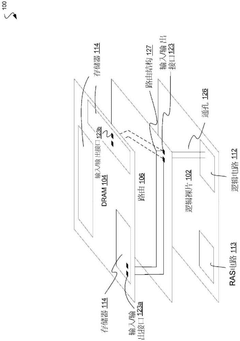
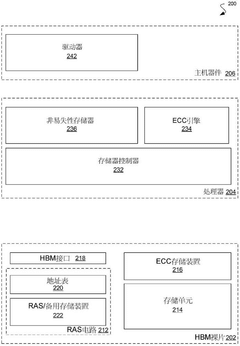
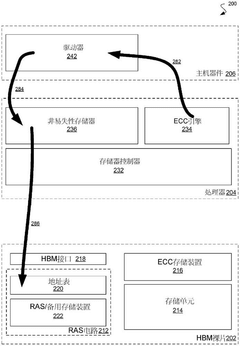
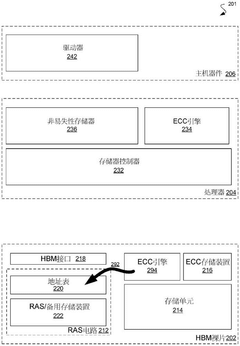
- A memory device is designed, including multiple stacked integrated circuit dies, equipped with reliability circuitry, including backup memory and address tables, for detecting and correcting data errors and achieving fault tolerance of memory accesses through the backup memory.
Industry Standards for Memory Error Rate Specifications
The semiconductor industry has established comprehensive standards for memory error rate specifications to ensure reliability and performance consistency across different memory technologies. These standards provide critical benchmarks for comparing HBM and Flash memory error characteristics, enabling manufacturers and system designers to make informed decisions based on quantifiable reliability metrics.
JEDEC Solid State Technology Association serves as the primary standardization body for memory specifications, publishing detailed error rate requirements for both volatile and non-volatile memory technologies. For HBM memory, JEDEC standards define acceptable bit error rates (BER) typically in the range of 10^-15 to 10^-17 errors per bit per hour under normal operating conditions. These specifications account for various error sources including soft errors caused by cosmic radiation, alpha particles, and thermal noise.
Flash memory error rate standards differ significantly due to the technology's inherent wear-out mechanisms and data retention characteristics. JEDEC specifications for NAND Flash typically allow higher raw bit error rates, ranging from 10^-4 to 10^-8 depending on the program/erase cycle count and technology node. However, these standards mandate robust error correction code (ECC) implementations to achieve system-level reliability comparable to other memory technologies.
International standards organizations including IEEE and IEC have developed complementary specifications addressing memory reliability in specific application contexts. IEEE 1633 provides guidelines for software reliability engineering that incorporate memory error rate considerations, while IEC 61508 establishes functional safety requirements that directly impact acceptable memory error thresholds in safety-critical applications.
Industry-specific standards further refine error rate requirements based on application demands. Automotive standards such as AEC-Q100 impose stringent reliability requirements with error rates often specified at 10^-9 failures in time (FIT) or lower. Aerospace applications governed by standards like MIL-STD-883 require even more rigorous error rate specifications, sometimes demanding error rates below 10^-12 FIT for mission-critical systems.
These standardized specifications enable objective comparison between HBM and Flash memory technologies, providing essential frameworks for system designers to evaluate trade-offs between performance, power consumption, and reliability requirements across diverse application scenarios.
JEDEC Solid State Technology Association serves as the primary standardization body for memory specifications, publishing detailed error rate requirements for both volatile and non-volatile memory technologies. For HBM memory, JEDEC standards define acceptable bit error rates (BER) typically in the range of 10^-15 to 10^-17 errors per bit per hour under normal operating conditions. These specifications account for various error sources including soft errors caused by cosmic radiation, alpha particles, and thermal noise.
Flash memory error rate standards differ significantly due to the technology's inherent wear-out mechanisms and data retention characteristics. JEDEC specifications for NAND Flash typically allow higher raw bit error rates, ranging from 10^-4 to 10^-8 depending on the program/erase cycle count and technology node. However, these standards mandate robust error correction code (ECC) implementations to achieve system-level reliability comparable to other memory technologies.
International standards organizations including IEEE and IEC have developed complementary specifications addressing memory reliability in specific application contexts. IEEE 1633 provides guidelines for software reliability engineering that incorporate memory error rate considerations, while IEC 61508 establishes functional safety requirements that directly impact acceptable memory error thresholds in safety-critical applications.
Industry-specific standards further refine error rate requirements based on application demands. Automotive standards such as AEC-Q100 impose stringent reliability requirements with error rates often specified at 10^-9 failures in time (FIT) or lower. Aerospace applications governed by standards like MIL-STD-883 require even more rigorous error rate specifications, sometimes demanding error rates below 10^-12 FIT for mission-critical systems.
These standardized specifications enable objective comparison between HBM and Flash memory technologies, providing essential frameworks for system designers to evaluate trade-offs between performance, power consumption, and reliability requirements across diverse application scenarios.
Cost-Performance Trade-offs in Memory Error Management
The cost-performance dynamics in memory error management present fundamentally different challenges for HBM and Flash memory technologies. HBM memory systems typically employ sophisticated Error Correction Code (ECC) mechanisms, including Single Error Correction and Double Error Detection (SECDED) schemes, which add approximately 12.5% overhead to memory capacity but provide real-time error correction capabilities. The implementation cost includes additional silicon area for ECC logic and increased power consumption, yet delivers immediate error recovery without performance degradation.
Flash memory error management operates on different economic principles due to its inherently higher error rates and wear-leveling requirements. Advanced error correction schemes such as Low-Density Parity-Check (LDPC) codes or Bose-Chaudhuri-Hocquenghem (BCH) codes are essential, consuming up to 20-25% of storage capacity for metadata and redundancy. The controller complexity significantly impacts system cost, with enterprise-grade controllers incorporating multiple correction layers and sophisticated algorithms for bad block management.
Performance implications vary dramatically between these technologies. HBM systems maintain consistent latency profiles even with ECC enabled, as correction occurs within nanosecond timeframes. The cost premium for enhanced ECC protection typically ranges from 15-30% of total memory subsystem cost, justified by the elimination of system-level failures and data corruption events.
Flash memory systems face more complex trade-offs, where aggressive error correction directly impacts read/write performance. Higher correction capability requires increased processing time, creating latency penalties that can reach several milliseconds for complex correction scenarios. The economic optimization often involves balancing correction strength against performance requirements, with different correction levels applied based on data criticality and access patterns.
Enterprise applications demonstrate distinct cost-benefit profiles for each technology. HBM deployments in high-performance computing environments justify premium error management costs through improved system reliability and reduced downtime expenses. Flash storage systems optimize costs through tiered correction approaches, applying stronger protection to critical data while using lighter correction for temporary or easily recoverable information, achieving optimal cost-performance ratios across diverse workload requirements.
Flash memory error management operates on different economic principles due to its inherently higher error rates and wear-leveling requirements. Advanced error correction schemes such as Low-Density Parity-Check (LDPC) codes or Bose-Chaudhuri-Hocquenghem (BCH) codes are essential, consuming up to 20-25% of storage capacity for metadata and redundancy. The controller complexity significantly impacts system cost, with enterprise-grade controllers incorporating multiple correction layers and sophisticated algorithms for bad block management.
Performance implications vary dramatically between these technologies. HBM systems maintain consistent latency profiles even with ECC enabled, as correction occurs within nanosecond timeframes. The cost premium for enhanced ECC protection typically ranges from 15-30% of total memory subsystem cost, justified by the elimination of system-level failures and data corruption events.
Flash memory systems face more complex trade-offs, where aggressive error correction directly impacts read/write performance. Higher correction capability requires increased processing time, creating latency penalties that can reach several milliseconds for complex correction scenarios. The economic optimization often involves balancing correction strength against performance requirements, with different correction levels applied based on data criticality and access patterns.
Enterprise applications demonstrate distinct cost-benefit profiles for each technology. HBM deployments in high-performance computing environments justify premium error management costs through improved system reliability and reduced downtime expenses. Flash storage systems optimize costs through tiered correction approaches, applying stronger protection to critical data while using lighter correction for temporary or easily recoverable information, achieving optimal cost-performance ratios across diverse workload requirements.
Unlock deeper insights with PatSnap Eureka Quick Research — get a full tech report to explore trends and direct your research. Try now!
Generate Your Research Report Instantly with AI Agent
Supercharge your innovation with PatSnap Eureka AI Agent Platform!