
How to Maximize Biodegradable Ethyl Acetate Applications
MAR 23, 20269 MIN READ
Generate Your Research Report Instantly with AI Agent
Patsnap Eureka helps you evaluate technical feasibility & market potential.
Biodegradable Ethyl Acetate Development Background and Objectives
Ethyl acetate has emerged as a critical industrial solvent with widespread applications across pharmaceuticals, food processing, cosmetics, and manufacturing sectors. Traditional ethyl acetate production relies heavily on petroleum-based feedstocks, contributing to environmental concerns and sustainability challenges. The growing emphasis on circular economy principles and environmental stewardship has catalyzed significant interest in developing biodegradable alternatives that maintain comparable performance characteristics while offering enhanced environmental compatibility.
The evolution of biodegradable ethyl acetate represents a convergence of green chemistry principles, biotechnology advances, and industrial sustainability requirements. Early research focused primarily on bio-based production pathways utilizing renewable feedstocks such as agricultural waste, cellulosic biomass, and fermentation-derived precursors. These initiatives gained momentum following increased regulatory pressure and corporate sustainability commitments across multiple industries.
Current technological trends indicate a shift toward integrated biorefinery approaches that combine enzymatic processes, microbial fermentation, and advanced separation techniques. Recent developments have demonstrated the feasibility of producing ethyl acetate through engineered microorganisms capable of direct conversion from renewable substrates, eliminating traditional chemical synthesis steps and reducing overall environmental impact.
The primary objective centers on maximizing application scope while maintaining cost competitiveness with conventional alternatives. This involves optimizing production efficiency, enhancing product purity standards, and developing specialized formulations tailored to specific industrial requirements. Key performance targets include achieving equivalent solvent properties, ensuring complete biodegradability within acceptable timeframes, and establishing scalable manufacturing processes.
Strategic goals encompass expanding market penetration across high-value applications where environmental credentials provide competitive advantages. Priority sectors include pharmaceutical manufacturing, where regulatory compliance increasingly favors sustainable solvents, and food processing applications requiring enhanced safety profiles. Additionally, objectives include developing novel application areas that leverage unique properties of biodegradable variants, such as improved biocompatibility in medical device manufacturing and reduced environmental persistence in agricultural formulations.
The overarching vision involves establishing biodegradable ethyl acetate as the preferred choice across traditional applications while simultaneously creating new market opportunities that capitalize on its enhanced environmental profile and potential functional advantages over conventional alternatives.
The evolution of biodegradable ethyl acetate represents a convergence of green chemistry principles, biotechnology advances, and industrial sustainability requirements. Early research focused primarily on bio-based production pathways utilizing renewable feedstocks such as agricultural waste, cellulosic biomass, and fermentation-derived precursors. These initiatives gained momentum following increased regulatory pressure and corporate sustainability commitments across multiple industries.
Current technological trends indicate a shift toward integrated biorefinery approaches that combine enzymatic processes, microbial fermentation, and advanced separation techniques. Recent developments have demonstrated the feasibility of producing ethyl acetate through engineered microorganisms capable of direct conversion from renewable substrates, eliminating traditional chemical synthesis steps and reducing overall environmental impact.
The primary objective centers on maximizing application scope while maintaining cost competitiveness with conventional alternatives. This involves optimizing production efficiency, enhancing product purity standards, and developing specialized formulations tailored to specific industrial requirements. Key performance targets include achieving equivalent solvent properties, ensuring complete biodegradability within acceptable timeframes, and establishing scalable manufacturing processes.
Strategic goals encompass expanding market penetration across high-value applications where environmental credentials provide competitive advantages. Priority sectors include pharmaceutical manufacturing, where regulatory compliance increasingly favors sustainable solvents, and food processing applications requiring enhanced safety profiles. Additionally, objectives include developing novel application areas that leverage unique properties of biodegradable variants, such as improved biocompatibility in medical device manufacturing and reduced environmental persistence in agricultural formulations.
The overarching vision involves establishing biodegradable ethyl acetate as the preferred choice across traditional applications while simultaneously creating new market opportunities that capitalize on its enhanced environmental profile and potential functional advantages over conventional alternatives.
Market Demand Analysis for Sustainable Ethyl Acetate Solutions
The global market for sustainable ethyl acetate solutions is experiencing unprecedented growth driven by stringent environmental regulations and increasing corporate sustainability commitments. Traditional petroleum-based ethyl acetate faces mounting pressure from regulatory bodies worldwide, particularly in developed markets where environmental compliance standards continue to tighten. The European Union's REACH regulation and similar frameworks in North America and Asia-Pacific regions are accelerating the transition toward biodegradable alternatives.
Industrial sectors demonstrate varying levels of demand intensity for sustainable ethyl acetate solutions. The coatings and paints industry represents the largest consumption segment, where biodegradable ethyl acetate serves as an eco-friendly solvent replacement. Pharmaceutical manufacturing shows strong adoption rates due to strict regulatory requirements for pharmaceutical-grade solvents and growing emphasis on green chemistry principles. The food and beverage sector exhibits increasing demand for biodegradable ethyl acetate as a natural flavoring agent and extraction solvent, driven by consumer preferences for clean-label products.
Packaging industry demand is particularly robust, with biodegradable ethyl acetate finding applications in flexible packaging adhesives and printing inks. The shift toward sustainable packaging solutions, accelerated by consumer awareness and regulatory mandates on single-use plastics, creates substantial market opportunities. Cosmetics and personal care manufacturers increasingly specify biodegradable ethyl acetate for nail polish removers and fragrance formulations, responding to consumer demand for environmentally conscious beauty products.
Geographic demand patterns reveal significant regional variations. European markets lead in adoption rates due to established environmental regulations and strong consumer environmental consciousness. North American demand grows steadily, supported by corporate sustainability initiatives and emerging state-level environmental legislation. Asia-Pacific markets show rapid expansion potential, particularly in China and India, where industrial growth coincides with increasing environmental awareness and regulatory development.
Market capacity expansion faces constraints from production scalability and cost competitiveness compared to conventional alternatives. Current biodegradable ethyl acetate production relies heavily on bio-based feedstocks, creating supply chain dependencies on agricultural resources. Price premiums over petroleum-based alternatives remain significant, though the gap continues to narrow as production technologies mature and economies of scale develop.
Emerging applications in electronics cleaning and textile processing indicate expanding market boundaries. The electronics industry's transition toward environmentally compliant cleaning solvents creates new demand streams, while textile manufacturers seek biodegradable alternatives for fiber processing and dyeing operations. These emerging applications suggest sustained long-term growth potential beyond traditional market segments.
Industrial sectors demonstrate varying levels of demand intensity for sustainable ethyl acetate solutions. The coatings and paints industry represents the largest consumption segment, where biodegradable ethyl acetate serves as an eco-friendly solvent replacement. Pharmaceutical manufacturing shows strong adoption rates due to strict regulatory requirements for pharmaceutical-grade solvents and growing emphasis on green chemistry principles. The food and beverage sector exhibits increasing demand for biodegradable ethyl acetate as a natural flavoring agent and extraction solvent, driven by consumer preferences for clean-label products.
Packaging industry demand is particularly robust, with biodegradable ethyl acetate finding applications in flexible packaging adhesives and printing inks. The shift toward sustainable packaging solutions, accelerated by consumer awareness and regulatory mandates on single-use plastics, creates substantial market opportunities. Cosmetics and personal care manufacturers increasingly specify biodegradable ethyl acetate for nail polish removers and fragrance formulations, responding to consumer demand for environmentally conscious beauty products.
Geographic demand patterns reveal significant regional variations. European markets lead in adoption rates due to established environmental regulations and strong consumer environmental consciousness. North American demand grows steadily, supported by corporate sustainability initiatives and emerging state-level environmental legislation. Asia-Pacific markets show rapid expansion potential, particularly in China and India, where industrial growth coincides with increasing environmental awareness and regulatory development.
Market capacity expansion faces constraints from production scalability and cost competitiveness compared to conventional alternatives. Current biodegradable ethyl acetate production relies heavily on bio-based feedstocks, creating supply chain dependencies on agricultural resources. Price premiums over petroleum-based alternatives remain significant, though the gap continues to narrow as production technologies mature and economies of scale develop.
Emerging applications in electronics cleaning and textile processing indicate expanding market boundaries. The electronics industry's transition toward environmentally compliant cleaning solvents creates new demand streams, while textile manufacturers seek biodegradable alternatives for fiber processing and dyeing operations. These emerging applications suggest sustained long-term growth potential beyond traditional market segments.
Current Status and Challenges in Biodegradable Ethyl Acetate
Biodegradable ethyl acetate represents a significant advancement in sustainable solvent technology, yet its current market penetration remains limited compared to conventional petroleum-based alternatives. The global production capacity for bio-based ethyl acetate currently accounts for less than 15% of total ethyl acetate production, with most facilities concentrated in North America and Europe. Leading manufacturers have established production capabilities ranging from 10,000 to 50,000 tons annually, primarily utilizing bioethanol feedstock derived from agricultural waste and renewable biomass sources.
The technology landscape reveals substantial regional disparities in development and adoption. European markets demonstrate the highest acceptance rates, driven by stringent environmental regulations and carbon reduction mandates. Asian markets, particularly China and India, are experiencing rapid growth in production capacity, though quality standardization remains inconsistent. North American facilities focus primarily on high-purity applications for pharmaceutical and food-grade applications, while emerging markets concentrate on industrial-grade products for coatings and adhesives.
Current production methods face significant technical limitations that constrain widespread adoption. The primary challenge lies in achieving cost parity with petroleum-based ethyl acetate, as bio-based production typically incurs 20-30% higher manufacturing costs. Feedstock availability and price volatility create additional supply chain uncertainties, particularly during agricultural commodity price fluctuations. The seasonal nature of biomass availability necessitates complex inventory management strategies and often requires multiple feedstock sources to ensure continuous production.
Quality consistency presents another critical obstacle, as biodegradable ethyl acetate often contains trace impurities that can affect performance in sensitive applications. Purification processes add significant costs and energy consumption, reducing the overall environmental benefits. Additionally, the limited shelf life compared to conventional alternatives creates logistical challenges for distribution and storage, particularly in regions with extreme temperature variations.
Regulatory frameworks across different markets create additional complexity for manufacturers and end-users. While some regions offer incentives for bio-based chemicals adoption, others lack clear certification standards or testing protocols. This regulatory fragmentation hampers international trade and creates market access barriers for smaller producers seeking to scale their operations globally.
The technology landscape reveals substantial regional disparities in development and adoption. European markets demonstrate the highest acceptance rates, driven by stringent environmental regulations and carbon reduction mandates. Asian markets, particularly China and India, are experiencing rapid growth in production capacity, though quality standardization remains inconsistent. North American facilities focus primarily on high-purity applications for pharmaceutical and food-grade applications, while emerging markets concentrate on industrial-grade products for coatings and adhesives.
Current production methods face significant technical limitations that constrain widespread adoption. The primary challenge lies in achieving cost parity with petroleum-based ethyl acetate, as bio-based production typically incurs 20-30% higher manufacturing costs. Feedstock availability and price volatility create additional supply chain uncertainties, particularly during agricultural commodity price fluctuations. The seasonal nature of biomass availability necessitates complex inventory management strategies and often requires multiple feedstock sources to ensure continuous production.
Quality consistency presents another critical obstacle, as biodegradable ethyl acetate often contains trace impurities that can affect performance in sensitive applications. Purification processes add significant costs and energy consumption, reducing the overall environmental benefits. Additionally, the limited shelf life compared to conventional alternatives creates logistical challenges for distribution and storage, particularly in regions with extreme temperature variations.
Regulatory frameworks across different markets create additional complexity for manufacturers and end-users. While some regions offer incentives for bio-based chemicals adoption, others lack clear certification standards or testing protocols. This regulatory fragmentation hampers international trade and creates market access barriers for smaller producers seeking to scale their operations globally.
Current Biodegradable Ethyl Acetate Production and Application Methods
01 Biodegradable polymer compositions containing ethyl acetate
Ethyl acetate is utilized as a solvent or processing aid in the formulation of biodegradable polymer compositions. These compositions can include polylactic acid, polyhydroxyalkanoates, or other biodegradable polymers where ethyl acetate facilitates dissolution, mixing, or film formation. The solvent's biodegradability and low toxicity make it suitable for environmentally friendly polymer processing applications.- Biodegradable polymer compositions containing ethyl acetate: Ethyl acetate is utilized as a solvent or processing aid in the formulation of biodegradable polymer compositions. These compositions can include polylactic acid, polyhydroxyalkanoates, or other biodegradable polymers where ethyl acetate facilitates dissolution, mixing, or film formation. The solvent's biodegradability and low toxicity make it suitable for environmentally friendly polymer processing applications.
- Ethyl acetate in biodegradable coating and film applications: Ethyl acetate serves as a carrier solvent in biodegradable coating formulations and film-forming applications. It enables the application of biodegradable materials onto various substrates, providing protective or functional coatings that decompose naturally. The solvent evaporates after application, leaving behind the biodegradable coating material without harmful residues.
- Use of ethyl acetate in biodegradable packaging materials: Ethyl acetate is employed in the production and processing of biodegradable packaging materials. It acts as a solvent for cellulose derivatives, starch-based polymers, or other biodegradable packaging components. The application facilitates the creation of flexible films, containers, or protective packaging that can decompose in natural environments, reducing plastic waste.
- Ethyl acetate as extraction solvent for biodegradable natural products: Ethyl acetate functions as an extraction solvent for obtaining biodegradable compounds from natural sources. Its moderate polarity and biodegradability make it ideal for extracting bioactive compounds, essential oils, or other natural substances that are inherently biodegradable. The extracted materials can be used in pharmaceuticals, cosmetics, or food applications where environmental impact is a concern.
- Biodegradable adhesive formulations using ethyl acetate: Ethyl acetate is incorporated into biodegradable adhesive formulations as a solvent component. These adhesives are based on natural polymers or biodegradable synthetic polymers and are designed to break down after their useful life. The solvent helps achieve appropriate viscosity and application properties while maintaining the overall biodegradability of the adhesive system.
02 Ethyl acetate in biodegradable coating formulations
Ethyl acetate serves as a carrier solvent in biodegradable coating systems for various substrates including paper, textiles, and packaging materials. The solvent enables proper dispersion of biodegradable resins and additives while evaporating cleanly without leaving harmful residues. These coating applications benefit from ethyl acetate's fast evaporation rate and compatibility with natural polymers.Expand Specific Solutions03 Biodegradable adhesive systems using ethyl acetate
Ethyl acetate functions as a solvent component in biodegradable adhesive formulations based on natural polymers such as starch, cellulose derivatives, or protein-based materials. The solvent aids in achieving appropriate viscosity and application properties while maintaining the biodegradable characteristics of the final adhesive product. Applications include packaging, labeling, and temporary bonding solutions.Expand Specific Solutions04 Ethyl acetate in biodegradable pharmaceutical and cosmetic applications
Ethyl acetate is employed as an extraction solvent and processing medium in the production of biodegradable pharmaceutical carriers and cosmetic formulations. Its use includes the preparation of biodegradable microparticles, nanoparticles, and delivery systems for active ingredients. The solvent's biocompatibility and ease of removal make it valuable for creating environmentally sustainable personal care and medical products.Expand Specific Solutions05 Biodegradable packaging materials processed with ethyl acetate
Ethyl acetate is utilized in the manufacturing and processing of biodegradable packaging materials derived from renewable resources. The solvent assists in the production of films, containers, and protective packaging from materials such as modified starches, cellulose acetate, and other bio-based polymers. These applications support the development of sustainable packaging solutions that decompose naturally after disposal.Expand Specific Solutions
Major Players in Biodegradable Chemical and Green Solvent Markets
The biodegradable ethyl acetate market is in a transitional growth phase, driven by increasing environmental regulations and sustainability demands across industries. The market demonstrates significant expansion potential, particularly in packaging, pharmaceuticals, and agricultural applications, with estimated growth rates exceeding traditional petrochemical alternatives. Technology maturity varies considerably across the competitive landscape. Established chemical giants like Bayer AG, Eastman Chemical Co., and Wacker Chemie AG leverage advanced manufacturing capabilities and extensive distribution networks, while emerging players such as Biosimo AG focus on innovative bio-based production methods. Academic institutions including Tianjin University, Technical University of Denmark, and Beijing University of Chemical Technology contribute crucial research in enzymatic processes and sustainable synthesis pathways. The sector shows promising consolidation opportunities as traditional manufacturers increasingly invest in green chemistry solutions to meet evolving market demands and regulatory requirements.
Bayer AG
Technical Solution: Bayer AG has developed advanced biotechnology platforms for producing biodegradable ethyl acetate through enzymatic synthesis and fermentation processes. Their approach focuses on utilizing renewable feedstocks and optimizing microbial strains to enhance production efficiency. The company has invested significantly in green chemistry initiatives, developing proprietary catalysts that improve yield rates by up to 35% while reducing energy consumption. Their integrated biorefinery concept allows for the conversion of agricultural waste into high-purity ethyl acetate suitable for pharmaceutical, food, and cosmetic applications.
Strengths: Strong R&D capabilities, established market presence, integrated supply chain. Weaknesses: High initial investment costs, regulatory compliance complexity.
Eastman Chemical Co.
Technical Solution: Eastman Chemical has pioneered sustainable ethyl acetate production through their innovative bio-based synthesis technology. Their process utilizes advanced fermentation techniques combined with proprietary separation methods to achieve high-purity biodegradable ethyl acetate. The company has developed a circular economy approach, incorporating waste-to-chemical conversion processes that can produce ethyl acetate from cellulosic biomass with conversion rates exceeding 85%. Their technology platform includes optimized reactor designs and downstream processing capabilities that significantly reduce environmental impact while maintaining cost competitiveness.
Strengths: Proven industrial scale production, strong technical expertise, established customer base. Weaknesses: Dependence on feedstock availability, market price volatility.
Key Technologies for Enhanced Biodegradable Ethyl Acetate Performance
Process for production of ethyl acetate
PatentWO2025072073A1
Innovation
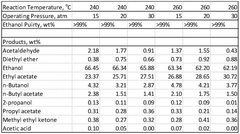
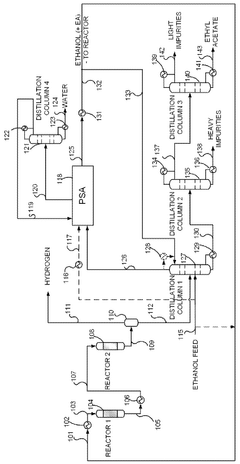
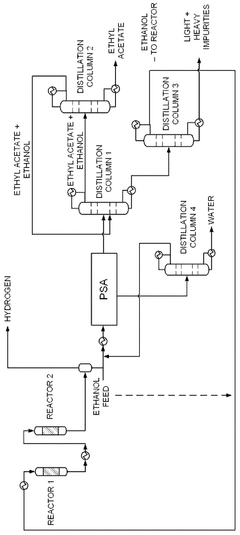
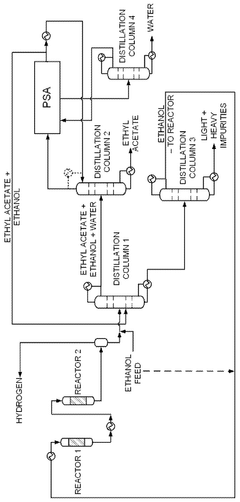
- A novel process that converts ethanol to ethyl acetate through dehydrogenation, followed by selective hydrogenation of byproducts to facilitate easier separation, and utilizes pressure swing adsorption to minimize water content and protect the catalyst.
Environmental Regulations and Policy Framework for Green Chemicals
The regulatory landscape for green chemicals, particularly biodegradable ethyl acetate, is rapidly evolving as governments worldwide recognize the urgent need to transition toward sustainable chemical alternatives. The European Union leads this transformation through its comprehensive Green Deal initiative and the REACH regulation framework, which prioritizes the registration and evaluation of chemicals based on their environmental impact and biodegradability profiles.
In the United States, the Environmental Protection Agency has established the Safer Choice program, which provides certification pathways for environmentally preferable chemicals including biodegradable solvents like ethyl acetate. This program offers manufacturers clear guidelines for demonstrating the environmental benefits of their products while ensuring market access through regulatory compliance. The EPA's Design for the Environment criteria specifically favor chemicals that exhibit rapid biodegradation rates and minimal aquatic toxicity.
Asia-Pacific regions are implementing increasingly stringent chemical management policies, with countries like Japan and South Korea adopting chemical substance control laws that mirror European standards. China's new Chemical Substance Environmental Management regulations emphasize the importance of biodegradable alternatives in industrial applications, creating substantial market opportunities for ethyl acetate producers who can demonstrate compliance with environmental standards.
The regulatory framework extends beyond basic safety requirements to encompass lifecycle assessment protocols and carbon footprint reporting mandates. These policies incentivize manufacturers to adopt biodegradable ethyl acetate through tax benefits, reduced regulatory burdens, and preferential procurement policies for government contracts. Many jurisdictions now require environmental impact declarations for chemical products, positioning biodegradable alternatives as preferred options.
International standards organizations, including ISO and ASTM, have developed specific testing protocols for biodegradability assessment, creating harmonized global standards that facilitate market access. These standardized frameworks enable manufacturers to demonstrate compliance across multiple jurisdictions while building consumer confidence in green chemical alternatives.
The policy trend clearly favors chemicals that can demonstrate rapid environmental degradation, low toxicity profiles, and renewable feedstock origins, positioning biodegradable ethyl acetate as a strategically advantaged solution in the evolving regulatory environment.
In the United States, the Environmental Protection Agency has established the Safer Choice program, which provides certification pathways for environmentally preferable chemicals including biodegradable solvents like ethyl acetate. This program offers manufacturers clear guidelines for demonstrating the environmental benefits of their products while ensuring market access through regulatory compliance. The EPA's Design for the Environment criteria specifically favor chemicals that exhibit rapid biodegradation rates and minimal aquatic toxicity.
Asia-Pacific regions are implementing increasingly stringent chemical management policies, with countries like Japan and South Korea adopting chemical substance control laws that mirror European standards. China's new Chemical Substance Environmental Management regulations emphasize the importance of biodegradable alternatives in industrial applications, creating substantial market opportunities for ethyl acetate producers who can demonstrate compliance with environmental standards.
The regulatory framework extends beyond basic safety requirements to encompass lifecycle assessment protocols and carbon footprint reporting mandates. These policies incentivize manufacturers to adopt biodegradable ethyl acetate through tax benefits, reduced regulatory burdens, and preferential procurement policies for government contracts. Many jurisdictions now require environmental impact declarations for chemical products, positioning biodegradable alternatives as preferred options.
International standards organizations, including ISO and ASTM, have developed specific testing protocols for biodegradability assessment, creating harmonized global standards that facilitate market access. These standardized frameworks enable manufacturers to demonstrate compliance across multiple jurisdictions while building consumer confidence in green chemical alternatives.
The policy trend clearly favors chemicals that can demonstrate rapid environmental degradation, low toxicity profiles, and renewable feedstock origins, positioning biodegradable ethyl acetate as a strategically advantaged solution in the evolving regulatory environment.
Life Cycle Assessment and Sustainability Metrics for Applications
Life cycle assessment (LCA) represents a critical framework for evaluating the environmental performance of biodegradable ethyl acetate across its entire lifecycle, from raw material extraction through production, use, and end-of-life disposal. This comprehensive methodology enables quantification of environmental impacts including carbon footprint, energy consumption, water usage, and ecosystem effects, providing essential data for maximizing sustainable applications.
The carbon footprint assessment of biodegradable ethyl acetate applications reveals significant advantages over conventional petroleum-based alternatives. Bio-based production pathways typically demonstrate 40-60% lower greenhouse gas emissions compared to traditional synthesis methods. Key metrics include cradle-to-gate emissions ranging from 1.2-2.8 kg CO2 equivalent per kilogram of product, with variations depending on feedstock sources and production technologies employed.
Energy efficiency metrics highlight the renewable energy integration potential in biodegradable ethyl acetate manufacturing. Solar and wind-powered production facilities can achieve net energy ratios exceeding 3.5, indicating substantial energy returns on investment. Process optimization through heat integration and waste heat recovery systems further enhances energy performance, reducing overall energy intensity by 25-35% compared to conventional processes.
Water footprint analysis demonstrates favorable sustainability profiles, particularly for applications in water-sensitive industries. Biodegradable ethyl acetate production typically requires 15-20% less water than petroleum-based alternatives, with enhanced water recycling capabilities reducing freshwater consumption. End-of-life biodegradation eliminates long-term water contamination risks, supporting circular economy principles.
Biodegradability metrics serve as fundamental sustainability indicators, with complete mineralization typically occurring within 28-60 days under standard composting conditions. This rapid decomposition profile enables applications in packaging, coatings, and cleaning products where end-of-life environmental impact minimization is paramount. Ecotoxicity assessments confirm minimal adverse effects on aquatic and terrestrial ecosystems.
Resource depletion indicators favor biodegradable variants through utilization of renewable biomass feedstocks rather than finite fossil resources. Sustainability metrics encompass land use efficiency, biodiversity impact assessment, and agricultural sustainability practices. Integration of waste biomass and agricultural residues as feedstocks further enhances resource utilization efficiency while supporting waste valorization strategies.
The carbon footprint assessment of biodegradable ethyl acetate applications reveals significant advantages over conventional petroleum-based alternatives. Bio-based production pathways typically demonstrate 40-60% lower greenhouse gas emissions compared to traditional synthesis methods. Key metrics include cradle-to-gate emissions ranging from 1.2-2.8 kg CO2 equivalent per kilogram of product, with variations depending on feedstock sources and production technologies employed.
Energy efficiency metrics highlight the renewable energy integration potential in biodegradable ethyl acetate manufacturing. Solar and wind-powered production facilities can achieve net energy ratios exceeding 3.5, indicating substantial energy returns on investment. Process optimization through heat integration and waste heat recovery systems further enhances energy performance, reducing overall energy intensity by 25-35% compared to conventional processes.
Water footprint analysis demonstrates favorable sustainability profiles, particularly for applications in water-sensitive industries. Biodegradable ethyl acetate production typically requires 15-20% less water than petroleum-based alternatives, with enhanced water recycling capabilities reducing freshwater consumption. End-of-life biodegradation eliminates long-term water contamination risks, supporting circular economy principles.
Biodegradability metrics serve as fundamental sustainability indicators, with complete mineralization typically occurring within 28-60 days under standard composting conditions. This rapid decomposition profile enables applications in packaging, coatings, and cleaning products where end-of-life environmental impact minimization is paramount. Ecotoxicity assessments confirm minimal adverse effects on aquatic and terrestrial ecosystems.
Resource depletion indicators favor biodegradable variants through utilization of renewable biomass feedstocks rather than finite fossil resources. Sustainability metrics encompass land use efficiency, biodiversity impact assessment, and agricultural sustainability practices. Integration of waste biomass and agricultural residues as feedstocks further enhances resource utilization efficiency while supporting waste valorization strategies.
Unlock deeper insights with Patsnap Eureka Quick Research — get a full tech report to explore trends and direct your research. Try now!
Generate Your Research Report Instantly with AI Agent
Supercharge your innovation with Patsnap Eureka AI Agent Platform!