How to Optimize Raman Spectroscopy for Data Acquisition Validity
SEP 19, 202510 MIN READ
Generate Your Research Report Instantly with AI Agent
PatSnap Eureka helps you evaluate technical feasibility & market potential.
Raman Spectroscopy Evolution and Optimization Goals
Raman spectroscopy has evolved significantly since its discovery by C.V. Raman in 1928, transforming from a purely academic tool into a versatile analytical technique with applications spanning pharmaceuticals, materials science, biomedical diagnostics, and environmental monitoring. The initial decades following its discovery were characterized by limited practical applications due to technological constraints, particularly weak signal intensity and interference from fluorescence.
The introduction of laser technology in the 1960s marked a pivotal advancement, providing the intense monochromatic light source necessary for efficient Raman scattering. This development catalyzed the expansion of Raman spectroscopy from laboratory curiosity to practical analytical tool. The subsequent integration of charge-coupled devices (CCDs) in the 1980s further revolutionized the field by enabling rapid, sensitive detection of scattered photons.
Recent technological innovations have focused on enhancing signal quality while minimizing acquisition time. Notable developments include Surface-Enhanced Raman Spectroscopy (SERS), which amplifies signals by factors of 10^6 to 10^14 through plasmonic enhancement, and Coherent Anti-Stokes Raman Spectroscopy (CARS), which employs multiple photons to generate stronger signals with reduced fluorescence interference.
The current technological trajectory is directed toward miniaturization and portability, with handheld and smartphone-integrated Raman devices emerging for point-of-need applications. Concurrently, computational methods including machine learning algorithms are being increasingly employed to extract meaningful information from complex spectral data, addressing challenges in signal processing and interpretation.
The optimization goals for Raman spectroscopy data acquisition validity center on several critical parameters. Signal-to-noise ratio (SNR) enhancement remains paramount, requiring innovations in both hardware design and signal processing algorithms. Minimizing fluorescence interference continues to be a significant challenge, particularly for biological samples with intrinsic fluorophores.
Calibration standardization represents another crucial objective, as variations in instrument response can compromise data reproducibility across different systems or over time. The development of universal calibration protocols and reference materials is essential for ensuring consistent, comparable results across the scientific community.
Speed optimization without compromising spectral quality constitutes an additional goal, particularly for applications requiring real-time monitoring or high-throughput screening. This necessitates advancements in detector technology, optical components, and data processing algorithms capable of rapid analysis.
The ultimate aim is to establish Raman spectroscopy as a reliable, user-friendly analytical technique with validated protocols ensuring data integrity across diverse application domains. This requires addressing current limitations while developing standardized methodologies for data acquisition, processing, and interpretation that can be universally adopted by researchers and industry practitioners.
The introduction of laser technology in the 1960s marked a pivotal advancement, providing the intense monochromatic light source necessary for efficient Raman scattering. This development catalyzed the expansion of Raman spectroscopy from laboratory curiosity to practical analytical tool. The subsequent integration of charge-coupled devices (CCDs) in the 1980s further revolutionized the field by enabling rapid, sensitive detection of scattered photons.
Recent technological innovations have focused on enhancing signal quality while minimizing acquisition time. Notable developments include Surface-Enhanced Raman Spectroscopy (SERS), which amplifies signals by factors of 10^6 to 10^14 through plasmonic enhancement, and Coherent Anti-Stokes Raman Spectroscopy (CARS), which employs multiple photons to generate stronger signals with reduced fluorescence interference.
The current technological trajectory is directed toward miniaturization and portability, with handheld and smartphone-integrated Raman devices emerging for point-of-need applications. Concurrently, computational methods including machine learning algorithms are being increasingly employed to extract meaningful information from complex spectral data, addressing challenges in signal processing and interpretation.
The optimization goals for Raman spectroscopy data acquisition validity center on several critical parameters. Signal-to-noise ratio (SNR) enhancement remains paramount, requiring innovations in both hardware design and signal processing algorithms. Minimizing fluorescence interference continues to be a significant challenge, particularly for biological samples with intrinsic fluorophores.
Calibration standardization represents another crucial objective, as variations in instrument response can compromise data reproducibility across different systems or over time. The development of universal calibration protocols and reference materials is essential for ensuring consistent, comparable results across the scientific community.
Speed optimization without compromising spectral quality constitutes an additional goal, particularly for applications requiring real-time monitoring or high-throughput screening. This necessitates advancements in detector technology, optical components, and data processing algorithms capable of rapid analysis.
The ultimate aim is to establish Raman spectroscopy as a reliable, user-friendly analytical technique with validated protocols ensuring data integrity across diverse application domains. This requires addressing current limitations while developing standardized methodologies for data acquisition, processing, and interpretation that can be universally adopted by researchers and industry practitioners.
Market Applications and Demand Analysis for Raman Technology
Raman spectroscopy has experienced significant market growth across multiple industries, with the global Raman spectroscopy market valued at approximately 1.8 billion USD in 2022 and projected to reach 2.9 billion USD by 2028, representing a compound annual growth rate of 8.2%. This growth is primarily driven by increasing demand for non-destructive analytical techniques in pharmaceutical development, materials science, and biomedical applications.
The pharmaceutical and biotechnology sectors represent the largest market segment, accounting for roughly 35% of the total market share. These industries leverage Raman technology for drug formulation analysis, raw material identification, and quality control processes. The ability to analyze samples through packaging materials without sample preparation has made Raman spectroscopy particularly valuable in pharmaceutical manufacturing environments where contamination risks must be minimized.
Academic and research institutions constitute another significant market segment, utilizing Raman spectroscopy for fundamental research across chemistry, physics, and materials science. This sector has been instrumental in driving technological innovations that subsequently find commercial applications.
Industrial applications represent the fastest-growing market segment, with a growth rate exceeding 10% annually. This includes process monitoring in chemical manufacturing, polymer production, and semiconductor fabrication. The demand for in-line and real-time analysis capabilities has spurred development of more robust and automated Raman systems capable of operating in harsh industrial environments.
Geographically, North America leads the market with approximately 40% share, followed by Europe (30%) and Asia-Pacific (25%). However, the Asia-Pacific region is experiencing the fastest growth rate due to expanding industrial bases in China, India, and South Korea, coupled with increasing research and development investments.
Market trends indicate growing demand for portable and handheld Raman devices, which now constitute about 20% of the market. These devices enable field-based applications in environmental monitoring, forensic investigation, and geological exploration. The miniaturization of components and improvements in spectral resolution have significantly expanded the application scope of portable Raman systems.
Cloud connectivity and data analytics integration represent emerging market requirements, with end-users increasingly seeking systems that can transmit spectral data to centralized databases for advanced analysis and pattern recognition. This trend aligns with broader industry movements toward digital transformation and data-driven decision making.
Customer feedback indicates that data acquisition validity remains a critical concern, with approximately 65% of users citing reliability and reproducibility as key factors influencing purchasing decisions. This underscores the importance of optimizing Raman spectroscopy for valid data acquisition to meet market expectations and drive further adoption across diverse application domains.
The pharmaceutical and biotechnology sectors represent the largest market segment, accounting for roughly 35% of the total market share. These industries leverage Raman technology for drug formulation analysis, raw material identification, and quality control processes. The ability to analyze samples through packaging materials without sample preparation has made Raman spectroscopy particularly valuable in pharmaceutical manufacturing environments where contamination risks must be minimized.
Academic and research institutions constitute another significant market segment, utilizing Raman spectroscopy for fundamental research across chemistry, physics, and materials science. This sector has been instrumental in driving technological innovations that subsequently find commercial applications.
Industrial applications represent the fastest-growing market segment, with a growth rate exceeding 10% annually. This includes process monitoring in chemical manufacturing, polymer production, and semiconductor fabrication. The demand for in-line and real-time analysis capabilities has spurred development of more robust and automated Raman systems capable of operating in harsh industrial environments.
Geographically, North America leads the market with approximately 40% share, followed by Europe (30%) and Asia-Pacific (25%). However, the Asia-Pacific region is experiencing the fastest growth rate due to expanding industrial bases in China, India, and South Korea, coupled with increasing research and development investments.
Market trends indicate growing demand for portable and handheld Raman devices, which now constitute about 20% of the market. These devices enable field-based applications in environmental monitoring, forensic investigation, and geological exploration. The miniaturization of components and improvements in spectral resolution have significantly expanded the application scope of portable Raman systems.
Cloud connectivity and data analytics integration represent emerging market requirements, with end-users increasingly seeking systems that can transmit spectral data to centralized databases for advanced analysis and pattern recognition. This trend aligns with broader industry movements toward digital transformation and data-driven decision making.
Customer feedback indicates that data acquisition validity remains a critical concern, with approximately 65% of users citing reliability and reproducibility as key factors influencing purchasing decisions. This underscores the importance of optimizing Raman spectroscopy for valid data acquisition to meet market expectations and drive further adoption across diverse application domains.
Current Limitations and Technical Challenges in Data Acquisition
Despite significant advancements in Raman spectroscopy technology, several critical limitations and technical challenges persist in data acquisition processes that impact measurement validity and reliability. Signal-to-noise ratio (SNR) remains a fundamental challenge, particularly when analyzing samples with weak Raman scattering properties or when rapid acquisition is required. The inherently weak nature of Raman scattering (approximately 1 in 10^7 photons) necessitates either long acquisition times or high laser powers, both of which introduce complications.
Fluorescence interference presents another significant obstacle, often overwhelming the weaker Raman signals. This is especially problematic when analyzing biological samples, pharmaceuticals, and natural products where fluorescent compounds are prevalent. Current hardware-based solutions like shifted-excitation or time-gated detection add substantial cost and complexity to instrumentation.
Thermal effects induced during measurement represent a critical challenge for data validity. High-power laser excitation can cause sample heating, leading to degradation, phase transitions, or chemical reactions that fundamentally alter the sample being measured. This creates a paradoxical situation where the act of measurement changes what is being measured.
Calibration drift and instrument stability issues significantly impact reproducibility across measurements. Environmental factors such as temperature fluctuations, humidity changes, and mechanical vibrations can alter optical alignment and detector response characteristics over time. Current calibration protocols often fail to adequately address these dynamic variations.
Sample heterogeneity and positioning inconsistencies introduce substantial variability in measurements. The highly localized nature of Raman sampling means that slight changes in sample position or focus can yield dramatically different spectra, particularly in heterogeneous materials. Automated mapping approaches partially address this but introduce significant time penalties.
Data processing challenges further complicate acquisition validity. Baseline correction, cosmic ray removal, and spectral normalization methods often rely on subjective parameters that can introduce artifacts or remove genuine spectral features. The lack of standardized processing protocols makes cross-comparison between different studies problematic.
Miniaturization efforts for portable and field-deployable systems face severe engineering constraints in maintaining optical stability and spectral resolution while reducing size and power requirements. Current portable systems typically sacrifice performance metrics like spectral resolution and sensitivity to achieve field deployment capabilities.
Quantitative analysis remains challenging due to matrix effects and non-linear relationships between analyte concentration and Raman signal intensity. Reference standards often behave differently than real-world complex samples, limiting the accuracy of quantitative measurements in practical applications.
Fluorescence interference presents another significant obstacle, often overwhelming the weaker Raman signals. This is especially problematic when analyzing biological samples, pharmaceuticals, and natural products where fluorescent compounds are prevalent. Current hardware-based solutions like shifted-excitation or time-gated detection add substantial cost and complexity to instrumentation.
Thermal effects induced during measurement represent a critical challenge for data validity. High-power laser excitation can cause sample heating, leading to degradation, phase transitions, or chemical reactions that fundamentally alter the sample being measured. This creates a paradoxical situation where the act of measurement changes what is being measured.
Calibration drift and instrument stability issues significantly impact reproducibility across measurements. Environmental factors such as temperature fluctuations, humidity changes, and mechanical vibrations can alter optical alignment and detector response characteristics over time. Current calibration protocols often fail to adequately address these dynamic variations.
Sample heterogeneity and positioning inconsistencies introduce substantial variability in measurements. The highly localized nature of Raman sampling means that slight changes in sample position or focus can yield dramatically different spectra, particularly in heterogeneous materials. Automated mapping approaches partially address this but introduce significant time penalties.
Data processing challenges further complicate acquisition validity. Baseline correction, cosmic ray removal, and spectral normalization methods often rely on subjective parameters that can introduce artifacts or remove genuine spectral features. The lack of standardized processing protocols makes cross-comparison between different studies problematic.
Miniaturization efforts for portable and field-deployable systems face severe engineering constraints in maintaining optical stability and spectral resolution while reducing size and power requirements. Current portable systems typically sacrifice performance metrics like spectral resolution and sensitivity to achieve field deployment capabilities.
Quantitative analysis remains challenging due to matrix effects and non-linear relationships between analyte concentration and Raman signal intensity. Reference standards often behave differently than real-world complex samples, limiting the accuracy of quantitative measurements in practical applications.
State-of-the-Art Data Validation Methodologies
01 Calibration and validation methods for Raman spectroscopy
Various calibration and validation techniques are employed to ensure the accuracy and reliability of Raman spectroscopy data. These methods include using reference standards, internal calibration markers, and automated validation protocols. Proper calibration addresses wavelength accuracy, intensity response, and spectral resolution, which are critical for obtaining valid spectroscopic measurements. Validation procedures may involve comparing results against known samples or using statistical methods to verify data quality.- Validation methods for Raman spectroscopy data: Various methods are employed to validate the accuracy and reliability of Raman spectroscopy data. These include reference standard comparison, statistical analysis techniques, and algorithm-based validation approaches. Validation processes often involve comparing collected spectra against known reference materials or using internal calibration standards to ensure measurement accuracy. Advanced statistical methods can be applied to identify outliers and confirm data consistency across multiple measurements.
- Hardware configurations for improving data acquisition validity: Specialized hardware configurations can significantly enhance the validity of Raman spectroscopy data acquisition. These include optimized optical components, advanced detector systems, and noise reduction mechanisms. Proper alignment of optical paths, temperature-controlled environments, and vibration isolation systems help minimize interference. High-sensitivity detectors with improved signal-to-noise ratios enable more accurate spectral measurements, while specialized sample holders ensure consistent positioning and measurement conditions.
- Software solutions for data quality assessment: Software solutions play a crucial role in assessing and ensuring the quality of Raman spectroscopy data. These include automated baseline correction, spectral preprocessing algorithms, and quality control systems that flag potentially invalid measurements. Machine learning approaches can be used to identify patterns indicative of measurement errors or sample contamination. Real-time data validation software can provide immediate feedback during acquisition, allowing operators to adjust parameters or repeat measurements when necessary.
- Calibration techniques for ensuring measurement accuracy: Proper calibration is essential for ensuring the validity of Raman spectroscopy data. Techniques include wavelength calibration using known reference materials, intensity calibration to account for instrument response functions, and regular performance verification protocols. Automated calibration systems can maintain instrument accuracy over time, while calibration transfer methods enable comparison of data across different instruments. Multi-point calibration approaches help ensure linearity across the spectral range of interest.
- Environmental and sample-related factors affecting data validity: Various environmental and sample-related factors can impact the validity of Raman spectroscopy data. These include temperature fluctuations, ambient light interference, sample fluorescence, and sample heterogeneity. Techniques to address these challenges include controlled measurement environments, fluorescence suppression methods, and appropriate sampling strategies for heterogeneous materials. Sample preparation protocols can be optimized to minimize interference and ensure representative measurements, while environmental monitoring systems can track conditions that might affect data quality.
02 Signal processing and noise reduction techniques
Advanced signal processing algorithms are essential for enhancing the validity of Raman spectroscopy data by improving signal-to-noise ratios. These techniques include baseline correction, cosmic ray removal, smoothing filters, and multivariate analysis methods. By effectively reducing noise and artifacts in the spectral data, these approaches enable more accurate peak identification and quantification. Real-time processing capabilities allow for immediate assessment of data quality during acquisition, ensuring valid results.Expand Specific Solutions03 Hardware configurations for optimizing data acquisition
Specialized hardware configurations significantly impact the validity of Raman spectroscopy data. These include optimized optical components, detector technologies with enhanced sensitivity, and sample positioning systems. Confocal arrangements minimize interference from surrounding materials, while fiber-optic probes enable remote sampling with maintained data integrity. Temperature control systems prevent thermal drift that could compromise measurement validity, and automated sample handling reduces human error in the data acquisition process.Expand Specific Solutions04 Quality control parameters and validation metrics
Specific quality control parameters and validation metrics are established to assess the reliability of Raman spectroscopy data. These include signal-to-noise ratio thresholds, peak resolution criteria, reproducibility measurements, and system suitability tests. Statistical methods such as principal component analysis and partial least squares are employed to validate spectral patterns and identify outliers. Automated quality assessment algorithms can flag potentially invalid data during acquisition, allowing for immediate corrective action.Expand Specific Solutions05 Integration with complementary analytical techniques
Combining Raman spectroscopy with complementary analytical techniques enhances data validity through cross-validation. Integration with methods such as infrared spectroscopy, mass spectrometry, or chromatography provides confirmatory information that increases confidence in results. Multimodal approaches allow for more comprehensive sample characterization and can overcome limitations inherent to any single technique. Correlation of Raman data with results from established methods serves as an important validation strategy, particularly for complex samples or novel applications.Expand Specific Solutions
Leading Manufacturers and Research Institutions in Raman Technology
Raman spectroscopy optimization for data acquisition validity exists in a mature yet evolving market landscape. The industry is currently in a growth phase, with an estimated global market size of $1.8-2.2 billion and projected annual growth of 7-9%. Leading companies demonstrate varying levels of technological maturity: ChemImage Corp., Tornado Spectral Systems, and Innovative Photonic Solutions have developed specialized solutions with HTVS technology and integrated Raman probes, while established players like Thermo Scientific, Horiba, and FUJIFILM offer comprehensive platforms. Academic institutions (Northeastern University, Xiamen University) collaborate with industry to advance fundamental research. The competitive landscape features both specialized Raman instrumentation providers and diversified scientific equipment manufacturers, with recent innovations focusing on portable devices, real-time analysis capabilities, and AI-enhanced data processing.
ChemImage Corp.
Technical Solution: ChemImage has developed advanced Raman spectroscopy systems that incorporate real-time chemical imaging capabilities. Their proprietary technology combines Raman spectroscopy with digital imaging to create detailed molecular maps of samples. The company's Raman systems employ sophisticated algorithms for automated background subtraction and noise reduction, significantly improving data acquisition validity. ChemImage's platforms feature automated calibration procedures that ensure measurement consistency across different sessions and instruments. Their systems also incorporate reference standards for wavelength calibration and intensity normalization, addressing key challenges in Raman data reproducibility[1]. The company has pioneered the integration of machine learning algorithms that can identify and compensate for common spectral artifacts, enhancing data reliability in complex sample matrices.
Strengths: Superior chemical imaging capabilities allowing spatial distribution analysis alongside spectral data; advanced automated calibration systems ensuring measurement consistency. Weaknesses: Proprietary systems may have limited compatibility with other analytical platforms; higher cost compared to conventional Raman systems may limit accessibility for some research applications.
Innovative Photonic Solutions, Inc.
Technical Solution: Innovative Photonic Solutions (IPS) specializes in developing high-performance laser sources specifically optimized for Raman spectroscopy applications. Their approach to improving data acquisition validity centers on providing exceptionally stable laser sources with narrow linewidths and precise wavelength control. IPS's semiconductor laser technology delivers wavelength stability of <0.1 nm over extended operation periods[7], addressing one of the critical factors affecting measurement reproducibility. Their lasers feature advanced temperature compensation systems that maintain consistent output power and wavelength across varying environmental conditions. IPS has developed proprietary optical feedback systems that continuously monitor and adjust laser parameters in real-time, ensuring measurement consistency. Their modular design philosophy allows for seamless integration with various spectrometer configurations, enabling customized solutions for specific application requirements.
Strengths: Exceptional laser stability providing consistent excitation conditions; specialized focus on a critical component of the Raman system chain. Weaknesses: As a component supplier rather than full-system provider, optimization requires integration with complementary technologies; limited direct control over other aspects of the spectroscopic system.
Key Patents and Innovations in Signal Processing Algorithms
Method for enhancing a raman contribution in a spectrum, spectroscopy system, computer program and non-transitory computer-readable storage medium
PatentPendingUS20250093269A1
Innovation
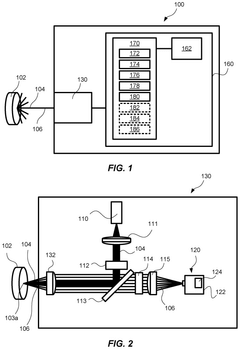
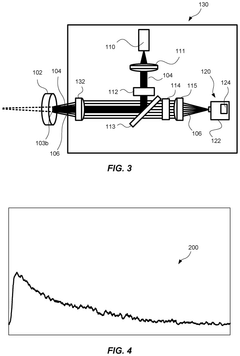
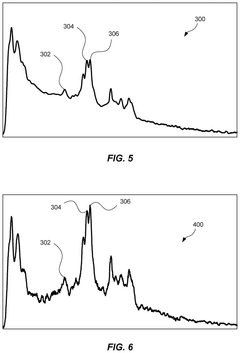
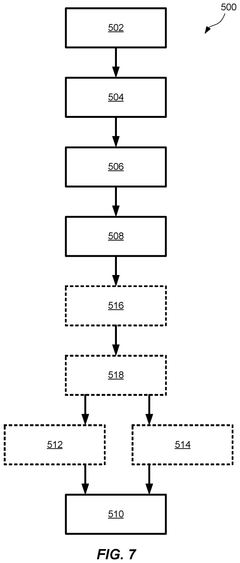
- The method involves setting a first and second spot size of light emitted by a light source at a sample, recording spectra with each spot size, and forming a data set based on the dissimilarity between the spectra to enhance the Raman contribution, using a liquid lens to adjust the focal point and intensity, thereby improving the signal-to-noise ratio and suppressing fluorescence and other optical responses.
Magnetic resonance imager with coils for arbitrary image space and fabrication thereof
PatentWO2021022252A1
Innovation
- The development of non-planar coil systems with rotating tables and synchronized wire height adjustment arms to fabricate coils that generate gradient or shim magnetic fields, allowing for improved magnetic field homogeneity and spatial resolution, including the use of multi-coil subsystems with cooling tubes to manage heat and vibrations.


Calibration Standards and Reference Materials Development
The development of robust calibration standards and reference materials is fundamental to ensuring the validity and reliability of Raman spectroscopy data acquisition. Current calibration approaches often rely on standardized materials such as silicon, polystyrene, and cyclohexane, which provide well-characterized Raman peaks for wavelength calibration. However, these traditional standards may not adequately address the complex requirements of modern Raman applications across diverse fields including pharmaceuticals, biomedicine, and materials science.
Recent advancements have focused on creating matrix-matched reference materials that more accurately reflect the composition and structure of actual samples being analyzed. These specialized standards help account for matrix effects that can significantly influence spectral quality and quantitative accuracy. For instance, NIST-traceable standards specifically designed for pharmaceutical applications have been developed to ensure compliance with regulatory requirements while providing reliable calibration across different instrument platforms.
The emergence of certified reference materials (CRMs) with precisely quantified Raman cross-sections represents a significant step forward in quantitative Raman analysis. These materials enable more accurate concentration determinations and improve inter-laboratory comparability of results. Additionally, the development of multi-component standards that simultaneously calibrate wavelength, intensity, and resolution parameters streamlines the calibration process while enhancing overall measurement reliability.
Nanomaterial-based calibration standards have shown particular promise for surface-enhanced Raman spectroscopy (SERS) applications. Gold and silver nanoparticle substrates with controlled morphology and reproducible enhancement factors are being standardized to address the historically poor reproducibility of SERS measurements. These advanced reference materials enable more consistent enhancement factors and better quantitative capabilities in SERS analysis.
For biological and biomedical applications, tissue-mimicking phantoms containing known concentrations of Raman-active molecules are being developed. These phantoms simulate the optical properties and Raman signatures of biological tissues, providing realistic calibration standards for in vivo and ex vivo measurements. Such biomimetic standards are particularly valuable for validating diagnostic algorithms and ensuring consistent performance in clinical settings.
The integration of machine learning approaches with reference material development has created adaptive calibration systems that can compensate for instrument drift and environmental variations. These intelligent calibration frameworks utilize reference spectra databases and automated correction algorithms to maintain measurement validity over extended operational periods, reducing the frequency of manual recalibration procedures while improving data reliability.
Recent advancements have focused on creating matrix-matched reference materials that more accurately reflect the composition and structure of actual samples being analyzed. These specialized standards help account for matrix effects that can significantly influence spectral quality and quantitative accuracy. For instance, NIST-traceable standards specifically designed for pharmaceutical applications have been developed to ensure compliance with regulatory requirements while providing reliable calibration across different instrument platforms.
The emergence of certified reference materials (CRMs) with precisely quantified Raman cross-sections represents a significant step forward in quantitative Raman analysis. These materials enable more accurate concentration determinations and improve inter-laboratory comparability of results. Additionally, the development of multi-component standards that simultaneously calibrate wavelength, intensity, and resolution parameters streamlines the calibration process while enhancing overall measurement reliability.
Nanomaterial-based calibration standards have shown particular promise for surface-enhanced Raman spectroscopy (SERS) applications. Gold and silver nanoparticle substrates with controlled morphology and reproducible enhancement factors are being standardized to address the historically poor reproducibility of SERS measurements. These advanced reference materials enable more consistent enhancement factors and better quantitative capabilities in SERS analysis.
For biological and biomedical applications, tissue-mimicking phantoms containing known concentrations of Raman-active molecules are being developed. These phantoms simulate the optical properties and Raman signatures of biological tissues, providing realistic calibration standards for in vivo and ex vivo measurements. Such biomimetic standards are particularly valuable for validating diagnostic algorithms and ensuring consistent performance in clinical settings.
The integration of machine learning approaches with reference material development has created adaptive calibration systems that can compensate for instrument drift and environmental variations. These intelligent calibration frameworks utilize reference spectra databases and automated correction algorithms to maintain measurement validity over extended operational periods, reducing the frequency of manual recalibration procedures while improving data reliability.
Environmental Factors Affecting Measurement Reliability
Environmental factors play a crucial role in determining the reliability and validity of Raman spectroscopy measurements. Temperature fluctuations represent one of the most significant environmental challenges, as they can cause spectral shifts and intensity variations. Research indicates that even minor temperature changes of 5°C can lead to peak shifts of up to 2 cm⁻¹ in certain materials, potentially resulting in misidentification of chemical compounds or inaccurate quantitative analysis.
Ambient lighting conditions similarly impact measurement quality by introducing background noise and potentially overwhelming weak Raman signals. This is particularly problematic when analyzing samples with low scattering cross-sections or when detecting trace components. Studies have demonstrated that ambient light interference can reduce signal-to-noise ratios by up to 40% in standard laboratory settings without proper light shielding.
Humidity presents another critical environmental factor affecting Raman spectroscopy reliability. High humidity environments can cause hygroscopic samples to absorb moisture, altering their chemical composition and consequently their Raman signatures. Additionally, water vapor in the optical path can introduce its own characteristic Raman bands, potentially masking or distorting signals from the target sample.
Mechanical vibrations transmitted through building structures or from nearby equipment can significantly degrade measurement quality. These vibrations affect optical alignment and spatial resolution, particularly in confocal Raman systems where positioning accuracy is paramount. Vibration-induced artifacts have been shown to reduce spatial resolution by up to 30% in high-precision mapping applications.
Electromagnetic interference (EMI) from nearby electronic equipment can introduce noise into detector systems, particularly in CCD-based spectrometers. This interference manifests as random spikes or baseline fluctuations in spectra, complicating data interpretation and reducing analytical sensitivity. Laboratory studies have documented EMI-related signal degradation of 15-25% in environments with multiple electronic instruments operating simultaneously.
Atmospheric composition variations, particularly in open-air or field measurements, introduce additional complexity. Atmospheric gases like oxygen and nitrogen produce their own Raman signatures that may overlap with sample features. Carbon dioxide fluctuations can be especially problematic for biological sample analysis, where carbonate and carboxyl group identification is often critical.
Dust particles and aerosols present in the measurement environment can scatter the excitation laser and collected Raman signal, reducing overall system efficiency. In industrial environments, airborne particulates have been shown to decrease signal intensity by up to 35% compared to clean-room conditions, necessitating more sophisticated background correction algorithms or physical mitigation strategies.
Ambient lighting conditions similarly impact measurement quality by introducing background noise and potentially overwhelming weak Raman signals. This is particularly problematic when analyzing samples with low scattering cross-sections or when detecting trace components. Studies have demonstrated that ambient light interference can reduce signal-to-noise ratios by up to 40% in standard laboratory settings without proper light shielding.
Humidity presents another critical environmental factor affecting Raman spectroscopy reliability. High humidity environments can cause hygroscopic samples to absorb moisture, altering their chemical composition and consequently their Raman signatures. Additionally, water vapor in the optical path can introduce its own characteristic Raman bands, potentially masking or distorting signals from the target sample.
Mechanical vibrations transmitted through building structures or from nearby equipment can significantly degrade measurement quality. These vibrations affect optical alignment and spatial resolution, particularly in confocal Raman systems where positioning accuracy is paramount. Vibration-induced artifacts have been shown to reduce spatial resolution by up to 30% in high-precision mapping applications.
Electromagnetic interference (EMI) from nearby electronic equipment can introduce noise into detector systems, particularly in CCD-based spectrometers. This interference manifests as random spikes or baseline fluctuations in spectra, complicating data interpretation and reducing analytical sensitivity. Laboratory studies have documented EMI-related signal degradation of 15-25% in environments with multiple electronic instruments operating simultaneously.
Atmospheric composition variations, particularly in open-air or field measurements, introduce additional complexity. Atmospheric gases like oxygen and nitrogen produce their own Raman signatures that may overlap with sample features. Carbon dioxide fluctuations can be especially problematic for biological sample analysis, where carbonate and carboxyl group identification is often critical.
Dust particles and aerosols present in the measurement environment can scatter the excitation laser and collected Raman signal, reducing overall system efficiency. In industrial environments, airborne particulates have been shown to decrease signal intensity by up to 35% compared to clean-room conditions, necessitating more sophisticated background correction algorithms or physical mitigation strategies.
Unlock deeper insights with PatSnap Eureka Quick Research — get a full tech report to explore trends and direct your research. Try now!
Generate Your Research Report Instantly with AI Agent
Supercharge your innovation with PatSnap Eureka AI Agent Platform!