

How to Scale Neuromorphic Photonic Computing for Big Data Analytics
JUN 2, 20269 MIN READ
Generate Your Research Report Instantly with AI Agent
PatSnap Eureka helps you evaluate technical feasibility & market potential.
Neuromorphic Photonic Computing Background and Objectives
Neuromorphic photonic computing represents a revolutionary convergence of three distinct technological paradigms: neuromorphic engineering, photonic computing, and artificial intelligence. This emerging field draws inspiration from the human brain's neural architecture while leveraging the unique properties of light for information processing. The technology emerged from decades of research in optical computing during the 1980s and 1990s, combined with advances in neuromorphic chip design pioneered by researchers like Carver Mead in the late 20th century.
The fundamental principle underlying neuromorphic photonic computing lies in mimicking biological neural networks using photonic components such as lasers, modulators, and photodetectors. Unlike traditional electronic processors that rely on digital switching, this approach utilizes the analog properties of light waves, including wavelength, phase, and amplitude, to perform parallel computations. The technology has evolved through several key phases, beginning with basic optical neural network demonstrations in research laboratories to current implementations of photonic spiking neural networks.
Recent developments have shown remarkable progress in creating photonic neurons and synapses that can process information at the speed of light while consuming significantly less power than their electronic counterparts. Major breakthroughs include the development of integrated photonic circuits capable of implementing complex neural network architectures and the demonstration of optical spike-timing-dependent plasticity for learning applications.
The primary objective of scaling neuromorphic photonic computing for big data analytics centers on addressing the computational bottlenecks inherent in traditional von Neumann architectures when processing massive datasets. Current electronic systems face fundamental limitations in memory bandwidth, energy efficiency, and parallel processing capabilities that become increasingly problematic as data volumes grow exponentially.
The technology aims to achieve several critical goals: dramatically reducing energy consumption per operation through photonic processing, enabling massive parallelism through wavelength division multiplexing, and providing real-time processing capabilities for streaming big data applications. Additionally, the objective includes developing scalable architectures that can seamlessly integrate with existing data center infrastructure while maintaining compatibility with current machine learning frameworks and algorithms.
The fundamental principle underlying neuromorphic photonic computing lies in mimicking biological neural networks using photonic components such as lasers, modulators, and photodetectors. Unlike traditional electronic processors that rely on digital switching, this approach utilizes the analog properties of light waves, including wavelength, phase, and amplitude, to perform parallel computations. The technology has evolved through several key phases, beginning with basic optical neural network demonstrations in research laboratories to current implementations of photonic spiking neural networks.
Recent developments have shown remarkable progress in creating photonic neurons and synapses that can process information at the speed of light while consuming significantly less power than their electronic counterparts. Major breakthroughs include the development of integrated photonic circuits capable of implementing complex neural network architectures and the demonstration of optical spike-timing-dependent plasticity for learning applications.
The primary objective of scaling neuromorphic photonic computing for big data analytics centers on addressing the computational bottlenecks inherent in traditional von Neumann architectures when processing massive datasets. Current electronic systems face fundamental limitations in memory bandwidth, energy efficiency, and parallel processing capabilities that become increasingly problematic as data volumes grow exponentially.
The technology aims to achieve several critical goals: dramatically reducing energy consumption per operation through photonic processing, enabling massive parallelism through wavelength division multiplexing, and providing real-time processing capabilities for streaming big data applications. Additionally, the objective includes developing scalable architectures that can seamlessly integrate with existing data center infrastructure while maintaining compatibility with current machine learning frameworks and algorithms.
Big Data Analytics Market Demand for Neuromorphic Solutions
The global big data analytics market is experiencing unprecedented growth driven by the exponential increase in data generation across industries. Traditional computing architectures face significant limitations in processing massive datasets efficiently, creating substantial demand for revolutionary computing paradigms. Organizations across sectors including healthcare, finance, telecommunications, and manufacturing are seeking solutions that can handle complex pattern recognition, real-time analytics, and machine learning workloads at scale.
Current big data processing systems consume enormous amounts of energy while struggling with latency issues inherent in von Neumann architectures. The separation of memory and processing units creates bottlenecks that become increasingly problematic as data volumes grow. This has created a critical market gap for computing solutions that can process information more efficiently, mimicking the parallel processing capabilities of biological neural networks.
Neuromorphic photonic computing emerges as a promising solution to address these market demands. The technology offers potential advantages including ultra-low power consumption, high-speed parallel processing, and the ability to perform in-memory computing operations. These characteristics align perfectly with market requirements for sustainable, high-performance analytics platforms capable of handling diverse data types and complex computational tasks.
Enterprise demand is particularly strong in sectors requiring real-time decision making from large datasets. Financial institutions need rapid fraud detection and algorithmic trading capabilities, while healthcare organizations require fast medical imaging analysis and genomic data processing. Telecommunications companies seek efficient network optimization and traffic management solutions, driving demand for computing architectures that can process streaming data with minimal latency.
The market opportunity extends beyond traditional data centers to edge computing applications. Internet of Things deployments and autonomous systems require local processing capabilities that can operate under power and space constraints while maintaining high computational performance. Neuromorphic photonic solutions could enable distributed analytics architectures that process data closer to its source, reducing bandwidth requirements and improving response times.
Investment trends indicate growing recognition of neuromorphic computing's commercial potential. Venture capital funding and corporate research investments are increasing, reflecting market confidence in the technology's ability to address current computational limitations. This financial backing supports the development of scalable neuromorphic photonic systems specifically designed for big data analytics applications.
Current big data processing systems consume enormous amounts of energy while struggling with latency issues inherent in von Neumann architectures. The separation of memory and processing units creates bottlenecks that become increasingly problematic as data volumes grow. This has created a critical market gap for computing solutions that can process information more efficiently, mimicking the parallel processing capabilities of biological neural networks.
Neuromorphic photonic computing emerges as a promising solution to address these market demands. The technology offers potential advantages including ultra-low power consumption, high-speed parallel processing, and the ability to perform in-memory computing operations. These characteristics align perfectly with market requirements for sustainable, high-performance analytics platforms capable of handling diverse data types and complex computational tasks.
Enterprise demand is particularly strong in sectors requiring real-time decision making from large datasets. Financial institutions need rapid fraud detection and algorithmic trading capabilities, while healthcare organizations require fast medical imaging analysis and genomic data processing. Telecommunications companies seek efficient network optimization and traffic management solutions, driving demand for computing architectures that can process streaming data with minimal latency.
The market opportunity extends beyond traditional data centers to edge computing applications. Internet of Things deployments and autonomous systems require local processing capabilities that can operate under power and space constraints while maintaining high computational performance. Neuromorphic photonic solutions could enable distributed analytics architectures that process data closer to its source, reducing bandwidth requirements and improving response times.
Investment trends indicate growing recognition of neuromorphic computing's commercial potential. Venture capital funding and corporate research investments are increasing, reflecting market confidence in the technology's ability to address current computational limitations. This financial backing supports the development of scalable neuromorphic photonic systems specifically designed for big data analytics applications.
Current State and Scalability Challenges in Neuromorphic Photonics
Neuromorphic photonic computing represents a convergence of brain-inspired computing architectures with photonic processing capabilities, offering unprecedented potential for parallel computation and energy efficiency. Current implementations primarily exist at laboratory scales, utilizing silicon photonic platforms integrated with electronic neuromorphic circuits. Leading research institutions have demonstrated proof-of-concept systems capable of performing basic neural network operations using optical interference, wavelength division multiplexing, and photonic reservoir computing approaches.
The technology landscape is dominated by hybrid architectures that combine photonic processing elements with electronic control systems. Silicon photonic neural networks have achieved modest scale demonstrations with tens to hundreds of artificial neurons, while photonic reservoir computing systems have shown promise for temporal data processing tasks. However, these implementations remain constrained by fabrication tolerances, optical loss accumulation, and limited integration density compared to their electronic counterparts.
Scalability challenges manifest across multiple dimensions, creating significant barriers to practical big data analytics applications. Manufacturing precision represents a fundamental constraint, as photonic components require nanometer-scale accuracy to maintain coherent operation across large arrays. Current fabrication processes struggle to maintain the uniformity necessary for thousand-node networks, leading to performance degradation and increased calibration complexity.
Optical power management emerges as another critical bottleneck. As network size increases, cumulative optical losses through waveguides, couplers, and processing elements necessitate increasingly powerful laser sources and sophisticated amplification schemes. This power scaling challenge directly contradicts the energy efficiency advantages that neuromorphic photonics promises to deliver over traditional computing architectures.
Thermal management issues compound these challenges, as high-density photonic circuits generate significant heat that affects wavelength stability and component performance. Current cooling solutions add substantial overhead that undermines system-level efficiency gains. Additionally, the integration of electronic control systems required for weight updates, bias control, and output processing creates hybrid complexity that limits overall scalability.
Programming and control infrastructure represents another significant hurdle. Unlike mature electronic neuromorphic platforms, photonic systems lack standardized programming frameworks and automated calibration procedures. Each photonic neuron requires individual tuning and monitoring, creating exponential complexity growth as network size increases. The absence of robust error correction mechanisms further complicates large-scale deployment scenarios.
Geographic distribution of neuromorphic photonic research reveals concentration in advanced semiconductor manufacturing regions, with limited global accessibility to the specialized fabrication facilities required for cutting-edge implementations. This geographic constraint restricts the pace of innovation and collaborative development necessary for addressing scalability challenges effectively.
The technology landscape is dominated by hybrid architectures that combine photonic processing elements with electronic control systems. Silicon photonic neural networks have achieved modest scale demonstrations with tens to hundreds of artificial neurons, while photonic reservoir computing systems have shown promise for temporal data processing tasks. However, these implementations remain constrained by fabrication tolerances, optical loss accumulation, and limited integration density compared to their electronic counterparts.
Scalability challenges manifest across multiple dimensions, creating significant barriers to practical big data analytics applications. Manufacturing precision represents a fundamental constraint, as photonic components require nanometer-scale accuracy to maintain coherent operation across large arrays. Current fabrication processes struggle to maintain the uniformity necessary for thousand-node networks, leading to performance degradation and increased calibration complexity.
Optical power management emerges as another critical bottleneck. As network size increases, cumulative optical losses through waveguides, couplers, and processing elements necessitate increasingly powerful laser sources and sophisticated amplification schemes. This power scaling challenge directly contradicts the energy efficiency advantages that neuromorphic photonics promises to deliver over traditional computing architectures.
Thermal management issues compound these challenges, as high-density photonic circuits generate significant heat that affects wavelength stability and component performance. Current cooling solutions add substantial overhead that undermines system-level efficiency gains. Additionally, the integration of electronic control systems required for weight updates, bias control, and output processing creates hybrid complexity that limits overall scalability.
Programming and control infrastructure represents another significant hurdle. Unlike mature electronic neuromorphic platforms, photonic systems lack standardized programming frameworks and automated calibration procedures. Each photonic neuron requires individual tuning and monitoring, creating exponential complexity growth as network size increases. The absence of robust error correction mechanisms further complicates large-scale deployment scenarios.
Geographic distribution of neuromorphic photonic research reveals concentration in advanced semiconductor manufacturing regions, with limited global accessibility to the specialized fabrication facilities required for cutting-edge implementations. This geographic constraint restricts the pace of innovation and collaborative development necessary for addressing scalability challenges effectively.
Existing Scaling Solutions for Neuromorphic Photonic Systems
01 Photonic neural network architectures and implementations
Development of optical neural network structures that mimic biological neural systems using photonic components. These architectures utilize light-based processing elements to perform neural computations, enabling parallel processing capabilities and reduced power consumption compared to traditional electronic systems. The implementations focus on creating scalable photonic circuits that can handle complex neural network operations through optical interference and modulation techniques.- Photonic neural network architectures and implementations: Development of optical neural network structures that mimic biological neural systems using photonic components. These architectures utilize light-based processing elements to perform neural computations, enabling parallel processing capabilities and reduced power consumption compared to traditional electronic systems. The implementations focus on creating scalable photonic circuits that can handle complex neural network operations through optical signal processing.
- Optical computing devices and photonic processors: Hardware implementations of photonic computing systems that leverage optical signals for computational tasks. These devices integrate various optical components such as waveguides, modulators, and detectors to create processing units capable of performing mathematical operations using light. The focus is on developing efficient optical processors that can scale to handle large-scale computational workloads while maintaining high speed and low latency.
- Scalable photonic integration and chip-level implementations: Methods and systems for integrating multiple photonic components on a single chip or across multiple chips to achieve scalable neuromorphic computing solutions. This involves developing manufacturing processes and design methodologies that enable the creation of large-scale photonic integrated circuits. The emphasis is on achieving high density integration while maintaining performance and reliability across different scales of implementation.
- Learning algorithms and training methods for photonic neural networks: Development of specialized algorithms and training techniques adapted for photonic neural network systems. These methods account for the unique characteristics of optical computing, including the properties of light propagation and optical signal processing. The approaches focus on optimizing learning processes in photonic environments and developing training protocols that can effectively utilize the parallel processing capabilities of optical systems.
- System architectures and scaling methodologies: Comprehensive system designs and methodologies for scaling neuromorphic photonic computing systems from laboratory prototypes to practical implementations. This includes developing interconnection schemes, system-level architectures, and scaling strategies that can accommodate growing computational demands. The focus is on creating flexible and modular system designs that can be expanded and adapted for various application requirements.
02 Optical computing processors and processing units
Specialized optical processing units designed for neuromorphic computing applications that leverage photonic properties for computational tasks. These processors integrate multiple optical components to create computing systems capable of handling large-scale neural network operations. The focus is on developing efficient optical processing architectures that can scale to meet the demands of complex artificial intelligence applications while maintaining high performance and energy efficiency.Expand Specific Solutions03 Scalable photonic integration and chip-level implementations
Integration techniques for combining multiple photonic components on single chips or multi-chip systems to achieve scalable neuromorphic computing solutions. These approaches focus on miniaturization and integration of optical elements to create compact, high-density photonic computing systems. The implementations address challenges related to optical coupling, signal routing, and maintaining performance while scaling up the number of processing elements.Expand Specific Solutions04 Optical signal processing and modulation techniques
Advanced methods for processing and modulating optical signals in neuromorphic photonic systems to enable efficient computation and data transmission. These techniques involve sophisticated control of light properties such as amplitude, phase, and wavelength to represent and process neural network data. The approaches focus on developing robust signal processing methods that can handle the complex requirements of large-scale neuromorphic computing while maintaining signal integrity and processing accuracy.Expand Specific Solutions05 System-level scaling and performance optimization
Comprehensive approaches to scaling neuromorphic photonic computing systems from component level to full system implementations with optimized performance characteristics. These methods address system-level challenges including thermal management, power distribution, and computational efficiency across large-scale photonic neural networks. The focus is on developing scalable architectures that can maintain performance while increasing system complexity and processing capabilities.Expand Specific Solutions
Key Players in Neuromorphic Photonic Computing Industry
The neuromorphic photonic computing landscape for big data analytics represents an emerging field at the intersection of nascent technology development and substantial market potential. The industry is in its early formative stage, characterized by fundamental research and proof-of-concept demonstrations rather than commercial deployment. Major technology corporations like IBM, Intel, Meta, and Huawei are investing heavily alongside specialized firms such as SambaNova Systems and Polyn Technology, indicating strong industrial interest. Leading research institutions including Tsinghua University, KAIST, USC, and EPFL are driving core technological breakthroughs in photonic neural networks and neuromorphic architectures. The technology maturity remains low, with most developments focused on solving scalability challenges, integration complexities, and manufacturing feasibility. While the addressable market for AI-accelerated big data analytics exceeds hundreds of billions globally, neuromorphic photonic solutions are still years from commercial viability, requiring significant advances in materials science, fabrication processes, and system integration before achieving the performance and cost metrics necessary for widespread adoption.
International Business Machines Corp.
Technical Solution: IBM has developed a comprehensive neuromorphic photonic computing platform that integrates silicon photonic circuits with memristive crossbar arrays for scalable big data analytics. Their approach utilizes wavelength-division multiplexing (WDM) to achieve massive parallelism, enabling simultaneous processing of multiple data streams across different optical wavelengths. The system incorporates phase-change materials and photonic neural networks that can handle matrix-vector multiplications at the speed of light, significantly reducing latency for real-time big data processing. IBM's architecture supports distributed computing across multiple photonic chips, with optical interconnects providing high-bandwidth, low-power communication between processing nodes. Their solution demonstrates energy efficiency improvements of up to 1000x compared to traditional electronic systems for specific machine learning workloads.
Strengths: Mature silicon photonics fabrication capabilities, extensive research infrastructure, proven scalability in enterprise systems. Weaknesses: High initial development costs, complex integration with existing data center infrastructure, limited commercial availability of specialized photonic components.
Huawei Technologies Canada Co. Ltd.
Technical Solution: Huawei has developed an innovative neuromorphic photonic computing architecture specifically designed for large-scale big data analytics in telecommunications and cloud computing environments. Their solution integrates photonic spiking neural networks with advanced optical switching matrices, enabling real-time processing of massive data streams with ultra-low latency. The system utilizes novel photonic memory devices and optical reservoir computing techniques to achieve high-speed pattern recognition and data classification tasks. Huawei's approach emphasizes scalability through modular photonic processing units that can be interconnected via optical fiber networks, allowing for distributed neuromorphic computing across multiple data centers. Their technology demonstrates significant improvements in energy efficiency and processing speed for applications such as network traffic analysis, fraud detection, and real-time recommendation systems.
Strengths: Strong telecommunications infrastructure expertise, advanced optical networking capabilities, focus on practical commercial applications. Weaknesses: Limited access to cutting-edge semiconductor fabrication facilities, regulatory restrictions in some markets, relatively smaller research ecosystem compared to US competitors.
Core Innovations in Scalable Photonic Neural Networks
Neuromorphic photonic processor using optical low-coherence interferometry
PatentWO2024240969A1
Innovation
- A neuromorphic photonic processor using low optical coherence interferometry is designed to perform multiplication-accumulation operations, leveraging coherence domain multiplexing to enable parallelization and reduce energy consumption, with a simplified detection scheme using a single detector per layer, allowing for scalable and efficient AI algorithm execution.


Neuromorphic photonics with coherent linear neurons
PatentActiveUS20220012582A1
Innovation
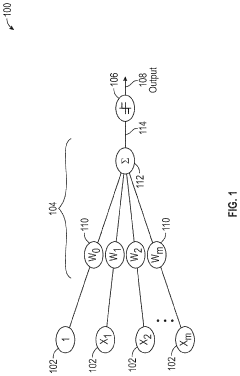
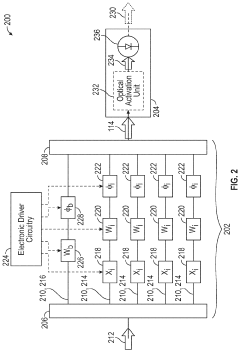
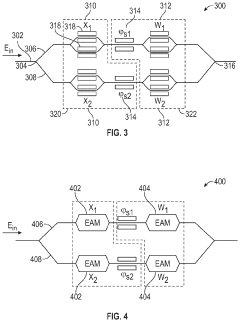
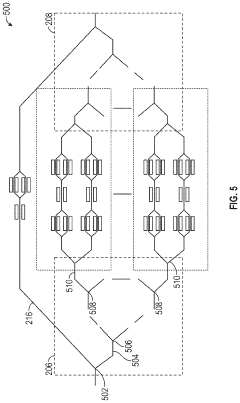
- The development of a single-wavelength, coherent linear neuron stage using a multipath interferometer with electronically controlled phase shifters and amplitude modulators, allowing for encoding of weight signs in the optical phase and enabling all-optical processing of weighted sums, which can be further processed electro-optically for non-linear activation functions.
Energy Efficiency Standards for Large-Scale Computing Systems
The scaling of neuromorphic photonic computing systems for big data analytics necessitates the establishment of comprehensive energy efficiency standards that address the unique characteristics of photonic neural networks. Unlike traditional electronic computing architectures, neuromorphic photonic systems operate through optical signal processing, requiring specialized metrics that account for both optical power consumption and electronic control overhead.
Current energy efficiency standards for large-scale computing systems primarily focus on electronic processors and memory hierarchies, measured through metrics such as Performance per Watt (GFLOPS/W) and Power Usage Effectiveness (PUE). However, these conventional standards inadequately capture the energy dynamics of photonic computing, where laser power, optical modulation efficiency, and photodetection contribute significantly to overall system consumption.
For neuromorphic photonic computing platforms, energy efficiency standards must incorporate optical-specific parameters including wall-plug efficiency of laser sources, insertion losses in photonic integrated circuits, and the energy cost of optical-to-electrical conversions. The standards should define minimum thresholds for operations per joule in spike-based neural processing, considering the temporal nature of neuromorphic computation where energy consumption varies dynamically with neural activity patterns.
Standardization bodies are beginning to recognize the need for hybrid energy metrics that encompass both photonic and electronic components. Proposed frameworks suggest measuring energy efficiency in terms of synaptic operations per watt, accounting for the massively parallel nature of photonic neural networks where thousands of multiply-accumulate operations can occur simultaneously through wavelength division multiplexing.
The development of these standards requires collaboration between photonic device manufacturers, system integrators, and data center operators to establish realistic benchmarks that promote innovation while ensuring practical deployment viability. These standards will ultimately enable fair comparison between different neuromorphic photonic architectures and guide the development of energy-optimal designs for big data analytics applications.
Current energy efficiency standards for large-scale computing systems primarily focus on electronic processors and memory hierarchies, measured through metrics such as Performance per Watt (GFLOPS/W) and Power Usage Effectiveness (PUE). However, these conventional standards inadequately capture the energy dynamics of photonic computing, where laser power, optical modulation efficiency, and photodetection contribute significantly to overall system consumption.
For neuromorphic photonic computing platforms, energy efficiency standards must incorporate optical-specific parameters including wall-plug efficiency of laser sources, insertion losses in photonic integrated circuits, and the energy cost of optical-to-electrical conversions. The standards should define minimum thresholds for operations per joule in spike-based neural processing, considering the temporal nature of neuromorphic computation where energy consumption varies dynamically with neural activity patterns.
Standardization bodies are beginning to recognize the need for hybrid energy metrics that encompass both photonic and electronic components. Proposed frameworks suggest measuring energy efficiency in terms of synaptic operations per watt, accounting for the massively parallel nature of photonic neural networks where thousands of multiply-accumulate operations can occur simultaneously through wavelength division multiplexing.
The development of these standards requires collaboration between photonic device manufacturers, system integrators, and data center operators to establish realistic benchmarks that promote innovation while ensuring practical deployment viability. These standards will ultimately enable fair comparison between different neuromorphic photonic architectures and guide the development of energy-optimal designs for big data analytics applications.
Hardware-Software Co-design for Photonic Neural Architectures
The successful scaling of neuromorphic photonic computing for big data analytics fundamentally depends on achieving seamless integration between hardware architectures and software frameworks. This co-design approach requires developing specialized programming models that can effectively map neural network computations onto photonic substrates while maximizing the inherent advantages of optical processing, such as high bandwidth and parallel processing capabilities.
Contemporary photonic neural architectures demand sophisticated software stacks that can abstract the complexity of optical components while providing intuitive interfaces for algorithm development. The software layer must handle critical functions including wavelength division multiplexing management, optical signal routing optimization, and real-time calibration of photonic elements. These software frameworks need to incorporate domain-specific languages that can express neural computations in terms of optical operations, enabling efficient compilation and execution on photonic hardware.
Hardware design considerations for scalable photonic neural networks center on modular architectures that support dynamic reconfiguration and fault tolerance. Silicon photonic platforms offer promising solutions through integrated optical circuits that can implement multiple neural network layers on a single chip. The hardware must incorporate adaptive elements such as micro-ring resonators and Mach-Zehnder interferometers that can be electronically controlled to modify network topology and weights in real-time.
The co-design methodology requires establishing standardized interfaces between optical processing units and electronic control systems. This includes developing hybrid architectures where electronic processors handle non-linear activation functions and memory operations while photonic circuits perform matrix multiplications and convolutions. The interface design must minimize conversion overhead between optical and electrical domains while maintaining computational precision.
Optimization strategies for hardware-software co-design focus on workload partitioning algorithms that can intelligently distribute computational tasks between photonic and electronic components based on their respective strengths. Machine learning compilers specifically designed for photonic architectures can analyze neural network topologies and automatically generate optimized mappings that consider factors such as optical path lengths, crosstalk minimization, and power consumption. These tools enable rapid prototyping and deployment of neural networks on photonic platforms while ensuring scalability for big data applications.
Contemporary photonic neural architectures demand sophisticated software stacks that can abstract the complexity of optical components while providing intuitive interfaces for algorithm development. The software layer must handle critical functions including wavelength division multiplexing management, optical signal routing optimization, and real-time calibration of photonic elements. These software frameworks need to incorporate domain-specific languages that can express neural computations in terms of optical operations, enabling efficient compilation and execution on photonic hardware.
Hardware design considerations for scalable photonic neural networks center on modular architectures that support dynamic reconfiguration and fault tolerance. Silicon photonic platforms offer promising solutions through integrated optical circuits that can implement multiple neural network layers on a single chip. The hardware must incorporate adaptive elements such as micro-ring resonators and Mach-Zehnder interferometers that can be electronically controlled to modify network topology and weights in real-time.
The co-design methodology requires establishing standardized interfaces between optical processing units and electronic control systems. This includes developing hybrid architectures where electronic processors handle non-linear activation functions and memory operations while photonic circuits perform matrix multiplications and convolutions. The interface design must minimize conversion overhead between optical and electrical domains while maintaining computational precision.
Optimization strategies for hardware-software co-design focus on workload partitioning algorithms that can intelligently distribute computational tasks between photonic and electronic components based on their respective strengths. Machine learning compilers specifically designed for photonic architectures can analyze neural network topologies and automatically generate optimized mappings that consider factors such as optical path lengths, crosstalk minimization, and power consumption. These tools enable rapid prototyping and deployment of neural networks on photonic platforms while ensuring scalability for big data applications.
Unlock deeper insights with PatSnap Eureka Quick Research — get a full tech report to explore trends and direct your research. Try now!
Generate Your Research Report Instantly with AI Agent
Supercharge your innovation with PatSnap Eureka AI Agent Platform!