Improving Oscillator Startup Time with Advanced Circuitry
MAR 13, 20269 MIN READ
Generate Your Research Report Instantly with AI Agent
Patsnap Eureka helps you evaluate technical feasibility & market potential.
Oscillator Technology Background and Startup Time Goals
Oscillator technology has evolved significantly since the early 20th century, beginning with vacuum tube-based circuits and progressing through discrete transistor implementations to modern integrated circuit solutions. The fundamental principle remains consistent: creating sustained periodic waveforms through positive feedback mechanisms. However, the demands for faster startup times have intensified dramatically with the proliferation of battery-powered devices, real-time systems, and high-frequency communication applications.
Traditional oscillator designs, including LC oscillators, crystal oscillators, and RC oscillators, typically exhibit startup times ranging from microseconds to milliseconds depending on their configuration and operating frequency. Crystal oscillators, while offering superior frequency stability, often suffer from prolonged startup periods due to the mechanical resonance characteristics of quartz crystals. This limitation becomes particularly problematic in applications requiring rapid system initialization or frequent power cycling.
The semiconductor industry's transition toward lower supply voltages and reduced power consumption has introduced additional complexity to oscillator startup behavior. Modern CMOS processes, operating at voltages below 1.8V, present challenges in achieving sufficient loop gain during initial startup phases. The reduced voltage headroom limits the available drive strength, potentially extending the time required for oscillation amplitude to reach stable operating levels.
Contemporary applications demand increasingly stringent startup time requirements. Mobile communication systems require oscillators to achieve stable operation within tens of microseconds to support rapid channel switching and power management protocols. Similarly, automotive electronics and industrial control systems necessitate reliable oscillator startup under varying temperature and supply voltage conditions, often within sub-millisecond timeframes.
The primary technical objectives for improving oscillator startup time center on minimizing the initial transient period while maintaining long-term frequency accuracy and phase noise performance. Advanced circuitry approaches target three critical aspects: enhancing initial loop gain through adaptive biasing techniques, implementing intelligent startup assistance circuits that provide temporary amplitude boosting, and optimizing feedback network characteristics to accelerate the transition from noise-driven initiation to stable oscillation.
Emerging design methodologies focus on dynamic bias adjustment during startup phases, utilizing auxiliary circuits that monitor oscillation amplitude and automatically adjust operating points to optimize startup behavior. These techniques aim to achieve startup times below 10 microseconds for integrated oscillators while preserving the fundamental performance characteristics required for precision timing applications.
Traditional oscillator designs, including LC oscillators, crystal oscillators, and RC oscillators, typically exhibit startup times ranging from microseconds to milliseconds depending on their configuration and operating frequency. Crystal oscillators, while offering superior frequency stability, often suffer from prolonged startup periods due to the mechanical resonance characteristics of quartz crystals. This limitation becomes particularly problematic in applications requiring rapid system initialization or frequent power cycling.
The semiconductor industry's transition toward lower supply voltages and reduced power consumption has introduced additional complexity to oscillator startup behavior. Modern CMOS processes, operating at voltages below 1.8V, present challenges in achieving sufficient loop gain during initial startup phases. The reduced voltage headroom limits the available drive strength, potentially extending the time required for oscillation amplitude to reach stable operating levels.
Contemporary applications demand increasingly stringent startup time requirements. Mobile communication systems require oscillators to achieve stable operation within tens of microseconds to support rapid channel switching and power management protocols. Similarly, automotive electronics and industrial control systems necessitate reliable oscillator startup under varying temperature and supply voltage conditions, often within sub-millisecond timeframes.
The primary technical objectives for improving oscillator startup time center on minimizing the initial transient period while maintaining long-term frequency accuracy and phase noise performance. Advanced circuitry approaches target three critical aspects: enhancing initial loop gain through adaptive biasing techniques, implementing intelligent startup assistance circuits that provide temporary amplitude boosting, and optimizing feedback network characteristics to accelerate the transition from noise-driven initiation to stable oscillation.
Emerging design methodologies focus on dynamic bias adjustment during startup phases, utilizing auxiliary circuits that monitor oscillation amplitude and automatically adjust operating points to optimize startup behavior. These techniques aim to achieve startup times below 10 microseconds for integrated oscillators while preserving the fundamental performance characteristics required for precision timing applications.
Market Demand for Fast-Starting Oscillator Solutions
The telecommunications industry represents the largest market segment driving demand for fast-starting oscillator solutions. Modern 5G base stations and network infrastructure require oscillators that can achieve stable frequency output within microseconds to minimize network latency and improve signal quality. The proliferation of small cell deployments and massive MIMO antenna systems has intensified requirements for rapid frequency stabilization, as these systems frequently switch between different operational modes.
Consumer electronics markets demonstrate substantial growth potential for advanced oscillator technologies. Smartphones, tablets, and wearable devices increasingly demand instant-on capabilities to enhance user experience. The trend toward always-connected devices and real-time applications creates pressure for oscillators that can transition from sleep modes to full operation with minimal delay. Gaming devices and augmented reality systems particularly benefit from reduced startup latency to maintain seamless interactive experiences.
Automotive applications present emerging opportunities as vehicles become more electronically sophisticated. Advanced driver assistance systems, autonomous driving technologies, and vehicle-to-everything communication protocols require oscillators with rapid startup characteristics to ensure safety-critical systems respond immediately upon activation. The automotive industry's shift toward electric vehicles introduces additional timing requirements for battery management systems and power conversion circuits.
Industrial automation and Internet of Things deployments create substantial demand for energy-efficient oscillators with fast startup capabilities. Manufacturing equipment, sensor networks, and edge computing devices often operate in duty-cycled modes to conserve power, necessitating oscillators that can quickly resume stable operation. The growing emphasis on predictive maintenance and real-time monitoring systems amplifies requirements for responsive timing solutions.
Data center and cloud computing infrastructure represents a significant market driver as operators seek to optimize power consumption while maintaining performance. Server processors and networking equipment benefit from oscillators that can rapidly transition between power states, enabling more aggressive power management strategies without compromising system responsiveness. The expansion of edge computing facilities further increases demand for compact, fast-starting oscillator solutions.
Medical device applications increasingly require precise timing with rapid startup characteristics for portable diagnostic equipment, implantable devices, and emergency response systems. Regulatory requirements for medical electronics emphasize reliability and consistent performance, creating opportunities for advanced oscillator technologies that combine fast startup with long-term stability.
Consumer electronics markets demonstrate substantial growth potential for advanced oscillator technologies. Smartphones, tablets, and wearable devices increasingly demand instant-on capabilities to enhance user experience. The trend toward always-connected devices and real-time applications creates pressure for oscillators that can transition from sleep modes to full operation with minimal delay. Gaming devices and augmented reality systems particularly benefit from reduced startup latency to maintain seamless interactive experiences.
Automotive applications present emerging opportunities as vehicles become more electronically sophisticated. Advanced driver assistance systems, autonomous driving technologies, and vehicle-to-everything communication protocols require oscillators with rapid startup characteristics to ensure safety-critical systems respond immediately upon activation. The automotive industry's shift toward electric vehicles introduces additional timing requirements for battery management systems and power conversion circuits.
Industrial automation and Internet of Things deployments create substantial demand for energy-efficient oscillators with fast startup capabilities. Manufacturing equipment, sensor networks, and edge computing devices often operate in duty-cycled modes to conserve power, necessitating oscillators that can quickly resume stable operation. The growing emphasis on predictive maintenance and real-time monitoring systems amplifies requirements for responsive timing solutions.
Data center and cloud computing infrastructure represents a significant market driver as operators seek to optimize power consumption while maintaining performance. Server processors and networking equipment benefit from oscillators that can rapidly transition between power states, enabling more aggressive power management strategies without compromising system responsiveness. The expansion of edge computing facilities further increases demand for compact, fast-starting oscillator solutions.
Medical device applications increasingly require precise timing with rapid startup characteristics for portable diagnostic equipment, implantable devices, and emergency response systems. Regulatory requirements for medical electronics emphasize reliability and consistent performance, creating opportunities for advanced oscillator technologies that combine fast startup with long-term stability.
Current Oscillator Startup Challenges and Limitations
Oscillator startup time remains a critical bottleneck in modern electronic systems, particularly as applications demand faster boot sequences and reduced power consumption. Traditional oscillator designs face fundamental limitations in achieving rapid stabilization while maintaining frequency accuracy and phase noise performance. The inherent trade-offs between startup speed, power efficiency, and signal quality create significant engineering challenges across various applications.
Crystal oscillators, widely used for their frequency stability, suffer from prolonged startup periods due to the mechanical resonance characteristics of quartz crystals. The quality factor that provides excellent frequency stability simultaneously increases the time required to reach steady-state oscillation. Typical crystal oscillators require several milliseconds to tens of milliseconds for complete stabilization, which becomes problematic in battery-powered devices and real-time systems requiring immediate operation.
Ring oscillators and LC oscillators, while offering faster startup capabilities, present their own limitations. Ring oscillators exhibit poor phase noise performance and significant process, voltage, and temperature variations that compromise frequency accuracy. LC oscillators face challenges related to inductor quality factors and parasitic effects that limit both startup speed and long-term stability. The startup transient behavior often includes frequency overshoot and amplitude settling issues.
Power consumption during startup represents another critical challenge. Conventional startup circuits often employ high bias currents to accelerate oscillation buildup, resulting in substantial power spikes that can stress power management systems. This approach conflicts with the growing demand for energy-efficient designs, particularly in Internet of Things devices and portable electronics where power budgets are severely constrained.
Temperature sensitivity further complicates oscillator startup behavior. Extreme temperature conditions can significantly extend startup times, with some oscillators failing to start reliably at temperature extremes. The temperature coefficient of frequency during startup often differs from steady-state behavior, creating additional complexity in system timing design.
Process variations in semiconductor manufacturing introduce unpredictable startup characteristics across different device lots. These variations affect bias conditions, parasitic capacitances, and transistor parameters that directly influence oscillation initiation and stabilization time. Current compensation techniques often prove inadequate for addressing the full range of process-induced variations.
Electromagnetic interference and supply voltage fluctuations can disrupt the delicate startup process, particularly in noisy industrial environments. Traditional oscillator designs lack robust startup mechanisms that can operate reliably under adverse conditions while maintaining consistent performance metrics.
Crystal oscillators, widely used for their frequency stability, suffer from prolonged startup periods due to the mechanical resonance characteristics of quartz crystals. The quality factor that provides excellent frequency stability simultaneously increases the time required to reach steady-state oscillation. Typical crystal oscillators require several milliseconds to tens of milliseconds for complete stabilization, which becomes problematic in battery-powered devices and real-time systems requiring immediate operation.
Ring oscillators and LC oscillators, while offering faster startup capabilities, present their own limitations. Ring oscillators exhibit poor phase noise performance and significant process, voltage, and temperature variations that compromise frequency accuracy. LC oscillators face challenges related to inductor quality factors and parasitic effects that limit both startup speed and long-term stability. The startup transient behavior often includes frequency overshoot and amplitude settling issues.
Power consumption during startup represents another critical challenge. Conventional startup circuits often employ high bias currents to accelerate oscillation buildup, resulting in substantial power spikes that can stress power management systems. This approach conflicts with the growing demand for energy-efficient designs, particularly in Internet of Things devices and portable electronics where power budgets are severely constrained.
Temperature sensitivity further complicates oscillator startup behavior. Extreme temperature conditions can significantly extend startup times, with some oscillators failing to start reliably at temperature extremes. The temperature coefficient of frequency during startup often differs from steady-state behavior, creating additional complexity in system timing design.
Process variations in semiconductor manufacturing introduce unpredictable startup characteristics across different device lots. These variations affect bias conditions, parasitic capacitances, and transistor parameters that directly influence oscillation initiation and stabilization time. Current compensation techniques often prove inadequate for addressing the full range of process-induced variations.
Electromagnetic interference and supply voltage fluctuations can disrupt the delicate startup process, particularly in noisy industrial environments. Traditional oscillator designs lack robust startup mechanisms that can operate reliably under adverse conditions while maintaining consistent performance metrics.
Existing Fast Startup Oscillator Circuit Solutions
01 Oscillator startup time reduction through bias current control
Techniques for reducing oscillator startup time by controlling and optimizing bias current in the oscillator circuit. This approach involves adjusting the initial bias conditions to enable faster oscillation buildup while maintaining stable operation once started. The bias current can be dynamically adjusted during startup and steady-state operation to achieve optimal performance.- Oscillator startup time reduction through bias current control: Techniques for reducing oscillator startup time by controlling and optimizing bias current in the oscillator circuit. This approach involves adjusting the initial bias conditions to enable faster oscillation buildup while maintaining stable operation once started. The bias current can be dynamically controlled during startup phase and then adjusted to normal operating levels.
- Fast startup oscillator circuits with amplitude detection: Oscillator designs incorporating amplitude detection mechanisms to monitor and accelerate the startup process. These circuits detect when oscillation amplitude reaches a predetermined threshold and can adjust operating parameters accordingly. The detection circuitry enables transition from startup mode to normal operation mode, optimizing both startup time and steady-state performance.
- Crystal oscillator startup time optimization: Methods specifically designed for crystal oscillators to minimize startup latency. These techniques address the inherent characteristics of crystal resonators and may include negative resistance enhancement, quality factor considerations, and drive level optimization during initial oscillation buildup. The approaches balance fast startup requirements with long-term frequency stability and reliability.
- Startup time control through switchable circuit configurations: Oscillator architectures employing switchable circuit elements or configurations to achieve rapid startup. These designs utilize different circuit topologies or component values during startup versus normal operation. Switching mechanisms allow for aggressive startup behavior followed by transition to optimized steady-state operation, effectively decoupling startup performance from running performance requirements.
- Power management and startup sequencing for oscillators: Integrated power management techniques and startup sequencing methods to minimize oscillator initialization time. These approaches coordinate power supply ramping, enable signal timing, and circuit biasing to achieve optimal startup conditions. The methods may include pre-charging techniques, staged power-up sequences, and intelligent control of oscillator enable signals to reduce overall system startup latency.
02 Fast startup oscillator circuits with amplitude detection
Oscillator designs incorporating amplitude detection mechanisms to monitor and control the startup process. These circuits detect when the oscillation amplitude reaches a predetermined threshold and adjust operating parameters accordingly. This enables rapid transition from startup mode to normal operation while ensuring reliable oscillation establishment.Expand Specific Solutions03 Crystal oscillator startup time optimization
Methods specifically designed for crystal oscillators to minimize startup time while maintaining frequency accuracy and stability. These techniques address the inherent characteristics of crystal resonators and may involve initial overdrive conditions, adaptive gain control, or parallel startup circuits that are disabled after oscillation is established.Expand Specific Solutions04 Startup time reduction using switched capacitor or resistor networks
Implementations utilizing switchable capacitor banks or resistor networks to modify oscillator characteristics during startup. By temporarily altering the circuit parameters during the initial phase, faster oscillation buildup can be achieved. Once stable oscillation is detected, the circuit switches to normal operating configuration for optimal steady-state performance.Expand Specific Solutions05 Power management and clock generation with fast startup oscillators
System-level approaches integrating fast startup oscillators for power management applications and clock generation in low-power devices. These solutions address the need for quick wake-up times in power-saving modes while minimizing overall power consumption. The implementations often include multiple oscillators with different startup characteristics optimized for various operational scenarios.Expand Specific Solutions
Key Players in Advanced Oscillator Circuit Industry
The oscillator startup time improvement technology represents a mature yet rapidly evolving market segment within the broader semiconductor timing solutions industry. The market demonstrates significant scale with established players like Texas Instruments, NXP, STMicroelectronics, and Renesas Electronics leading through comprehensive portfolios spanning automotive, industrial, and consumer applications. Technology maturity varies considerably across the competitive landscape - while traditional silicon-based solutions from companies like Cypress Semiconductor and MediaTek offer proven reliability, emerging players like Piezo Studio are pioneering advanced piezoelectric materials with CTGS crystal oscillators achieving ultra-fast startup times and 90% lower power consumption. The industry shows strong growth momentum driven by IoT device proliferation and 5G infrastructure demands, with companies like Synopsys providing critical EDA tools enabling next-generation circuit optimization, while specialized firms focus on breakthrough materials and circuit architectures to address the fundamental trade-offs between startup speed, power consumption, and frequency stability.
ROHM Co., Ltd.
Technical Solution: ROHM specializes in ultra-fast oscillator startup circuits featuring their unique SiCrystal technology that combines silicon and crystal resonator optimization. Their solutions employ high-speed operational amplifiers with programmable gain control and implement advanced feedback compensation networks to accelerate oscillation buildup. The company utilizes proprietary low-noise bias generation circuits and incorporates temperature-independent startup mechanisms. ROHM's oscillator designs feature integrated startup detection circuits with automatic mode switching capabilities, transitioning from high-power startup mode to efficient steady-state operation. Their circuits achieve consistent startup performance with times typically under 1.8ms while maintaining excellent frequency accuracy and low phase noise characteristics suitable for precision timing applications.
Strengths: Excellent component integration capabilities, superior noise performance, strong automotive market focus. Weaknesses: Limited product portfolio breadth, higher cost for high-performance variants.
Renesas Electronics Corp.
Technical Solution: Renesas implements innovative oscillator startup acceleration through their proprietary fast-start circuit architecture that combines high-speed comparators with adaptive threshold control. Their technology employs multi-phase startup sequences with intelligent power management, reducing typical startup delays by up to 70%. The company utilizes advanced CMOS process optimizations and incorporates temperature-compensated bias generators to ensure consistent startup performance. Renesas' oscillator circuits feature integrated startup monitoring systems that provide real-time feedback for system optimization. Their solutions support wide frequency ranges from 32kHz to 50MHz with startup times ranging from 0.8ms to 3ms depending on frequency and load conditions.
Strengths: Strong microcontroller integration capabilities, excellent power efficiency, comprehensive frequency range support. Weaknesses: Limited standalone oscillator offerings, dependency on specific process technologies.
Core Innovations in Startup Time Reduction Circuitry
Reducing Duration of Start-up Period for a Crystal Oscillator Circuit
PatentActiveUS20180198411A1
Innovation
- A crystal oscillator circuit with a differential pair of transistors configured in a cross-coupled mode, combined with a kick-start circuit that injects pulses during the start-up period to reduce start-up time and minimize parasitic oscillations, utilizing a complementary differential pair for current reuse and a dedicated oscillator for accurate frequency generation.


Fast start-up crystal oscillator
PatentActiveUS8120439B2
Innovation
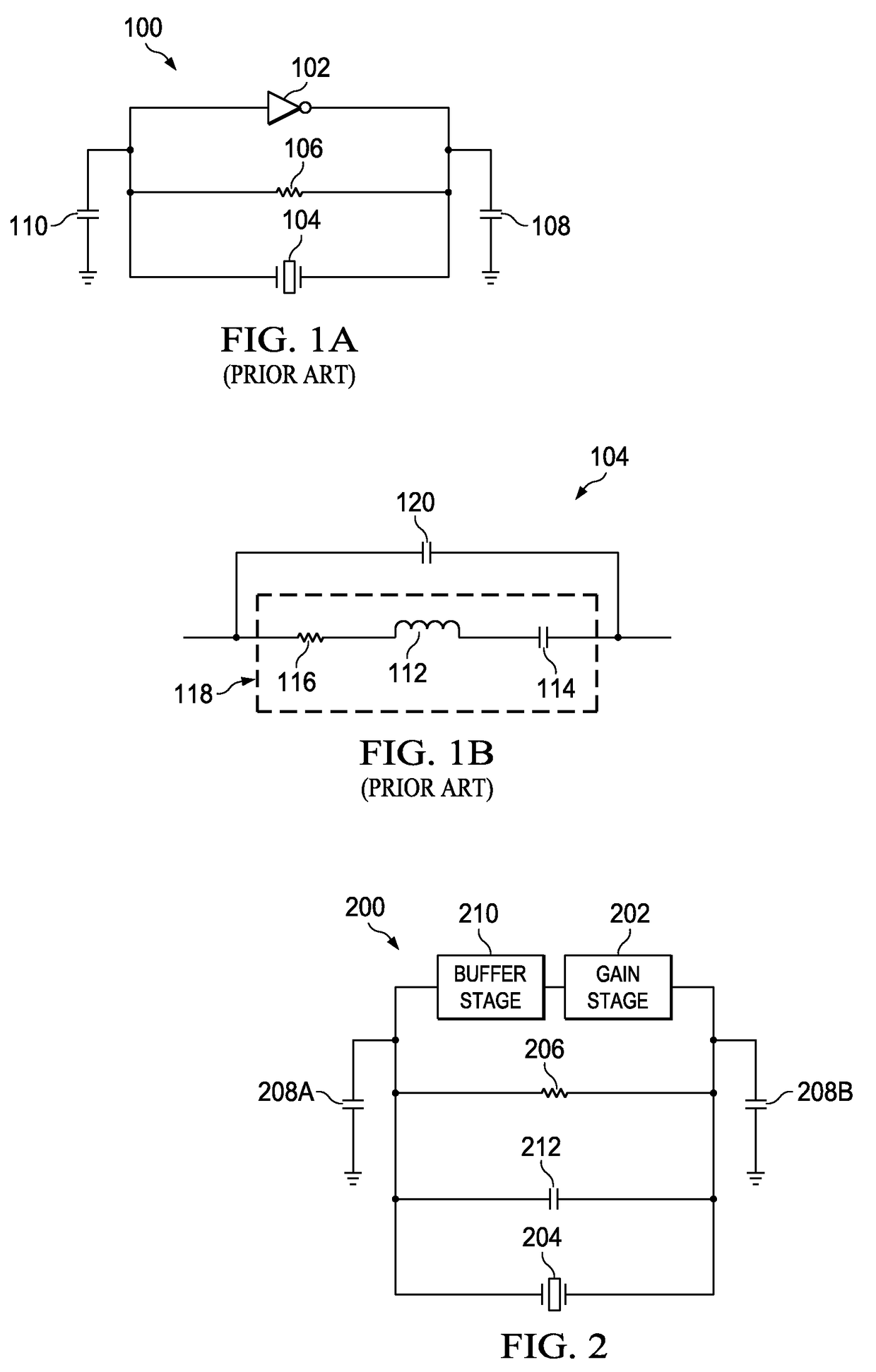
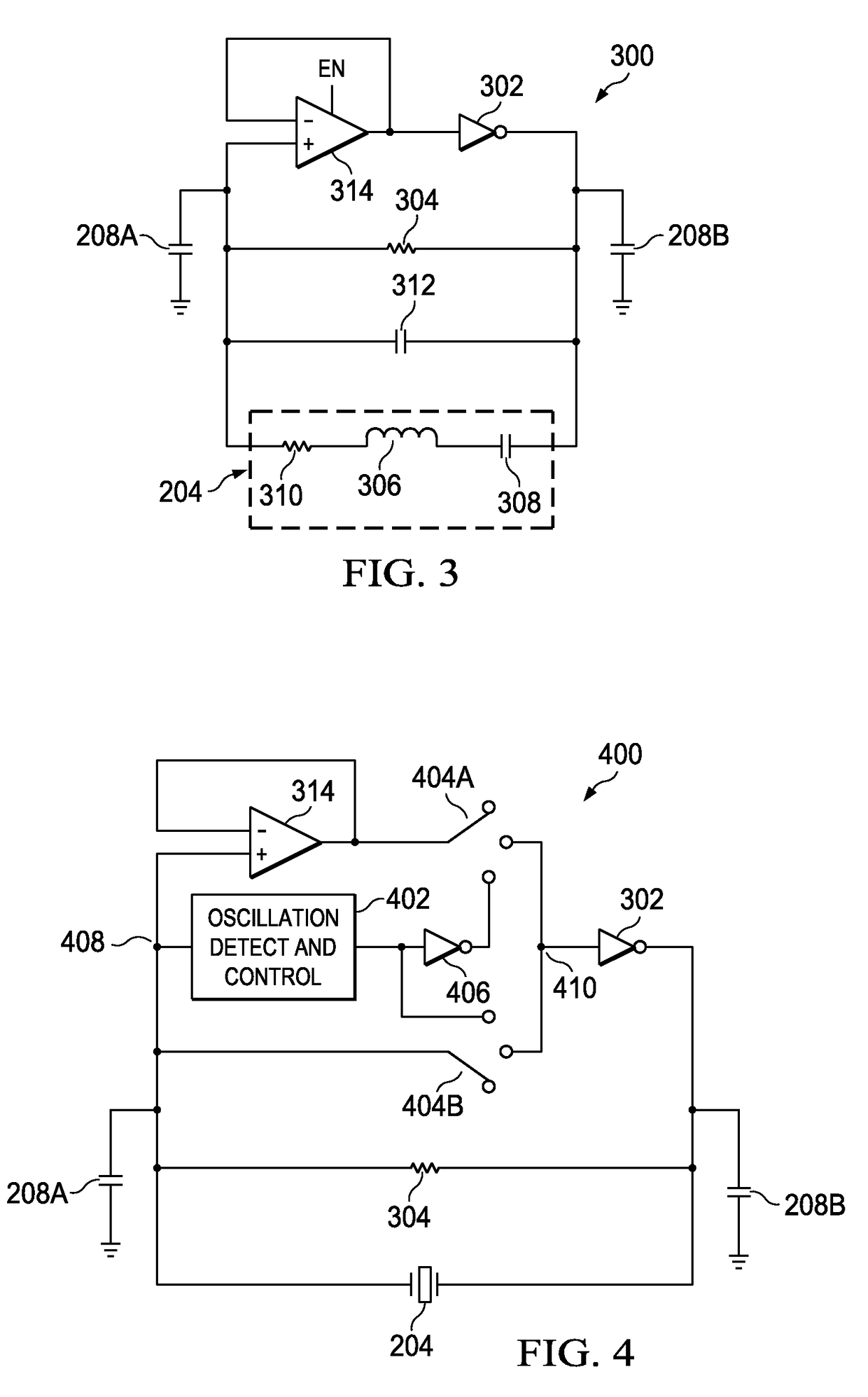
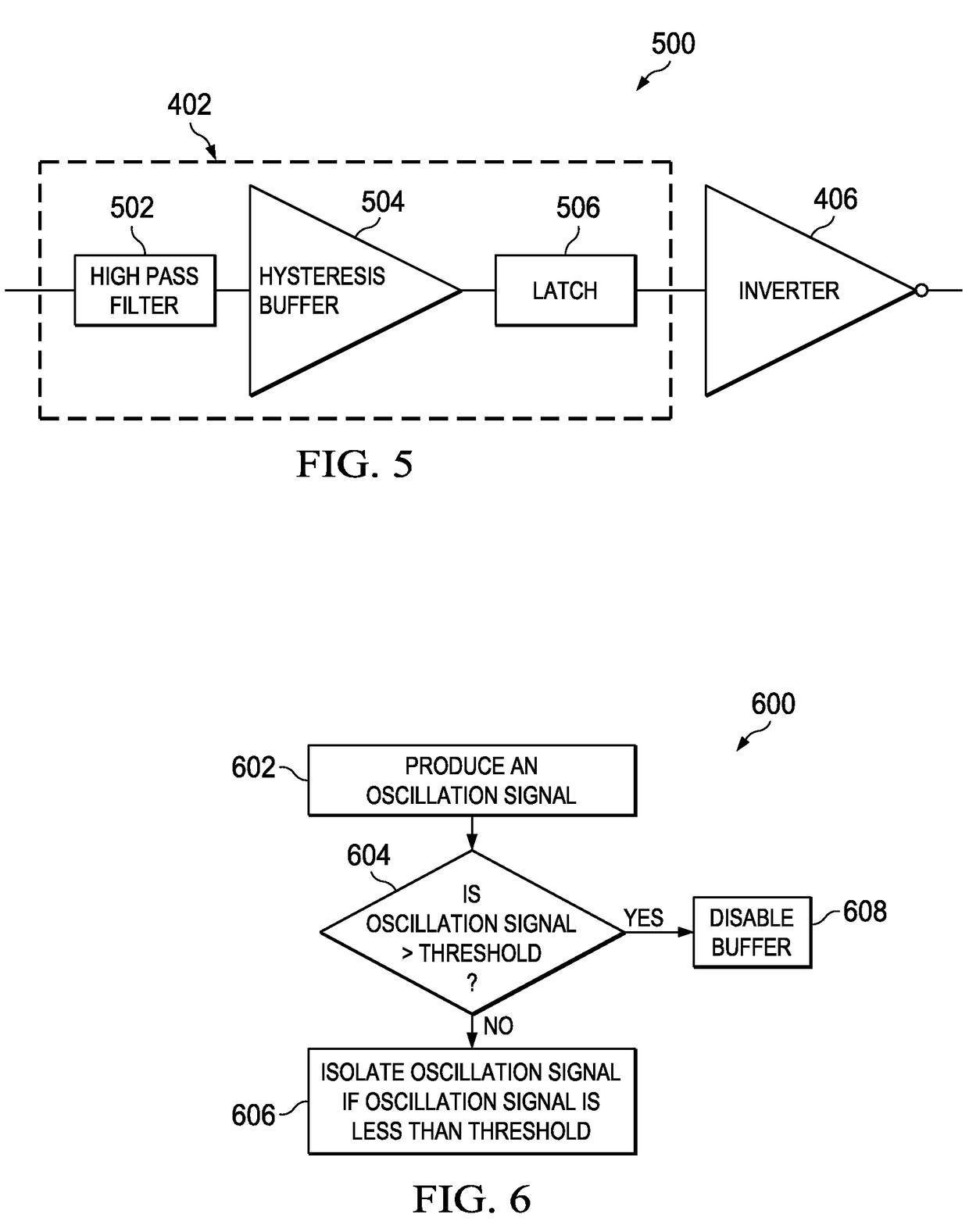
- Incorporating a gain stage with negative resistance and a buffer to isolate the shunt capacitance, increasing the negative resistance and reducing the start-up time by boosting the rate of oscillation signal growth.

Power Consumption Trade-offs in Startup Optimization
The optimization of oscillator startup time through advanced circuitry presents a fundamental trade-off between performance enhancement and power consumption. Traditional startup acceleration techniques often require additional current paths, boosted bias conditions, or auxiliary circuits that inherently increase power draw during the critical startup phase. This relationship creates a complex optimization challenge where engineers must balance the competing demands of rapid frequency stabilization and energy efficiency.
Advanced startup circuits typically employ current boosting mechanisms that temporarily increase bias currents to accelerate oscillation buildup. These techniques can reduce startup time by 50-80% compared to conventional designs, but at the cost of 2-5x higher instantaneous power consumption during the startup period. The power penalty becomes particularly significant in battery-powered applications where frequent wake-up cycles occur, as the cumulative energy overhead can substantially impact overall system efficiency.
Modern circuit topologies attempt to mitigate these trade-offs through intelligent power management strategies. Adaptive bias control circuits dynamically adjust current levels based on oscillation amplitude detection, providing high startup currents initially and then rapidly scaling back to nominal operating conditions. This approach can reduce the average startup power penalty by 40-60% while maintaining accelerated startup performance.
Temperature compensation adds another layer of complexity to the power-performance equation. Startup optimization circuits must account for temperature-dependent variations in transistor characteristics and oscillator Q-factor, often requiring additional sensing and compensation circuitry that contributes to baseline power consumption. Advanced implementations utilize temperature-aware startup algorithms that adjust boost levels based on ambient conditions, optimizing the power-time product across operating ranges.
Process variation tolerance represents a critical consideration in startup power optimization. Circuits designed with excessive startup assistance to ensure reliable operation across process corners may consume unnecessary power in typical conditions. Statistical design approaches and post-fabrication trimming techniques enable more precise power-performance optimization, reducing worst-case power consumption while maintaining startup reliability margins.
The emergence of ultra-low-power applications has driven development of novel startup architectures that minimize energy-per-startup rather than instantaneous power. These designs focus on optimizing the total energy integral during the startup transient, leading to fundamentally different circuit topologies that may accept longer startup times in exchange for dramatically reduced energy consumption per startup event.
Advanced startup circuits typically employ current boosting mechanisms that temporarily increase bias currents to accelerate oscillation buildup. These techniques can reduce startup time by 50-80% compared to conventional designs, but at the cost of 2-5x higher instantaneous power consumption during the startup period. The power penalty becomes particularly significant in battery-powered applications where frequent wake-up cycles occur, as the cumulative energy overhead can substantially impact overall system efficiency.
Modern circuit topologies attempt to mitigate these trade-offs through intelligent power management strategies. Adaptive bias control circuits dynamically adjust current levels based on oscillation amplitude detection, providing high startup currents initially and then rapidly scaling back to nominal operating conditions. This approach can reduce the average startup power penalty by 40-60% while maintaining accelerated startup performance.
Temperature compensation adds another layer of complexity to the power-performance equation. Startup optimization circuits must account for temperature-dependent variations in transistor characteristics and oscillator Q-factor, often requiring additional sensing and compensation circuitry that contributes to baseline power consumption. Advanced implementations utilize temperature-aware startup algorithms that adjust boost levels based on ambient conditions, optimizing the power-time product across operating ranges.
Process variation tolerance represents a critical consideration in startup power optimization. Circuits designed with excessive startup assistance to ensure reliable operation across process corners may consume unnecessary power in typical conditions. Statistical design approaches and post-fabrication trimming techniques enable more precise power-performance optimization, reducing worst-case power consumption while maintaining startup reliability margins.
The emergence of ultra-low-power applications has driven development of novel startup architectures that minimize energy-per-startup rather than instantaneous power. These designs focus on optimizing the total energy integral during the startup transient, leading to fundamentally different circuit topologies that may accept longer startup times in exchange for dramatically reduced energy consumption per startup event.
Reliability Standards for Critical Timing Applications
Critical timing applications in modern electronic systems demand stringent reliability standards to ensure consistent performance across diverse operating conditions. These standards encompass multiple dimensions including temperature stability, power supply variations, electromagnetic interference resistance, and long-term aging characteristics. For oscillator circuits with improved startup performance, reliability requirements become particularly challenging as advanced circuitry must maintain precision while achieving rapid initialization.
Temperature coefficient specifications typically require oscillator frequency stability within ±20 to ±100 parts per million across industrial temperature ranges of -40°C to +85°C. Advanced startup circuitry introduces additional thermal considerations, as bias current generators and startup detection circuits must maintain consistent behavior across temperature extremes. The reliability framework mandates comprehensive thermal cycling tests spanning 1000 to 5000 cycles to validate startup time consistency and frequency accuracy retention.
Power supply rejection ratio standards for critical timing applications typically specify -40dB to -60dB across relevant frequency ranges. Enhanced startup circuits often incorporate multiple voltage domains and current mirrors, creating potential vulnerabilities to supply noise. Reliability protocols require extensive power supply stress testing, including brownout conditions, supply ramp rates, and ripple injection scenarios to ensure startup reliability under adverse power conditions.
Electromagnetic compatibility standards such as IEC 61000 series impose strict requirements on both emissions and immunity characteristics. Advanced oscillator startup circuitry, particularly circuits employing high-gain amplification stages during initialization, must demonstrate compliance with radiated and conducted emission limits while maintaining immunity to external interference. Special attention focuses on startup behavior during electromagnetic stress conditions, as transient coupling can disrupt initialization sequences.
Long-term reliability assessment involves accelerated aging tests following industry standards like JEDEC JESD22 series. These protocols evaluate parameter drift over extended operational periods, with particular emphasis on startup time degradation due to threshold voltage shifts, interconnect resistance changes, and oxide degradation. Critical applications often require failure rates below 10 failures per billion hours, necessitating extensive statistical validation of startup performance consistency across device populations and operational lifetimes.
Temperature coefficient specifications typically require oscillator frequency stability within ±20 to ±100 parts per million across industrial temperature ranges of -40°C to +85°C. Advanced startup circuitry introduces additional thermal considerations, as bias current generators and startup detection circuits must maintain consistent behavior across temperature extremes. The reliability framework mandates comprehensive thermal cycling tests spanning 1000 to 5000 cycles to validate startup time consistency and frequency accuracy retention.
Power supply rejection ratio standards for critical timing applications typically specify -40dB to -60dB across relevant frequency ranges. Enhanced startup circuits often incorporate multiple voltage domains and current mirrors, creating potential vulnerabilities to supply noise. Reliability protocols require extensive power supply stress testing, including brownout conditions, supply ramp rates, and ripple injection scenarios to ensure startup reliability under adverse power conditions.
Electromagnetic compatibility standards such as IEC 61000 series impose strict requirements on both emissions and immunity characteristics. Advanced oscillator startup circuitry, particularly circuits employing high-gain amplification stages during initialization, must demonstrate compliance with radiated and conducted emission limits while maintaining immunity to external interference. Special attention focuses on startup behavior during electromagnetic stress conditions, as transient coupling can disrupt initialization sequences.
Long-term reliability assessment involves accelerated aging tests following industry standards like JEDEC JESD22 series. These protocols evaluate parameter drift over extended operational periods, with particular emphasis on startup time degradation due to threshold voltage shifts, interconnect resistance changes, and oxide degradation. Critical applications often require failure rates below 10 failures per billion hours, necessitating extensive statistical validation of startup performance consistency across device populations and operational lifetimes.
Unlock deeper insights with Patsnap Eureka Quick Research — get a full tech report to explore trends and direct your research. Try now!
Generate Your Research Report Instantly with AI Agent
Supercharge your innovation with Patsnap Eureka AI Agent Platform!