Intercooling in Fluid Dynamics: Heat Transfer Improvements
APR 3, 20269 MIN READ
Generate Your Research Report Instantly with AI Agent
Patsnap Eureka helps you evaluate technical feasibility & market potential.
Intercooling Technology Background and Thermal Objectives
Intercooling technology emerged from the fundamental need to manage thermal loads in compressed fluid systems, where temperature rise during compression significantly impacts system efficiency and performance. The concept originated in early steam engine applications during the industrial revolution, where engineers recognized that cooling compressed air or steam between compression stages could dramatically improve overall thermodynamic efficiency. This principle has since evolved into a cornerstone technology across multiple industries, from automotive turbocharging systems to industrial gas compression facilities.
The historical development of intercooling can be traced through several key phases, beginning with simple air-cooled heat exchangers in the late 19th century. Early implementations focused primarily on reducing discharge temperatures to prevent equipment damage, but subsequent research revealed the profound impact on volumetric efficiency and power consumption. The aviation industry's demands during the mid-20th century accelerated intercooling innovations, particularly in supercharged aircraft engines where altitude performance was critical.
Modern intercooling applications have expanded far beyond traditional compression systems to encompass advanced thermal management in electronics cooling, renewable energy systems, and high-performance computing environments. The technology now plays a crucial role in electric vehicle battery thermal management, data center cooling architectures, and industrial process optimization where precise temperature control directly correlates with product quality and energy efficiency.
Contemporary thermal objectives in intercooling systems center on achieving maximum heat transfer effectiveness while minimizing pressure losses and system complexity. Primary goals include reducing fluid temperatures to within 10-15°C of ambient conditions, maintaining consistent thermal performance across varying operational loads, and optimizing heat exchanger geometries for specific application requirements. Advanced objectives focus on integrating smart thermal control systems that can dynamically adjust cooling capacity based on real-time thermal loads and environmental conditions.
The evolution toward more sophisticated intercooling solutions reflects growing demands for energy efficiency, environmental sustainability, and system reliability. Current research emphasizes developing compact, lightweight heat exchangers with enhanced surface area-to-volume ratios, implementing phase-change materials for thermal buffering, and exploring novel heat transfer enhancement techniques including micro-channel designs and advanced surface treatments.
The historical development of intercooling can be traced through several key phases, beginning with simple air-cooled heat exchangers in the late 19th century. Early implementations focused primarily on reducing discharge temperatures to prevent equipment damage, but subsequent research revealed the profound impact on volumetric efficiency and power consumption. The aviation industry's demands during the mid-20th century accelerated intercooling innovations, particularly in supercharged aircraft engines where altitude performance was critical.
Modern intercooling applications have expanded far beyond traditional compression systems to encompass advanced thermal management in electronics cooling, renewable energy systems, and high-performance computing environments. The technology now plays a crucial role in electric vehicle battery thermal management, data center cooling architectures, and industrial process optimization where precise temperature control directly correlates with product quality and energy efficiency.
Contemporary thermal objectives in intercooling systems center on achieving maximum heat transfer effectiveness while minimizing pressure losses and system complexity. Primary goals include reducing fluid temperatures to within 10-15°C of ambient conditions, maintaining consistent thermal performance across varying operational loads, and optimizing heat exchanger geometries for specific application requirements. Advanced objectives focus on integrating smart thermal control systems that can dynamically adjust cooling capacity based on real-time thermal loads and environmental conditions.
The evolution toward more sophisticated intercooling solutions reflects growing demands for energy efficiency, environmental sustainability, and system reliability. Current research emphasizes developing compact, lightweight heat exchangers with enhanced surface area-to-volume ratios, implementing phase-change materials for thermal buffering, and exploring novel heat transfer enhancement techniques including micro-channel designs and advanced surface treatments.
Market Demand for Enhanced Heat Transfer Systems
The global market for enhanced heat transfer systems is experiencing unprecedented growth driven by escalating energy efficiency requirements and stringent environmental regulations across multiple industries. Power generation facilities, particularly gas turbine plants, represent the largest demand segment as operators seek to maximize thermal efficiency while reducing fuel consumption and emissions. The automotive sector follows closely, with turbocharged engines requiring sophisticated intercooling solutions to meet increasingly strict emission standards and performance expectations.
Industrial manufacturing processes constitute another significant demand driver, where enhanced heat transfer systems enable higher production rates and improved product quality. Chemical processing plants, refineries, and petrochemical facilities are investing heavily in advanced heat exchanger technologies to optimize their operations and comply with environmental mandates. The aerospace industry also contributes substantial demand, as modern aircraft engines require lightweight yet highly efficient intercooling systems to achieve optimal fuel economy.
Data centers and electronics cooling applications represent rapidly expanding market segments, fueled by the exponential growth in cloud computing and artificial intelligence workloads. These facilities demand innovative heat transfer solutions capable of managing increasingly dense thermal loads while maintaining energy efficiency. The renewable energy sector, particularly concentrated solar power and geothermal systems, creates additional demand for specialized heat transfer equipment designed for extreme operating conditions.
Regional market dynamics reveal strong growth in Asia-Pacific markets, driven by rapid industrialization and expanding manufacturing capacity. North American and European markets demonstrate steady demand focused on retrofitting existing facilities with more efficient systems to meet updated regulatory requirements. Emerging economies are increasingly prioritizing energy efficiency investments, creating new opportunities for advanced heat transfer technologies.
Market research indicates that end-users are willing to invest in premium heat transfer solutions that demonstrate clear return on investment through reduced energy consumption, lower maintenance costs, and improved system reliability. The trend toward system integration and smart monitoring capabilities is reshaping customer expectations, with buyers seeking comprehensive solutions rather than individual components.
Industrial manufacturing processes constitute another significant demand driver, where enhanced heat transfer systems enable higher production rates and improved product quality. Chemical processing plants, refineries, and petrochemical facilities are investing heavily in advanced heat exchanger technologies to optimize their operations and comply with environmental mandates. The aerospace industry also contributes substantial demand, as modern aircraft engines require lightweight yet highly efficient intercooling systems to achieve optimal fuel economy.
Data centers and electronics cooling applications represent rapidly expanding market segments, fueled by the exponential growth in cloud computing and artificial intelligence workloads. These facilities demand innovative heat transfer solutions capable of managing increasingly dense thermal loads while maintaining energy efficiency. The renewable energy sector, particularly concentrated solar power and geothermal systems, creates additional demand for specialized heat transfer equipment designed for extreme operating conditions.
Regional market dynamics reveal strong growth in Asia-Pacific markets, driven by rapid industrialization and expanding manufacturing capacity. North American and European markets demonstrate steady demand focused on retrofitting existing facilities with more efficient systems to meet updated regulatory requirements. Emerging economies are increasingly prioritizing energy efficiency investments, creating new opportunities for advanced heat transfer technologies.
Market research indicates that end-users are willing to invest in premium heat transfer solutions that demonstrate clear return on investment through reduced energy consumption, lower maintenance costs, and improved system reliability. The trend toward system integration and smart monitoring capabilities is reshaping customer expectations, with buyers seeking comprehensive solutions rather than individual components.
Current State of Intercooling Heat Transfer Technologies
Intercooling heat transfer technologies have evolved significantly over the past decades, with current implementations spanning multiple industrial sectors including automotive turbocharging, gas turbine power generation, and compressed air systems. The fundamental principle remains consistent across applications: removing heat from compressed fluids to improve system efficiency and performance through enhanced density and reduced compression work requirements.
Air-to-air intercoolers represent the most prevalent technology in automotive applications, utilizing finned tube heat exchangers with cross-flow configurations. These systems typically achieve heat transfer coefficients ranging from 50-150 W/m²K on the air side, with effectiveness values between 60-80%. The compact design requirements in automotive applications have driven innovations in fin geometry, including louvered, wavy, and offset strip fins to enhance heat transfer while managing pressure drop penalties.
Liquid-cooled intercooling systems demonstrate superior heat transfer performance, particularly in high-performance and marine applications where packaging constraints are less restrictive. Water-cooled intercoolers can achieve effectiveness values exceeding 85% due to the higher heat transfer coefficients on the coolant side, typically ranging from 2000-8000 W/m²K. These systems incorporate plate-and-frame or shell-and-tube configurations, with recent developments focusing on microchannel designs to maximize surface area density.
Advanced surface enhancement techniques have emerged as critical enablers for improved intercooling performance. Microfin tubes, twisted tape inserts, and surface roughening elements are increasingly deployed to augment convective heat transfer coefficients. Computational fluid dynamics modeling has become instrumental in optimizing these enhancement features, enabling precise control of heat transfer augmentation while minimizing associated pressure losses.
Phase change intercooling represents an emerging frontier, utilizing evaporative cooling principles to achieve superior heat removal rates. These systems employ direct water injection or indirect evaporative cooling through wetted surfaces, achieving temperature reductions that approach the wet-bulb temperature limit. However, implementation challenges include water consumption, potential corrosion issues, and system complexity.
Current research trajectories focus on additive manufacturing capabilities for creating complex internal geometries previously unachievable through conventional manufacturing. Lattice structures, gyroid surfaces, and biomimetic designs are being explored to maximize heat transfer surface area while maintaining structural integrity. Additionally, smart materials and adaptive cooling systems are under development to provide variable heat transfer characteristics based on operating conditions.
The integration of heat recovery systems with intercooling technologies has gained prominence, particularly in industrial applications where waste heat utilization can significantly improve overall system efficiency. Combined cooling and power systems leverage intercooler waste heat for space heating or process applications, demonstrating the evolution toward more holistic thermal management approaches.
Air-to-air intercoolers represent the most prevalent technology in automotive applications, utilizing finned tube heat exchangers with cross-flow configurations. These systems typically achieve heat transfer coefficients ranging from 50-150 W/m²K on the air side, with effectiveness values between 60-80%. The compact design requirements in automotive applications have driven innovations in fin geometry, including louvered, wavy, and offset strip fins to enhance heat transfer while managing pressure drop penalties.
Liquid-cooled intercooling systems demonstrate superior heat transfer performance, particularly in high-performance and marine applications where packaging constraints are less restrictive. Water-cooled intercoolers can achieve effectiveness values exceeding 85% due to the higher heat transfer coefficients on the coolant side, typically ranging from 2000-8000 W/m²K. These systems incorporate plate-and-frame or shell-and-tube configurations, with recent developments focusing on microchannel designs to maximize surface area density.
Advanced surface enhancement techniques have emerged as critical enablers for improved intercooling performance. Microfin tubes, twisted tape inserts, and surface roughening elements are increasingly deployed to augment convective heat transfer coefficients. Computational fluid dynamics modeling has become instrumental in optimizing these enhancement features, enabling precise control of heat transfer augmentation while minimizing associated pressure losses.
Phase change intercooling represents an emerging frontier, utilizing evaporative cooling principles to achieve superior heat removal rates. These systems employ direct water injection or indirect evaporative cooling through wetted surfaces, achieving temperature reductions that approach the wet-bulb temperature limit. However, implementation challenges include water consumption, potential corrosion issues, and system complexity.
Current research trajectories focus on additive manufacturing capabilities for creating complex internal geometries previously unachievable through conventional manufacturing. Lattice structures, gyroid surfaces, and biomimetic designs are being explored to maximize heat transfer surface area while maintaining structural integrity. Additionally, smart materials and adaptive cooling systems are under development to provide variable heat transfer characteristics based on operating conditions.
The integration of heat recovery systems with intercooling technologies has gained prominence, particularly in industrial applications where waste heat utilization can significantly improve overall system efficiency. Combined cooling and power systems leverage intercooler waste heat for space heating or process applications, demonstrating the evolution toward more holistic thermal management approaches.
Existing Heat Transfer Enhancement Solutions
01 Intercooler structure with enhanced heat exchange surfaces
Intercoolers designed with optimized heat exchange surfaces, including finned structures, corrugated plates, or extended surface areas to maximize contact between the cooling medium and compressed air. These structural enhancements improve heat transfer efficiency by increasing the surface area available for thermal exchange, thereby reducing the temperature of compressed gases more effectively.- Intercooler structure with enhanced heat exchange surfaces: Intercoolers designed with optimized heat exchange surfaces, including finned structures, corrugated plates, or extended surface areas to maximize contact between the cooling medium and compressed air. These structural enhancements improve heat transfer efficiency by increasing the surface area available for thermal exchange, thereby reducing the temperature of compressed gases more effectively.
- Multi-stage intercooling systems: Implementation of multi-stage cooling configurations where compressed gas passes through sequential cooling stages. Each stage progressively reduces the temperature, allowing for more efficient overall heat removal. This approach is particularly effective in high-compression applications where single-stage cooling is insufficient to achieve desired temperature reductions.
- Liquid cooling and spray injection methods: Utilization of liquid coolants or direct spray injection into the compressed gas stream to enhance heat transfer. The liquid absorbs heat through evaporation or direct contact, providing rapid temperature reduction. This method is effective for achieving lower outlet temperatures and can be integrated with traditional air-cooled systems for hybrid cooling solutions.
- Flow optimization and turbulence enhancement: Design features that optimize gas flow patterns and induce controlled turbulence within the intercooler to improve convective heat transfer. These include specialized baffle arrangements, flow distributors, and channel geometries that ensure uniform flow distribution and prevent hot spots, thereby maximizing the effectiveness of the cooling process.
- Compact and integrated intercooler designs: Development of space-efficient intercooler configurations that integrate cooling functions within compact housings suitable for applications with limited installation space. These designs often incorporate innovative manifold arrangements, modular construction, and integrated mounting features that facilitate installation while maintaining high heat transfer performance.
02 Multi-stage intercooling systems
Implementation of multi-stage cooling configurations where compressed gas passes through sequential cooling stages. Each stage progressively reduces the temperature, allowing for more efficient overall heat removal. This approach is particularly effective in high-compression applications where single-stage cooling is insufficient to achieve desired temperature reductions.Expand Specific Solutions03 Liquid cooling medium circulation systems
Intercooling systems utilizing liquid coolants that circulate through dedicated channels or passages within the intercooler assembly. The liquid medium absorbs heat from the compressed gas and transfers it to an external heat sink or radiator. This method provides superior heat transfer coefficients compared to air cooling and enables more compact intercooler designs.Expand Specific Solutions04 Air-to-air intercooling with optimized flow paths
Intercooler designs that use ambient air as the cooling medium with specially engineered flow paths to maximize convective heat transfer. These systems incorporate features such as turbulence generators, optimized inlet and outlet configurations, and strategic placement to ensure efficient airflow across heat exchange surfaces, particularly suitable for mobile applications.Expand Specific Solutions05 Integrated intercooler designs with compact configurations
Compact intercooler assemblies integrated directly into compression systems or engine architectures to minimize space requirements while maintaining heat transfer performance. These designs often feature innovative packaging solutions, combined cooling circuits, or dual-function components that serve both structural and thermal management purposes, enabling efficient cooling in space-constrained applications.Expand Specific Solutions
Key Players in Intercooling and Heat Exchanger Industry
The intercooling technology in fluid dynamics for heat transfer improvements represents a mature market segment currently in the growth-to-maturity phase, driven by increasing demands for thermal efficiency across automotive, aerospace, and industrial applications. The global market demonstrates substantial scale, particularly within the automotive thermal management sector valued at several billion dollars annually, with significant expansion expected due to electrification trends and stricter emission regulations. Technology maturity varies considerably among market participants, with established leaders like DENSO Corp., Modine Manufacturing, and MAHLE International demonstrating advanced intercooling solutions and extensive R&D capabilities. Aerospace specialists including Rolls-Royce, RTX Corp., and United Technologies maintain sophisticated intercooling technologies for turbine applications. Meanwhile, companies like Hanon Systems, Parker-Hannifin, and ZF Friedrichshafen contribute specialized thermal management components. The competitive landscape shows consolidation around companies with strong engineering capabilities and manufacturing scale, while emerging players focus on innovative materials and designs for next-generation applications.
DENSO Corp.
Technical Solution: DENSO develops advanced intercooler systems utilizing multi-pass heat exchanger designs with enhanced fin geometries and optimized air flow channels. Their technology incorporates aluminum brazed construction with micro-channel heat exchangers that achieve superior heat transfer coefficients through increased surface area density. The company's intercooling solutions feature integrated bypass valves and variable geometry designs that adapt to different operating conditions, maximizing cooling efficiency while minimizing pressure drop across the system.
Strengths: Market-leading automotive thermal management expertise, proven reliability in high-volume production. Weaknesses: Limited application beyond automotive sector, higher manufacturing costs for complex geometries.
Hanon Systems
Technical Solution: Hanon Systems specializes in compact intercooler designs using advanced aluminum alloy construction with optimized tube and fin configurations. Their technology employs computational fluid dynamics modeling to enhance heat transfer performance through improved air flow distribution and reduced thermal resistance. The company develops integrated thermal management systems that combine intercooling with other heat exchangers, utilizing shared cooling circuits and intelligent control systems to maximize overall system efficiency while reducing weight and packaging constraints.
Strengths: Strong integration capabilities with complete thermal systems, cost-effective manufacturing processes. Weaknesses: Relatively newer player in intercooler technology, limited high-performance applications experience.
Core Innovations in Intercooling Heat Transfer Patents
Method for improving heat transfer and heat exchange device
PatentWO1998022772A1
Innovation
- The method involves creating a distribution of flow velocity with alternating areas of low and high velocity near the heat exchange surface, which tears open the thermal boundary layer, increasing turbulence and enhancing heat transfer. This is achieved by forming zones of different surface roughness or adhesive stress on the heat exchange surface, with the velocity or stress gradient deviating from the main flow direction, and applying materials with varying wettability or roughness.


Intercooler system
PatentInactiveUS20120291993A1
Innovation
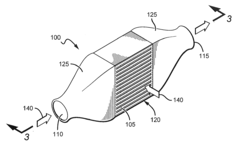
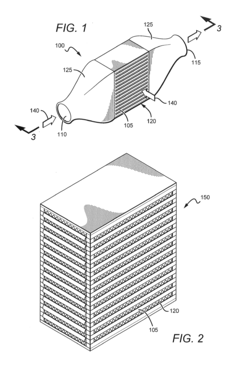
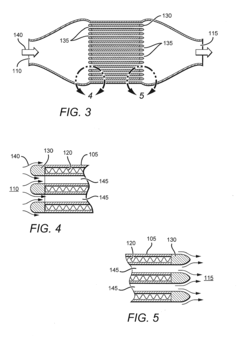
- The use of unique coil configurations and profiled passage separators to enhance airflow through the intercooler, applying basic fluid mechanics to improve fluid flow and temperature cooling in a smaller packaging size, with convex surfaces funneling fluid efficiently through passageways.
Energy Efficiency Standards for Thermal Systems
Energy efficiency standards for thermal systems incorporating intercooling technologies have become increasingly stringent across global markets, driven by environmental regulations and economic pressures. Current international frameworks, including ISO 50001 and ASHRAE standards, establish baseline requirements for thermal system performance, with specific provisions for heat recovery and temperature management systems. These standards typically mandate minimum coefficient of performance (COP) values and maximum energy consumption thresholds for industrial cooling applications.
The European Union's Ecodesign Directive sets particularly rigorous benchmarks for thermal systems, requiring intercooled configurations to achieve energy efficiency ratios exceeding 3.5 for commercial applications. Similarly, the U.S. Department of Energy's Federal Energy Management Program establishes performance criteria that directly impact intercooling system design, emphasizing the optimization of heat transfer coefficients and pressure drop minimization. These regulations have catalyzed significant innovation in intercooler design methodologies and operational strategies.
Emerging efficiency standards specifically address intercooling applications in gas turbines, compressor systems, and industrial heat exchangers. The International Electrotechnical Commission's recent updates to IEC 60034 standards incorporate provisions for intercooling effectiveness measurements, requiring systems to demonstrate heat removal rates that maintain fluid temperatures within specified operational ranges while minimizing parasitic energy losses.
Compliance frameworks increasingly emphasize lifecycle energy assessment, mandating that intercooling systems demonstrate sustained performance over extended operational periods. Advanced monitoring requirements now include real-time efficiency tracking, with automated reporting systems that ensure continuous adherence to established thermal performance benchmarks. These evolving standards are driving the adoption of smart intercooling technologies that can dynamically adjust operational parameters to maintain optimal energy efficiency across varying load conditions.
Future regulatory trends indicate movement toward performance-based standards that reward innovative intercooling approaches, potentially including adaptive control systems and advanced materials that enhance heat transfer while reducing overall system energy consumption.
The European Union's Ecodesign Directive sets particularly rigorous benchmarks for thermal systems, requiring intercooled configurations to achieve energy efficiency ratios exceeding 3.5 for commercial applications. Similarly, the U.S. Department of Energy's Federal Energy Management Program establishes performance criteria that directly impact intercooling system design, emphasizing the optimization of heat transfer coefficients and pressure drop minimization. These regulations have catalyzed significant innovation in intercooler design methodologies and operational strategies.
Emerging efficiency standards specifically address intercooling applications in gas turbines, compressor systems, and industrial heat exchangers. The International Electrotechnical Commission's recent updates to IEC 60034 standards incorporate provisions for intercooling effectiveness measurements, requiring systems to demonstrate heat removal rates that maintain fluid temperatures within specified operational ranges while minimizing parasitic energy losses.
Compliance frameworks increasingly emphasize lifecycle energy assessment, mandating that intercooling systems demonstrate sustained performance over extended operational periods. Advanced monitoring requirements now include real-time efficiency tracking, with automated reporting systems that ensure continuous adherence to established thermal performance benchmarks. These evolving standards are driving the adoption of smart intercooling technologies that can dynamically adjust operational parameters to maintain optimal energy efficiency across varying load conditions.
Future regulatory trends indicate movement toward performance-based standards that reward innovative intercooling approaches, potentially including adaptive control systems and advanced materials that enhance heat transfer while reducing overall system energy consumption.
Environmental Impact of Advanced Intercooling Technologies
Advanced intercooling technologies present a complex environmental profile that requires careful evaluation across multiple impact dimensions. While these systems deliver substantial energy efficiency improvements, their environmental implications extend beyond simple energy savings to encompass manufacturing footprints, material lifecycles, and operational considerations.
The primary environmental benefit of advanced intercooling systems lies in their capacity to reduce overall energy consumption in industrial processes. Enhanced heat transfer efficiency translates directly to lower fuel consumption in gas turbines, reduced electrical demand in compression systems, and decreased thermal loads in manufacturing operations. Studies indicate that optimized intercooling can achieve energy savings of 15-25% compared to conventional cooling methods, resulting in proportional reductions in greenhouse gas emissions.
Material selection for advanced intercooling systems significantly influences environmental impact. High-performance heat exchangers often require specialized alloys, advanced ceramics, or composite materials that may have intensive manufacturing processes. However, the extended operational lifespan and superior performance of these materials typically offset their initial environmental cost through reduced replacement frequency and enhanced system efficiency.
Water consumption represents a critical environmental consideration, particularly for evaporative and hybrid cooling systems. Advanced intercooling technologies increasingly incorporate closed-loop designs and heat recovery mechanisms to minimize water usage. Air-cooled systems eliminate water dependency entirely, though they may require higher electrical input for fan operation.
Refrigerant selection in active cooling systems poses environmental challenges related to global warming potential and ozone depletion. Modern intercooling designs prioritize natural refrigerants or low-GWP synthetic alternatives, while advanced leak detection and recovery systems minimize atmospheric releases during operation and maintenance.
The manufacturing phase environmental impact varies significantly across intercooling technologies. Additive manufacturing techniques for complex heat exchanger geometries can reduce material waste compared to traditional machining, while advanced surface treatments may involve chemical processes requiring careful environmental management.
End-of-life considerations increasingly influence intercooling system design, with emphasis on material recyclability and component separation. Modular designs facilitate selective replacement and refurbishment, extending system lifespan while reducing waste generation.
The primary environmental benefit of advanced intercooling systems lies in their capacity to reduce overall energy consumption in industrial processes. Enhanced heat transfer efficiency translates directly to lower fuel consumption in gas turbines, reduced electrical demand in compression systems, and decreased thermal loads in manufacturing operations. Studies indicate that optimized intercooling can achieve energy savings of 15-25% compared to conventional cooling methods, resulting in proportional reductions in greenhouse gas emissions.
Material selection for advanced intercooling systems significantly influences environmental impact. High-performance heat exchangers often require specialized alloys, advanced ceramics, or composite materials that may have intensive manufacturing processes. However, the extended operational lifespan and superior performance of these materials typically offset their initial environmental cost through reduced replacement frequency and enhanced system efficiency.
Water consumption represents a critical environmental consideration, particularly for evaporative and hybrid cooling systems. Advanced intercooling technologies increasingly incorporate closed-loop designs and heat recovery mechanisms to minimize water usage. Air-cooled systems eliminate water dependency entirely, though they may require higher electrical input for fan operation.
Refrigerant selection in active cooling systems poses environmental challenges related to global warming potential and ozone depletion. Modern intercooling designs prioritize natural refrigerants or low-GWP synthetic alternatives, while advanced leak detection and recovery systems minimize atmospheric releases during operation and maintenance.
The manufacturing phase environmental impact varies significantly across intercooling technologies. Additive manufacturing techniques for complex heat exchanger geometries can reduce material waste compared to traditional machining, while advanced surface treatments may involve chemical processes requiring careful environmental management.
End-of-life considerations increasingly influence intercooling system design, with emphasis on material recyclability and component separation. Modular designs facilitate selective replacement and refurbishment, extending system lifespan while reducing waste generation.
Unlock deeper insights with Patsnap Eureka Quick Research — get a full tech report to explore trends and direct your research. Try now!
Generate Your Research Report Instantly with AI Agent
Supercharge your innovation with Patsnap Eureka AI Agent Platform!