

Investigate Solid Oxygen Potential in Alternative Fuels
JAN 30, 20269 MIN READ
Generate Your Research Report Instantly with AI Agent
PatSnap Eureka helps you evaluate technical feasibility & market potential.
Solid Oxygen Fuel Technology Background and Objectives
Solid oxygen represents a paradigm shift in alternative fuel technology, emerging from the fundamental challenge of storing and utilizing oxidizers in compact, stable forms for propulsion and energy generation systems. Traditional liquid or gaseous oxygen systems face inherent limitations including cryogenic storage requirements, boil-off losses, and complex handling infrastructure. The concept of solid oxygen compounds as oxidizer sources dates back to early rocket propulsion research in the mid-20th century, where researchers explored metal peroxides and superoxides for military applications. However, recent advances in materials science and nanotechnology have rekindled interest in this field, expanding potential applications beyond aerospace into portable power generation, emergency energy systems, and remote operation scenarios.
The fundamental principle underlying solid oxygen technology involves chemical compounds that can release molecular oxygen through controlled decomposition reactions. These materials include peroxides, superoxides, ozonides, and oxygen-rich salts that store oxygen in chemically bound forms at ambient conditions. The energy density advantages are compelling: solid oxygen carriers can achieve volumetric oxygen densities exceeding that of liquid oxygen while eliminating cryogenic requirements. This characteristic positions solid oxygen as a transformative solution for applications where weight, volume, and operational simplicity are critical constraints.
The primary technical objectives driving current research focus on three interconnected goals. First, developing solid oxygen compounds with enhanced stability under varied environmental conditions while maintaining rapid, controllable oxygen release kinetics when activated. Second, achieving competitive energy density metrics that justify the transition from conventional oxidizer systems, requiring optimization of both oxygen content and decomposition energetics. Third, establishing safe, scalable synthesis and handling protocols that enable practical implementation across target application domains.
Contemporary research trajectories emphasize hybrid fuel systems where solid oxygen sources integrate with novel fuel formulations to create self-contained propulsion or power generation units. The technology aims to eliminate the oxidizer storage penalty that constrains current portable energy systems, particularly in environments where atmospheric oxygen is unavailable or insufficient. Success in these objectives would enable breakthrough capabilities in underwater propulsion, space exploration, emergency power systems, and distributed energy applications where conventional fuel-oxidizer combinations prove impractical or inefficient.
The fundamental principle underlying solid oxygen technology involves chemical compounds that can release molecular oxygen through controlled decomposition reactions. These materials include peroxides, superoxides, ozonides, and oxygen-rich salts that store oxygen in chemically bound forms at ambient conditions. The energy density advantages are compelling: solid oxygen carriers can achieve volumetric oxygen densities exceeding that of liquid oxygen while eliminating cryogenic requirements. This characteristic positions solid oxygen as a transformative solution for applications where weight, volume, and operational simplicity are critical constraints.
The primary technical objectives driving current research focus on three interconnected goals. First, developing solid oxygen compounds with enhanced stability under varied environmental conditions while maintaining rapid, controllable oxygen release kinetics when activated. Second, achieving competitive energy density metrics that justify the transition from conventional oxidizer systems, requiring optimization of both oxygen content and decomposition energetics. Third, establishing safe, scalable synthesis and handling protocols that enable practical implementation across target application domains.
Contemporary research trajectories emphasize hybrid fuel systems where solid oxygen sources integrate with novel fuel formulations to create self-contained propulsion or power generation units. The technology aims to eliminate the oxidizer storage penalty that constrains current portable energy systems, particularly in environments where atmospheric oxygen is unavailable or insufficient. Success in these objectives would enable breakthrough capabilities in underwater propulsion, space exploration, emergency power systems, and distributed energy applications where conventional fuel-oxidizer combinations prove impractical or inefficient.
Alternative Fuel Market Demand Analysis
The alternative fuel market is experiencing unprecedented momentum driven by global decarbonization commitments and stringent emissions regulations across major economies. Transportation sectors, particularly aviation and heavy-duty trucking, face mounting pressure to transition away from conventional fossil fuels. These industries require energy-dense solutions that can match or exceed the performance characteristics of traditional hydrocarbon fuels while significantly reducing carbon footprints.
Solid oxygen represents a compelling proposition within this evolving landscape due to its potential to address critical limitations of existing alternative fuel technologies. Unlike hydrogen fuel cells or battery electric systems, solid oxygen-based propulsion systems could deliver superior energy density comparable to conventional jet fuel, making them particularly attractive for long-haul aviation and space applications where weight constraints are paramount.
The aerospace industry demonstrates particularly strong demand signals for breakthrough propulsion technologies. Commercial aviation accounts for substantial global carbon emissions, and industry leaders have committed to achieving net-zero emissions by mid-century. Current sustainable aviation fuel solutions face scalability challenges and cost barriers, creating market opportunities for disruptive technologies that can provide both environmental benefits and operational performance.
Military and defense sectors represent another significant demand driver. Advanced propulsion systems utilizing solid oxygen could enable extended operational ranges and reduced logistical footprints for military aircraft and unmanned systems. The strategic value of fuel systems that eliminate dependence on traditional supply chains has generated sustained research investment from defense agencies worldwide.
The space exploration sector continues expanding rapidly, with both governmental and commercial entities pursuing ambitious missions. Solid oxygen propulsion systems could revolutionize spacecraft design by offering improved specific impulse and simplified fuel storage compared to cryogenic liquid oxygen systems. Growing commercial space activities and planned deep-space missions amplify demand for innovative propulsion solutions.
Market barriers remain substantial, including technological maturity gaps, safety certification requirements, and infrastructure development needs. However, escalating environmental regulations, volatile fossil fuel prices, and technological convergence in materials science and chemical engineering are accelerating market readiness. Early adoption is anticipated in niche applications where performance advantages justify premium costs, followed by broader commercialization as production scales and costs decline.
Solid oxygen represents a compelling proposition within this evolving landscape due to its potential to address critical limitations of existing alternative fuel technologies. Unlike hydrogen fuel cells or battery electric systems, solid oxygen-based propulsion systems could deliver superior energy density comparable to conventional jet fuel, making them particularly attractive for long-haul aviation and space applications where weight constraints are paramount.
The aerospace industry demonstrates particularly strong demand signals for breakthrough propulsion technologies. Commercial aviation accounts for substantial global carbon emissions, and industry leaders have committed to achieving net-zero emissions by mid-century. Current sustainable aviation fuel solutions face scalability challenges and cost barriers, creating market opportunities for disruptive technologies that can provide both environmental benefits and operational performance.
Military and defense sectors represent another significant demand driver. Advanced propulsion systems utilizing solid oxygen could enable extended operational ranges and reduced logistical footprints for military aircraft and unmanned systems. The strategic value of fuel systems that eliminate dependence on traditional supply chains has generated sustained research investment from defense agencies worldwide.
The space exploration sector continues expanding rapidly, with both governmental and commercial entities pursuing ambitious missions. Solid oxygen propulsion systems could revolutionize spacecraft design by offering improved specific impulse and simplified fuel storage compared to cryogenic liquid oxygen systems. Growing commercial space activities and planned deep-space missions amplify demand for innovative propulsion solutions.
Market barriers remain substantial, including technological maturity gaps, safety certification requirements, and infrastructure development needs. However, escalating environmental regulations, volatile fossil fuel prices, and technological convergence in materials science and chemical engineering are accelerating market readiness. Early adoption is anticipated in niche applications where performance advantages justify premium costs, followed by broader commercialization as production scales and costs decline.
Solid Oxygen Technology Status and Challenges
Solid oxygen technology represents a paradigm shift in oxidizer storage and utilization for propulsion and energy systems. Currently, the field exists at a nascent stage with limited commercial deployment, though fundamental research has demonstrated technical feasibility. The primary technological approaches include cryogenic solidification of oxygen, chemical oxygen carriers, and oxygen-rich solid compounds. Cryogenic solid oxygen, maintained below 54.36 K, offers the highest purity and energy density but demands sophisticated thermal management systems that significantly increase system complexity and operational costs.
Chemical oxygen storage methods, particularly metal peroxides and superoxides, present more practical near-term solutions. These compounds can release oxygen through controlled thermal decomposition or chemical reactions, eliminating the need for extreme cryogenic conditions. However, current formulations suffer from incomplete oxygen release, typically achieving only 60-75% theoretical yield, and exhibit slow reaction kinetics that limit power density applications. The reversibility of oxygen absorption and desorption cycles remains problematic, with most materials degrading after fewer than fifty cycles.
The geographical distribution of solid oxygen research concentrates heavily in aerospace-oriented nations. The United States leads in cryogenic solid oxygen systems through NASA and defense contractors, while European institutions focus on chemical oxygen carriers for space applications. Emerging research from China and India emphasizes cost-effective synthesis methods for oxygen-rich compounds suitable for terrestrial energy applications.
Major technical challenges constraining widespread adoption include thermal stability issues, where many solid oxygen compounds decompose unpredictably under operational temperature fluctuations. Safety concerns dominate the discourse, as concentrated oxygen sources inherently pose combustion and explosion risks, particularly when integrated with fuel systems. Material compatibility presents another critical barrier, with many container materials experiencing accelerated oxidation and structural degradation when in prolonged contact with solid oxygen sources.
The energy density advantage of solid oxygen compared to gaseous or liquid forms remains theoretically compelling, potentially enabling 40-60% volume reduction in oxidizer storage. However, the parasitic mass of containment systems and thermal management infrastructure currently negates much of this benefit in practical implementations. Achieving rapid, controlled oxygen release rates that match combustion requirements without thermal runaway represents an unsolved engineering challenge that limits current applications to niche scenarios where volume constraints outweigh system complexity penalties.
Chemical oxygen storage methods, particularly metal peroxides and superoxides, present more practical near-term solutions. These compounds can release oxygen through controlled thermal decomposition or chemical reactions, eliminating the need for extreme cryogenic conditions. However, current formulations suffer from incomplete oxygen release, typically achieving only 60-75% theoretical yield, and exhibit slow reaction kinetics that limit power density applications. The reversibility of oxygen absorption and desorption cycles remains problematic, with most materials degrading after fewer than fifty cycles.
The geographical distribution of solid oxygen research concentrates heavily in aerospace-oriented nations. The United States leads in cryogenic solid oxygen systems through NASA and defense contractors, while European institutions focus on chemical oxygen carriers for space applications. Emerging research from China and India emphasizes cost-effective synthesis methods for oxygen-rich compounds suitable for terrestrial energy applications.
Major technical challenges constraining widespread adoption include thermal stability issues, where many solid oxygen compounds decompose unpredictably under operational temperature fluctuations. Safety concerns dominate the discourse, as concentrated oxygen sources inherently pose combustion and explosion risks, particularly when integrated with fuel systems. Material compatibility presents another critical barrier, with many container materials experiencing accelerated oxidation and structural degradation when in prolonged contact with solid oxygen sources.
The energy density advantage of solid oxygen compared to gaseous or liquid forms remains theoretically compelling, potentially enabling 40-60% volume reduction in oxidizer storage. However, the parasitic mass of containment systems and thermal management infrastructure currently negates much of this benefit in practical implementations. Achieving rapid, controlled oxygen release rates that match combustion requirements without thermal runaway represents an unsolved engineering challenge that limits current applications to niche scenarios where volume constraints outweigh system complexity penalties.
Current Solid Oxygen Fuel Solutions
01 Solid oxygen generation and production methods
Technologies for generating and producing solid oxygen through various physical and chemical processes. These methods involve cooling gaseous oxygen to extremely low temperatures or using chemical compounds that can release oxygen in solid form. The production techniques focus on creating stable solid oxygen materials that can be stored and transported efficiently for various applications.- Solid oxygen generation and production methods: Technologies for generating and producing solid oxygen through various physical and chemical processes. These methods involve cooling gaseous oxygen to extremely low temperatures or using chemical compounds that can release oxygen in solid form. The production techniques focus on creating stable solid oxygen materials that can be stored and transported efficiently for various applications.
- Solid oxygen storage and containment systems: Specialized storage systems and containers designed to maintain solid oxygen at required low temperatures and pressures. These systems incorporate insulation materials, cryogenic vessels, and safety mechanisms to prevent degradation or unwanted phase transitions. The containment solutions ensure long-term stability and safe handling of solid oxygen materials.
- Solid oxygen release and delivery mechanisms: Devices and methods for controlled release of oxygen from solid oxygen sources. These mechanisms enable gradual or on-demand oxygen delivery for medical, industrial, or emergency applications. The systems may include chemical activators, thermal triggers, or mechanical devices that facilitate the conversion of solid oxygen to usable gaseous form.
- Solid oxygen compounds and compositions: Chemical formulations and compounds that contain oxygen in solid form or can generate solid oxygen. These compositions may include peroxides, superoxides, or other oxygen-rich materials that maintain stability at various temperatures. The formulations are designed to optimize oxygen content, stability, and ease of handling for specific applications.
- Applications of solid oxygen in industrial and medical fields: Utilization of solid oxygen in various sectors including medical oxygen therapy, aerospace applications, emergency oxygen supply, and industrial processes. These applications leverage the advantages of solid oxygen such as high density, portability, and extended storage capability. The technologies enable oxygen delivery in situations where traditional gaseous or liquid oxygen systems are impractical.
02 Solid oxygen storage and containment systems
Specialized containers and storage systems designed to maintain solid oxygen at required temperatures and pressures. These systems incorporate insulation materials, pressure regulation mechanisms, and safety features to prevent degradation or hazardous conditions. The storage solutions ensure long-term stability and safe handling of solid oxygen materials.Expand Specific Solutions03 Solid oxygen applications in combustion and propulsion
Utilization of solid oxygen as an oxidizer in combustion systems and propulsion technologies. These applications leverage the high oxygen concentration and controlled release properties of solid oxygen for enhanced combustion efficiency. The technology is particularly relevant for aerospace, rocket propulsion, and specialized industrial combustion processes.Expand Specific Solutions04 Solid oxygen compounds and chemical compositions
Development of chemical compounds and compositions that contain oxygen in solid crystalline or molecular forms. These materials include peroxides, superoxides, and other oxygen-rich compounds that can release oxygen under specific conditions. The compositions are designed for controlled oxygen release in various industrial and medical applications.Expand Specific Solutions05 Solid oxygen release and delivery mechanisms
Systems and devices for controlled release and delivery of oxygen from solid oxygen sources. These mechanisms include thermal activation, catalytic decomposition, and pressure-triggered release methods. The technology enables precise oxygen dosing for medical oxygen therapy, emergency oxygen supply, and industrial processes requiring controlled oxygen environments.Expand Specific Solutions
Major Players in Solid Oxygen Fuel Sector
The solid oxygen alternative fuels sector represents an emerging technology area in early development stages, characterized by limited commercial deployment and nascent market formation. Current research focuses primarily on fundamental science and proof-of-concept demonstrations, with technology maturity remaining at low TRL levels. The competitive landscape is dominated by academic institutions including University of Akron, Nanjing Tech University, Iowa State University Research Foundation, Dalian Institute of Chemical Physics, and École Polytechnique Fédérale de Lausanne, alongside national research laboratories such as Battelle Memorial Institute and UT-Battelle LLC. Industrial interest is evidenced by major energy players like Saudi Arabian Oil Co., Phillips 66, and Air Liquide SA exploring potential applications, while automotive manufacturers Ford Motor Co. and Aptiv Technologies Ltd. investigate transportation integration possibilities. The technology remains pre-commercial with significant technical barriers requiring resolution before market viability.
Ford Motor Co.
Technical Solution: Ford has invested in oxygen sensor and oxygen storage technologies for alternative fuel vehicle applications, particularly focusing on flex-fuel and hydrogen fuel cell systems. Their research encompasses solid-state oxygen sensors utilizing zirconia-based electrolytes that enable precise air-fuel ratio control in engines running on ethanol blends, biodiesel, and gaseous fuels. Ford's oxygen storage component (OSC) technology employs cerium-zirconium mixed oxide materials in catalytic converters that temporarily store and release oxygen to optimize exhaust gas treatment across varying engine operating conditions. For fuel cell applications, Ford has developed oxygen reduction reaction (ORR) catalysts with platinum-group metal loadings reduced by 30-40% while maintaining performance, addressing cost barriers in hydrogen vehicle commercialization. The company's integrated approach combines oxygen management in both combustion and electrochemical systems, with particular emphasis on cold-start performance and transient response characteristics critical for automotive applications.
Strengths: Deep automotive engineering expertise with focus on practical vehicle integration; extensive testing and validation capabilities across diverse operating conditions; strong partnerships with catalyst and materials suppliers. Weaknesses: Technology development primarily driven by regulatory compliance rather than fundamental alternative fuel advancement; limited involvement in upstream oxygen production or large-scale stationary applications.
General Electric Technology GmbH
Technical Solution: GE has developed comprehensive oxy-combustion systems for power generation using alternative fuels including biomass, waste-derived fuels, and hydrogen blends. Their technology centers on chemical looping combustion (CLC) using iron-based and nickel-based oxygen carrier particles that circulate between fuel and air reactors. The oxygen carriers, typically supported on alumina or zirconia substrates, demonstrate oxygen transfer capacities of 5-12 wt% with mechanical stability exceeding 1000 redox cycles. GE's system architecture incorporates advanced computational fluid dynamics (CFD) modeling to optimize particle circulation rates (typically 10-50 kg/s for 100 MW thermal input) and reactor geometries that maximize fuel conversion efficiency (>98%) while minimizing oxygen carrier attrition (<0.1%/h). The technology achieves inherent CO2 capture with concentration >90% in the flue gas stream, eliminating the need for separate carbon capture equipment. GE has demonstrated pilot-scale operations at 1-3 MW thermal capacity with various solid and gaseous alternative fuels.
Strengths: Extensive power generation experience with large-scale turbine and combustion systems; strong engineering capabilities in high-temperature materials and reactor design; proven track record in commercial power plant deployment. Weaknesses: Technology primarily optimized for large centralized power generation facilities; high capital costs and complexity may limit applications in distributed energy systems.
Core Patents in Solid Oxygen Technology
Solid fuels for fuel cells
PatentInactiveEP1807898A1
Innovation
- Development of a solid fuel comprising a mixture of oxygenates like methanol or acetaldehyde with polymers and metal compounds, which generates a gaseous fuel upon reaction with water, reducing permeation and enhancing power density through the addition of oxidizing agents like hydrogen peroxide.
Solid Oxide Cell
PatentPendingUS20240088402A1
Innovation
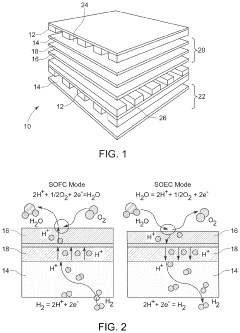
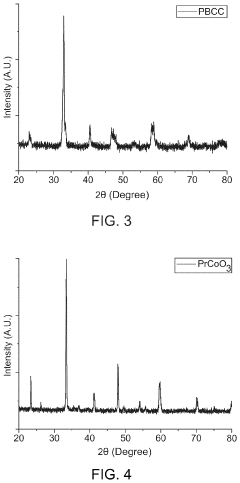
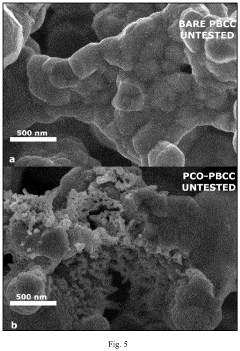
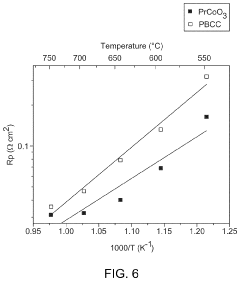
- Incorporating a perovskite oxide material coated with a Pr1−xCo1−yO3 catalyst into the oxygen electrode and using a proton conducting electrolyte, such as BaZr0.1Ce0.7Y0.1Yb0.1O3−δ, to enhance reaction rates and resistance to degradation, with a method involving infiltration of the catalyst into the electrode to form a stable and efficient solid oxide cell.
Safety and Regulatory Framework for Solid Oxygen
The deployment of solid oxygen as an alternative fuel component necessitates a comprehensive safety and regulatory framework to address its unique hazards and operational requirements. Solid oxygen compounds, particularly chemical oxygen generators and oxygen-rich oxidizers, present distinct challenges compared to conventional liquid or gaseous oxygen systems. The primary safety concerns include thermal instability, rapid decomposition under certain conditions, and the potential for violent reactions when in contact with incompatible materials. Establishing clear safety protocols for storage, handling, and transportation is essential to mitigate risks associated with accidental ignition or uncontrolled oxygen release.
Current regulatory frameworks for oxidizers and energetic materials provide a foundational reference, yet solid oxygen applications require tailored standards. International bodies such as the International Civil Aviation Organization and the United Nations Committee of Experts on the Transport of Dangerous Goods have classified certain solid oxygen sources under hazardous materials categories. However, specific guidelines addressing solid oxygen in fuel systems remain underdeveloped. Regulatory gaps exist particularly in defining permissible concentration limits, compatibility testing protocols, and emergency response procedures for solid oxygen-based propulsion systems.
Industry stakeholders must collaborate with regulatory authorities to develop standardized testing methodologies that evaluate thermal stability, sensitivity to shock and friction, and long-term storage degradation. Certification processes should encompass material compatibility assessments, ensuring that solid oxygen does not react adversely with fuel components, containment materials, or environmental contaminants. Additionally, personnel training programs and operational safety procedures must be institutionalized to minimize human error during system integration and maintenance activities.
Environmental and public safety considerations also demand attention within the regulatory framework. Disposal protocols for spent or degraded solid oxygen materials must prevent environmental contamination while ensuring safe neutralization. Furthermore, risk assessment models should be integrated into regulatory approval processes, enabling quantitative evaluation of failure scenarios and their potential consequences. Establishing a robust safety and regulatory infrastructure will be critical to facilitating the responsible adoption of solid oxygen technologies in alternative fuel applications.
Current regulatory frameworks for oxidizers and energetic materials provide a foundational reference, yet solid oxygen applications require tailored standards. International bodies such as the International Civil Aviation Organization and the United Nations Committee of Experts on the Transport of Dangerous Goods have classified certain solid oxygen sources under hazardous materials categories. However, specific guidelines addressing solid oxygen in fuel systems remain underdeveloped. Regulatory gaps exist particularly in defining permissible concentration limits, compatibility testing protocols, and emergency response procedures for solid oxygen-based propulsion systems.
Industry stakeholders must collaborate with regulatory authorities to develop standardized testing methodologies that evaluate thermal stability, sensitivity to shock and friction, and long-term storage degradation. Certification processes should encompass material compatibility assessments, ensuring that solid oxygen does not react adversely with fuel components, containment materials, or environmental contaminants. Additionally, personnel training programs and operational safety procedures must be institutionalized to minimize human error during system integration and maintenance activities.
Environmental and public safety considerations also demand attention within the regulatory framework. Disposal protocols for spent or degraded solid oxygen materials must prevent environmental contamination while ensuring safe neutralization. Furthermore, risk assessment models should be integrated into regulatory approval processes, enabling quantitative evaluation of failure scenarios and their potential consequences. Establishing a robust safety and regulatory infrastructure will be critical to facilitating the responsible adoption of solid oxygen technologies in alternative fuel applications.
Environmental Impact of Solid Oxygen Fuels
Solid oxygen fuels represent a paradigm shift in propulsion and energy systems, yet their environmental implications warrant comprehensive examination. Unlike conventional liquid or gaseous propellants, solid oxygen compounds offer unique environmental profiles that span manufacturing, operational deployment, and end-of-life considerations. The environmental assessment of these fuels must address atmospheric emissions, ecological footprint, and long-term sustainability metrics to determine their viability as genuinely cleaner alternatives.
The combustion characteristics of solid oxygen fuels present both advantages and challenges from an environmental perspective. When properly formulated, these fuels can achieve near-complete combustion with minimal production of unburned hydrocarbons and particulate matter. The stoichiometric precision enabled by solid-phase oxygen carriers reduces excess oxidizer requirements, potentially lowering nitrogen oxide formation compared to air-breathing systems. However, the energy-intensive synthesis processes for certain solid oxygen compounds, particularly advanced peroxides and superoxides, introduce upstream carbon footprints that must be factored into lifecycle assessments.
Terrestrial and atmospheric impact assessments reveal nuanced environmental trade-offs. Solid oxygen fuels eliminate the need for cryogenic storage infrastructure, reducing energy consumption associated with liquefaction and refrigeration systems. This advantage translates to decreased greenhouse gas emissions across the fuel supply chain. Conversely, the chemical stability requirements of some solid oxygen formulations necessitate protective coatings and binders that may introduce persistent organic pollutants or heavy metal residues into ecosystems upon disposal or accidental release.
The potential for environmental contamination during production and handling phases requires rigorous evaluation. Manufacturing facilities must implement stringent controls to prevent oxidizer dust emissions and manage chemical waste streams containing reactive oxygen species. Compared to traditional rocket propellants like hydrazine derivatives, many solid oxygen alternatives demonstrate reduced acute toxicity profiles, offering safer handling conditions and lower risks of groundwater contamination at launch sites and testing facilities.
Climate impact modeling suggests that widespread adoption of solid oxygen fuels in specific applications could yield measurable reductions in sectoral carbon intensity, particularly in aerospace and remote power generation contexts where alternative solutions remain limited. However, comprehensive environmental validation demands transparent reporting of full lifecycle emissions, including raw material extraction, processing energy requirements, and decommissioning protocols to ensure these fuels deliver genuine ecological benefits rather than merely displacing environmental burdens across different impact categories.
The combustion characteristics of solid oxygen fuels present both advantages and challenges from an environmental perspective. When properly formulated, these fuels can achieve near-complete combustion with minimal production of unburned hydrocarbons and particulate matter. The stoichiometric precision enabled by solid-phase oxygen carriers reduces excess oxidizer requirements, potentially lowering nitrogen oxide formation compared to air-breathing systems. However, the energy-intensive synthesis processes for certain solid oxygen compounds, particularly advanced peroxides and superoxides, introduce upstream carbon footprints that must be factored into lifecycle assessments.
Terrestrial and atmospheric impact assessments reveal nuanced environmental trade-offs. Solid oxygen fuels eliminate the need for cryogenic storage infrastructure, reducing energy consumption associated with liquefaction and refrigeration systems. This advantage translates to decreased greenhouse gas emissions across the fuel supply chain. Conversely, the chemical stability requirements of some solid oxygen formulations necessitate protective coatings and binders that may introduce persistent organic pollutants or heavy metal residues into ecosystems upon disposal or accidental release.
The potential for environmental contamination during production and handling phases requires rigorous evaluation. Manufacturing facilities must implement stringent controls to prevent oxidizer dust emissions and manage chemical waste streams containing reactive oxygen species. Compared to traditional rocket propellants like hydrazine derivatives, many solid oxygen alternatives demonstrate reduced acute toxicity profiles, offering safer handling conditions and lower risks of groundwater contamination at launch sites and testing facilities.
Climate impact modeling suggests that widespread adoption of solid oxygen fuels in specific applications could yield measurable reductions in sectoral carbon intensity, particularly in aerospace and remote power generation contexts where alternative solutions remain limited. However, comprehensive environmental validation demands transparent reporting of full lifecycle emissions, including raw material extraction, processing energy requirements, and decommissioning protocols to ensure these fuels deliver genuine ecological benefits rather than merely displacing environmental burdens across different impact categories.
Unlock deeper insights with PatSnap Eureka Quick Research — get a full tech report to explore trends and direct your research. Try now!
Generate Your Research Report Instantly with AI Agent
Supercharge your innovation with PatSnap Eureka AI Agent Platform!