
Laser Engineered Net Shaping: Innovations in Structural Design
APR 1, 202610 MIN READ
Generate Your Research Report Instantly with AI Agent
Patsnap Eureka helps you evaluate technical feasibility & market potential.
LENS Technology Background and Structural Design Objectives
Laser Engineered Net Shaping (LENS) represents a revolutionary additive manufacturing technology that emerged in the mid-1990s as a direct metal deposition process. Developed initially at Sandia National Laboratories, LENS technology combines the precision of laser processing with the flexibility of powder-based material deposition to create complex three-dimensional metallic structures directly from computer-aided design models.
The fundamental principle of LENS involves the simultaneous delivery of metal powder and focused laser energy to create a molten pool on a substrate or previously deposited layer. As the laser beam moves according to predetermined patterns, it selectively melts the incoming powder particles, which then solidify to form dense, metallurgically bonded structures. This layer-by-layer construction approach enables the fabrication of components with intricate geometries that would be impossible or economically unfeasible using traditional manufacturing methods.
The evolution of LENS technology has been driven by the increasing demand for lightweight, high-performance structures across aerospace, automotive, and biomedical industries. Unlike conventional subtractive manufacturing processes that remove material from solid blocks, LENS offers a net-shape or near-net-shape manufacturing capability, significantly reducing material waste and enabling the production of components with complex internal features such as cooling channels, lattice structures, and functionally graded materials.
The primary structural design objectives of LENS technology encompass several critical aspects. First, achieving optimal mechanical properties through controlled microstructure formation during the rapid solidification process. The technology aims to produce components with mechanical properties comparable to or exceeding those of conventionally manufactured parts while maintaining dimensional accuracy and surface quality standards.
Second, LENS technology targets the creation of multi-material and functionally graded structures by enabling real-time material composition changes during the build process. This capability opens possibilities for designing components with spatially varying properties, such as wear-resistant surfaces combined with tough cores, or structures with tailored thermal and electrical conductivity distributions.
Third, the technology focuses on minimizing post-processing requirements through improved process control and optimization of deposition parameters. Advanced monitoring systems and closed-loop control mechanisms are being integrated to ensure consistent layer adhesion, minimize porosity, and achieve desired surface finishes directly from the deposition process.
The strategic importance of LENS technology lies in its potential to revolutionize manufacturing paradigms by enabling on-demand production, rapid prototyping, and repair of high-value components. As industries increasingly demand customized solutions and sustainable manufacturing practices, LENS technology positions itself as a key enabler for next-generation structural design and manufacturing capabilities.
The fundamental principle of LENS involves the simultaneous delivery of metal powder and focused laser energy to create a molten pool on a substrate or previously deposited layer. As the laser beam moves according to predetermined patterns, it selectively melts the incoming powder particles, which then solidify to form dense, metallurgically bonded structures. This layer-by-layer construction approach enables the fabrication of components with intricate geometries that would be impossible or economically unfeasible using traditional manufacturing methods.
The evolution of LENS technology has been driven by the increasing demand for lightweight, high-performance structures across aerospace, automotive, and biomedical industries. Unlike conventional subtractive manufacturing processes that remove material from solid blocks, LENS offers a net-shape or near-net-shape manufacturing capability, significantly reducing material waste and enabling the production of components with complex internal features such as cooling channels, lattice structures, and functionally graded materials.
The primary structural design objectives of LENS technology encompass several critical aspects. First, achieving optimal mechanical properties through controlled microstructure formation during the rapid solidification process. The technology aims to produce components with mechanical properties comparable to or exceeding those of conventionally manufactured parts while maintaining dimensional accuracy and surface quality standards.
Second, LENS technology targets the creation of multi-material and functionally graded structures by enabling real-time material composition changes during the build process. This capability opens possibilities for designing components with spatially varying properties, such as wear-resistant surfaces combined with tough cores, or structures with tailored thermal and electrical conductivity distributions.
Third, the technology focuses on minimizing post-processing requirements through improved process control and optimization of deposition parameters. Advanced monitoring systems and closed-loop control mechanisms are being integrated to ensure consistent layer adhesion, minimize porosity, and achieve desired surface finishes directly from the deposition process.
The strategic importance of LENS technology lies in its potential to revolutionize manufacturing paradigms by enabling on-demand production, rapid prototyping, and repair of high-value components. As industries increasingly demand customized solutions and sustainable manufacturing practices, LENS technology positions itself as a key enabler for next-generation structural design and manufacturing capabilities.
Market Demand for Advanced LENS Structural Applications
The aerospace industry represents the most significant market segment driving demand for advanced LENS structural applications. Aircraft manufacturers increasingly require lightweight, high-strength components with complex geometries that traditional manufacturing methods cannot efficiently produce. LENS technology addresses critical needs for turbine blades, fuel injection systems, and structural brackets where material waste reduction and design freedom are paramount. The ability to create functionally graded materials and repair high-value components in-situ has positioned LENS as a strategic manufacturing solution for next-generation aircraft development.
Medical device manufacturing constitutes another rapidly expanding market for LENS applications. The technology's capability to produce patient-specific implants with intricate internal structures aligns perfectly with the healthcare industry's shift toward personalized medicine. Orthopedic implants, dental prosthetics, and surgical instruments benefit from LENS's ability to create biocompatible titanium and cobalt-chrome structures with optimized porosity and surface characteristics. The growing aging population and increasing demand for customized medical solutions continue to fuel market expansion in this sector.
Energy sector applications, particularly in oil and gas exploration, nuclear power, and renewable energy systems, demonstrate substantial market potential for LENS technology. The ability to manufacture components that withstand extreme temperatures, corrosive environments, and high-stress conditions makes LENS attractive for producing specialized tooling, heat exchangers, and reactor components. Wind turbine manufacturers increasingly utilize LENS for creating complex cooling channels in generator components and producing replacement parts with enhanced durability characteristics.
Automotive industry adoption of LENS technology accelerates as manufacturers pursue lightweighting initiatives and electric vehicle development. The technology enables production of complex cooling systems, lightweight structural components, and high-performance engine parts with integrated functionality. Racing and luxury vehicle segments lead adoption due to their tolerance for higher manufacturing costs in exchange for performance advantages and design flexibility.
Defense and military applications represent a stable, high-value market segment where LENS technology addresses critical supply chain vulnerabilities and enables rapid prototyping of specialized equipment. The ability to produce components on-demand in remote locations and create parts with enhanced ballistic protection characteristics drives continued investment in LENS capabilities across defense contractors and military research facilities.
Medical device manufacturing constitutes another rapidly expanding market for LENS applications. The technology's capability to produce patient-specific implants with intricate internal structures aligns perfectly with the healthcare industry's shift toward personalized medicine. Orthopedic implants, dental prosthetics, and surgical instruments benefit from LENS's ability to create biocompatible titanium and cobalt-chrome structures with optimized porosity and surface characteristics. The growing aging population and increasing demand for customized medical solutions continue to fuel market expansion in this sector.
Energy sector applications, particularly in oil and gas exploration, nuclear power, and renewable energy systems, demonstrate substantial market potential for LENS technology. The ability to manufacture components that withstand extreme temperatures, corrosive environments, and high-stress conditions makes LENS attractive for producing specialized tooling, heat exchangers, and reactor components. Wind turbine manufacturers increasingly utilize LENS for creating complex cooling channels in generator components and producing replacement parts with enhanced durability characteristics.
Automotive industry adoption of LENS technology accelerates as manufacturers pursue lightweighting initiatives and electric vehicle development. The technology enables production of complex cooling systems, lightweight structural components, and high-performance engine parts with integrated functionality. Racing and luxury vehicle segments lead adoption due to their tolerance for higher manufacturing costs in exchange for performance advantages and design flexibility.
Defense and military applications represent a stable, high-value market segment where LENS technology addresses critical supply chain vulnerabilities and enables rapid prototyping of specialized equipment. The ability to produce components on-demand in remote locations and create parts with enhanced ballistic protection characteristics drives continued investment in LENS capabilities across defense contractors and military research facilities.
Current LENS Structural Design Limitations and Challenges
Despite its revolutionary potential in additive manufacturing, Laser Engineered Net Shaping technology faces significant structural design limitations that constrain its widespread industrial adoption. The fundamental challenge lies in the inherent thermal gradients generated during the layer-by-layer deposition process, which create residual stresses that can lead to part distortion, cracking, and dimensional inaccuracies. These thermal effects become particularly pronounced in complex geometries with varying cross-sectional areas, where rapid heating and cooling cycles create non-uniform stress distributions throughout the structure.
Material property inconsistencies represent another critical limitation in LENS structural design. The rapid solidification rates characteristic of the process often result in microstructural variations between deposited layers and within individual layers. This heterogeneity manifests as anisotropic mechanical properties, where strength and ductility differ significantly along build direction versus transverse directions. Such property variations severely limit the predictability of structural performance and complicate design optimization efforts.
Geometric constraints pose substantial challenges for structural applications requiring intricate internal features or overhanging elements. The powder-fed nature of LENS technology struggles with steep overhangs exceeding 45 degrees without support structures, limiting design freedom for complex geometries. Additionally, the minimum feature resolution is constrained by laser spot size and powder particle distribution, preventing the fabrication of fine-scale structural details that might be critical for optimized performance.
Surface quality and dimensional accuracy issues further compound structural design limitations. The inherent roughness of as-built LENS surfaces, typically ranging from 50-200 micrometers Ra, necessitates extensive post-processing for applications requiring precise tolerances or fatigue resistance. This surface condition creates stress concentration points that can significantly reduce structural integrity under cyclic loading conditions.
Process parameter sensitivity creates reproducibility challenges that directly impact structural reliability. Small variations in laser power, scan speed, powder flow rate, or environmental conditions can dramatically alter the final part properties. This sensitivity makes it difficult to establish robust design guidelines and quality assurance protocols for structural components, particularly for safety-critical applications where consistent performance is paramount.
The limited availability of qualified materials specifically optimized for LENS processing restricts structural design options. While traditional alloys can be processed, their performance often differs significantly from conventionally manufactured counterparts due to the unique thermal history experienced during deposition. This material limitation forces designers to work within narrow property envelopes that may not align with optimal structural requirements.
Material property inconsistencies represent another critical limitation in LENS structural design. The rapid solidification rates characteristic of the process often result in microstructural variations between deposited layers and within individual layers. This heterogeneity manifests as anisotropic mechanical properties, where strength and ductility differ significantly along build direction versus transverse directions. Such property variations severely limit the predictability of structural performance and complicate design optimization efforts.
Geometric constraints pose substantial challenges for structural applications requiring intricate internal features or overhanging elements. The powder-fed nature of LENS technology struggles with steep overhangs exceeding 45 degrees without support structures, limiting design freedom for complex geometries. Additionally, the minimum feature resolution is constrained by laser spot size and powder particle distribution, preventing the fabrication of fine-scale structural details that might be critical for optimized performance.
Surface quality and dimensional accuracy issues further compound structural design limitations. The inherent roughness of as-built LENS surfaces, typically ranging from 50-200 micrometers Ra, necessitates extensive post-processing for applications requiring precise tolerances or fatigue resistance. This surface condition creates stress concentration points that can significantly reduce structural integrity under cyclic loading conditions.
Process parameter sensitivity creates reproducibility challenges that directly impact structural reliability. Small variations in laser power, scan speed, powder flow rate, or environmental conditions can dramatically alter the final part properties. This sensitivity makes it difficult to establish robust design guidelines and quality assurance protocols for structural components, particularly for safety-critical applications where consistent performance is paramount.
The limited availability of qualified materials specifically optimized for LENS processing restricts structural design options. While traditional alloys can be processed, their performance often differs significantly from conventionally manufactured counterparts due to the unique thermal history experienced during deposition. This material limitation forces designers to work within narrow property envelopes that may not align with optimal structural requirements.
Current LENS Structural Design Solutions and Methods
01 Process parameter optimization for laser engineered net shaping
Optimization of key process parameters in laser engineered net shaping is critical for achieving desired structural properties. This includes controlling laser power, scanning speed, powder feed rate, and layer thickness to minimize defects and improve dimensional accuracy. Advanced monitoring and feedback control systems can be integrated to adjust parameters in real-time, ensuring consistent quality throughout the manufacturing process. Parameter optimization also helps reduce porosity, improve surface finish, and enhance mechanical properties of the fabricated structures.- Process parameter optimization for laser engineered net shaping: Optimization of process parameters is critical for laser engineered net shaping to achieve desired structural properties. Key parameters include laser power, scanning speed, powder feed rate, and layer thickness. By systematically adjusting these parameters, the microstructure, density, and mechanical properties of the fabricated parts can be controlled. Advanced monitoring and feedback systems can be integrated to ensure real-time parameter adjustment during the manufacturing process.
- Support structure design and optimization: Support structures are essential in laser engineered net shaping to prevent deformation and ensure dimensional accuracy during fabrication. The design of support structures must consider factors such as thermal stress distribution, ease of removal, and minimal material waste. Optimized support structures can be generated through computational algorithms that analyze the geometry and identify critical areas requiring support. Lattice-based and topology-optimized support designs have shown improved efficiency.
- Material composition and powder characteristics: The selection and preparation of powder materials significantly impact the quality of laser engineered net shaping structures. Powder characteristics such as particle size distribution, morphology, flowability, and chemical composition must be carefully controlled. Alloy compositions can be tailored to achieve specific mechanical properties, corrosion resistance, or thermal stability. Pre-treatment processes including powder drying, mixing, and sieving ensure consistent material properties throughout the fabrication process.
- Path planning and scanning strategy: Effective path planning and scanning strategies are crucial for achieving uniform energy distribution and minimizing defects in laser engineered net shaping. Various scanning patterns including raster, spiral, and contour-based strategies can be employed depending on the part geometry. Layer-by-layer rotation of scanning direction helps reduce anisotropy and residual stress. Advanced algorithms incorporating artificial intelligence and machine learning can optimize scanning paths to improve build efficiency and part quality.
- Post-processing and quality control: Post-processing techniques are necessary to enhance the final properties of laser engineered net shaping structures. Common post-processing methods include heat treatment, hot isostatic pressing, surface finishing, and support removal. Quality control measures such as dimensional inspection, non-destructive testing, and microstructural analysis ensure that fabricated parts meet design specifications. Integration of in-situ monitoring systems enables real-time defect detection and process adjustment to maintain consistent quality.
02 Material composition and powder characteristics for LENS
The selection and preparation of metal powders significantly impact the quality of laser engineered net shaped structures. Powder characteristics such as particle size distribution, morphology, flowability, and chemical composition must be carefully controlled. Specialized alloy compositions and composite materials can be developed to achieve specific mechanical, thermal, or corrosion-resistant properties. Pre-treatment methods for powders, including drying and sieving, ensure consistent material delivery during the deposition process.Expand Specific Solutions03 Structural design and topology optimization
Advanced structural design methodologies enable the creation of complex geometries and optimized structures through laser engineered net shaping. Topology optimization algorithms can be applied to reduce weight while maintaining structural integrity. Lattice structures, gradient designs, and functionally graded materials can be incorporated to achieve specific performance requirements. Computer-aided design tools integrated with simulation software allow for predictive modeling of thermal and mechanical behavior before actual fabrication.Expand Specific Solutions04 Support structure design and removal techniques
Effective support structure design is essential for successful fabrication of overhanging features and complex geometries in laser engineered net shaping. Support structures must provide adequate mechanical stability during the build process while being easily removable afterward. Design strategies include optimizing support density, geometry, and attachment points to minimize material usage and post-processing effort. Automated support generation algorithms can identify critical areas requiring support based on geometric analysis and thermal simulation.Expand Specific Solutions05 Quality control and defect detection methods
Comprehensive quality control systems are necessary to ensure the reliability of laser engineered net shaped structures. In-situ monitoring techniques using optical sensors, thermal cameras, and acoustic emission detection can identify defects during the build process. Post-processing inspection methods include non-destructive testing such as X-ray computed tomography, ultrasonic testing, and surface profilometry. Data analytics and machine learning algorithms can be employed to correlate process parameters with defect formation, enabling predictive quality control.Expand Specific Solutions
Key Players in LENS and Additive Manufacturing Industry
The Laser Engineered Net Shaping (LENS) technology represents a mature additive manufacturing sector experiencing steady growth, with the global market expanding as industries increasingly adopt direct metal deposition techniques for complex structural applications. The competitive landscape spans diverse players from leading research institutions like Dalian University of Technology, Huazhong University of Science & Technology, and California Institute of Technology driving fundamental innovations, to established industrial giants including General Electric, Rolls-Royce, and Siemens Energy implementing LENS for aerospace and energy applications. Technology maturity varies significantly across applications, with companies like TRUMPF Photonic Components and 3D-Micromac advancing laser precision capabilities, while organizations such as Fraunhofer-Gesellschaft and National Research Council of Canada focus on process optimization and material development, creating a multi-tiered ecosystem where academic research, industrial implementation, and specialized equipment manufacturing converge to advance structural design capabilities.
Fraunhofer-Gesellschaft eV
Technical Solution: Fraunhofer institutes have pioneered research in LENS technology with focus on process optimization and material development. Their approach emphasizes understanding the fundamental physics of laser-material interaction and melt pool dynamics. The organization has developed innovative beam shaping techniques and multi-laser systems to improve deposition rates and part quality. Fraunhofer's LENS research includes development of new powder materials, process monitoring systems using high-speed imaging and spectroscopy, and advanced simulation tools for predicting microstructure and mechanical properties of deposited materials.
Strengths: Strong research foundation, comprehensive material science expertise, advanced simulation capabilities. Weaknesses: Limited commercial manufacturing experience, technology transfer challenges from research to industry.
Rolls-Royce Plc
Technical Solution: Rolls-Royce employs LENS technology for manufacturing and repairing high-performance aerospace components, particularly focusing on turbine blade restoration and complex engine parts. Their innovative approach combines LENS with hybrid manufacturing processes, integrating subtractive and additive techniques in a single platform. The company has developed proprietary algorithms for path planning and thermal management to minimize residual stresses and achieve near-net-shape manufacturing. Their LENS systems feature advanced powder recycling capabilities and multi-material deposition for creating functionally graded structures in aerospace applications.
Strengths: Deep aerospace expertise, hybrid manufacturing integration, advanced thermal management solutions. Weaknesses: Limited commercial availability of technology, high implementation complexity.
Core Innovations in LENS Structural Design Patents
Methods for fabricating gradient alloy articles with multi-functional properties
PatentActiveUS20150044084A1
Innovation
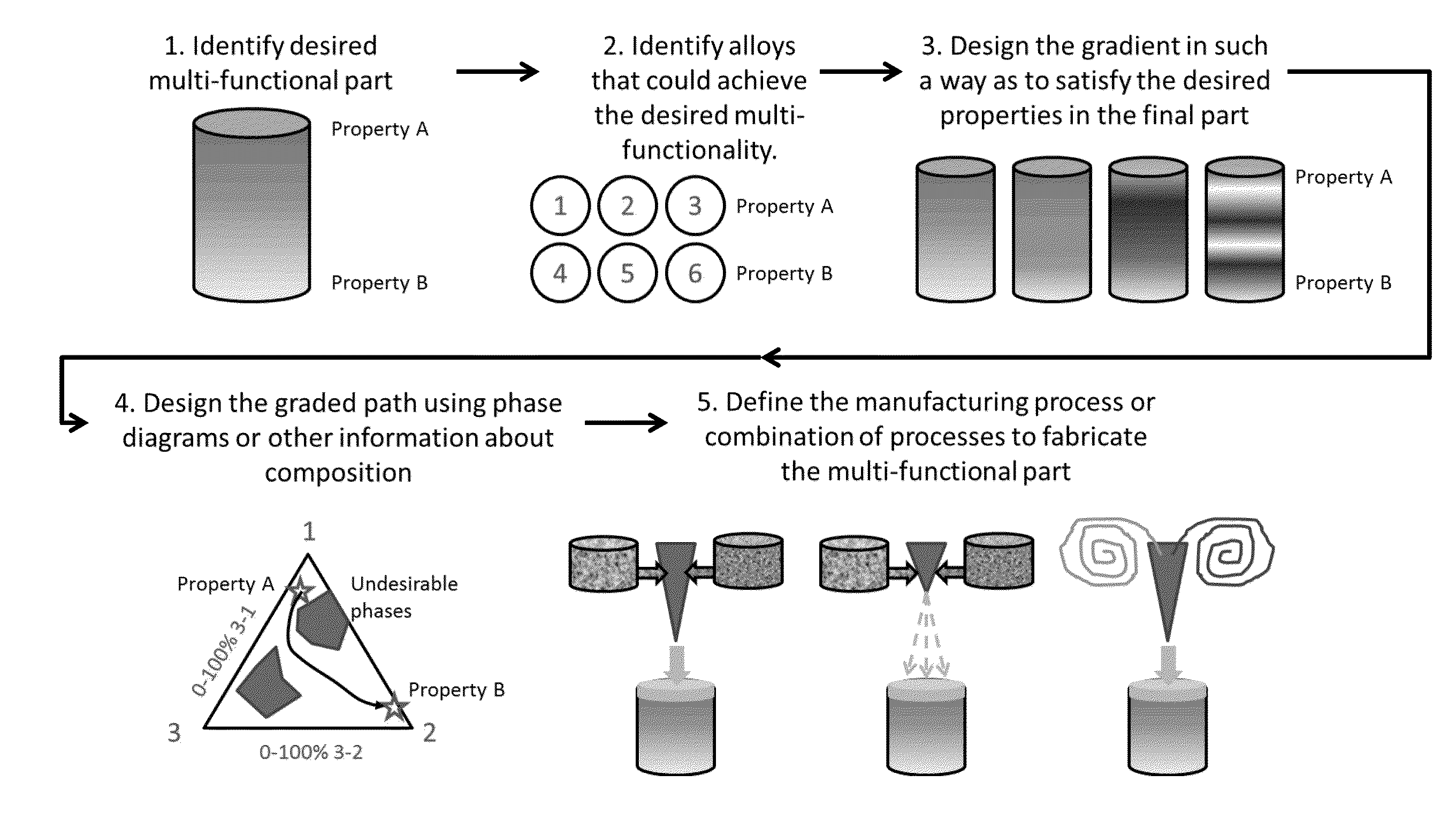
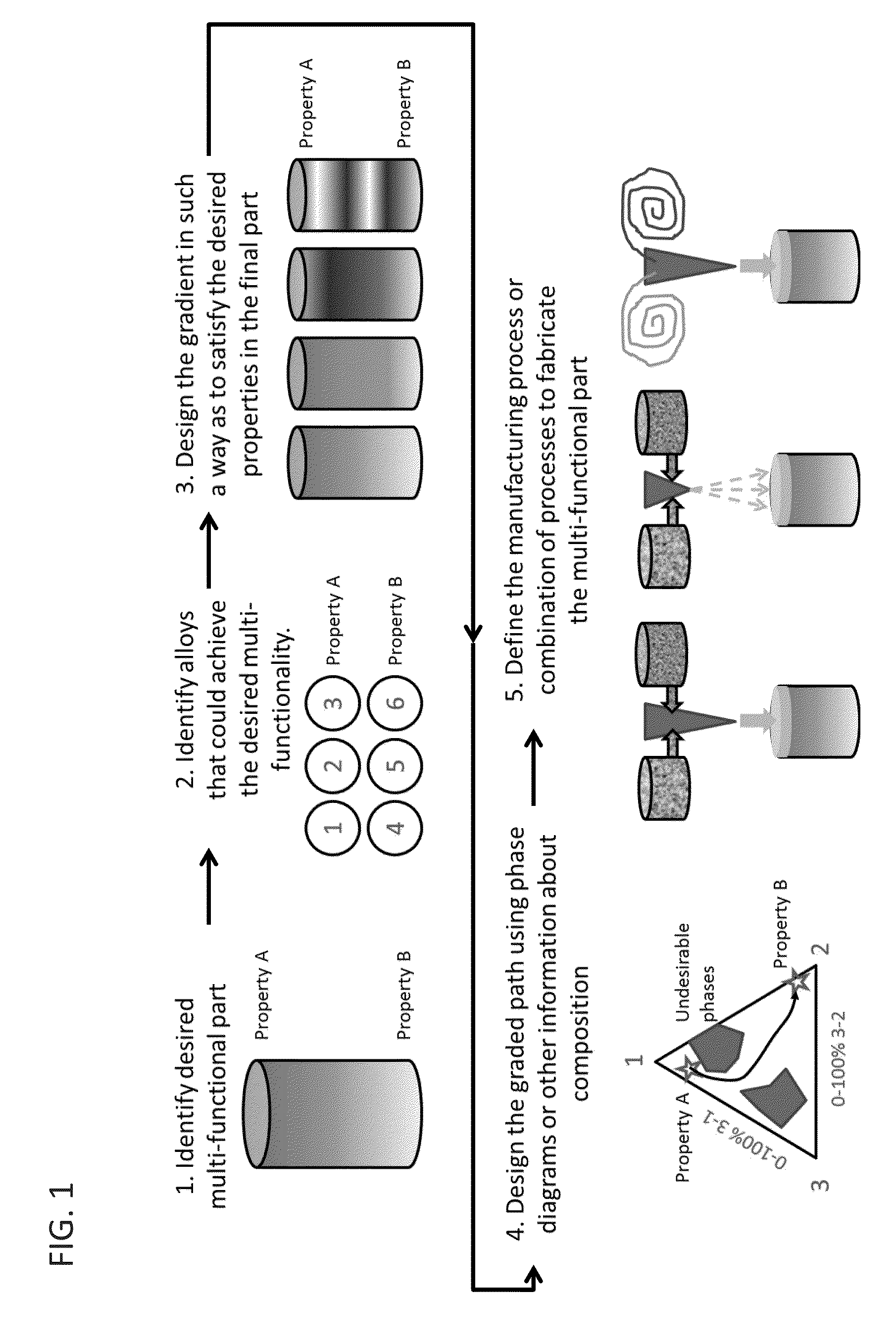
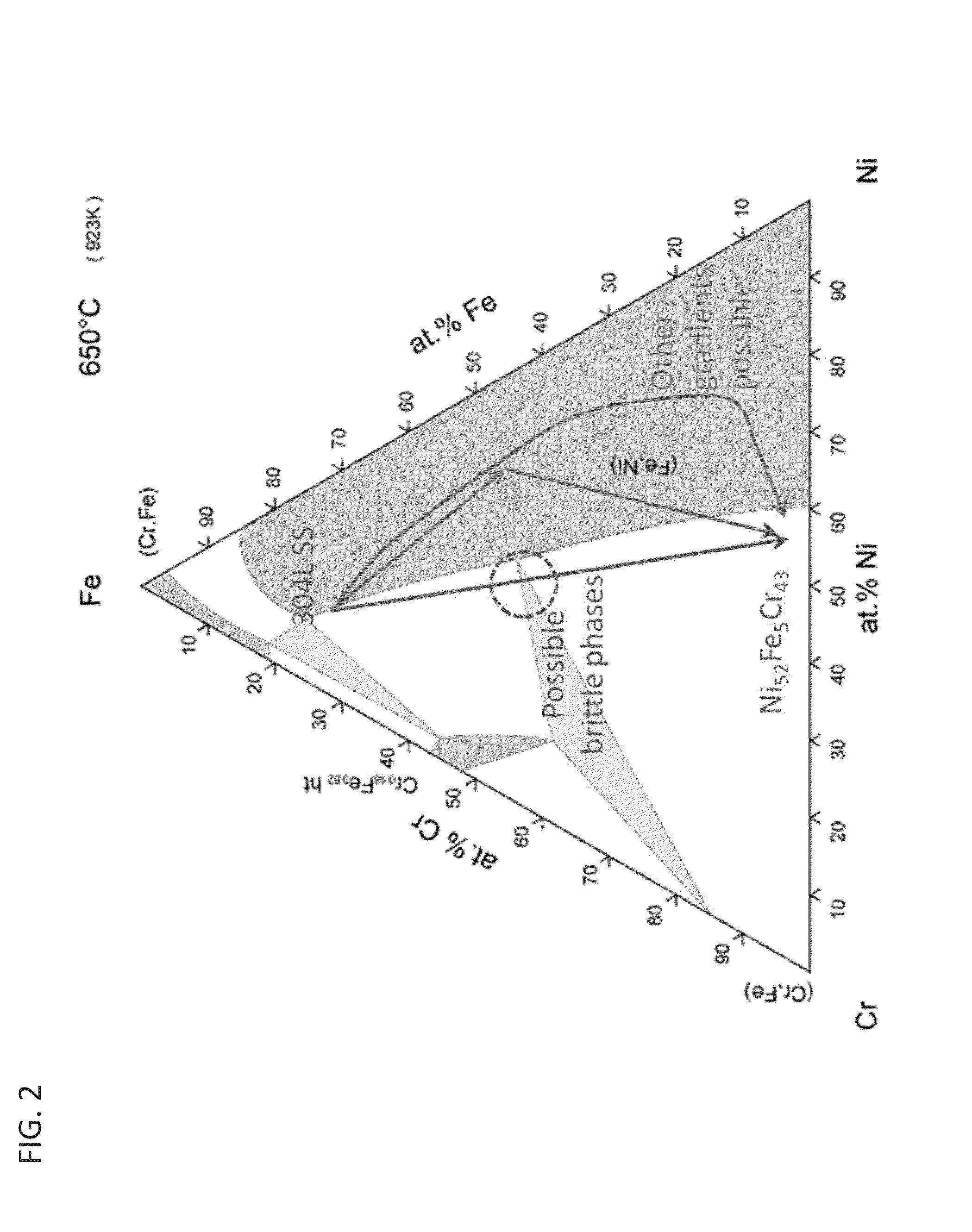
- The method involves determining a compositional gradient pathway between distinct materials using phase diagrams to avoid undesirable phases, and then using additive manufacturing techniques like Laser Engineered Net Shaping (LENS) to form multi-functional articles with precise compositional transitions, allowing for the creation of gradient layers with varying mechanical and thermophysical properties.

Laser net shape manufactured component using an adaptive toolpath deposition method
PatentActiveUS20160076374A1
Innovation
- The adaptive toolpath deposition method in Laser Net Shape Manufacturing (LNSM) uses a laser to deposit thin layers of metal powder with variable bead widths and controlled overlap ratios, allowing for precise 3D geometry creation and minimizing fusion imperfections by dynamically adjusting laser power and toolpath parameters.


Material Standards and Certification for LENS Structures
The establishment of comprehensive material standards for LENS structures represents a critical foundation for widespread industrial adoption. Current standardization efforts focus on defining acceptable material properties, including mechanical strength, surface finish, dimensional accuracy, and microstructural characteristics. Organizations such as ASTM International and ISO have initiated development of specific standards for additive manufacturing processes, with ASTM F2792 providing fundamental terminology and ASTM F3049 addressing characterization and testing of materials used in powder bed fusion processes, which serve as reference frameworks for LENS applications.
Material certification protocols for LENS structures require rigorous testing methodologies that account for the unique characteristics of laser-deposited materials. Unlike traditional manufacturing processes, LENS creates materials with directional properties and varying microstructures throughout the build volume. Certification standards must therefore incorporate anisotropic property evaluation, including tensile strength, fatigue resistance, and fracture toughness measurements in multiple orientations. These protocols typically mandate statistical sampling approaches to ensure consistent material performance across different build locations and processing parameters.
Quality assurance frameworks for LENS materials emphasize real-time monitoring and post-processing verification. In-process monitoring systems track laser power stability, powder feed rates, and thermal gradients to ensure consistent deposition conditions. Post-processing certification involves comprehensive material characterization through metallographic analysis, non-destructive testing methods such as ultrasonic inspection and computed tomography, and mechanical property validation through standardized test specimens built alongside production components.
Traceability requirements for certified LENS materials demand detailed documentation of powder feedstock properties, processing parameters, environmental conditions, and post-processing treatments. This documentation enables correlation between processing conditions and final material properties, supporting continuous improvement initiatives and failure analysis investigations. Advanced certification systems incorporate digital material passports that track component history from raw material receipt through final inspection.
Regulatory compliance considerations vary significantly across industries, with aerospace and medical applications requiring the most stringent certification protocols. Aviation authorities such as FAA and EASA have established specific requirements for additive manufacturing processes, including material qualification procedures and production oversight protocols. Medical device regulations mandate biocompatibility testing and sterilization validation for LENS-produced implants and surgical instruments.
Future certification frameworks will likely incorporate machine learning algorithms to predict material properties based on processing parameters, reducing the need for extensive physical testing while maintaining quality assurance standards. These intelligent certification systems will enable real-time quality control and adaptive processing parameter optimization during LENS operations.
Material certification protocols for LENS structures require rigorous testing methodologies that account for the unique characteristics of laser-deposited materials. Unlike traditional manufacturing processes, LENS creates materials with directional properties and varying microstructures throughout the build volume. Certification standards must therefore incorporate anisotropic property evaluation, including tensile strength, fatigue resistance, and fracture toughness measurements in multiple orientations. These protocols typically mandate statistical sampling approaches to ensure consistent material performance across different build locations and processing parameters.
Quality assurance frameworks for LENS materials emphasize real-time monitoring and post-processing verification. In-process monitoring systems track laser power stability, powder feed rates, and thermal gradients to ensure consistent deposition conditions. Post-processing certification involves comprehensive material characterization through metallographic analysis, non-destructive testing methods such as ultrasonic inspection and computed tomography, and mechanical property validation through standardized test specimens built alongside production components.
Traceability requirements for certified LENS materials demand detailed documentation of powder feedstock properties, processing parameters, environmental conditions, and post-processing treatments. This documentation enables correlation between processing conditions and final material properties, supporting continuous improvement initiatives and failure analysis investigations. Advanced certification systems incorporate digital material passports that track component history from raw material receipt through final inspection.
Regulatory compliance considerations vary significantly across industries, with aerospace and medical applications requiring the most stringent certification protocols. Aviation authorities such as FAA and EASA have established specific requirements for additive manufacturing processes, including material qualification procedures and production oversight protocols. Medical device regulations mandate biocompatibility testing and sterilization validation for LENS-produced implants and surgical instruments.
Future certification frameworks will likely incorporate machine learning algorithms to predict material properties based on processing parameters, reducing the need for extensive physical testing while maintaining quality assurance standards. These intelligent certification systems will enable real-time quality control and adaptive processing parameter optimization during LENS operations.
Quality Control and Testing Methods for LENS Components
Quality control and testing methods for LENS components represent critical aspects of ensuring manufacturing reliability and component performance in additive manufacturing processes. The unique layer-by-layer deposition nature of LENS technology requires specialized inspection approaches that differ significantly from traditional manufacturing quality assurance protocols.
Non-destructive testing methods form the foundation of LENS component evaluation. X-ray computed tomography has emerged as the primary technique for internal defect detection, enabling identification of porosity, lack of fusion, and inclusion defects without compromising component integrity. Ultrasonic testing provides complementary capabilities for detecting subsurface discontinuities, particularly in thick-walled structures where X-ray penetration may be limited.
Surface quality assessment utilizes advanced optical measurement systems including laser scanning and structured light techniques. These methods capture detailed surface topography data, enabling quantification of surface roughness parameters and dimensional accuracy verification against design specifications. White light interferometry offers nanometer-level precision for critical surface finish measurements.
Mechanical property validation requires comprehensive testing protocols addressing the anisotropic nature of LENS-built components. Tensile testing specimens must be extracted from multiple orientations to characterize directional property variations. Fatigue testing protocols have been specifically developed to account for the unique microstructural characteristics resulting from rapid solidification and thermal cycling during the LENS process.
Microstructural characterization employs metallographic analysis combined with electron microscopy techniques. Grain structure evaluation reveals the effects of thermal gradients and cooling rates on material properties. Energy-dispersive spectroscopy mapping identifies compositional variations and segregation patterns that may affect component performance.
Real-time monitoring systems integrate multiple sensor technologies including pyrometry, photodiode arrays, and acoustic emission sensors. These systems enable in-process quality assessment and adaptive control capabilities. Machine learning algorithms analyze sensor data patterns to predict potential defects before they manifest in the final component.
Statistical process control methodologies have been adapted for LENS manufacturing, incorporating build parameter monitoring and correlation analysis between process variables and final component quality. Control charts track key metrics including layer height consistency, powder flow rates, and thermal profiles to maintain process stability and repeatability.
Non-destructive testing methods form the foundation of LENS component evaluation. X-ray computed tomography has emerged as the primary technique for internal defect detection, enabling identification of porosity, lack of fusion, and inclusion defects without compromising component integrity. Ultrasonic testing provides complementary capabilities for detecting subsurface discontinuities, particularly in thick-walled structures where X-ray penetration may be limited.
Surface quality assessment utilizes advanced optical measurement systems including laser scanning and structured light techniques. These methods capture detailed surface topography data, enabling quantification of surface roughness parameters and dimensional accuracy verification against design specifications. White light interferometry offers nanometer-level precision for critical surface finish measurements.
Mechanical property validation requires comprehensive testing protocols addressing the anisotropic nature of LENS-built components. Tensile testing specimens must be extracted from multiple orientations to characterize directional property variations. Fatigue testing protocols have been specifically developed to account for the unique microstructural characteristics resulting from rapid solidification and thermal cycling during the LENS process.
Microstructural characterization employs metallographic analysis combined with electron microscopy techniques. Grain structure evaluation reveals the effects of thermal gradients and cooling rates on material properties. Energy-dispersive spectroscopy mapping identifies compositional variations and segregation patterns that may affect component performance.
Real-time monitoring systems integrate multiple sensor technologies including pyrometry, photodiode arrays, and acoustic emission sensors. These systems enable in-process quality assessment and adaptive control capabilities. Machine learning algorithms analyze sensor data patterns to predict potential defects before they manifest in the final component.
Statistical process control methodologies have been adapted for LENS manufacturing, incorporating build parameter monitoring and correlation analysis between process variables and final component quality. Control charts track key metrics including layer height consistency, powder flow rates, and thermal profiles to maintain process stability and repeatability.
Unlock deeper insights with Patsnap Eureka Quick Research — get a full tech report to explore trends and direct your research. Try now!
Generate Your Research Report Instantly with AI Agent
Supercharge your innovation with Patsnap Eureka AI Agent Platform!