

Laser Engineered Net Shaping for Mass Customization Solutions
APR 1, 20269 MIN READ
Generate Your Research Report Instantly with AI Agent
PatSnap Eureka helps you evaluate technical feasibility & market potential.
LENS Technology Background and Mass Customization Goals
Laser Engineered Net Shaping (LENS) represents a revolutionary additive manufacturing technology that emerged in the mid-1990s at Sandia National Laboratories. This directed energy deposition process utilizes a high-powered laser beam to simultaneously melt metallic powder and substrate material, creating fully dense three-dimensional components layer by layer. The technology fundamentally differs from traditional subtractive manufacturing by building parts directly from digital designs, eliminating the need for tooling and enabling complex geometries previously impossible to manufacture.
The evolution of LENS technology has been driven by the convergence of several technological advances, including precision laser systems, computer-controlled motion platforms, and sophisticated powder delivery mechanisms. Early developments focused on proving the feasibility of direct metal deposition, while subsequent iterations have emphasized improving surface finish, dimensional accuracy, and material properties. The technology has progressed from laboratory demonstrations to industrial applications across aerospace, automotive, and medical device sectors.
Mass customization has emerged as a critical manufacturing paradigm in response to increasingly diverse consumer demands and shortened product lifecycles. Traditional manufacturing approaches struggle to balance the efficiency of mass production with the flexibility required for customized products. This challenge has intensified across industries where personalization drives competitive advantage, from medical implants requiring patient-specific geometries to aerospace components demanding unique performance characteristics.
The primary goal of integrating LENS technology with mass customization strategies centers on achieving economically viable production of individualized products without the traditional trade-offs between cost, quality, and delivery time. This objective encompasses several key technical targets: reducing setup times between different product variants, minimizing material waste through near-net-shape manufacturing, and enabling real-time design modifications during production processes.
Furthermore, the technology aims to establish distributed manufacturing networks where LENS systems can produce customized components closer to end users, reducing inventory requirements and transportation costs. The ultimate vision involves creating responsive manufacturing ecosystems capable of producing unique products at costs approaching traditional mass production while maintaining superior quality and performance characteristics.
The evolution of LENS technology has been driven by the convergence of several technological advances, including precision laser systems, computer-controlled motion platforms, and sophisticated powder delivery mechanisms. Early developments focused on proving the feasibility of direct metal deposition, while subsequent iterations have emphasized improving surface finish, dimensional accuracy, and material properties. The technology has progressed from laboratory demonstrations to industrial applications across aerospace, automotive, and medical device sectors.
Mass customization has emerged as a critical manufacturing paradigm in response to increasingly diverse consumer demands and shortened product lifecycles. Traditional manufacturing approaches struggle to balance the efficiency of mass production with the flexibility required for customized products. This challenge has intensified across industries where personalization drives competitive advantage, from medical implants requiring patient-specific geometries to aerospace components demanding unique performance characteristics.
The primary goal of integrating LENS technology with mass customization strategies centers on achieving economically viable production of individualized products without the traditional trade-offs between cost, quality, and delivery time. This objective encompasses several key technical targets: reducing setup times between different product variants, minimizing material waste through near-net-shape manufacturing, and enabling real-time design modifications during production processes.
Furthermore, the technology aims to establish distributed manufacturing networks where LENS systems can produce customized components closer to end users, reducing inventory requirements and transportation costs. The ultimate vision involves creating responsive manufacturing ecosystems capable of producing unique products at costs approaching traditional mass production while maintaining superior quality and performance characteristics.
Market Demand for LENS-Based Mass Customization
The aerospace and defense industries represent the primary driving force behind LENS-based mass customization demand, where complex geometries and lightweight structures are essential for next-generation aircraft and spacecraft components. These sectors require rapid prototyping capabilities for custom brackets, heat exchangers, and structural elements that traditional manufacturing cannot efficiently produce in small batches. The ability to create parts with internal cooling channels and complex lattice structures directly addresses critical performance requirements while reducing lead times from months to weeks.
Medical device manufacturing has emerged as another significant market segment, particularly for patient-specific implants and surgical instruments. The growing trend toward personalized medicine creates substantial demand for custom orthopedic implants, dental prosthetics, and surgical guides tailored to individual patient anatomy. LENS technology enables the production of biocompatible titanium and cobalt-chrome components with precise dimensional accuracy and surface finish requirements that meet regulatory standards.
The automotive industry increasingly seeks LENS solutions for low-volume production runs and specialized components, especially in the luxury and racing vehicle segments. Custom exhaust systems, lightweight structural components, and specialized tooling represent key application areas where traditional manufacturing economics become prohibitive for small quantities. The technology's ability to repair and refurbish expensive components also creates additional market opportunities in maintenance and aftermarket services.
Energy sector applications, particularly in oil and gas exploration, nuclear power, and renewable energy systems, drive demand for custom components that can withstand extreme operating conditions. LENS enables the production of specialized valve components, turbine parts, and heat exchanger elements with material properties and geometries optimized for specific operational environments.
The tooling and mold-making industry represents an emerging market segment where LENS technology addresses the need for conformal cooling channels and complex internal geometries that enhance manufacturing efficiency. Custom injection mold inserts and specialized forming tools benefit from the technology's ability to integrate cooling systems directly into the component structure, improving cycle times and product quality in downstream manufacturing processes.
Medical device manufacturing has emerged as another significant market segment, particularly for patient-specific implants and surgical instruments. The growing trend toward personalized medicine creates substantial demand for custom orthopedic implants, dental prosthetics, and surgical guides tailored to individual patient anatomy. LENS technology enables the production of biocompatible titanium and cobalt-chrome components with precise dimensional accuracy and surface finish requirements that meet regulatory standards.
The automotive industry increasingly seeks LENS solutions for low-volume production runs and specialized components, especially in the luxury and racing vehicle segments. Custom exhaust systems, lightweight structural components, and specialized tooling represent key application areas where traditional manufacturing economics become prohibitive for small quantities. The technology's ability to repair and refurbish expensive components also creates additional market opportunities in maintenance and aftermarket services.
Energy sector applications, particularly in oil and gas exploration, nuclear power, and renewable energy systems, drive demand for custom components that can withstand extreme operating conditions. LENS enables the production of specialized valve components, turbine parts, and heat exchanger elements with material properties and geometries optimized for specific operational environments.
The tooling and mold-making industry represents an emerging market segment where LENS technology addresses the need for conformal cooling channels and complex internal geometries that enhance manufacturing efficiency. Custom injection mold inserts and specialized forming tools benefit from the technology's ability to integrate cooling systems directly into the component structure, improving cycle times and product quality in downstream manufacturing processes.
Current LENS Technology Status and Manufacturing Challenges
Laser Engineered Net Shaping (LENS) technology has reached a significant level of maturity in the additive manufacturing landscape, demonstrating capabilities for direct metal deposition with complex geometries. Current LENS systems utilize high-power laser beams ranging from 500W to 4kW, enabling processing of various metal powders including titanium alloys, stainless steels, and nickel-based superalloys. The technology achieves layer thicknesses between 0.25-1.0mm with build rates of 1-10 cubic inches per hour, depending on material and part complexity.
Contemporary LENS systems integrate advanced closed-loop control mechanisms for powder flow regulation and melt pool monitoring. Real-time feedback systems utilize pyrometers and optical sensors to maintain consistent deposition quality, while inert gas environments prevent oxidation during processing. Multi-axis capabilities allow for non-planar deposition, enabling repair operations and complex internal geometries that traditional manufacturing cannot achieve.
Despite technological advances, several manufacturing challenges persist in current LENS implementations. Thermal management remains critical, as rapid heating and cooling cycles create residual stresses leading to part distortion and cracking. The heat-affected zone extends 2-5mm from the deposition area, requiring sophisticated thermal modeling and process optimization to minimize adverse effects on substrate materials.
Surface finish quality presents another significant challenge, with as-built surfaces typically exhibiting roughness values of Ra 25-50 micrometers. Post-processing requirements including machining and heat treatment add complexity and cost to the manufacturing workflow. Powder utilization efficiency remains suboptimal at 60-80%, with unused powder requiring careful handling and recycling protocols to maintain material properties.
Process repeatability and quality assurance represent ongoing challenges for mass customization applications. Variations in powder characteristics, environmental conditions, and machine calibration can lead to inconsistent mechanical properties between builds. Current monitoring systems, while advanced, still require skilled operators for parameter adjustment and quality interpretation.
Scalability limitations affect mass customization potential, as most LENS systems operate as single-head configurations with limited build volumes. Multi-head systems exist but introduce complexity in synchronization and quality control. Integration with automated material handling and part removal systems remains underdeveloped, limiting throughput for high-volume customized production scenarios.
Contemporary LENS systems integrate advanced closed-loop control mechanisms for powder flow regulation and melt pool monitoring. Real-time feedback systems utilize pyrometers and optical sensors to maintain consistent deposition quality, while inert gas environments prevent oxidation during processing. Multi-axis capabilities allow for non-planar deposition, enabling repair operations and complex internal geometries that traditional manufacturing cannot achieve.
Despite technological advances, several manufacturing challenges persist in current LENS implementations. Thermal management remains critical, as rapid heating and cooling cycles create residual stresses leading to part distortion and cracking. The heat-affected zone extends 2-5mm from the deposition area, requiring sophisticated thermal modeling and process optimization to minimize adverse effects on substrate materials.
Surface finish quality presents another significant challenge, with as-built surfaces typically exhibiting roughness values of Ra 25-50 micrometers. Post-processing requirements including machining and heat treatment add complexity and cost to the manufacturing workflow. Powder utilization efficiency remains suboptimal at 60-80%, with unused powder requiring careful handling and recycling protocols to maintain material properties.
Process repeatability and quality assurance represent ongoing challenges for mass customization applications. Variations in powder characteristics, environmental conditions, and machine calibration can lead to inconsistent mechanical properties between builds. Current monitoring systems, while advanced, still require skilled operators for parameter adjustment and quality interpretation.
Scalability limitations affect mass customization potential, as most LENS systems operate as single-head configurations with limited build volumes. Multi-head systems exist but introduce complexity in synchronization and quality control. Integration with automated material handling and part removal systems remains underdeveloped, limiting throughput for high-volume customized production scenarios.
Existing LENS Solutions for Customized Manufacturing
01 Laser cladding and surface modification techniques
Laser Engineered Net Shaping technology can be applied for surface modification and cladding processes to enhance material properties. The technique involves using laser energy to melt and deposit materials onto substrate surfaces, creating protective coatings or repairing worn components. This process allows for precise control of material deposition, resulting in improved wear resistance, corrosion protection, and extended component life. The method is particularly useful for manufacturing and remanufacturing applications where surface quality is critical.- Laser cladding and surface modification techniques: Laser Engineered Net Shaping technology can be applied for laser cladding processes to modify surface properties of materials. This involves depositing material layer by layer using a laser beam to create coatings or repair worn surfaces. The process enables precise control over material composition and microstructure, resulting in enhanced wear resistance, corrosion resistance, and mechanical properties of the substrate material.
- Powder feeding and material delivery systems: Advanced powder feeding mechanisms are critical for laser net shaping processes. These systems control the delivery rate, flow pattern, and distribution of powder materials to the laser processing zone. Precise powder feeding ensures uniform material deposition, consistent layer thickness, and improved part quality. The systems may incorporate multiple powder feeders for processing composite or gradient materials.
- Process parameter optimization and control: Optimization of laser processing parameters is essential for achieving desired part properties in net shaping applications. Key parameters include laser power, scanning speed, powder feed rate, and layer thickness. Advanced control systems monitor and adjust these parameters in real-time to maintain process stability and part quality. Process optimization also involves thermal management to minimize residual stresses and distortion.
- Three-dimensional component manufacturing and repair: Laser net shaping enables direct fabrication of complex three-dimensional components from digital models without requiring molds or dies. The technology builds parts layer by layer through selective melting and solidification of powder materials. This additive manufacturing approach is particularly valuable for producing customized parts, prototypes, and repairing damaged or worn components in aerospace, automotive, and tooling applications.
- Material development and alloy systems: Various material systems have been developed specifically for laser net shaping processes. These include metal alloys, ceramics, composites, and functionally graded materials. Material selection depends on application requirements such as strength, temperature resistance, and corrosion resistance. Research focuses on developing new alloy compositions and understanding the relationship between processing conditions and resulting microstructures to achieve optimal mechanical properties.
02 Powder feeding and material delivery systems
Advanced powder feeding mechanisms are essential for controlling material deposition in laser-based additive manufacturing. These systems regulate the flow rate, distribution, and delivery of metal powders to the laser interaction zone. Precise powder feeding ensures uniform material deposition, consistent layer thickness, and optimal part quality. The technology includes coaxial powder delivery nozzles, carrier gas systems, and feedback control mechanisms that maintain stable processing conditions throughout the manufacturing process.Expand Specific Solutions03 Process parameter optimization and control
Optimizing processing parameters is crucial for achieving desired part properties and dimensional accuracy. Key parameters include laser power, scanning speed, powder feed rate, and layer thickness. Advanced control systems monitor and adjust these parameters in real-time to compensate for thermal variations and ensure consistent quality. The optimization process involves understanding the relationships between processing conditions and resulting microstructure, mechanical properties, and geometric accuracy of fabricated parts.Expand Specific Solutions04 Multi-material and functionally graded structures
The technology enables fabrication of components with varying material compositions and properties within a single part. By controlling the powder composition during deposition, it is possible to create functionally graded materials with smooth transitions between different alloys or material systems. This capability allows for tailoring material properties to specific functional requirements, such as combining wear-resistant surfaces with tough core materials, or integrating different thermal expansion characteristics in complex assemblies.Expand Specific Solutions05 Defect detection and quality monitoring
Real-time monitoring and quality control systems are integrated to detect defects and ensure part integrity during the manufacturing process. These systems employ various sensing technologies to monitor melt pool characteristics, temperature distribution, and layer formation. Advanced algorithms analyze sensor data to identify anomalies such as porosity, cracks, or incomplete fusion. Feedback control mechanisms can automatically adjust process parameters to correct deviations and maintain consistent part quality throughout the build process.Expand Specific Solutions
Key Players in LENS and Mass Customization Industry
The Laser Engineered Net Shaping (LENS) technology for mass customization represents an emerging sector within additive manufacturing, currently in the growth phase with expanding market opportunities driven by increasing demand for personalized products across aerospace, automotive, and medical industries. The market demonstrates significant potential as companies seek flexible manufacturing solutions that can efficiently produce small batches and customized components. Technology maturity varies considerably among key players, with established manufacturers like TRUMPF Laser and Rolls-Royce leading in industrial applications, while research institutions including Huazhong University of Science & Technology and California Institute of Technology drive fundamental innovations. Companies such as Farsoon Technologies and Wolfspeed contribute specialized materials and equipment, while tech giants like Intel and Google provide computational infrastructure and AI-driven optimization capabilities, creating a diverse ecosystem spanning from basic research to commercial implementation.
Huazhong University of Science & Technology
Technical Solution: HUST has conducted extensive research on LENS process optimization for mass customization, developing novel approaches for multi-material deposition and functionally graded structures. Their research focuses on process parameter modeling using artificial intelligence algorithms to predict optimal laser power, scanning speed, and powder feed rates for different materials and geometries. The university has developed hybrid LENS systems combining subtractive and additive processes for enhanced surface finish and dimensional accuracy. Their work includes development of specialized powder delivery systems for reactive materials and investigation of in-situ alloying techniques during deposition. HUST's research contributes to understanding microstructural evolution during LENS processing and development of process monitoring techniques using acoustic emission and thermal imaging.
Strengths: Strong research foundation, innovative process development, comprehensive academic resources for fundamental studies. Weaknesses: Limited commercial implementation, focus primarily on research rather than industrial applications, longer technology transfer timelines.
Rolls-Royce Plc
Technical Solution: Rolls-Royce has implemented LENS technology for aerospace engine component manufacturing and repair, particularly focusing on turbine blade restoration and complex internal cooling channel fabrication. Their approach combines LENS with advanced metallurgical analysis to ensure component integrity meets aviation standards. The company utilizes LENS for depositing high-temperature superalloys like Inconel 718 and René alloys, achieving mechanical properties comparable to wrought materials. Their process includes post-deposition heat treatment protocols and non-destructive testing procedures. Rolls-Royce has demonstrated successful repair of high-value engine components, reducing lead times from months to weeks while maintaining stringent quality requirements for critical aerospace applications.
Strengths: Deep aerospace application expertise, rigorous quality control standards, proven track record in critical applications. Weaknesses: Limited to aerospace-specific applications, high regulatory compliance requirements, conservative adoption of new process parameters.
Core LENS Patents and Net Shaping Innovations
Methods for fabricating gradient alloy articles with multi-functional properties
PatentActiveUS20150044084A1
Innovation
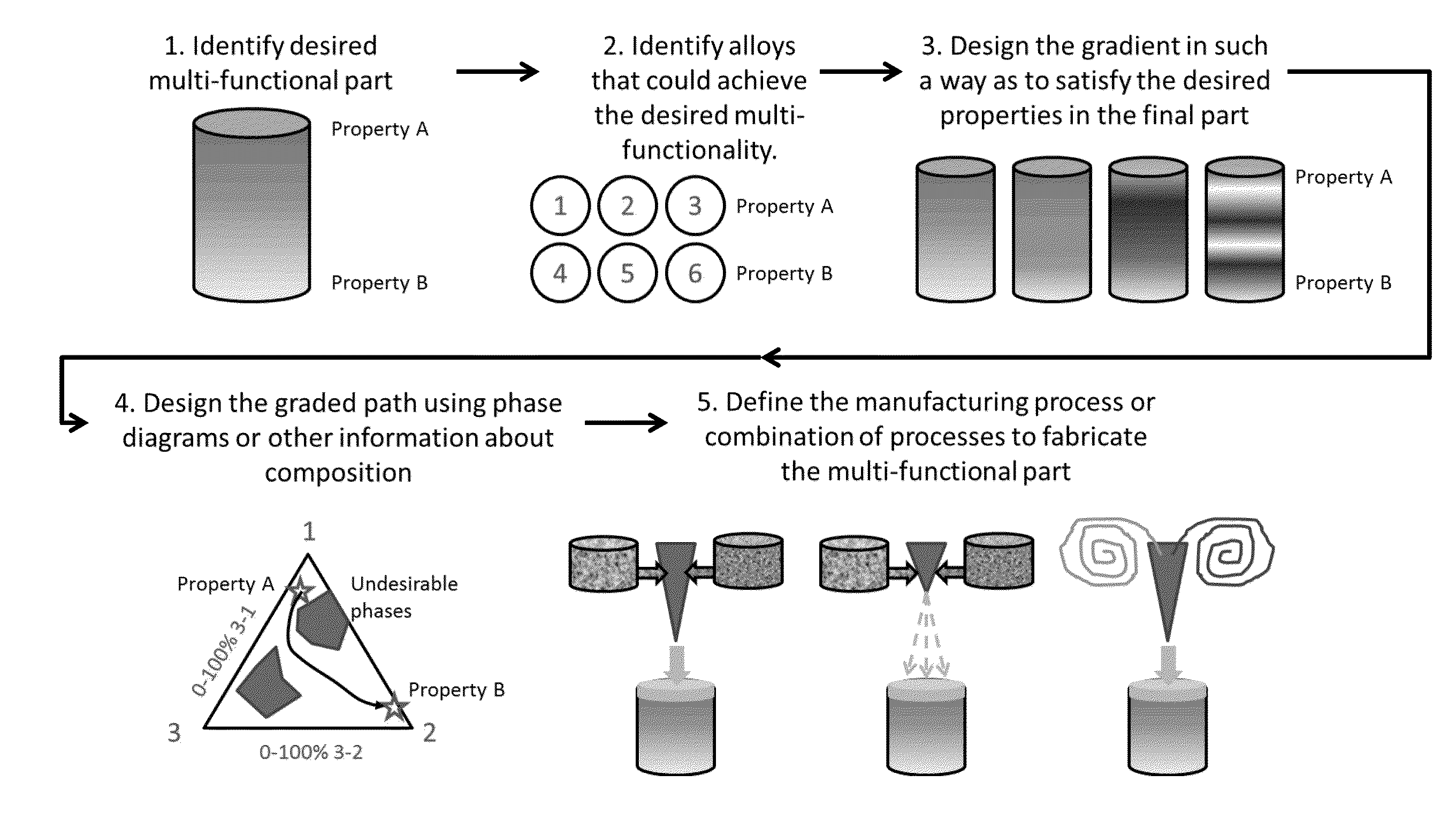
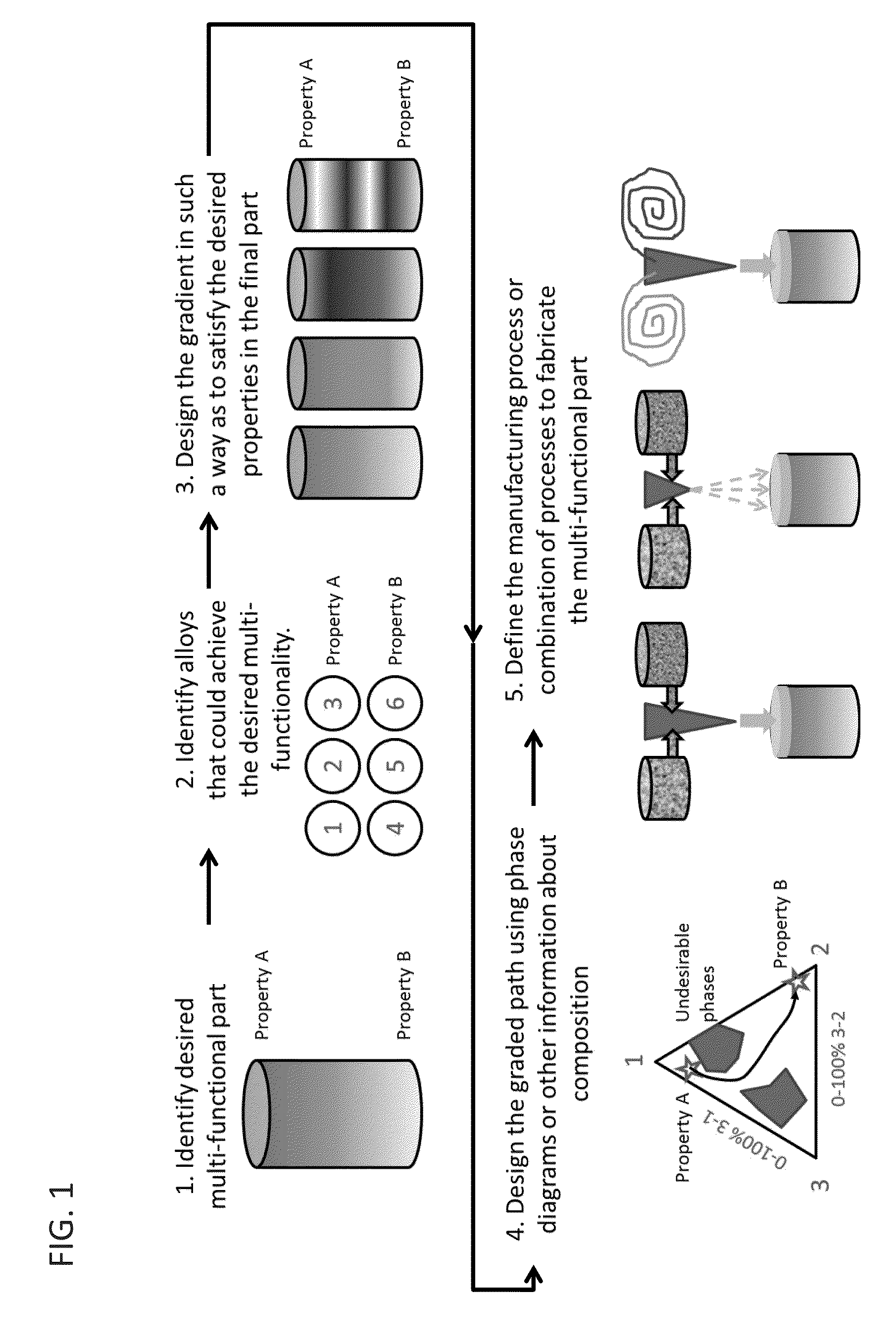
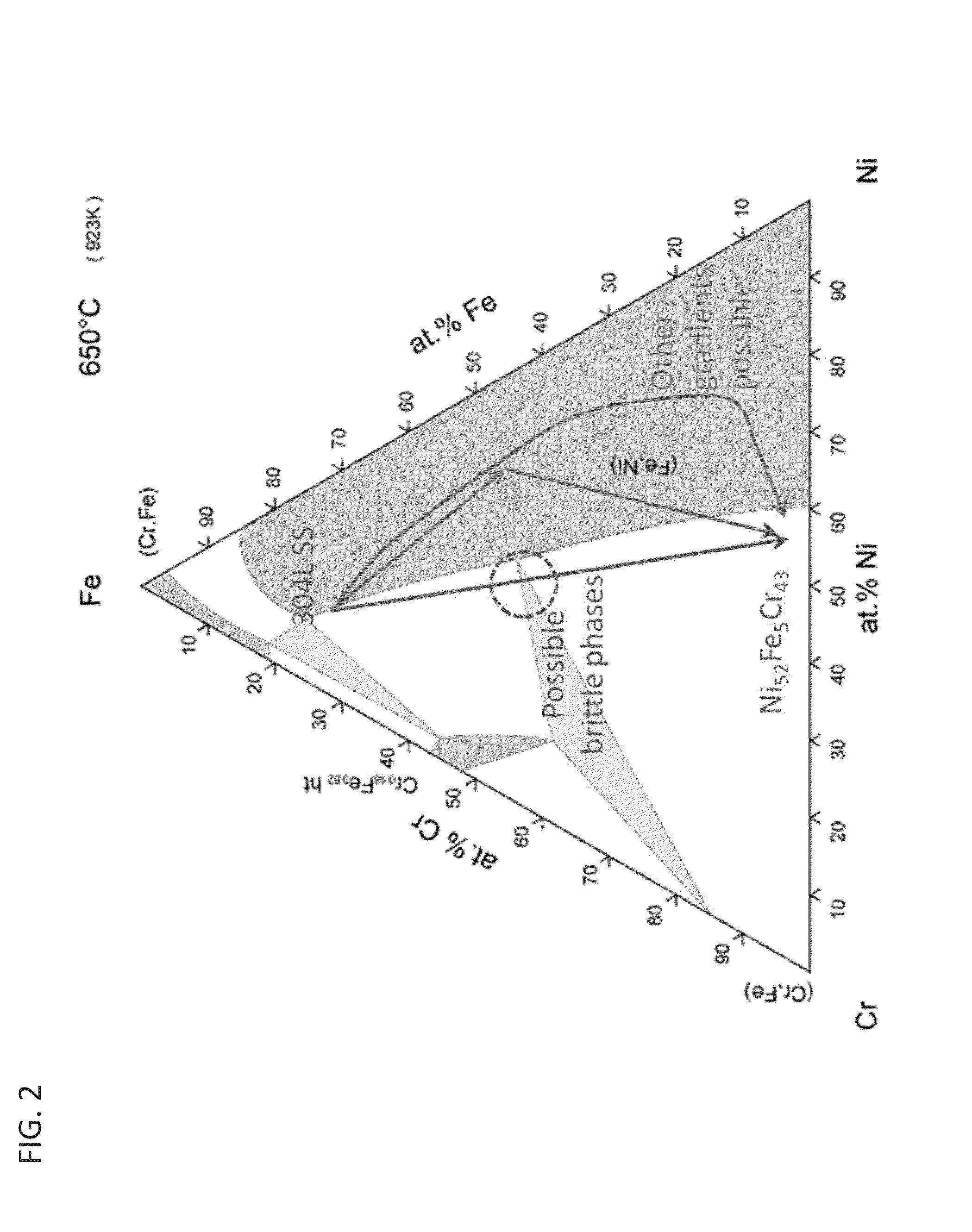
- The method involves determining a compositional gradient pathway between distinct materials using phase diagrams to avoid undesirable phases, and then using additive manufacturing techniques like Laser Engineered Net Shaping (LENS) to form multi-functional articles with precise compositional transitions, allowing for the creation of gradient layers with varying mechanical and thermophysical properties.

Mass customization in additive manufacturing
PatentActiveUS20220143917A1
Innovation
- A method for rapid production of objects using light-polymerizable resins, involving inputting boundary shapes and desired mechanical properties into a processor, subdividing the shape into work cells, selecting lattices from a database based on mechanical properties and compatibility, and performing modification operations to ensure desired properties are met, followed by additive manufacturing.


Quality Standards for LENS Manufacturing Processes
Quality standards for LENS manufacturing processes represent a critical framework for ensuring consistent and reliable production outcomes in mass customization applications. The establishment of comprehensive quality metrics addresses the inherent variability challenges associated with additive manufacturing technologies, particularly when scaling from prototype development to industrial production volumes.
The dimensional accuracy standards for LENS processes typically require tolerances within ±0.1mm for critical features, with surface roughness specifications ranging from Ra 6.3 to Ra 25 micrometers depending on application requirements. These standards must account for the layer-by-layer deposition characteristics and thermal effects that influence final part geometry. Process monitoring protocols incorporate real-time feedback systems to maintain consistent powder flow rates, laser power stability, and substrate temperature control throughout the manufacturing cycle.
Material property standards focus on mechanical performance consistency, requiring tensile strength variations within 5% of nominal values across production batches. Porosity levels must remain below 2% for structural applications, with specific requirements for fatigue resistance and fracture toughness. Microstructural uniformity standards address grain size distribution and phase composition, ensuring predictable material behavior across different geometric configurations within the same build.
Process validation protocols establish statistical process control methodologies specifically adapted for LENS operations. These include pre-production qualification procedures, in-process monitoring checkpoints, and post-production verification testing. Quality assurance frameworks incorporate automated inspection systems utilizing coordinate measuring machines and non-destructive testing methods to verify compliance with established standards.
Certification requirements align with industry-specific regulations, particularly for aerospace and medical applications where traceability and documentation standards are stringent. The quality management system integrates ISO 9001 principles with additive manufacturing-specific guidelines, establishing clear procedures for material certification, equipment calibration, and operator qualification. These comprehensive standards enable LENS technology to achieve the reliability and repeatability necessary for successful mass customization implementation across diverse industrial applications.
The dimensional accuracy standards for LENS processes typically require tolerances within ±0.1mm for critical features, with surface roughness specifications ranging from Ra 6.3 to Ra 25 micrometers depending on application requirements. These standards must account for the layer-by-layer deposition characteristics and thermal effects that influence final part geometry. Process monitoring protocols incorporate real-time feedback systems to maintain consistent powder flow rates, laser power stability, and substrate temperature control throughout the manufacturing cycle.
Material property standards focus on mechanical performance consistency, requiring tensile strength variations within 5% of nominal values across production batches. Porosity levels must remain below 2% for structural applications, with specific requirements for fatigue resistance and fracture toughness. Microstructural uniformity standards address grain size distribution and phase composition, ensuring predictable material behavior across different geometric configurations within the same build.
Process validation protocols establish statistical process control methodologies specifically adapted for LENS operations. These include pre-production qualification procedures, in-process monitoring checkpoints, and post-production verification testing. Quality assurance frameworks incorporate automated inspection systems utilizing coordinate measuring machines and non-destructive testing methods to verify compliance with established standards.
Certification requirements align with industry-specific regulations, particularly for aerospace and medical applications where traceability and documentation standards are stringent. The quality management system integrates ISO 9001 principles with additive manufacturing-specific guidelines, establishing clear procedures for material certification, equipment calibration, and operator qualification. These comprehensive standards enable LENS technology to achieve the reliability and repeatability necessary for successful mass customization implementation across diverse industrial applications.
Sustainability Impact of LENS Mass Production
The sustainability impact of LENS mass production represents a paradigm shift in manufacturing environmental considerations, fundamentally altering traditional production footprints through additive manufacturing principles. Unlike conventional subtractive manufacturing processes that generate substantial material waste, LENS technology achieves near-net-shape production with material utilization rates exceeding 95%, dramatically reducing raw material consumption and associated extraction impacts.
Energy efficiency emerges as a critical sustainability factor in LENS mass production implementations. While laser systems require significant power input during operation, the elimination of multiple manufacturing stages, tooling requirements, and extensive machining operations results in overall energy reduction of 30-40% compared to traditional manufacturing chains. The localized heating approach inherent to LENS processes minimizes thermal energy waste, concentrating power delivery precisely where material consolidation occurs.
Carbon footprint reduction manifests through multiple pathways in LENS mass production scenarios. The technology's capability to produce complex geometries in single operations eliminates transportation between manufacturing facilities, reducing logistics-related emissions. Additionally, the ability to repair and refurbish existing components rather than complete replacement extends product lifecycles significantly, contributing to circular economy principles and reducing overall material demand.
Waste stream management in LENS mass production demonstrates substantial environmental advantages. Powder-based feedstock systems enable complete recycling of unused materials, with reclamation rates approaching 98% under proper handling protocols. This closed-loop material flow contrasts sharply with traditional machining operations where metal chips and cutting fluids create complex waste disposal challenges requiring specialized treatment facilities.
The decentralized production potential of LENS technology supports sustainable manufacturing distribution models. By enabling on-demand production closer to end-users, LENS systems reduce global supply chain dependencies and associated transportation emissions. This distributed manufacturing approach particularly benefits customized products, where traditional economies of scale become less relevant compared to localized production efficiency and reduced inventory requirements.
However, sustainability challenges persist in LENS mass production scaling. Powder production processes remain energy-intensive, requiring specialized atomization techniques and quality control measures. Additionally, the technology's current limitation to specific material classes restricts its applicability across broader manufacturing sectors, potentially limiting overall environmental impact potential until material compatibility expands significantly.
Energy efficiency emerges as a critical sustainability factor in LENS mass production implementations. While laser systems require significant power input during operation, the elimination of multiple manufacturing stages, tooling requirements, and extensive machining operations results in overall energy reduction of 30-40% compared to traditional manufacturing chains. The localized heating approach inherent to LENS processes minimizes thermal energy waste, concentrating power delivery precisely where material consolidation occurs.
Carbon footprint reduction manifests through multiple pathways in LENS mass production scenarios. The technology's capability to produce complex geometries in single operations eliminates transportation between manufacturing facilities, reducing logistics-related emissions. Additionally, the ability to repair and refurbish existing components rather than complete replacement extends product lifecycles significantly, contributing to circular economy principles and reducing overall material demand.
Waste stream management in LENS mass production demonstrates substantial environmental advantages. Powder-based feedstock systems enable complete recycling of unused materials, with reclamation rates approaching 98% under proper handling protocols. This closed-loop material flow contrasts sharply with traditional machining operations where metal chips and cutting fluids create complex waste disposal challenges requiring specialized treatment facilities.
The decentralized production potential of LENS technology supports sustainable manufacturing distribution models. By enabling on-demand production closer to end-users, LENS systems reduce global supply chain dependencies and associated transportation emissions. This distributed manufacturing approach particularly benefits customized products, where traditional economies of scale become less relevant compared to localized production efficiency and reduced inventory requirements.
However, sustainability challenges persist in LENS mass production scaling. Powder production processes remain energy-intensive, requiring specialized atomization techniques and quality control measures. Additionally, the technology's current limitation to specific material classes restricts its applicability across broader manufacturing sectors, potentially limiting overall environmental impact potential until material compatibility expands significantly.
Unlock deeper insights with PatSnap Eureka Quick Research — get a full tech report to explore trends and direct your research. Try now!
Generate Your Research Report Instantly with AI Agent
Supercharge your innovation with PatSnap Eureka AI Agent Platform!