

Lightweight Materials Research for Scramjet Structural Components
AUG 13, 20259 MIN READ
Generate Your Research Report Instantly with AI Agent
PatSnap Eureka helps you evaluate technical feasibility & market potential.
Scramjet Lightweight Materials Evolution and Objectives
The evolution of lightweight materials for scramjet structural components has been a critical focus in aerospace engineering over the past decades. This field has witnessed significant advancements, driven by the need for materials that can withstand extreme temperatures and stresses while maintaining minimal weight. The journey began with conventional aerospace alloys and has progressed towards more exotic composites and ceramics.
In the early stages, titanium alloys were the primary choice due to their high strength-to-weight ratio and temperature resistance. However, as scramjet technology advanced, the demand for materials capable of withstanding even higher temperatures and offering better weight savings intensified. This led to the development of nickel-based superalloys and advanced titanium alloys, which provided improved performance at elevated temperatures.
The next significant leap came with the introduction of carbon-carbon composites. These materials offered exceptional heat resistance and lightweight properties, making them ideal for leading edges and other high-temperature zones in scramjet structures. Concurrently, ceramic matrix composites (CMCs) emerged as promising candidates, offering excellent thermal and mechanical properties.
Recent years have seen a surge in research on ultra-high temperature ceramics (UHTCs) and their composites. Materials such as zirconium diboride and hafnium diboride have shown remarkable potential for use in extreme temperature environments, pushing the boundaries of what's possible in scramjet design.
The objectives of lightweight materials research for scramjet structural components are multifaceted. Primarily, there is a continuous drive to reduce the overall weight of the vehicle while maintaining or improving structural integrity. This weight reduction is crucial for increasing payload capacity and improving fuel efficiency.
Another key objective is to develop materials that can withstand the extreme thermal and mechanical stresses encountered during hypersonic flight. This includes resistance to oxidation, thermal shock, and erosion, all while maintaining dimensional stability under high-temperature gradients.
Researchers are also focusing on improving the manufacturability and cost-effectiveness of these advanced materials. The goal is to develop production techniques that can scale up from laboratory samples to full-sized components without compromising material properties or significantly increasing costs.
Looking forward, the field aims to push the temperature limits even further, exploring novel material combinations and nanostructured materials that could revolutionize scramjet design. There's also a growing emphasis on multi-functional materials that can serve structural, thermal management, and even propulsion roles simultaneously, potentially leading to more integrated and efficient scramjet designs.
In the early stages, titanium alloys were the primary choice due to their high strength-to-weight ratio and temperature resistance. However, as scramjet technology advanced, the demand for materials capable of withstanding even higher temperatures and offering better weight savings intensified. This led to the development of nickel-based superalloys and advanced titanium alloys, which provided improved performance at elevated temperatures.
The next significant leap came with the introduction of carbon-carbon composites. These materials offered exceptional heat resistance and lightweight properties, making them ideal for leading edges and other high-temperature zones in scramjet structures. Concurrently, ceramic matrix composites (CMCs) emerged as promising candidates, offering excellent thermal and mechanical properties.
Recent years have seen a surge in research on ultra-high temperature ceramics (UHTCs) and their composites. Materials such as zirconium diboride and hafnium diboride have shown remarkable potential for use in extreme temperature environments, pushing the boundaries of what's possible in scramjet design.
The objectives of lightweight materials research for scramjet structural components are multifaceted. Primarily, there is a continuous drive to reduce the overall weight of the vehicle while maintaining or improving structural integrity. This weight reduction is crucial for increasing payload capacity and improving fuel efficiency.
Another key objective is to develop materials that can withstand the extreme thermal and mechanical stresses encountered during hypersonic flight. This includes resistance to oxidation, thermal shock, and erosion, all while maintaining dimensional stability under high-temperature gradients.
Researchers are also focusing on improving the manufacturability and cost-effectiveness of these advanced materials. The goal is to develop production techniques that can scale up from laboratory samples to full-sized components without compromising material properties or significantly increasing costs.
Looking forward, the field aims to push the temperature limits even further, exploring novel material combinations and nanostructured materials that could revolutionize scramjet design. There's also a growing emphasis on multi-functional materials that can serve structural, thermal management, and even propulsion roles simultaneously, potentially leading to more integrated and efficient scramjet designs.
Aerospace Market Demand for Advanced Structural Materials
The aerospace industry is experiencing a growing demand for advanced structural materials, particularly in the development of scramjet engines. This demand is driven by the need for lightweight, high-strength materials capable of withstanding extreme temperatures and pressures encountered during hypersonic flight. The market for these materials is expanding rapidly, with projections indicating significant growth over the next decade.
Scramjet engines require structural components that can maintain their integrity under intense thermal and mechanical stresses. Traditional materials often fall short in meeting these demanding requirements, creating a substantial market opportunity for innovative lightweight materials. The aerospace sector, including both commercial and defense applications, is actively seeking materials that offer superior strength-to-weight ratios, thermal resistance, and durability.
The global market for advanced aerospace materials is expected to grow substantially, with a particular focus on materials suitable for hypersonic applications. This growth is fueled by increased investment in hypersonic technology by major aerospace companies and government agencies worldwide. The United States, China, and Russia are at the forefront of this race, allocating significant resources to develop hypersonic capabilities, thus driving the demand for cutting-edge materials.
In the commercial sector, there is a rising interest in hypersonic travel, with several companies exploring the potential for ultra-fast passenger aircraft. This emerging market segment is creating additional demand for lightweight, heat-resistant materials that can be used in the construction of scramjet-powered vehicles. The potential for reduced travel times and increased efficiency in long-distance flights is a major driver for this market.
The defense sector remains a key driver of demand for advanced structural materials in scramjet applications. Military organizations worldwide are investing heavily in hypersonic missile technology and reconnaissance platforms, which require materials capable of withstanding extreme conditions. This has led to increased funding for research and development of novel materials specifically tailored for scramjet engines and related hypersonic technologies.
Environmental considerations are also influencing the market demand for advanced materials in aerospace applications. There is a growing emphasis on developing materials that not only meet performance requirements but also contribute to improved fuel efficiency and reduced emissions. This aligns with broader industry trends towards sustainability and environmental responsibility, further driving innovation in lightweight material research for scramjet structural components.
Scramjet engines require structural components that can maintain their integrity under intense thermal and mechanical stresses. Traditional materials often fall short in meeting these demanding requirements, creating a substantial market opportunity for innovative lightweight materials. The aerospace sector, including both commercial and defense applications, is actively seeking materials that offer superior strength-to-weight ratios, thermal resistance, and durability.
The global market for advanced aerospace materials is expected to grow substantially, with a particular focus on materials suitable for hypersonic applications. This growth is fueled by increased investment in hypersonic technology by major aerospace companies and government agencies worldwide. The United States, China, and Russia are at the forefront of this race, allocating significant resources to develop hypersonic capabilities, thus driving the demand for cutting-edge materials.
In the commercial sector, there is a rising interest in hypersonic travel, with several companies exploring the potential for ultra-fast passenger aircraft. This emerging market segment is creating additional demand for lightweight, heat-resistant materials that can be used in the construction of scramjet-powered vehicles. The potential for reduced travel times and increased efficiency in long-distance flights is a major driver for this market.
The defense sector remains a key driver of demand for advanced structural materials in scramjet applications. Military organizations worldwide are investing heavily in hypersonic missile technology and reconnaissance platforms, which require materials capable of withstanding extreme conditions. This has led to increased funding for research and development of novel materials specifically tailored for scramjet engines and related hypersonic technologies.
Environmental considerations are also influencing the market demand for advanced materials in aerospace applications. There is a growing emphasis on developing materials that not only meet performance requirements but also contribute to improved fuel efficiency and reduced emissions. This aligns with broader industry trends towards sustainability and environmental responsibility, further driving innovation in lightweight material research for scramjet structural components.
Current Challenges in Scramjet Structural Materials
The development of lightweight materials for scramjet structural components faces several significant challenges. One of the primary issues is the extreme operating conditions these materials must withstand. Scramjet engines operate at hypersonic speeds, exposing structural components to temperatures exceeding 2000°C and intense aerodynamic heating. This environment demands materials with exceptional thermal resistance and stability.
Another critical challenge is the need for materials that maintain their structural integrity under high-stress conditions. The intense pressure and vibration experienced during hypersonic flight can lead to material fatigue and failure. Researchers are grappling with the task of developing materials that offer both high strength-to-weight ratios and resistance to thermal and mechanical stresses.
Oxidation resistance is a crucial factor in material selection for scramjet components. At hypersonic speeds, the air becomes highly reactive, potentially causing rapid oxidation of structural materials. This oxidation can lead to material degradation and compromise the integrity of the entire system. Developing materials with inherent oxidation resistance or effective protective coatings is an ongoing challenge.
The manufacturing and processing of advanced lightweight materials present another set of hurdles. Many promising materials, such as ceramic matrix composites (CMCs) and advanced metal alloys, require complex manufacturing processes. Ensuring consistency in material properties, scalability of production, and cost-effectiveness are significant challenges that researchers and engineers must address.
Thermal management is a critical aspect of scramjet design, and it poses unique challenges for material selection. Materials must not only withstand high temperatures but also effectively dissipate heat to protect other components. Balancing thermal conductivity with other desirable properties like strength and weight is a complex optimization problem.
Lastly, the long-term durability and reliability of materials in the scramjet environment remain largely unknown. The lack of extensive real-world testing data for many advanced materials in hypersonic conditions creates uncertainty in predicting their long-term performance. This gap in knowledge poses risks for the design and operation of scramjet-powered vehicles.
Another critical challenge is the need for materials that maintain their structural integrity under high-stress conditions. The intense pressure and vibration experienced during hypersonic flight can lead to material fatigue and failure. Researchers are grappling with the task of developing materials that offer both high strength-to-weight ratios and resistance to thermal and mechanical stresses.
Oxidation resistance is a crucial factor in material selection for scramjet components. At hypersonic speeds, the air becomes highly reactive, potentially causing rapid oxidation of structural materials. This oxidation can lead to material degradation and compromise the integrity of the entire system. Developing materials with inherent oxidation resistance or effective protective coatings is an ongoing challenge.
The manufacturing and processing of advanced lightweight materials present another set of hurdles. Many promising materials, such as ceramic matrix composites (CMCs) and advanced metal alloys, require complex manufacturing processes. Ensuring consistency in material properties, scalability of production, and cost-effectiveness are significant challenges that researchers and engineers must address.
Thermal management is a critical aspect of scramjet design, and it poses unique challenges for material selection. Materials must not only withstand high temperatures but also effectively dissipate heat to protect other components. Balancing thermal conductivity with other desirable properties like strength and weight is a complex optimization problem.
Lastly, the long-term durability and reliability of materials in the scramjet environment remain largely unknown. The lack of extensive real-world testing data for many advanced materials in hypersonic conditions creates uncertainty in predicting their long-term performance. This gap in knowledge poses risks for the design and operation of scramjet-powered vehicles.
Existing Lightweight Solutions for Scramjet Structures
01 Lightweight composite materials
Composite materials are used to create lightweight structures with high strength-to-weight ratios. These materials often combine different components, such as fibers and resins, to achieve desired properties. They are widely used in industries where weight reduction is crucial, such as aerospace and automotive.- Lightweight composite materials: Composite materials are developed to reduce weight while maintaining strength. These materials often combine different components such as fibers, resins, and lightweight fillers to achieve optimal properties. They are used in various applications including aerospace, automotive, and sporting goods industries.
- Lightweight metal alloys: Advanced metal alloys, particularly those based on aluminum, magnesium, or titanium, are engineered to provide high strength-to-weight ratios. These alloys are crucial in reducing the overall weight of structures and components in transportation and construction sectors.
- Foam-based lightweight materials: Foam materials, including metal foams and polymer foams, offer significant weight reduction possibilities. These materials feature a cellular structure that provides low density while maintaining adequate mechanical properties, making them suitable for various applications such as insulation and impact absorption.
- Nanostructured lightweight materials: Nanotechnology is employed to create ultra-lightweight materials with enhanced properties. By manipulating materials at the nanoscale, it's possible to achieve significant weight reduction while improving strength, stiffness, and other desirable characteristics.
- Lightweight textiles and fabrics: Advanced textiles and fabrics are developed using innovative fibers and manufacturing techniques to reduce weight. These materials find applications in clothing, protective gear, and technical textiles where low weight is crucial for performance and comfort.
02 Lightweight metal alloys
Metal alloys, particularly those based on aluminum, magnesium, or titanium, are developed to provide lightweight solutions for various applications. These alloys offer reduced weight while maintaining necessary strength and durability. They are commonly used in transportation and construction industries.Expand Specific Solutions03 Lightweight polymers and plastics
Advanced polymers and plastics are engineered to offer lightweight alternatives to traditional materials. These materials can be tailored to have specific properties such as high strength, impact resistance, or thermal stability while maintaining a low weight. They find applications in consumer products, packaging, and automotive components.Expand Specific Solutions04 Lightweight construction techniques
Innovative construction techniques and designs are employed to reduce the overall weight of structures and products. These may include the use of honeycomb structures, foam cores, or optimized geometries that minimize material usage while maintaining structural integrity. Such techniques are applied in architecture, aerospace, and product design.Expand Specific Solutions05 Lightweight nanomaterials
Nanomaterials, such as carbon nanotubes or graphene, are utilized to create ultra-lightweight materials with exceptional properties. These materials can offer high strength and stiffness at extremely low densities. They have potential applications in advanced composites, electronics, and energy storage devices.Expand Specific Solutions
Key Players in Aerospace Lightweight Materials Industry
The lightweight materials research for scramjet structural components is in a nascent stage, with significant potential for growth. The market is relatively small but expanding rapidly due to increasing interest in hypersonic technologies. The technical maturity is still developing, with key players like Airbus Operations GmbH, Boeing Co., and Fraunhofer-Gesellschaft eV leading research efforts. Academic institutions such as Harbin Institute of Technology and National University of Defense Technology are also contributing to advancements. The competitive landscape is characterized by a mix of aerospace giants, research organizations, and specialized materials companies, indicating a collaborative yet competitive environment as the technology progresses towards practical applications.
Airbus Operations GmbH
Technical Solution: Airbus has focused on developing lightweight materials for scramjet structural components through their innovative use of advanced composites and metal alloys. They have pioneered the application of titanium-matrix composites (TMCs) for high-temperature regions of scramjet engines, offering superior strength-to-weight ratios compared to traditional superalloys[4]. Airbus has also invested in the development of ceramic matrix composites (CMCs) reinforced with silicon carbide fibers, capable of withstanding temperatures up to 1600°C while maintaining structural integrity[5]. Their research includes the integration of thermal protection systems using ablative materials and the exploration of functionally graded materials to optimize weight and thermal performance[6].
Strengths: Strong expertise in composite materials and thermal protection systems. Weaknesses: Potential high production costs and limited experience with scramjet-specific applications.
Harbin Institute of Technology
Technical Solution: Harbin Institute of Technology (HIT) has been at the forefront of lightweight materials research for scramjet structural components in China. Their approach focuses on developing ultra-high temperature ceramics (UHTCs) and advanced carbon-based composites. HIT has made breakthroughs in the synthesis of zirconium diboride (ZrB2) and hafnium diboride (HfB2) based UHTCs with improved oxidation resistance and mechanical properties at extreme temperatures[10]. They have also explored novel carbon/carbon-silicon carbide (C/C-SiC) composites with tailored microstructures to enhance thermal shock resistance and reduce weight[11]. HIT's research includes the development of gradient porosity structures to optimize thermal insulation while maintaining structural integrity[12].
Strengths: Strong expertise in UHTCs and carbon-based composites, state-of-the-art research facilities. Weaknesses: Potential challenges in technology transfer and international collaboration due to geopolitical factors.
Core Innovations in High-Temperature Resistant Composites
Step cylinder combustor design
PatentInactiveUS3864907A
Innovation
- A combustor chamber design with multiple stabilizing steps followed by constant area cylindrical sections allows for selective heat addition, avoiding divergent flow issues and enabling greater heat and energy input through progressively increasing diameter chambers.


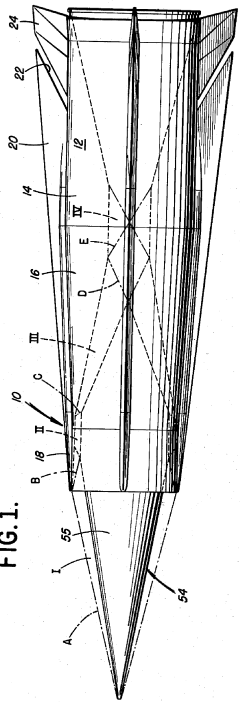
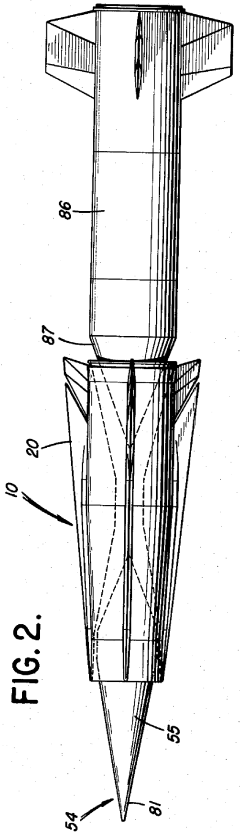
Supersonic ramjet missile
PatentInactiveUS4291533A
Innovation
- A supersonic combustion ramjet missile design that accelerates from Mach 4 to Mach 6.5-7 at sea level and Mach 8.5-10 at altitude, featuring a structural design with thermal protection using titanium or magnesium alloys, refractory materials, and active cooling, along with a booster rocket for efficient thrust and maneuverability, enabling rapid altitude gain and extended range.


Environmental Impact of Advanced Aerospace Materials
The environmental impact of advanced aerospace materials, particularly those used in lightweight scramjet structural components, is a critical consideration in the development of next-generation aerospace technologies. These materials, while offering significant performance benefits, also present unique environmental challenges throughout their lifecycle.
During the production phase, advanced aerospace materials often require energy-intensive manufacturing processes. The creation of high-performance composites, such as carbon fiber reinforced polymers (CFRPs) and ceramic matrix composites (CMCs), involves complex chemical reactions and high-temperature treatments. These processes can result in substantial greenhouse gas emissions and the release of potentially harmful chemicals into the environment.
The use of rare earth elements and exotic alloys in some advanced aerospace materials raises concerns about resource depletion and the environmental impact of mining operations. Extraction of these materials can lead to habitat destruction, soil erosion, and water pollution in mining regions. Additionally, the global supply chain for these materials often involves long-distance transportation, further contributing to the carbon footprint.
In-service environmental impacts of lightweight scramjet materials are generally positive. Their reduced weight leads to improved fuel efficiency and lower emissions during flight operations. However, the potential for material degradation in extreme operating conditions may result in the release of microscopic particles into the upper atmosphere, with unknown long-term environmental consequences.
End-of-life considerations for advanced aerospace materials present significant challenges. Many of these materials are not easily recyclable due to their complex compositions and the difficulty in separating different components. The disposal of composite materials, in particular, can be problematic as they often cannot be incinerated without releasing toxic fumes and are not biodegradable.
Research into more environmentally friendly alternatives is ongoing. Bio-based composites and recyclable thermoplastic matrices are being explored as potential substitutes for traditional aerospace materials. Additionally, advancements in additive manufacturing techniques may lead to more efficient production processes with less material waste.
The aerospace industry is increasingly adopting life cycle assessment (LCA) methodologies to evaluate and mitigate the environmental impact of advanced materials. This holistic approach considers environmental effects from raw material extraction through manufacturing, use, and disposal, helping to guide more sustainable material choices and production methods for future scramjet and aerospace applications.
During the production phase, advanced aerospace materials often require energy-intensive manufacturing processes. The creation of high-performance composites, such as carbon fiber reinforced polymers (CFRPs) and ceramic matrix composites (CMCs), involves complex chemical reactions and high-temperature treatments. These processes can result in substantial greenhouse gas emissions and the release of potentially harmful chemicals into the environment.
The use of rare earth elements and exotic alloys in some advanced aerospace materials raises concerns about resource depletion and the environmental impact of mining operations. Extraction of these materials can lead to habitat destruction, soil erosion, and water pollution in mining regions. Additionally, the global supply chain for these materials often involves long-distance transportation, further contributing to the carbon footprint.
In-service environmental impacts of lightweight scramjet materials are generally positive. Their reduced weight leads to improved fuel efficiency and lower emissions during flight operations. However, the potential for material degradation in extreme operating conditions may result in the release of microscopic particles into the upper atmosphere, with unknown long-term environmental consequences.
End-of-life considerations for advanced aerospace materials present significant challenges. Many of these materials are not easily recyclable due to their complex compositions and the difficulty in separating different components. The disposal of composite materials, in particular, can be problematic as they often cannot be incinerated without releasing toxic fumes and are not biodegradable.
Research into more environmentally friendly alternatives is ongoing. Bio-based composites and recyclable thermoplastic matrices are being explored as potential substitutes for traditional aerospace materials. Additionally, advancements in additive manufacturing techniques may lead to more efficient production processes with less material waste.
The aerospace industry is increasingly adopting life cycle assessment (LCA) methodologies to evaluate and mitigate the environmental impact of advanced materials. This holistic approach considers environmental effects from raw material extraction through manufacturing, use, and disposal, helping to guide more sustainable material choices and production methods for future scramjet and aerospace applications.
Cost-Benefit Analysis of Lightweight Scramjet Materials
The cost-benefit analysis of lightweight materials for scramjet structural components is a critical aspect of advanced aerospace engineering. This analysis involves evaluating the economic feasibility and potential returns on investment in developing and implementing lightweight materials for scramjet structures.
One of the primary benefits of using lightweight materials in scramjet components is the significant reduction in overall vehicle weight. This weight reduction directly translates to improved fuel efficiency and increased payload capacity. For example, replacing traditional titanium alloys with advanced composites can result in weight savings of up to 30%, potentially increasing the scramjet's range or allowing for additional fuel or payload.
However, the costs associated with lightweight materials can be substantial. Advanced composites and ceramic matrix composites (CMCs) often require specialized manufacturing processes and equipment, leading to higher production costs. Additionally, these materials may have limited suppliers, potentially increasing procurement expenses and lead times.
The durability and longevity of lightweight materials in the extreme conditions experienced by scramjets must also be considered. While some advanced materials offer superior heat resistance and strength-to-weight ratios, they may require more frequent replacement or maintenance compared to traditional materials. This factor could impact long-term operational costs and vehicle availability.
Research and development costs for new lightweight materials can be significant. Extensive testing and certification processes are necessary to ensure the materials meet the stringent requirements of scramjet applications. These costs must be amortized over the expected production run of the scramjet vehicles.
On the benefit side, lightweight materials can enable scramjets to achieve higher speeds and altitudes, potentially opening new markets or mission capabilities. This could lead to increased demand and production volumes, helping to offset initial development costs.
The environmental impact of lightweight materials should also be factored into the cost-benefit analysis. While the production of some advanced composites may have a higher environmental footprint, the reduced fuel consumption over the life of the scramjet could result in a net positive environmental impact.
In conclusion, the cost-benefit analysis of lightweight materials for scramjet structural components must balance the initial higher costs against long-term performance gains and potential market advantages. As technology advances and production scales up, the cost-benefit ratio is likely to improve, making lightweight materials an increasingly attractive option for scramjet manufacturers.
One of the primary benefits of using lightweight materials in scramjet components is the significant reduction in overall vehicle weight. This weight reduction directly translates to improved fuel efficiency and increased payload capacity. For example, replacing traditional titanium alloys with advanced composites can result in weight savings of up to 30%, potentially increasing the scramjet's range or allowing for additional fuel or payload.
However, the costs associated with lightweight materials can be substantial. Advanced composites and ceramic matrix composites (CMCs) often require specialized manufacturing processes and equipment, leading to higher production costs. Additionally, these materials may have limited suppliers, potentially increasing procurement expenses and lead times.
The durability and longevity of lightweight materials in the extreme conditions experienced by scramjets must also be considered. While some advanced materials offer superior heat resistance and strength-to-weight ratios, they may require more frequent replacement or maintenance compared to traditional materials. This factor could impact long-term operational costs and vehicle availability.
Research and development costs for new lightweight materials can be significant. Extensive testing and certification processes are necessary to ensure the materials meet the stringent requirements of scramjet applications. These costs must be amortized over the expected production run of the scramjet vehicles.
On the benefit side, lightweight materials can enable scramjets to achieve higher speeds and altitudes, potentially opening new markets or mission capabilities. This could lead to increased demand and production volumes, helping to offset initial development costs.
The environmental impact of lightweight materials should also be factored into the cost-benefit analysis. While the production of some advanced composites may have a higher environmental footprint, the reduced fuel consumption over the life of the scramjet could result in a net positive environmental impact.
In conclusion, the cost-benefit analysis of lightweight materials for scramjet structural components must balance the initial higher costs against long-term performance gains and potential market advantages. As technology advances and production scales up, the cost-benefit ratio is likely to improve, making lightweight materials an increasingly attractive option for scramjet manufacturers.
Unlock deeper insights with PatSnap Eureka Quick Research — get a full tech report to explore trends and direct your research. Try now!
Generate Your Research Report Instantly with AI Agent
Supercharge your innovation with PatSnap Eureka AI Agent Platform!