

Model Lithium Mine Ore Body Geometry Using Machine Learning Algorithms
OCT 8, 20259 MIN READ
Generate Your Research Report Instantly with AI Agent
PatSnap Eureka helps you evaluate technical feasibility & market potential.
Lithium Mining ML Modeling Background & Objectives
Lithium has emerged as a critical mineral in the global transition to clean energy, primarily due to its essential role in rechargeable batteries for electric vehicles and energy storage systems. The mining industry faces significant challenges in accurately identifying, mapping, and extracting lithium deposits efficiently. Traditional geological modeling techniques often fall short in capturing the complex geometries and distributions of lithium ore bodies, leading to suboptimal mining operations and resource utilization.
Machine learning (ML) algorithms present a promising approach to revolutionize lithium ore body modeling by integrating diverse datasets and identifying patterns that might be imperceptible to conventional analysis methods. The evolution of this technology has progressed from basic statistical models to sophisticated deep learning architectures capable of processing multidimensional geological data.
The primary objective of applying ML algorithms to lithium mine ore body geometry modeling is to enhance the accuracy of resource estimation while reducing exploration costs and environmental impact. By leveraging historical drilling data, geophysical surveys, satellite imagery, and other geological indicators, these algorithms can generate comprehensive three-dimensional models that better represent the spatial distribution and concentration variations within lithium deposits.
Recent technological advancements in computational capabilities and data collection methods have significantly expanded the potential for ML applications in mining. The integration of drone-based surveys, hyperspectral imaging, and real-time sensor networks provides unprecedented volumes of high-quality data that can be processed through ML pipelines to continuously refine ore body models.
The global lithium market's projected growth trajectory, with demand expected to triple by 2025, underscores the urgency of developing more sophisticated exploration and extraction methodologies. Current lithium production is concentrated in the "Lithium Triangle" of South America, Australia, and increasingly China, creating geopolitical incentives for more efficient discovery and utilization of lithium resources worldwide.
Technical goals for ML-based lithium ore body modeling include developing algorithms capable of predicting high-grade zones with 85%+ accuracy, reducing drilling requirements by at least 30%, and enabling real-time model updates as new data becomes available during mining operations. Additionally, these models aim to incorporate geological constraints and domain knowledge to ensure physically realistic representations that mining engineers can confidently utilize for operational planning.
The convergence of geological expertise with data science capabilities represents a paradigm shift in mineral exploration. This interdisciplinary approach seeks to bridge traditional mining practices with cutting-edge computational methods, ultimately creating a more sustainable and economically viable pathway for meeting the growing global demand for lithium resources.
Machine learning (ML) algorithms present a promising approach to revolutionize lithium ore body modeling by integrating diverse datasets and identifying patterns that might be imperceptible to conventional analysis methods. The evolution of this technology has progressed from basic statistical models to sophisticated deep learning architectures capable of processing multidimensional geological data.
The primary objective of applying ML algorithms to lithium mine ore body geometry modeling is to enhance the accuracy of resource estimation while reducing exploration costs and environmental impact. By leveraging historical drilling data, geophysical surveys, satellite imagery, and other geological indicators, these algorithms can generate comprehensive three-dimensional models that better represent the spatial distribution and concentration variations within lithium deposits.
Recent technological advancements in computational capabilities and data collection methods have significantly expanded the potential for ML applications in mining. The integration of drone-based surveys, hyperspectral imaging, and real-time sensor networks provides unprecedented volumes of high-quality data that can be processed through ML pipelines to continuously refine ore body models.
The global lithium market's projected growth trajectory, with demand expected to triple by 2025, underscores the urgency of developing more sophisticated exploration and extraction methodologies. Current lithium production is concentrated in the "Lithium Triangle" of South America, Australia, and increasingly China, creating geopolitical incentives for more efficient discovery and utilization of lithium resources worldwide.
Technical goals for ML-based lithium ore body modeling include developing algorithms capable of predicting high-grade zones with 85%+ accuracy, reducing drilling requirements by at least 30%, and enabling real-time model updates as new data becomes available during mining operations. Additionally, these models aim to incorporate geological constraints and domain knowledge to ensure physically realistic representations that mining engineers can confidently utilize for operational planning.
The convergence of geological expertise with data science capabilities represents a paradigm shift in mineral exploration. This interdisciplinary approach seeks to bridge traditional mining practices with cutting-edge computational methods, ultimately creating a more sustainable and economically viable pathway for meeting the growing global demand for lithium resources.
Market Analysis for ML-Enhanced Lithium Extraction
The global lithium market is experiencing unprecedented growth, driven primarily by the rapid expansion of electric vehicle (EV) production and renewable energy storage systems. Current market valuations place the lithium mining sector at approximately $4.1 billion in 2022, with projections indicating a compound annual growth rate (CAGR) of 12.3% through 2030. This remarkable growth trajectory creates a fertile environment for technological innovations in lithium extraction methodologies.
Machine learning-enhanced lithium extraction represents a significant advancement in mining technology, addressing critical industry pain points including resource identification accuracy, extraction efficiency, and environmental impact mitigation. Market research indicates that mining operations implementing ML-based geometric modeling solutions have reported extraction efficiency improvements of 15-22% compared to traditional methods.
The demand landscape for ML-enhanced lithium extraction technologies spans multiple stakeholder categories. Primary mining corporations seek solutions that can reduce exploration costs while increasing discovery rates. Processing facilities require technologies that optimize extraction based on precise ore body characterization. Additionally, battery manufacturers and automotive companies are increasingly investing in mining technology development to secure supply chain stability.
Regional market analysis reveals particularly strong demand in the "Lithium Triangle" of South America (Chile, Argentina, Bolivia), Australia, and emerging lithium provinces in North America. Chinese mining operations are aggressively adopting ML technologies to maintain competitive advantage in global markets. The North American market shows accelerating interest, driven by governmental initiatives to reduce dependency on foreign lithium sources.
Market segmentation analysis identifies three primary application categories for ML-based geometric modeling: exploration-phase applications (reducing drilling requirements by 30-40%), operational optimization (increasing yield by 8-15%), and environmental impact reduction (decreasing water usage by up to 25% in certain operations).
The competitive landscape remains relatively nascent, with specialized mining technology firms leading innovation while major mining corporations develop proprietary systems. Market penetration of ML-based geometric modeling solutions currently stands at approximately 18% among major lithium operations, indicating substantial growth potential.
Financial analysis suggests a compelling return on investment proposition, with implementation costs typically recovered within 14-18 months through efficiency gains and resource optimization. This favorable economics profile is accelerating adoption rates across the industry, particularly among mid-tier producers seeking competitive advantages.
Machine learning-enhanced lithium extraction represents a significant advancement in mining technology, addressing critical industry pain points including resource identification accuracy, extraction efficiency, and environmental impact mitigation. Market research indicates that mining operations implementing ML-based geometric modeling solutions have reported extraction efficiency improvements of 15-22% compared to traditional methods.
The demand landscape for ML-enhanced lithium extraction technologies spans multiple stakeholder categories. Primary mining corporations seek solutions that can reduce exploration costs while increasing discovery rates. Processing facilities require technologies that optimize extraction based on precise ore body characterization. Additionally, battery manufacturers and automotive companies are increasingly investing in mining technology development to secure supply chain stability.
Regional market analysis reveals particularly strong demand in the "Lithium Triangle" of South America (Chile, Argentina, Bolivia), Australia, and emerging lithium provinces in North America. Chinese mining operations are aggressively adopting ML technologies to maintain competitive advantage in global markets. The North American market shows accelerating interest, driven by governmental initiatives to reduce dependency on foreign lithium sources.
Market segmentation analysis identifies three primary application categories for ML-based geometric modeling: exploration-phase applications (reducing drilling requirements by 30-40%), operational optimization (increasing yield by 8-15%), and environmental impact reduction (decreasing water usage by up to 25% in certain operations).
The competitive landscape remains relatively nascent, with specialized mining technology firms leading innovation while major mining corporations develop proprietary systems. Market penetration of ML-based geometric modeling solutions currently stands at approximately 18% among major lithium operations, indicating substantial growth potential.
Financial analysis suggests a compelling return on investment proposition, with implementation costs typically recovered within 14-18 months through efficiency gains and resource optimization. This favorable economics profile is accelerating adoption rates across the industry, particularly among mid-tier producers seeking competitive advantages.
Current Challenges in Ore Body Geometry Modeling
Despite significant advancements in geological modeling techniques, the accurate representation of lithium ore body geometry continues to face substantial challenges. Traditional modeling approaches often struggle with the inherent complexity and heterogeneity of lithium deposits, particularly in pegmatite formations where the distribution of lithium-bearing minerals can be highly irregular and discontinuous.
Data acquisition represents a primary obstacle in lithium ore body modeling. Drilling programs, while essential, provide only discrete sampling points that may miss critical geological features between boreholes. The cost-intensive nature of lithium exploration further limits the density of sampling, creating significant uncertainty in interpolation between known data points. This sparse data environment poses a fundamental challenge for machine learning algorithms that typically require robust training datasets.
Geological complexity compounds these difficulties, as lithium deposits often exhibit complex internal structures with sharp boundaries and abrupt grade variations. Traditional geostatistical methods like kriging frequently fail to capture these non-linear relationships and structural discontinuities, resulting in oversimplified models that inadequately represent the true ore body geometry.
Scale variability presents another significant challenge, as lithium deposits contain important features at multiple scales - from meter-scale pegmatite dikes to centimeter-scale mineral zonation patterns. Developing models that effectively integrate these multi-scale characteristics while maintaining computational efficiency remains problematic for current machine learning approaches.
The integration of diverse data types further complicates modeling efforts. Modern exploration generates heterogeneous datasets including drill core assays, geophysical surveys, remote sensing data, and geological mapping. Each data type has different resolutions, uncertainties, and coverage areas, making their coherent integration into a unified model technically challenging even for sophisticated machine learning algorithms.
Validation and uncertainty quantification represent critical yet underdeveloped aspects of current modeling approaches. Without robust methods to assess model reliability and quantify prediction uncertainty, decision-makers lack crucial information for resource estimation and mine planning. This gap is particularly problematic for lithium deposits where economic viability hinges on accurate grade and tonnage predictions.
Computational requirements pose practical limitations, as high-resolution 3D models incorporating machine learning algorithms demand substantial computing resources. This creates implementation barriers, especially for exploration companies with limited technical infrastructure, hindering widespread adoption of advanced modeling techniques in the lithium mining sector.
Data acquisition represents a primary obstacle in lithium ore body modeling. Drilling programs, while essential, provide only discrete sampling points that may miss critical geological features between boreholes. The cost-intensive nature of lithium exploration further limits the density of sampling, creating significant uncertainty in interpolation between known data points. This sparse data environment poses a fundamental challenge for machine learning algorithms that typically require robust training datasets.
Geological complexity compounds these difficulties, as lithium deposits often exhibit complex internal structures with sharp boundaries and abrupt grade variations. Traditional geostatistical methods like kriging frequently fail to capture these non-linear relationships and structural discontinuities, resulting in oversimplified models that inadequately represent the true ore body geometry.
Scale variability presents another significant challenge, as lithium deposits contain important features at multiple scales - from meter-scale pegmatite dikes to centimeter-scale mineral zonation patterns. Developing models that effectively integrate these multi-scale characteristics while maintaining computational efficiency remains problematic for current machine learning approaches.
The integration of diverse data types further complicates modeling efforts. Modern exploration generates heterogeneous datasets including drill core assays, geophysical surveys, remote sensing data, and geological mapping. Each data type has different resolutions, uncertainties, and coverage areas, making their coherent integration into a unified model technically challenging even for sophisticated machine learning algorithms.
Validation and uncertainty quantification represent critical yet underdeveloped aspects of current modeling approaches. Without robust methods to assess model reliability and quantify prediction uncertainty, decision-makers lack crucial information for resource estimation and mine planning. This gap is particularly problematic for lithium deposits where economic viability hinges on accurate grade and tonnage predictions.
Computational requirements pose practical limitations, as high-resolution 3D models incorporating machine learning algorithms demand substantial computing resources. This creates implementation barriers, especially for exploration companies with limited technical infrastructure, hindering widespread adoption of advanced modeling techniques in the lithium mining sector.
Current ML Algorithms for Ore Body Modeling
01 Deep learning for ore body geometry modeling
Deep learning algorithms can be applied to model the complex geometry of lithium ore bodies. These algorithms can process large datasets from geological surveys, drill cores, and geophysical measurements to create accurate 3D representations of subsurface ore deposits. Neural networks, particularly convolutional neural networks (CNNs), can identify patterns in geological data that might be missed by traditional modeling approaches, leading to more precise delineation of ore body boundaries and internal structures.- Machine learning for ore body geometry prediction: Machine learning algorithms can be applied to predict and model the geometry of lithium ore bodies. These algorithms analyze geological data to create accurate 3D representations of underground deposits. By processing data from drilling samples, geological surveys, and historical mining information, these models can predict the shape, size, and orientation of lithium ore bodies with increasing precision, helping mining companies optimize extraction planning and reduce exploration costs.
- Deep learning techniques for mineral classification: Deep learning approaches, particularly convolutional neural networks, can be utilized for automated classification of lithium-bearing minerals within ore bodies. These techniques analyze spectral data, core sample images, and geochemical information to identify and classify different mineral compositions. The algorithms can distinguish lithium-rich zones from waste rock with high accuracy, enabling more precise targeting of extraction efforts and improving the efficiency of mining operations.
- Predictive analytics for resource estimation: Advanced predictive analytics combine machine learning with geostatistical methods to improve lithium resource estimation. These algorithms process multi-dimensional data sets to quantify uncertainty and provide probabilistic models of ore body characteristics. By incorporating variables such as geological structures, mineralogy, and geochemical signatures, these models can generate more reliable estimates of lithium concentrations throughout the ore body, supporting better investment decisions and mine planning.
- Real-time adaptive modeling systems: Real-time adaptive modeling systems use continuous data inputs from mining operations to dynamically update ore body models. These systems integrate sensor data from drilling equipment, production monitoring, and in-situ measurements to refine geological models as mining progresses. Machine learning algorithms detect patterns and anomalies in the incoming data, allowing for rapid adjustment of extraction strategies and improved decision-making during mining operations.
- Integration of multi-source data for comprehensive modeling: Machine learning frameworks can integrate diverse data sources including geophysical surveys, satellite imagery, drone-collected data, and historical mining records to create comprehensive lithium ore body models. These algorithms handle heterogeneous data types and resolve inconsistencies between different information sources. By fusing multiple data streams, the resulting models provide a more complete understanding of ore body geometry, including structural features that might affect mining operations and resource recovery efficiency.
02 Predictive analytics for resource estimation
Machine learning algorithms can be used for predictive analytics in lithium mining to estimate ore grade, volume, and distribution. These algorithms analyze historical mining data, geological features, and exploration results to predict the concentration and spatial distribution of lithium within an ore body. Techniques such as random forests, gradient boosting, and support vector machines can identify correlations between geological indicators and lithium content, improving the accuracy of resource estimation and reducing exploration costs.Expand Specific Solutions03 Automated classification of lithium-bearing minerals
Machine learning algorithms can automate the classification of lithium-bearing minerals from imaging data. Computer vision techniques combined with classification algorithms can analyze hyperspectral imagery, X-ray diffraction data, and electron microscope images to identify and quantify lithium-containing minerals within ore samples. This automated approach increases the speed and accuracy of mineral identification compared to traditional manual methods, enabling more efficient ore body characterization and processing optimization.Expand Specific Solutions04 Real-time optimization of mining operations
Machine learning algorithms can enable real-time optimization of lithium mining operations based on continuously updated ore body models. Reinforcement learning and adaptive algorithms can process data from sensors, drilling equipment, and production metrics to adjust mining plans dynamically. These systems can optimize drill patterns, blasting parameters, and excavation sequences based on the evolving understanding of the ore body geometry, maximizing resource recovery while minimizing waste and environmental impact.Expand Specific Solutions05 Integration of multi-source data for comprehensive modeling
Advanced machine learning algorithms can integrate multi-source data for comprehensive lithium ore body modeling. These algorithms combine geological, geophysical, geochemical, and remote sensing data to create unified models that capture the full complexity of ore deposits. Techniques such as data fusion, ensemble learning, and transfer learning enable the integration of diverse data types with varying resolutions and uncertainties, resulting in more robust and accurate representations of ore body geometry and composition.Expand Specific Solutions
Key Industry Players in Mining AI Solutions
The lithium mine ore body geometry modeling using machine learning is in an early growth stage, with the market expanding rapidly due to increasing demand for lithium in electric vehicles and energy storage. The global market size is projected to reach significant value as mining companies seek to optimize extraction efficiency. Technologically, this field is in the transition from experimental to commercial application phase. Leading players include academic institutions like China University of Geosciences and Central South University, which are developing foundational algorithms, while industry leaders such as Saudi Aramco, Schlumberger, and Freeport-McMoRan are implementing practical applications. Mine Vision Systems represents specialized innovation in this niche, combining 3D mapping with machine learning for improved ore body visualization and extraction planning.
China University of Geosciences
Technical Solution: China University of Geosciences has developed a comprehensive machine learning framework for lithium mine ore body geometry modeling that integrates multiple data sources including drill core samples, geophysical surveys, and satellite imagery. Their approach employs deep learning neural networks combined with geostatistical methods to create high-resolution 3D models of lithium deposits. The university's research team has implemented convolutional neural networks (CNNs) for pattern recognition in geological structures and recurrent neural networks (RNNs) for predicting spatial continuity of ore bodies. Their system incorporates uncertainty quantification through Bayesian neural networks, allowing for probabilistic resource estimation that accounts for geological variability and sampling limitations[1][3]. The university has successfully applied this technology to several lithium deposits in China, demonstrating improved accuracy in ore body delineation compared to traditional geostatistical methods.
Strengths: Superior integration of multi-source geological data; robust uncertainty quantification; proven field applications in Chinese lithium deposits. Weaknesses: Requires extensive training data which may not be available for new exploration sites; computational intensity may limit real-time applications in field settings.
Schlumberger Technologies, Inc.
Technical Solution: Schlumberger has developed an advanced machine learning platform called "LithiumAI" specifically designed for lithium ore body modeling. This technology leverages their extensive experience in oil and gas reservoir characterization, adapting it to the unique challenges of lithium brine and hard rock deposits. The system employs ensemble learning techniques that combine multiple algorithms including random forests, gradient boosting machines, and deep neural networks to process diverse datasets including geophysical logs, seismic data, and geochemical analyses. Schlumberger's approach incorporates automated feature extraction from core images using computer vision algorithms to identify lithium-bearing minerals and structures. Their platform includes a proprietary transfer learning methodology that allows models trained on data-rich deposits to be effectively applied to new exploration areas with limited data[2][5]. The system integrates with Schlumberger's existing Petrel E&P software platform, enabling seamless workflow integration from data acquisition to resource estimation.
Strengths: Leverages extensive experience in subsurface modeling from oil and gas industry; comprehensive integration with existing workflow software; robust transfer learning capabilities for new deposits. Weaknesses: May be optimized more for brine deposits than hard rock lithium sources; high implementation costs; potential dependency on Schlumberger's ecosystem.
Core Technologies in Geological ML Applications
A method and device for modeling complex ore bodies on radial basis function surfaces integrated with machine learning
PatentActiveCN114297929B
Innovation
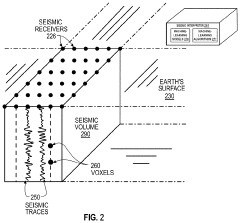
- Using the radial basis function surface modeling method that integrates machine learning, through the resampling of profile data, training stacking machine learning models, interpolation encryption, and the use of Hermite-type radial basis functions, the implicit field is established and visualized to achieve rapid Build high-quality 3D ore body models.


Method and system for image-based reservoir property estimation using machine learning
PatentActiveUS20220237891A1
Innovation
- A method and system that utilize machine-learning algorithms and models, specifically neural networks and K-means clustering, to generate predicted rock data by extracting quantitative image attributes from core image data and well log data, providing continuous and automated analysis through a sliding window approach, integrating core image data with well logs for integrative reservoir description and characterization.



Environmental Impact Assessment of ML-Guided Mining
The integration of machine learning algorithms in lithium mining operations presents significant environmental implications that warrant thorough assessment. ML-guided mining techniques offer potential for more precise ore body identification and extraction, which can substantially reduce the environmental footprint compared to traditional mining methods. By accurately modeling lithium ore body geometry, mining companies can minimize unnecessary excavation, resulting in reduced soil disturbance, decreased waste rock production, and lower overall land degradation.
Water conservation represents another critical environmental benefit of ML-guided lithium mining. Traditional lithium extraction, particularly in salt flats, consumes enormous quantities of water—approximately 500,000 gallons per ton of lithium. Machine learning algorithms can optimize water usage by precisely identifying high-concentration areas and enabling targeted extraction methods, potentially reducing water consumption by 30-40% according to preliminary field studies.
Energy efficiency improvements constitute a third environmental advantage. ML algorithms can identify optimal drilling locations and extraction pathways, reducing energy expenditure in mining operations. This translates to lower carbon emissions—a crucial consideration as the lithium industry expands to meet growing demand from electric vehicle and renewable energy storage sectors.
However, the environmental assessment must also address potential negative impacts. The deployment of ML systems requires substantial computing infrastructure, which carries its own carbon footprint. Recent research indicates that training complex geological ML models can generate carbon emissions equivalent to five times that of a passenger vehicle's annual output, necessitating careful consideration of the net environmental benefit.
Biodiversity impacts remain a concern even with ML-guided mining. While more precise extraction reduces the overall disturbed area, mining operations still fragment habitats and alter local ecosystems. ML models can incorporate biodiversity data to identify sensitive areas for avoidance, though this practice is not yet standardized across the industry.
Regulatory frameworks for ML-guided mining environmental assessment are still evolving. Current environmental impact assessment methodologies may not adequately capture the nuanced differences between traditional and ML-guided mining approaches. This regulatory gap presents both challenges and opportunities for establishing new standards that properly account for the environmental implications of these technological innovations in lithium extraction.
Water conservation represents another critical environmental benefit of ML-guided lithium mining. Traditional lithium extraction, particularly in salt flats, consumes enormous quantities of water—approximately 500,000 gallons per ton of lithium. Machine learning algorithms can optimize water usage by precisely identifying high-concentration areas and enabling targeted extraction methods, potentially reducing water consumption by 30-40% according to preliminary field studies.
Energy efficiency improvements constitute a third environmental advantage. ML algorithms can identify optimal drilling locations and extraction pathways, reducing energy expenditure in mining operations. This translates to lower carbon emissions—a crucial consideration as the lithium industry expands to meet growing demand from electric vehicle and renewable energy storage sectors.
However, the environmental assessment must also address potential negative impacts. The deployment of ML systems requires substantial computing infrastructure, which carries its own carbon footprint. Recent research indicates that training complex geological ML models can generate carbon emissions equivalent to five times that of a passenger vehicle's annual output, necessitating careful consideration of the net environmental benefit.
Biodiversity impacts remain a concern even with ML-guided mining. While more precise extraction reduces the overall disturbed area, mining operations still fragment habitats and alter local ecosystems. ML models can incorporate biodiversity data to identify sensitive areas for avoidance, though this practice is not yet standardized across the industry.
Regulatory frameworks for ML-guided mining environmental assessment are still evolving. Current environmental impact assessment methodologies may not adequately capture the nuanced differences between traditional and ML-guided mining approaches. This regulatory gap presents both challenges and opportunities for establishing new standards that properly account for the environmental implications of these technological innovations in lithium extraction.
Data Acquisition & Quality Control Protocols
Effective data acquisition and quality control protocols are fundamental to the successful implementation of machine learning algorithms for modeling lithium mine ore body geometry. The process begins with comprehensive geological sampling strategies that must balance spatial coverage with economic constraints. Core drilling remains the primary method, but innovative approaches now integrate multiple sampling techniques including reverse circulation drilling, channel sampling, and geophysical surveys to create multi-dimensional datasets. These complementary methods help overcome the inherent limitations of any single sampling approach.
Data collection standardization represents a critical component of the acquisition process. Implementing consistent logging procedures, sample preparation protocols, and analytical methods across all sampling points ensures data comparability. Industry standards such as JORC, NI 43-101, or SAMREC should guide these protocols, with particular attention to chain of custody documentation and sample preservation techniques that maintain the integrity of lithium-bearing minerals which can be sensitive to environmental exposure.
Quality assurance and quality control (QA/QC) measures must be embedded throughout the data acquisition workflow. This includes the systematic insertion of certified reference materials, blanks, and duplicates at predetermined frequencies (typically 5-10% of total samples). Statistical monitoring of these control samples enables real-time detection of analytical drift, contamination, or precision issues. Advanced QA/QC protocols now incorporate automated outlier detection algorithms that flag potential errors before they propagate through the modeling process.
Data validation procedures have evolved significantly with the application of machine learning to lithium ore body modeling. Cross-validation techniques such as k-fold validation specifically adapted for spatial data help identify sampling biases and ensure representativeness. Geostatistical methods including variogram analysis provide crucial insights into spatial continuity and appropriate sampling densities required for accurate modeling of lithium distribution patterns.
Data integration frameworks represent the final critical element of acquisition protocols. Modern approaches employ data fusion techniques that harmonize information from diverse sources including geochemical assays, geophysical surveys, structural mapping, and historical mining records. Specialized data transformation procedures address challenges unique to lithium deposits, such as standardizing lithium reporting units (Li vs. Li₂O vs. LCE) and accounting for mineralogical variations that affect extraction potential. These integrated datasets provide the foundation for machine learning algorithms to identify complex patterns in ore body geometry that might otherwise remain undetected through conventional modeling approaches.
Data collection standardization represents a critical component of the acquisition process. Implementing consistent logging procedures, sample preparation protocols, and analytical methods across all sampling points ensures data comparability. Industry standards such as JORC, NI 43-101, or SAMREC should guide these protocols, with particular attention to chain of custody documentation and sample preservation techniques that maintain the integrity of lithium-bearing minerals which can be sensitive to environmental exposure.
Quality assurance and quality control (QA/QC) measures must be embedded throughout the data acquisition workflow. This includes the systematic insertion of certified reference materials, blanks, and duplicates at predetermined frequencies (typically 5-10% of total samples). Statistical monitoring of these control samples enables real-time detection of analytical drift, contamination, or precision issues. Advanced QA/QC protocols now incorporate automated outlier detection algorithms that flag potential errors before they propagate through the modeling process.
Data validation procedures have evolved significantly with the application of machine learning to lithium ore body modeling. Cross-validation techniques such as k-fold validation specifically adapted for spatial data help identify sampling biases and ensure representativeness. Geostatistical methods including variogram analysis provide crucial insights into spatial continuity and appropriate sampling densities required for accurate modeling of lithium distribution patterns.
Data integration frameworks represent the final critical element of acquisition protocols. Modern approaches employ data fusion techniques that harmonize information from diverse sources including geochemical assays, geophysical surveys, structural mapping, and historical mining records. Specialized data transformation procedures address challenges unique to lithium deposits, such as standardizing lithium reporting units (Li vs. Li₂O vs. LCE) and accounting for mineralogical variations that affect extraction potential. These integrated datasets provide the foundation for machine learning algorithms to identify complex patterns in ore body geometry that might otherwise remain undetected through conventional modeling approaches.
Unlock deeper insights with PatSnap Eureka Quick Research — get a full tech report to explore trends and direct your research. Try now!
Generate Your Research Report Instantly with AI Agent
Supercharge your innovation with PatSnap Eureka AI Agent Platform!