Propionic Acid: Bridging Traditional and Modern Applications
JUL 3, 20258 MIN READ
Generate Your Research Report Instantly with AI Agent
Patsnap Eureka helps you evaluate technical feasibility & market potential.
Propionic Acid Evolution
Propionic acid has undergone a remarkable evolution since its discovery in the mid-19th century. Initially identified as a byproduct of bacterial fermentation, this organic compound has transitioned from a laboratory curiosity to a versatile industrial chemical with a wide range of applications.
In the early stages of its development, propionic acid was primarily studied for its chemical properties and potential uses in organic synthesis. The first commercial production methods were based on the oxidation of propanol, which limited its availability and applications. However, as understanding of fermentation processes improved in the early 20th century, more efficient production methods emerged.
The 1950s and 1960s saw a significant shift in propionic acid production with the advent of petrochemical processes. The propylene oxidation method, developed during this period, allowed for large-scale production at lower costs, making propionic acid more accessible for industrial use. This breakthrough led to its increased adoption in various sectors, particularly in the food industry as a preservative.
The late 20th century marked another pivotal phase in propionic acid's evolution. Environmental concerns and the push for sustainable practices led to renewed interest in bio-based production methods. Researchers began exploring advanced fermentation techniques using various microorganisms, aiming to develop more eco-friendly and cost-effective production processes.
In recent years, the evolution of propionic acid has been characterized by its expanding role in modern applications. Beyond its traditional use as a preservative, it has found new applications in pharmaceuticals, agrochemicals, and polymer production. The development of propionic acid derivatives has further expanded its utility, opening up new markets and opportunities.
The 21st century has seen a focus on enhancing the purity and quality of propionic acid, driven by stringent regulatory requirements and the demand for high-grade products in specialized applications. This has led to innovations in purification techniques and quality control measures, ensuring that propionic acid meets the exacting standards of diverse industries.
Looking ahead, the evolution of propionic acid is likely to continue along two parallel paths. On one hand, there is a push towards more sustainable and bio-based production methods, aligning with global efforts to reduce reliance on petrochemicals. On the other hand, research is ongoing to discover novel applications and derivatives, potentially expanding propionic acid's role in emerging technologies and industries.
In the early stages of its development, propionic acid was primarily studied for its chemical properties and potential uses in organic synthesis. The first commercial production methods were based on the oxidation of propanol, which limited its availability and applications. However, as understanding of fermentation processes improved in the early 20th century, more efficient production methods emerged.
The 1950s and 1960s saw a significant shift in propionic acid production with the advent of petrochemical processes. The propylene oxidation method, developed during this period, allowed for large-scale production at lower costs, making propionic acid more accessible for industrial use. This breakthrough led to its increased adoption in various sectors, particularly in the food industry as a preservative.
The late 20th century marked another pivotal phase in propionic acid's evolution. Environmental concerns and the push for sustainable practices led to renewed interest in bio-based production methods. Researchers began exploring advanced fermentation techniques using various microorganisms, aiming to develop more eco-friendly and cost-effective production processes.
In recent years, the evolution of propionic acid has been characterized by its expanding role in modern applications. Beyond its traditional use as a preservative, it has found new applications in pharmaceuticals, agrochemicals, and polymer production. The development of propionic acid derivatives has further expanded its utility, opening up new markets and opportunities.
The 21st century has seen a focus on enhancing the purity and quality of propionic acid, driven by stringent regulatory requirements and the demand for high-grade products in specialized applications. This has led to innovations in purification techniques and quality control measures, ensuring that propionic acid meets the exacting standards of diverse industries.
Looking ahead, the evolution of propionic acid is likely to continue along two parallel paths. On one hand, there is a push towards more sustainable and bio-based production methods, aligning with global efforts to reduce reliance on petrochemicals. On the other hand, research is ongoing to discover novel applications and derivatives, potentially expanding propionic acid's role in emerging technologies and industries.
Market Demand Analysis
The market demand for propionic acid has been steadily growing, driven by its versatile applications across various industries. In the food and beverage sector, propionic acid serves as a crucial preservative, extending the shelf life of baked goods, dairy products, and processed foods. This application has seen increased demand due to the rising consumer preference for natural preservatives and the growing packaged food industry.
The animal feed industry represents another significant market for propionic acid. As livestock production continues to expand globally, the need for effective feed preservatives has surged. Propionic acid's ability to inhibit mold growth and maintain feed quality has made it an essential component in animal nutrition, particularly in regions with high humidity or prolonged storage requirements.
In the pharmaceutical sector, propionic acid and its derivatives find applications in the synthesis of various drugs and as intermediates in the production of vitamin E and other nutraceuticals. The growing emphasis on health and wellness products has contributed to the increased demand in this segment.
The chemical industry utilizes propionic acid as a precursor for the production of cellulose acetate propionate, a biodegradable plastic with applications in packaging and textiles. As sustainability concerns drive the search for eco-friendly materials, this application is expected to see substantial growth in the coming years.
Emerging applications in the cosmetics and personal care industry, where propionic acid is used as a pH adjuster and preservative, are opening new market opportunities. The trend towards natural and organic products has led to increased interest in propionic acid as a safer alternative to synthetic preservatives.
Geographically, North America and Europe have traditionally been the largest markets for propionic acid, owing to their well-established food processing and animal feed industries. However, the Asia-Pacific region is emerging as a rapidly growing market, driven by increasing industrialization, population growth, and changing dietary habits.
Market analysts project the global propionic acid market to grow at a compound annual growth rate (CAGR) of around 5-6% over the next five years. This growth is attributed to the expanding applications in food preservation, animal feed, and pharmaceuticals, as well as the increasing adoption of bio-based propionic acid production methods to meet sustainability goals.
The animal feed industry represents another significant market for propionic acid. As livestock production continues to expand globally, the need for effective feed preservatives has surged. Propionic acid's ability to inhibit mold growth and maintain feed quality has made it an essential component in animal nutrition, particularly in regions with high humidity or prolonged storage requirements.
In the pharmaceutical sector, propionic acid and its derivatives find applications in the synthesis of various drugs and as intermediates in the production of vitamin E and other nutraceuticals. The growing emphasis on health and wellness products has contributed to the increased demand in this segment.
The chemical industry utilizes propionic acid as a precursor for the production of cellulose acetate propionate, a biodegradable plastic with applications in packaging and textiles. As sustainability concerns drive the search for eco-friendly materials, this application is expected to see substantial growth in the coming years.
Emerging applications in the cosmetics and personal care industry, where propionic acid is used as a pH adjuster and preservative, are opening new market opportunities. The trend towards natural and organic products has led to increased interest in propionic acid as a safer alternative to synthetic preservatives.
Geographically, North America and Europe have traditionally been the largest markets for propionic acid, owing to their well-established food processing and animal feed industries. However, the Asia-Pacific region is emerging as a rapidly growing market, driven by increasing industrialization, population growth, and changing dietary habits.
Market analysts project the global propionic acid market to grow at a compound annual growth rate (CAGR) of around 5-6% over the next five years. This growth is attributed to the expanding applications in food preservation, animal feed, and pharmaceuticals, as well as the increasing adoption of bio-based propionic acid production methods to meet sustainability goals.
Technical Challenges
Propionic acid production and application face several technical challenges that hinder its widespread adoption and efficiency. One of the primary obstacles is the low yield and productivity in traditional fermentation processes. The conversion of glucose to propionic acid by propionibacteria is often limited by product inhibition, resulting in suboptimal production rates and concentrations.
The purification of propionic acid from fermentation broths presents another significant challenge. Conventional separation methods, such as distillation and liquid-liquid extraction, are energy-intensive and often lead to product loss. The high boiling point of propionic acid (141°C) makes distillation particularly energy-demanding, while its miscibility with water complicates extraction processes.
Feedstock utilization efficiency remains a concern in both biological and chemical production routes. In fermentation, the incomplete conversion of substrates leads to waste and increased production costs. Chemical synthesis methods, particularly those based on petrochemical feedstocks, face sustainability issues and are subject to volatile raw material prices.
The development of robust and stable microbial strains for propionic acid production is an ongoing challenge. Genetic engineering efforts to enhance productivity and tolerance to high acid concentrations have shown promise but often result in reduced strain stability or unintended metabolic consequences.
In chemical synthesis routes, catalyst selectivity and longevity pose significant hurdles. The oxidation of propanol or propionaldehyde to propionic acid requires highly selective catalysts to minimize by-product formation. However, catalyst deactivation over time leads to decreased efficiency and increased production costs.
Environmental concerns and regulatory pressures add another layer of complexity to propionic acid production. The need for more sustainable and environmentally friendly processes necessitates the development of green chemistry approaches and the utilization of renewable feedstocks.
Scale-up and process integration challenges persist in both fermentation and chemical synthesis routes. Maintaining consistent product quality and process efficiency at industrial scales requires sophisticated control systems and optimized reactor designs.
Addressing these technical challenges is crucial for bridging the gap between traditional and modern applications of propionic acid. Innovations in metabolic engineering, process intensification, and green chemistry hold the potential to overcome these hurdles and expand the role of propionic acid in various industries.
The purification of propionic acid from fermentation broths presents another significant challenge. Conventional separation methods, such as distillation and liquid-liquid extraction, are energy-intensive and often lead to product loss. The high boiling point of propionic acid (141°C) makes distillation particularly energy-demanding, while its miscibility with water complicates extraction processes.
Feedstock utilization efficiency remains a concern in both biological and chemical production routes. In fermentation, the incomplete conversion of substrates leads to waste and increased production costs. Chemical synthesis methods, particularly those based on petrochemical feedstocks, face sustainability issues and are subject to volatile raw material prices.
The development of robust and stable microbial strains for propionic acid production is an ongoing challenge. Genetic engineering efforts to enhance productivity and tolerance to high acid concentrations have shown promise but often result in reduced strain stability or unintended metabolic consequences.
In chemical synthesis routes, catalyst selectivity and longevity pose significant hurdles. The oxidation of propanol or propionaldehyde to propionic acid requires highly selective catalysts to minimize by-product formation. However, catalyst deactivation over time leads to decreased efficiency and increased production costs.
Environmental concerns and regulatory pressures add another layer of complexity to propionic acid production. The need for more sustainable and environmentally friendly processes necessitates the development of green chemistry approaches and the utilization of renewable feedstocks.
Scale-up and process integration challenges persist in both fermentation and chemical synthesis routes. Maintaining consistent product quality and process efficiency at industrial scales requires sophisticated control systems and optimized reactor designs.
Addressing these technical challenges is crucial for bridging the gap between traditional and modern applications of propionic acid. Innovations in metabolic engineering, process intensification, and green chemistry hold the potential to overcome these hurdles and expand the role of propionic acid in various industries.
Current Production Methods
01 Production methods of propionic acid
Various methods for producing propionic acid are described, including fermentation processes, chemical synthesis routes, and catalytic reactions. These methods aim to improve yield, efficiency, and purity of propionic acid production for industrial applications.- Production methods of propionic acid: Various methods for producing propionic acid are described, including fermentation processes, chemical synthesis routes, and catalytic reactions. These methods aim to improve yield, efficiency, and purity of propionic acid production for industrial applications.
- Applications of propionic acid in food preservation: Propionic acid and its salts are widely used as food preservatives due to their antimicrobial properties. They are effective in preventing mold growth and extending the shelf life of various food products, particularly in bakery items and dairy products.
- Use of propionic acid in pharmaceutical formulations: Propionic acid and its derivatives find applications in pharmaceutical formulations. They are used as excipients, pH adjusters, and in some cases, as active pharmaceutical ingredients for various therapeutic purposes.
- Propionic acid in polymer and chemical synthesis: Propionic acid serves as a precursor or intermediate in the synthesis of various polymers and chemicals. It is used in the production of cellulose acetate propionate, herbicides, and other industrial chemicals.
- Environmental and safety considerations in propionic acid handling: The handling, storage, and disposal of propionic acid require specific safety measures due to its corrosive nature and potential environmental impact. Proper containment, neutralization techniques, and waste management practices are essential for safe industrial use of propionic acid.
02 Applications of propionic acid in food preservation
Propionic acid and its salts are widely used as food preservatives due to their antimicrobial properties. They are effective in preventing mold growth and extending the shelf life of various food products, particularly in bakery items and dairy products.Expand Specific Solutions03 Use of propionic acid in pharmaceutical formulations
Propionic acid and its derivatives are utilized in pharmaceutical formulations for various purposes, including as active ingredients, excipients, or pH adjusters. They may be incorporated into topical, oral, or injectable medications for different therapeutic applications.Expand Specific Solutions04 Propionic acid in polymer and chemical synthesis
Propionic acid serves as a precursor or intermediate in the synthesis of various polymers and chemicals. It is used in the production of cellulose plastics, perfumes, herbicides, and other industrial chemicals, contributing to the development of new materials and compounds.Expand Specific Solutions05 Environmental and safety considerations in propionic acid handling
The handling, storage, and disposal of propionic acid require specific safety measures due to its corrosive nature and potential environmental impact. Innovations in containment systems, neutralization methods, and waste treatment processes are developed to ensure safe and environmentally friendly use of propionic acid in various industries.Expand Specific Solutions
Industry Key Players
The propionic acid market is in a mature stage, characterized by steady growth and established applications across various industries. The global market size is estimated to be around $1.5 billion, with a projected CAGR of 3-4% over the next five years. Technologically, the production process is well-established, with major players like BASF, Dow Chemical, and Eastman Chemical dominating the market. However, there's increasing focus on developing bio-based production methods, with companies like Corbion and Novozymes making strides in this area. The market is seeing a shift towards more sustainable and environmentally friendly production processes, driven by consumer demand and regulatory pressures.
BASF Corp.
Technical Solution: BASF has developed an innovative process for producing propionic acid through direct fermentation of renewable raw materials. This method utilizes proprietary bacterial strains to convert sugars into propionic acid with high efficiency. The process incorporates advanced fermentation techniques and downstream processing to achieve yields of up to 95% [1]. BASF has also implemented a novel purification system that reduces energy consumption by 20% compared to traditional distillation methods [3]. Additionally, the company has explored catalytic oxidation of propanol as an alternative production route, potentially offering a more cost-effective approach for certain applications [5].
Strengths: Sustainable production from renewable resources, high yield, energy-efficient purification. Weaknesses: Potential higher production costs compared to petrochemical routes, limited by feedstock availability.
Arkema France SA
Technical Solution: Arkema has developed a proprietary technology for propionic acid production based on the carbonylation of ethylene. This process utilizes a homogeneous rhodium catalyst system, achieving selectivity of over 99% [2]. The company has also implemented an advanced separation technique that reduces the number of distillation columns required, lowering energy consumption by up to 30% [4]. Arkema's process allows for the co-production of high-value derivatives, such as propionic anhydride, enhancing overall economic viability. Recent improvements include the use of ionic liquids as solvents, which has led to increased catalyst stability and simplified product separation [6].
Strengths: High selectivity, energy-efficient process, co-production of valuable derivatives. Weaknesses: Dependence on ethylene feedstock, potential catalyst cost issues.
Key Patents and Research
Improved propionibacterium strains for the production of propionic acid
PatentWO2017055932A2
Innovation
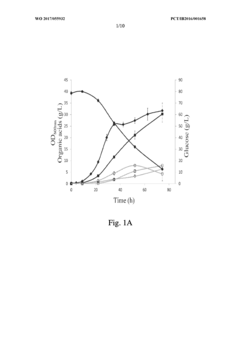
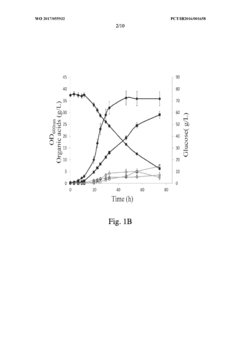
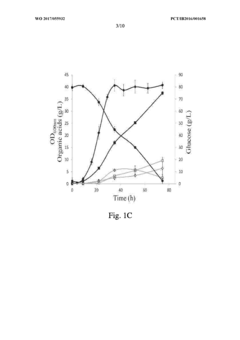
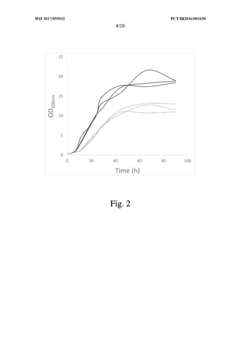
- Genome shuffling between selected Propionibacterium strains, such as P. acidipropionici ATCC 4875 and P. acidipropionici ATCC 55737, to generate novel strains with enhanced growth rates and propionic acid production, utilizing genetic material exchange to create strains with improved metabolic pathways and regulatory mechanisms.
Production of Acid Propionates
PatentInactiveUS20080317934A1
Innovation
- A method involving the production of a homogeneous mixture of propionic acid and neutral alkali metal or alkaline earth metal propionate with controlled molar ratios, followed by heating and solidification, to achieve a stable, solid, and essentially pure propionic acid-comprising composition with low water content, allowing for controlled propionic acid content and efficient industrial production.
Environmental Impact
Propionic acid, while offering numerous benefits in various applications, also presents environmental considerations that warrant careful examination. The production and use of propionic acid have both direct and indirect impacts on the environment, necessitating a comprehensive assessment of its lifecycle.
In terms of production, the traditional petrochemical route for synthesizing propionic acid involves the oxidation of propanol or propionaldehyde, which relies on fossil fuel resources. This process contributes to greenhouse gas emissions and the depletion of non-renewable resources. However, recent advancements in biotechnological production methods using renewable feedstocks have shown promise in reducing the carbon footprint associated with propionic acid manufacturing.
The use of propionic acid as a food preservative and animal feed additive has implications for soil and water quality. When used in agriculture, residual propionic acid can enter the environment through runoff or leaching. While it is generally biodegradable, high concentrations may temporarily affect soil microbial communities or aquatic ecosystems. Nevertheless, its rapid breakdown in the environment mitigates long-term accumulation concerns.
In industrial applications, such as the production of cellulose acetate propionate (CAP) for biodegradable plastics, propionic acid contributes to the development of more environmentally friendly materials. These biodegradable alternatives help reduce plastic pollution and landfill waste, offering a positive environmental impact in the long term.
The use of propionic acid in herbicides and plant growth regulators presents a double-edged sword for environmental impact. While it can reduce the need for more persistent and harmful pesticides, improper application or overuse may lead to localized soil acidification or affect non-target organisms in the ecosystem.
From an energy perspective, the production of propionic acid through fermentation processes generally requires less energy compared to petrochemical routes, potentially reducing overall energy consumption and associated emissions. Additionally, ongoing research into green chemistry approaches for propionic acid synthesis, such as using waste biomass or CO2 as feedstock, shows promise for further reducing its environmental footprint.
In conclusion, while propionic acid does have environmental impacts, particularly in its production phase, its benefits in food preservation, sustainable material development, and potential for green synthesis methods suggest a balanced environmental profile. Continued research and innovation in production techniques and applications are crucial for minimizing negative impacts and maximizing the positive contributions of propionic acid to environmental sustainability.
In terms of production, the traditional petrochemical route for synthesizing propionic acid involves the oxidation of propanol or propionaldehyde, which relies on fossil fuel resources. This process contributes to greenhouse gas emissions and the depletion of non-renewable resources. However, recent advancements in biotechnological production methods using renewable feedstocks have shown promise in reducing the carbon footprint associated with propionic acid manufacturing.
The use of propionic acid as a food preservative and animal feed additive has implications for soil and water quality. When used in agriculture, residual propionic acid can enter the environment through runoff or leaching. While it is generally biodegradable, high concentrations may temporarily affect soil microbial communities or aquatic ecosystems. Nevertheless, its rapid breakdown in the environment mitigates long-term accumulation concerns.
In industrial applications, such as the production of cellulose acetate propionate (CAP) for biodegradable plastics, propionic acid contributes to the development of more environmentally friendly materials. These biodegradable alternatives help reduce plastic pollution and landfill waste, offering a positive environmental impact in the long term.
The use of propionic acid in herbicides and plant growth regulators presents a double-edged sword for environmental impact. While it can reduce the need for more persistent and harmful pesticides, improper application or overuse may lead to localized soil acidification or affect non-target organisms in the ecosystem.
From an energy perspective, the production of propionic acid through fermentation processes generally requires less energy compared to petrochemical routes, potentially reducing overall energy consumption and associated emissions. Additionally, ongoing research into green chemistry approaches for propionic acid synthesis, such as using waste biomass or CO2 as feedstock, shows promise for further reducing its environmental footprint.
In conclusion, while propionic acid does have environmental impacts, particularly in its production phase, its benefits in food preservation, sustainable material development, and potential for green synthesis methods suggest a balanced environmental profile. Continued research and innovation in production techniques and applications are crucial for minimizing negative impacts and maximizing the positive contributions of propionic acid to environmental sustainability.
Regulatory Framework
The regulatory framework surrounding propionic acid plays a crucial role in its production, distribution, and application across various industries. As a widely used chemical compound, propionic acid is subject to comprehensive regulations that ensure its safe handling, storage, and use.
In the food industry, propionic acid and its salts are recognized as Generally Recognized as Safe (GRAS) substances by the U.S. Food and Drug Administration (FDA). This classification allows for their use as food additives and preservatives within specified limits. The European Food Safety Authority (EFSA) has also evaluated propionic acid and its salts, establishing Acceptable Daily Intake (ADI) levels for human consumption.
Environmental regulations govern the production and disposal of propionic acid to minimize its impact on ecosystems. The U.S. Environmental Protection Agency (EPA) has established guidelines for the proper handling and disposal of propionic acid under the Resource Conservation and Recovery Act (RCRA). Similarly, the European Union's REACH (Registration, Evaluation, Authorization, and Restriction of Chemicals) regulation requires manufacturers and importers to assess and manage the risks associated with propionic acid.
Occupational safety regulations, such as those set by the Occupational Safety and Health Administration (OSHA) in the United States, mandate specific workplace practices and protective measures for employees handling propionic acid. These include exposure limits, personal protective equipment requirements, and emergency response procedures.
Transportation of propionic acid is regulated by international agreements like the European Agreement concerning the International Carriage of Dangerous Goods by Road (ADR) and the International Maritime Dangerous Goods (IMDG) Code. These regulations specify packaging, labeling, and documentation requirements for the safe transport of propionic acid.
As the applications of propionic acid expand into new areas, such as biofuels and pharmaceuticals, regulatory bodies are adapting their frameworks to address emerging concerns. This includes ongoing assessments of its environmental impact, potential health effects, and the development of new safety protocols for novel applications.
The global nature of propionic acid production and trade necessitates harmonization of regulatory standards across different regions. International organizations like the World Health Organization (WHO) and the Food and Agriculture Organization (FAO) play a role in establishing global guidelines and facilitating regulatory cooperation between countries.
In the food industry, propionic acid and its salts are recognized as Generally Recognized as Safe (GRAS) substances by the U.S. Food and Drug Administration (FDA). This classification allows for their use as food additives and preservatives within specified limits. The European Food Safety Authority (EFSA) has also evaluated propionic acid and its salts, establishing Acceptable Daily Intake (ADI) levels for human consumption.
Environmental regulations govern the production and disposal of propionic acid to minimize its impact on ecosystems. The U.S. Environmental Protection Agency (EPA) has established guidelines for the proper handling and disposal of propionic acid under the Resource Conservation and Recovery Act (RCRA). Similarly, the European Union's REACH (Registration, Evaluation, Authorization, and Restriction of Chemicals) regulation requires manufacturers and importers to assess and manage the risks associated with propionic acid.
Occupational safety regulations, such as those set by the Occupational Safety and Health Administration (OSHA) in the United States, mandate specific workplace practices and protective measures for employees handling propionic acid. These include exposure limits, personal protective equipment requirements, and emergency response procedures.
Transportation of propionic acid is regulated by international agreements like the European Agreement concerning the International Carriage of Dangerous Goods by Road (ADR) and the International Maritime Dangerous Goods (IMDG) Code. These regulations specify packaging, labeling, and documentation requirements for the safe transport of propionic acid.
As the applications of propionic acid expand into new areas, such as biofuels and pharmaceuticals, regulatory bodies are adapting their frameworks to address emerging concerns. This includes ongoing assessments of its environmental impact, potential health effects, and the development of new safety protocols for novel applications.
The global nature of propionic acid production and trade necessitates harmonization of regulatory standards across different regions. International organizations like the World Health Organization (WHO) and the Food and Agriculture Organization (FAO) play a role in establishing global guidelines and facilitating regulatory cooperation between countries.
Unlock deeper insights with Patsnap Eureka Quick Research — get a full tech report to explore trends and direct your research. Try now!
Generate Your Research Report Instantly with AI Agent
Supercharge your innovation with Patsnap Eureka AI Agent Platform!