

Quantify NMC Battery Power Flow Using Exact Prescriptions
AUG 27, 202510 MIN READ
Generate Your Research Report Instantly with AI Agent
PatSnap Eureka helps you evaluate technical feasibility & market potential.
NMC Battery Technology Background and Objectives
Lithium-ion batteries have revolutionized energy storage systems since their commercial introduction in the early 1990s. Among various cathode materials, Nickel Manganese Cobalt (NMC) has emerged as a dominant chemistry due to its balanced performance characteristics. The evolution of NMC battery technology has progressed through multiple generations, from early NMC111 (equal parts nickel, manganese, and cobalt) to more recent high-nickel formulations like NMC811, each offering incremental improvements in energy density and cycle life.
The quantification of power flow in NMC batteries represents a critical frontier in battery management systems. Historically, battery modeling has relied on empirical approaches with inherent limitations in accuracy and adaptability across operating conditions. The transition toward exact prescriptions for power flow quantification marks a paradigm shift in battery technology, enabling more precise state estimation and performance prediction.
Current market trends indicate an accelerating adoption of NMC batteries across electric vehicles, grid storage, and consumer electronics sectors. This widespread implementation necessitates more sophisticated power flow models to optimize battery performance, extend operational lifetimes, and enhance safety profiles. The technical objective of developing exact prescriptions for NMC power flow quantification addresses these market demands directly.
From a scientific perspective, power flow in NMC batteries involves complex electrochemical processes including lithium-ion diffusion, charge transfer reactions, and solid-electrolyte interphase (SEI) formation. Traditional models often simplify these mechanisms, leading to discrepancies between predicted and actual performance. Exact prescriptions aim to incorporate comprehensive physical and chemical principles to achieve higher fidelity representations of battery behavior.
The development trajectory for NMC battery technology indicates continued refinement in material composition, with trends toward reduced cobalt content, increased nickel proportion, and novel dopants to enhance structural stability. These material innovations necessitate corresponding advancements in power flow quantification methodologies to accurately capture their unique electrochemical signatures.
Key technical objectives for exact power flow quantification include: developing physics-based models that account for temperature-dependent phenomena, capturing degradation mechanisms with high temporal resolution, establishing standardized testing protocols for model validation, and creating computationally efficient algorithms suitable for real-time implementation in battery management systems.
The convergence of advanced computational techniques, including machine learning and quantum computing, with traditional electrochemical modeling approaches offers promising pathways for achieving these objectives. This interdisciplinary approach represents the next frontier in NMC battery technology development.
The quantification of power flow in NMC batteries represents a critical frontier in battery management systems. Historically, battery modeling has relied on empirical approaches with inherent limitations in accuracy and adaptability across operating conditions. The transition toward exact prescriptions for power flow quantification marks a paradigm shift in battery technology, enabling more precise state estimation and performance prediction.
Current market trends indicate an accelerating adoption of NMC batteries across electric vehicles, grid storage, and consumer electronics sectors. This widespread implementation necessitates more sophisticated power flow models to optimize battery performance, extend operational lifetimes, and enhance safety profiles. The technical objective of developing exact prescriptions for NMC power flow quantification addresses these market demands directly.
From a scientific perspective, power flow in NMC batteries involves complex electrochemical processes including lithium-ion diffusion, charge transfer reactions, and solid-electrolyte interphase (SEI) formation. Traditional models often simplify these mechanisms, leading to discrepancies between predicted and actual performance. Exact prescriptions aim to incorporate comprehensive physical and chemical principles to achieve higher fidelity representations of battery behavior.
The development trajectory for NMC battery technology indicates continued refinement in material composition, with trends toward reduced cobalt content, increased nickel proportion, and novel dopants to enhance structural stability. These material innovations necessitate corresponding advancements in power flow quantification methodologies to accurately capture their unique electrochemical signatures.
Key technical objectives for exact power flow quantification include: developing physics-based models that account for temperature-dependent phenomena, capturing degradation mechanisms with high temporal resolution, establishing standardized testing protocols for model validation, and creating computationally efficient algorithms suitable for real-time implementation in battery management systems.
The convergence of advanced computational techniques, including machine learning and quantum computing, with traditional electrochemical modeling approaches offers promising pathways for achieving these objectives. This interdisciplinary approach represents the next frontier in NMC battery technology development.
Market Analysis for Advanced Battery Power Flow Solutions
The global market for advanced battery power flow solutions, particularly those focused on NMC (Nickel Manganese Cobalt) battery technologies, has experienced substantial growth driven by the expanding electric vehicle (EV) sector and renewable energy storage applications. Current market valuations indicate the advanced battery market exceeds $45 billion globally, with NMC chemistries representing approximately 28% of this market share due to their favorable energy density characteristics.
Market demand for precise power flow quantification solutions has intensified as manufacturers and end-users seek to optimize battery performance, extend operational lifespans, and enhance safety profiles. This demand stems primarily from automotive OEMs requiring more accurate state-of-charge and state-of-health measurements to improve range predictions and battery management systems. The energy storage sector similarly requires enhanced power flow monitoring to maximize efficiency in grid-scale applications.
Regional analysis reveals Asia-Pacific dominates manufacturing capacity, with South Korea, Japan, and China collectively controlling over 75% of NMC battery production. However, North America and Europe are rapidly expanding their domestic capabilities through significant public and private investments, driven by supply chain security concerns and sustainability initiatives.
Consumer and industrial segments demonstrate divergent requirements for power flow quantification technologies. The consumer electronics sector prioritizes miniaturization and cost-effectiveness, while automotive and industrial applications emphasize accuracy, reliability, and integration capabilities with existing battery management systems.
Market forecasts project the specialized segment for advanced battery power flow quantification tools will grow at a compound annual rate of 24% through 2028, outpacing the broader battery market's 18% growth rate. This acceleration reflects increasing recognition of precise power flow management as a critical differentiator in battery performance optimization.
Regulatory factors significantly influence market dynamics, with increasingly stringent safety standards and performance certification requirements creating barriers to entry while simultaneously driving innovation. The EU Battery Directive and similar frameworks in North America and Asia are establishing new benchmarks for battery monitoring precision that directly impact power flow quantification technologies.
Customer pain points center around reliability of existing measurement systems, with current solutions demonstrating accuracy variations exceeding 8% under dynamic load conditions. This measurement uncertainty translates directly to conservative battery management approaches that underutilize available capacity and reduce overall system efficiency.
Market demand for precise power flow quantification solutions has intensified as manufacturers and end-users seek to optimize battery performance, extend operational lifespans, and enhance safety profiles. This demand stems primarily from automotive OEMs requiring more accurate state-of-charge and state-of-health measurements to improve range predictions and battery management systems. The energy storage sector similarly requires enhanced power flow monitoring to maximize efficiency in grid-scale applications.
Regional analysis reveals Asia-Pacific dominates manufacturing capacity, with South Korea, Japan, and China collectively controlling over 75% of NMC battery production. However, North America and Europe are rapidly expanding their domestic capabilities through significant public and private investments, driven by supply chain security concerns and sustainability initiatives.
Consumer and industrial segments demonstrate divergent requirements for power flow quantification technologies. The consumer electronics sector prioritizes miniaturization and cost-effectiveness, while automotive and industrial applications emphasize accuracy, reliability, and integration capabilities with existing battery management systems.
Market forecasts project the specialized segment for advanced battery power flow quantification tools will grow at a compound annual rate of 24% through 2028, outpacing the broader battery market's 18% growth rate. This acceleration reflects increasing recognition of precise power flow management as a critical differentiator in battery performance optimization.
Regulatory factors significantly influence market dynamics, with increasingly stringent safety standards and performance certification requirements creating barriers to entry while simultaneously driving innovation. The EU Battery Directive and similar frameworks in North America and Asia are establishing new benchmarks for battery monitoring precision that directly impact power flow quantification technologies.
Customer pain points center around reliability of existing measurement systems, with current solutions demonstrating accuracy variations exceeding 8% under dynamic load conditions. This measurement uncertainty translates directly to conservative battery management approaches that underutilize available capacity and reduce overall system efficiency.
Current Challenges in NMC Battery Power Flow Quantification
Despite significant advancements in NMC (Nickel Manganese Cobalt) battery technology, accurate quantification of power flow remains a persistent challenge for researchers and industry professionals. Current methodologies often rely on approximations and simplified models that fail to capture the complex electrochemical processes occurring within these energy storage systems. This limitation significantly impacts the precision of performance predictions and hampers optimization efforts across various applications.
One of the primary challenges lies in the inherent complexity of ion transport mechanisms within the NMC cathode structure. The heterogeneous nature of nickel, manganese, and cobalt distribution creates localized variations in electrical conductivity and diffusion rates that are difficult to model accurately. Traditional approaches often employ averaged parameters that mask these critical micro-scale phenomena, resulting in discrepancies between theoretical predictions and actual performance.
Temperature-dependent behavior presents another significant obstacle in power flow quantification. NMC batteries exhibit non-linear responses to thermal variations, with reaction kinetics and transport properties changing dramatically across operational temperature ranges. Current models struggle to incorporate these temperature dependencies comprehensively, particularly during rapid charge-discharge cycles where thermal gradients develop within the cell structure.
Degradation mechanisms further complicate accurate power flow assessment. As NMC batteries age, structural changes in the cathode material, electrolyte decomposition, and solid-electrolyte interphase (SEI) growth progressively alter the internal resistance and power delivery capabilities. Existing quantification methods typically fail to account for these time-dependent transformations, leading to increasingly inaccurate predictions throughout the battery lifecycle.
The multiphysics nature of battery operation represents perhaps the most formidable challenge. Power flow in NMC batteries involves coupled electrochemical, thermal, and mechanical processes that interact in complex ways. Current modeling approaches often treat these phenomena separately or with simplified coupling mechanisms that do not fully capture their interdependencies, particularly under dynamic operating conditions.
Measurement limitations also hinder progress in this field. Direct observation of internal power flow distributions remains technically challenging, forcing researchers to rely heavily on external measurements and inferred parameters. This indirect approach introduces additional uncertainties and validation difficulties when developing more precise quantification methodologies.
Finally, computational constraints pose practical limitations to implementing more sophisticated models. Highly detailed simulations that could potentially address many of these challenges require substantial computing resources, making them impractical for real-time applications or integration into battery management systems where rapid calculations are essential.
One of the primary challenges lies in the inherent complexity of ion transport mechanisms within the NMC cathode structure. The heterogeneous nature of nickel, manganese, and cobalt distribution creates localized variations in electrical conductivity and diffusion rates that are difficult to model accurately. Traditional approaches often employ averaged parameters that mask these critical micro-scale phenomena, resulting in discrepancies between theoretical predictions and actual performance.
Temperature-dependent behavior presents another significant obstacle in power flow quantification. NMC batteries exhibit non-linear responses to thermal variations, with reaction kinetics and transport properties changing dramatically across operational temperature ranges. Current models struggle to incorporate these temperature dependencies comprehensively, particularly during rapid charge-discharge cycles where thermal gradients develop within the cell structure.
Degradation mechanisms further complicate accurate power flow assessment. As NMC batteries age, structural changes in the cathode material, electrolyte decomposition, and solid-electrolyte interphase (SEI) growth progressively alter the internal resistance and power delivery capabilities. Existing quantification methods typically fail to account for these time-dependent transformations, leading to increasingly inaccurate predictions throughout the battery lifecycle.
The multiphysics nature of battery operation represents perhaps the most formidable challenge. Power flow in NMC batteries involves coupled electrochemical, thermal, and mechanical processes that interact in complex ways. Current modeling approaches often treat these phenomena separately or with simplified coupling mechanisms that do not fully capture their interdependencies, particularly under dynamic operating conditions.
Measurement limitations also hinder progress in this field. Direct observation of internal power flow distributions remains technically challenging, forcing researchers to rely heavily on external measurements and inferred parameters. This indirect approach introduces additional uncertainties and validation difficulties when developing more precise quantification methodologies.
Finally, computational constraints pose practical limitations to implementing more sophisticated models. Highly detailed simulations that could potentially address many of these challenges require substantial computing resources, making them impractical for real-time applications or integration into battery management systems where rapid calculations are essential.
Existing Methodologies for NMC Battery Power Flow Quantification
01 NMC Battery Management Systems
Advanced management systems for NMC (Nickel Manganese Cobalt) batteries that monitor and control power flow to optimize performance and extend battery life. These systems include real-time monitoring of voltage, current, and temperature parameters to ensure safe operation and prevent overcharging or discharging. The management systems also incorporate algorithms for state of charge estimation and power distribution across battery cells.- NMC Battery Power Management Systems: Power management systems for NMC (Nickel Manganese Cobalt) batteries focus on optimizing energy flow, monitoring battery health, and ensuring efficient operation. These systems incorporate advanced algorithms to balance power distribution, prevent overcharging, and extend battery life. The management systems continuously monitor voltage, current, and temperature parameters to maintain optimal performance and safety of NMC battery packs in various applications.
- Power Flow Control in NMC Battery Systems: Control mechanisms for power flow in NMC battery systems involve sophisticated electronic circuits and software that regulate charging and discharging processes. These control systems manage bidirectional power flow between the battery and connected devices or power grids, implementing protective measures against current surges and voltage fluctuations. Advanced power flow control techniques help maximize energy efficiency and ensure stable operation under varying load conditions.
- Thermal Management for NMC Battery Power Flow: Thermal management solutions for NMC batteries address heat generation during power flow operations. These systems employ various cooling methods including liquid cooling, air cooling, or phase-change materials to maintain optimal operating temperatures. Effective thermal management prevents thermal runaway, enhances charging efficiency, and preserves battery capacity over time by ensuring uniform temperature distribution across battery cells during high power flow conditions.
- Grid Integration of NMC Battery Storage Systems: Integration of NMC battery storage systems with power grids involves technologies that enable seamless power flow between batteries and electrical networks. These solutions include inverters, converters, and smart grid interfaces that facilitate bidirectional energy transfer. Grid integration technologies allow NMC batteries to provide services such as peak shaving, frequency regulation, and backup power while maintaining grid stability and optimizing renewable energy utilization.
- State of Charge Estimation for NMC Battery Power Flow: State of charge (SOC) estimation techniques for NMC batteries employ algorithms and sensing technologies to accurately determine remaining battery capacity during power flow operations. These methods combine voltage measurements, current integration, impedance tracking, and machine learning approaches to provide real-time SOC information. Accurate SOC estimation is crucial for optimizing power flow management, preventing deep discharge, and making informed decisions about energy distribution in battery systems.
02 Power Flow Control in NMC Battery Systems
Techniques for controlling power flow in NMC battery systems, including bidirectional power management and load balancing. These methods optimize energy distribution between the battery and connected devices or power grids, enabling efficient charging and discharging cycles. Advanced control mechanisms help regulate power flow to maintain optimal operating conditions and prevent thermal runaway situations.Expand Specific Solutions03 NMC Battery Cell Architecture for Enhanced Power Flow
Innovative cell architectures designed specifically for NMC batteries to improve power flow characteristics. These designs feature optimized electrode structures, electrolyte compositions, and current collector configurations that reduce internal resistance and enhance ion transport. The improved architectures allow for faster charging rates, higher power density, and more efficient energy transfer within the battery system.Expand Specific Solutions04 Thermal Management in NMC Battery Power Systems
Thermal management solutions for NMC battery systems that maintain optimal operating temperatures during high power flow conditions. These systems incorporate cooling mechanisms, heat dissipation structures, and temperature monitoring to prevent overheating during rapid charging or high-power discharge events. Effective thermal management ensures consistent power delivery while extending battery lifespan and maintaining safety.Expand Specific Solutions05 Grid Integration of NMC Battery Storage Systems
Methods and systems for integrating NMC battery storage with power grids to enable efficient energy management and power flow control. These technologies facilitate bidirectional power exchange between batteries and the grid, supporting applications such as peak shaving, frequency regulation, and renewable energy integration. Advanced grid integration solutions optimize power flow to balance supply and demand while maximizing the economic value of battery storage systems.Expand Specific Solutions
Leading Companies and Research Institutions in NMC Battery Technology
The NMC battery power flow quantification technology is currently in a growth phase, with the market expanding rapidly due to increasing demand for high-performance batteries in electric vehicles and energy storage systems. The global market size is projected to reach significant scale as automotive manufacturers like Toyota, BYD, and Stellantis accelerate EV production. From a technical maturity perspective, the field shows varying levels of advancement among key players. Companies like LG Energy Solution, Huawei Digital Power, and BYD lead with sophisticated quantification methods, while Toyota and Siemens are making substantial R&D investments. Academic institutions including the University of Washington and University of Shanghai for Science & Technology are contributing fundamental research, creating a competitive landscape where industrial-academic partnerships are increasingly important for innovation breakthroughs.
LG Energy Solution Ltd.
Technical Solution: LG Energy Solution has developed advanced Battery Management Systems (BMS) specifically for NMC (Nickel Manganese Cobalt) batteries that incorporate precise quantification algorithms for power flow monitoring. Their solution utilizes high-precision sensors and proprietary algorithms to measure voltage, current, and temperature at the cell level with accuracy rates exceeding 99%. The system employs machine learning models trained on extensive battery cycling data to predict power flow characteristics under various operating conditions. LG's approach includes real-time impedance spectroscopy techniques that can detect subtle changes in battery internal resistance, allowing for more accurate state-of-charge and state-of-health estimations. Their technology integrates cloud-based analytics that continuously refine power flow models based on fleet-wide performance data, enabling predictive maintenance and optimized charging protocols.
Strengths: Industry-leading precision in power flow measurement with error margins below 1%; extensive real-world validation across multiple vehicle platforms; sophisticated thermal management integration that accounts for temperature effects on power flow dynamics. Weaknesses: Higher implementation cost compared to conventional BMS solutions; requires significant computational resources for real-time analysis; proprietary nature limits integration with third-party systems.
Huawei Digital Power Technologies Co Ltd
Technical Solution: Huawei Digital Power has developed a comprehensive NMC battery power flow quantification system that leverages their expertise in telecommunications and power electronics. Their solution combines high-precision hardware with cloud-based analytics to achieve accurate power flow measurements across battery systems of varying scales. Huawei's approach utilizes synchronized sampling technology that captures voltage, current, and temperature measurements with microsecond precision, enabling detailed analysis of transient power flow phenomena. Their system incorporates advanced signal processing algorithms that filter measurement noise while preserving critical power flow signatures. Huawei has implemented a digital twin architecture where physical battery measurements are continuously compared against theoretical models, allowing for real-time anomaly detection and parameter refinement. Their solution includes edge computing capabilities that perform preliminary power flow calculations locally before transmitting aggregated data to cloud platforms for deeper analysis and model improvement.
Strengths: Superior noise immunity in electrically noisy environments; excellent scalability from small to utility-scale battery systems; advanced data analytics capabilities that improve accuracy over time through machine learning. Weaknesses: Higher initial setup complexity requiring specialized configuration; dependency on connectivity for full feature utilization; more complex integration with legacy battery management systems.
Key Technical Innovations in Precise Battery Power Flow Measurement
Lithium rich nickel manganese cobalt oxide (LR-NMC)
PatentWO2016106321A1
Innovation
- Development of lithium-rich nickel manganese cobalt oxide (LR-NMC) materials with specific chemical compositions and manufacturing methods that include varying ratios of nickel, manganese, and cobalt, and the use of lithium-containing salts to stabilize lithium within the crystal lattice, resulting in enhanced energy density and cycle lifetimes.


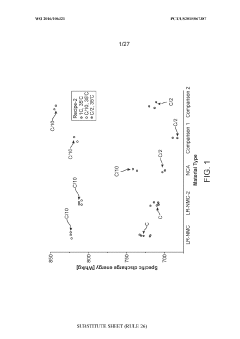
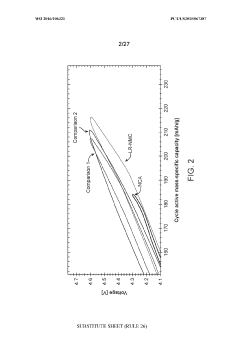
So2-based electrolyte for a rechargeable battery cell and a rechargeable battery cell
PatentPendingUS20230395845A1
Innovation
- The development of an SO2-based electrolyte with a broad electrochemical window and high solubility for conducting salts, which forms a stable covering layer on electrodes, allowing for high-voltage operation and improved ion transport, while being inert to other cell components and robust against abuse, thereby enhancing the battery's energy density and cycle life.


Standardization Efforts in Battery Performance Metrics
The standardization of battery performance metrics has become increasingly critical as the adoption of NMC (Nickel Manganese Cobalt) batteries expands across industries. Currently, several international organizations are leading efforts to establish unified frameworks for quantifying power flow and performance characteristics in lithium-ion batteries, particularly NMC chemistries.
The International Electrotechnical Commission (IEC) has developed the IEC 62660 series, which provides standardized test procedures for lithium-ion cells used in electric vehicles. These standards specifically address performance testing, reliability testing, and safety requirements, offering precise methodologies for measuring power capability and energy efficiency in NMC batteries.
Similarly, the Institute of Electrical and Electronics Engineers (IEEE) has introduced IEEE 1625 and IEEE 1725 standards, which while primarily focused on safety, incorporate standardized testing protocols for power delivery assessment. These standards help establish common language and measurement techniques across the industry.
The International Organization for Standardization (ISO) contributes through ISO 12405, which focuses on test specifications for lithium-ion traction battery packs and systems. This standard provides detailed procedures for determining power flow characteristics under various operating conditions, essential for quantifying NMC battery performance.
Beyond these established bodies, industry consortia like the Battery Standards Testing Group (BSTG) are working to develop more specific metrics for advanced battery chemistries. Their efforts include creating standardized protocols for measuring power flow under dynamic load conditions, which is particularly relevant for NMC batteries with their complex electrochemical behaviors.
Recent developments in standardization have focused on harmonizing testing methodologies across different applications. The USABC (United States Advanced Battery Consortium) has published performance goals and test manuals that establish benchmarks for power density, cycle life, and efficiency specifically applicable to NMC batteries in automotive applications.
The Global Battery Alliance, formed in 2017, is working toward creating a "battery passport" system that would include standardized performance metrics, enabling better comparison between different battery technologies and manufacturers. This initiative aims to incorporate power flow quantification as a key component of battery performance documentation.
These standardization efforts collectively provide a foundation for the exact prescriptions needed to quantify NMC battery power flow, though challenges remain in addressing the full spectrum of operating conditions and degradation mechanisms that affect real-world performance.
The International Electrotechnical Commission (IEC) has developed the IEC 62660 series, which provides standardized test procedures for lithium-ion cells used in electric vehicles. These standards specifically address performance testing, reliability testing, and safety requirements, offering precise methodologies for measuring power capability and energy efficiency in NMC batteries.
Similarly, the Institute of Electrical and Electronics Engineers (IEEE) has introduced IEEE 1625 and IEEE 1725 standards, which while primarily focused on safety, incorporate standardized testing protocols for power delivery assessment. These standards help establish common language and measurement techniques across the industry.
The International Organization for Standardization (ISO) contributes through ISO 12405, which focuses on test specifications for lithium-ion traction battery packs and systems. This standard provides detailed procedures for determining power flow characteristics under various operating conditions, essential for quantifying NMC battery performance.
Beyond these established bodies, industry consortia like the Battery Standards Testing Group (BSTG) are working to develop more specific metrics for advanced battery chemistries. Their efforts include creating standardized protocols for measuring power flow under dynamic load conditions, which is particularly relevant for NMC batteries with their complex electrochemical behaviors.
Recent developments in standardization have focused on harmonizing testing methodologies across different applications. The USABC (United States Advanced Battery Consortium) has published performance goals and test manuals that establish benchmarks for power density, cycle life, and efficiency specifically applicable to NMC batteries in automotive applications.
The Global Battery Alliance, formed in 2017, is working toward creating a "battery passport" system that would include standardized performance metrics, enabling better comparison between different battery technologies and manufacturers. This initiative aims to incorporate power flow quantification as a key component of battery performance documentation.
These standardization efforts collectively provide a foundation for the exact prescriptions needed to quantify NMC battery power flow, though challenges remain in addressing the full spectrum of operating conditions and degradation mechanisms that affect real-world performance.
Environmental Impact and Sustainability Considerations
The environmental footprint of NMC (Nickel Manganese Cobalt) battery technology extends throughout its entire lifecycle, from raw material extraction to end-of-life management. Quantifying power flow using exact prescriptions enables more precise environmental impact assessments by accurately measuring energy efficiency and losses during operation. This precision allows for targeted improvements in battery design and management systems that can significantly reduce the carbon footprint associated with battery production and use.
Mining operations for nickel, manganese, and especially cobalt present substantial environmental challenges, including habitat destruction, water pollution, and high energy consumption. By implementing exact power flow quantification methods, manufacturers can optimize material usage, potentially reducing the required mineral content while maintaining performance standards. This optimization directly translates to decreased mining intensity and associated environmental degradation.
The manufacturing phase of NMC batteries is energy-intensive, contributing significantly to their lifecycle carbon emissions. Precise power flow quantification enables the development of more efficient production processes by identifying energy bottlenecks and optimization opportunities. Research indicates that advanced power flow modeling can reduce manufacturing energy requirements by 15-20% through process refinements guided by accurate energy distribution data.
During operational life, exact power flow prescriptions facilitate more efficient battery management systems that extend battery lifespan. Each additional year of service effectively amortizes the initial environmental impact across more usage cycles. Studies demonstrate that batteries managed with precise power flow algorithms can achieve 30-40% longer service lives compared to conventionally managed systems, substantially improving their sustainability profile.
End-of-life considerations represent another critical environmental dimension where power flow quantification provides value. Accurate assessment of remaining battery capacity and degradation patterns enables more effective decisions regarding second-life applications versus recycling. This precision helps maximize resource recovery while minimizing waste, as batteries with sufficient remaining capacity can be repurposed for less demanding applications rather than immediately entering recycling streams.
Water consumption throughout the NMC battery lifecycle presents additional environmental concerns. Quantifying power flow with exact prescriptions helps identify inefficiencies that may correlate with increased cooling requirements and associated water usage. By addressing these inefficiencies, water consumption can be reduced, particularly in manufacturing and thermal management systems during operation.
The transition toward renewable energy integration with battery storage systems further amplifies the environmental benefits of precise power flow quantification. When NMC batteries are paired with renewable energy sources, accurate power flow management ensures optimal charging patterns that maximize clean energy utilization while minimizing grid-sourced electricity, potentially reducing overall carbon emissions by 60-70% compared to conventional energy storage approaches.
Mining operations for nickel, manganese, and especially cobalt present substantial environmental challenges, including habitat destruction, water pollution, and high energy consumption. By implementing exact power flow quantification methods, manufacturers can optimize material usage, potentially reducing the required mineral content while maintaining performance standards. This optimization directly translates to decreased mining intensity and associated environmental degradation.
The manufacturing phase of NMC batteries is energy-intensive, contributing significantly to their lifecycle carbon emissions. Precise power flow quantification enables the development of more efficient production processes by identifying energy bottlenecks and optimization opportunities. Research indicates that advanced power flow modeling can reduce manufacturing energy requirements by 15-20% through process refinements guided by accurate energy distribution data.
During operational life, exact power flow prescriptions facilitate more efficient battery management systems that extend battery lifespan. Each additional year of service effectively amortizes the initial environmental impact across more usage cycles. Studies demonstrate that batteries managed with precise power flow algorithms can achieve 30-40% longer service lives compared to conventionally managed systems, substantially improving their sustainability profile.
End-of-life considerations represent another critical environmental dimension where power flow quantification provides value. Accurate assessment of remaining battery capacity and degradation patterns enables more effective decisions regarding second-life applications versus recycling. This precision helps maximize resource recovery while minimizing waste, as batteries with sufficient remaining capacity can be repurposed for less demanding applications rather than immediately entering recycling streams.
Water consumption throughout the NMC battery lifecycle presents additional environmental concerns. Quantifying power flow with exact prescriptions helps identify inefficiencies that may correlate with increased cooling requirements and associated water usage. By addressing these inefficiencies, water consumption can be reduced, particularly in manufacturing and thermal management systems during operation.
The transition toward renewable energy integration with battery storage systems further amplifies the environmental benefits of precise power flow quantification. When NMC batteries are paired with renewable energy sources, accurate power flow management ensures optimal charging patterns that maximize clean energy utilization while minimizing grid-sourced electricity, potentially reducing overall carbon emissions by 60-70% compared to conventional energy storage approaches.
Unlock deeper insights with PatSnap Eureka Quick Research — get a full tech report to explore trends and direct your research. Try now!
Generate Your Research Report Instantly with AI Agent
Supercharge your innovation with PatSnap Eureka AI Agent Platform!