

Quantifying Adhesion Strength in Electrohydrodynamically Printed Layers
APR 29, 20269 MIN READ
Generate Your Research Report Instantly with AI Agent
Patsnap Eureka helps you evaluate technical feasibility & market potential.
EHD Printing Adhesion Background and Objectives
Electrohydrodynamic (EHD) printing has emerged as a revolutionary additive manufacturing technique that leverages electric fields to control the deposition of materials at micro and nanoscale resolutions. This technology enables precise patterning of functional materials including polymers, ceramics, and conductive inks through the manipulation of charged droplets or jets under high voltage conditions. The ability to achieve feature sizes ranging from hundreds of nanometers to several micrometers has positioned EHD printing as a critical technology for applications in flexible electronics, biomedical devices, and advanced sensor systems.
The evolution of EHD printing technology has been driven by the increasing demand for high-resolution manufacturing processes that can bridge the gap between traditional printing methods and lithographic techniques. Early developments in the 1960s focused on understanding the fundamental physics of electrospray phenomena, while subsequent decades witnessed significant advances in nozzle design, voltage control systems, and substrate preparation methods. The integration of computer-controlled positioning systems and real-time monitoring capabilities has transformed EHD printing from a laboratory curiosity into a viable manufacturing platform.
Despite these technological advances, the quantification of adhesion strength in EHD-printed layers remains a critical challenge that limits the widespread adoption of this technology. Adhesion strength directly impacts the mechanical reliability, durability, and functional performance of printed structures, particularly in applications subjected to thermal cycling, mechanical stress, or environmental exposure. Current assessment methods often rely on qualitative observations or indirect measurements that fail to provide the quantitative data necessary for process optimization and quality control.
The primary objective of developing robust adhesion quantification methods is to establish standardized testing protocols that can accurately measure the interfacial bonding strength between EHD-printed layers and various substrate materials. This includes understanding the relationship between printing parameters such as voltage, flow rate, substrate temperature, and the resulting adhesion characteristics. Additionally, the development of predictive models that correlate material properties, process conditions, and adhesion performance represents a crucial step toward achieving consistent and reliable EHD printing outcomes.
Furthermore, the establishment of adhesion strength databases and failure mode analysis frameworks will enable the optimization of material formulations and printing strategies for specific applications. This comprehensive approach aims to transform adhesion assessment from a reactive quality control measure into a proactive design tool that enhances the overall reliability and performance of EHD-printed devices and systems.
The evolution of EHD printing technology has been driven by the increasing demand for high-resolution manufacturing processes that can bridge the gap between traditional printing methods and lithographic techniques. Early developments in the 1960s focused on understanding the fundamental physics of electrospray phenomena, while subsequent decades witnessed significant advances in nozzle design, voltage control systems, and substrate preparation methods. The integration of computer-controlled positioning systems and real-time monitoring capabilities has transformed EHD printing from a laboratory curiosity into a viable manufacturing platform.
Despite these technological advances, the quantification of adhesion strength in EHD-printed layers remains a critical challenge that limits the widespread adoption of this technology. Adhesion strength directly impacts the mechanical reliability, durability, and functional performance of printed structures, particularly in applications subjected to thermal cycling, mechanical stress, or environmental exposure. Current assessment methods often rely on qualitative observations or indirect measurements that fail to provide the quantitative data necessary for process optimization and quality control.
The primary objective of developing robust adhesion quantification methods is to establish standardized testing protocols that can accurately measure the interfacial bonding strength between EHD-printed layers and various substrate materials. This includes understanding the relationship between printing parameters such as voltage, flow rate, substrate temperature, and the resulting adhesion characteristics. Additionally, the development of predictive models that correlate material properties, process conditions, and adhesion performance represents a crucial step toward achieving consistent and reliable EHD printing outcomes.
Furthermore, the establishment of adhesion strength databases and failure mode analysis frameworks will enable the optimization of material formulations and printing strategies for specific applications. This comprehensive approach aims to transform adhesion assessment from a reactive quality control measure into a proactive design tool that enhances the overall reliability and performance of EHD-printed devices and systems.
Market Demand for EHD Printed Layer Applications
The market demand for electrohydrodynamic (EHD) printed layer applications is experiencing significant growth across multiple industrial sectors, driven by the technology's unique capabilities in producing high-resolution, controlled deposition patterns. The electronics industry represents the largest market segment, where EHD printing enables the fabrication of ultra-thin conductive traces, flexible circuits, and advanced display components. The ability to precisely control layer thickness and adhesion properties makes EHD printing particularly valuable for next-generation electronic devices requiring miniaturization and enhanced performance.
Biomedical applications constitute another rapidly expanding market segment, where EHD printing technology addresses critical needs in drug delivery systems, tissue engineering scaffolds, and biosensor development. The pharmaceutical industry increasingly relies on EHD printing for creating controlled-release drug formulations and personalized medicine applications. The precise control over layer adhesion strength is crucial for ensuring proper drug release kinetics and biocompatibility in medical devices.
The aerospace and automotive industries are emerging as significant consumers of EHD printing technology, particularly for lightweight composite materials and functional coatings. These sectors demand materials with specific adhesion characteristics to withstand extreme environmental conditions while maintaining structural integrity. EHD printing offers advantages in creating gradient materials and multi-layered structures with tailored adhesion properties.
Energy storage and conversion applications represent a growing market opportunity, where EHD printing enables the production of advanced battery electrodes, fuel cell components, and photovoltaic devices. The technology's ability to create uniform layers with controlled porosity and adhesion strength directly impacts device performance and longevity.
Market growth is further accelerated by increasing demand for sustainable manufacturing processes and reduced material waste. EHD printing's additive nature and precise material placement align with environmental regulations and cost reduction initiatives across industries. The technology's scalability from laboratory prototyping to industrial production makes it attractive for companies seeking flexible manufacturing solutions.
Current market challenges include the need for standardized adhesion measurement techniques and quality control protocols, which directly relates to the importance of quantifying adhesion strength in EHD printed layers for ensuring consistent product performance and reliability.
Biomedical applications constitute another rapidly expanding market segment, where EHD printing technology addresses critical needs in drug delivery systems, tissue engineering scaffolds, and biosensor development. The pharmaceutical industry increasingly relies on EHD printing for creating controlled-release drug formulations and personalized medicine applications. The precise control over layer adhesion strength is crucial for ensuring proper drug release kinetics and biocompatibility in medical devices.
The aerospace and automotive industries are emerging as significant consumers of EHD printing technology, particularly for lightweight composite materials and functional coatings. These sectors demand materials with specific adhesion characteristics to withstand extreme environmental conditions while maintaining structural integrity. EHD printing offers advantages in creating gradient materials and multi-layered structures with tailored adhesion properties.
Energy storage and conversion applications represent a growing market opportunity, where EHD printing enables the production of advanced battery electrodes, fuel cell components, and photovoltaic devices. The technology's ability to create uniform layers with controlled porosity and adhesion strength directly impacts device performance and longevity.
Market growth is further accelerated by increasing demand for sustainable manufacturing processes and reduced material waste. EHD printing's additive nature and precise material placement align with environmental regulations and cost reduction initiatives across industries. The technology's scalability from laboratory prototyping to industrial production makes it attractive for companies seeking flexible manufacturing solutions.
Current market challenges include the need for standardized adhesion measurement techniques and quality control protocols, which directly relates to the importance of quantifying adhesion strength in EHD printed layers for ensuring consistent product performance and reliability.
Current EHD Adhesion Measurement Challenges
The quantification of adhesion strength in electrohydrodynamically printed layers faces significant measurement challenges that stem from the unique characteristics of EHD printing processes and the resulting material interfaces. Traditional adhesion testing methods, originally developed for conventional coating and printing technologies, often prove inadequate when applied to EHD-printed structures due to fundamental differences in layer formation mechanisms and material properties.
One of the primary challenges lies in the microscale nature of EHD-printed features. The typical layer thicknesses range from nanometers to micrometers, making it extremely difficult to apply conventional mechanical testing approaches such as pull-off tests or cross-cut adhesion measurements. The small scale of these features requires specialized instrumentation capable of applying and measuring forces at the micro-Newton level, which significantly limits the availability and accessibility of appropriate testing equipment.
The heterogeneous nature of EHD-printed layers presents another substantial measurement challenge. Unlike uniform coatings produced by traditional methods, EHD printing often results in non-uniform thickness distributions and varying material densities across the printed area. This heterogeneity makes it challenging to obtain representative adhesion measurements, as different regions of the same printed layer may exhibit significantly different adhesion properties.
Substrate interaction complexity further complicates adhesion quantification in EHD systems. The high electric fields inherent in EHD processes can induce chemical and physical changes at the substrate-layer interface that are not present in conventional printing methods. These field-induced modifications can create gradient adhesion properties that vary with depth from the interface, making it difficult to establish standardized measurement protocols.
Sample preparation and handling represent additional critical challenges in EHD adhesion measurement. The delicate nature of EHD-printed layers makes them susceptible to damage during sample preparation for testing. Traditional sample mounting and fixturing methods may introduce artifacts or alter the adhesion properties being measured, leading to unreliable or non-representative results.
Environmental sensitivity of EHD-printed materials poses another measurement challenge. Many EHD-compatible materials exhibit strong dependencies on humidity, temperature, and atmospheric conditions, which can significantly affect adhesion properties during testing. Maintaining consistent environmental conditions throughout the measurement process becomes crucial but technically demanding.
The lack of standardized testing protocols specifically designed for EHD-printed materials creates inconsistencies in measurement approaches across different research groups and industrial applications. This absence of standardization makes it difficult to compare results between studies and establish reliable benchmarks for adhesion performance in EHD systems.
One of the primary challenges lies in the microscale nature of EHD-printed features. The typical layer thicknesses range from nanometers to micrometers, making it extremely difficult to apply conventional mechanical testing approaches such as pull-off tests or cross-cut adhesion measurements. The small scale of these features requires specialized instrumentation capable of applying and measuring forces at the micro-Newton level, which significantly limits the availability and accessibility of appropriate testing equipment.
The heterogeneous nature of EHD-printed layers presents another substantial measurement challenge. Unlike uniform coatings produced by traditional methods, EHD printing often results in non-uniform thickness distributions and varying material densities across the printed area. This heterogeneity makes it challenging to obtain representative adhesion measurements, as different regions of the same printed layer may exhibit significantly different adhesion properties.
Substrate interaction complexity further complicates adhesion quantification in EHD systems. The high electric fields inherent in EHD processes can induce chemical and physical changes at the substrate-layer interface that are not present in conventional printing methods. These field-induced modifications can create gradient adhesion properties that vary with depth from the interface, making it difficult to establish standardized measurement protocols.
Sample preparation and handling represent additional critical challenges in EHD adhesion measurement. The delicate nature of EHD-printed layers makes them susceptible to damage during sample preparation for testing. Traditional sample mounting and fixturing methods may introduce artifacts or alter the adhesion properties being measured, leading to unreliable or non-representative results.
Environmental sensitivity of EHD-printed materials poses another measurement challenge. Many EHD-compatible materials exhibit strong dependencies on humidity, temperature, and atmospheric conditions, which can significantly affect adhesion properties during testing. Maintaining consistent environmental conditions throughout the measurement process becomes crucial but technically demanding.
The lack of standardized testing protocols specifically designed for EHD-printed materials creates inconsistencies in measurement approaches across different research groups and industrial applications. This absence of standardization makes it difficult to compare results between studies and establish reliable benchmarks for adhesion performance in EHD systems.
Existing Adhesion Quantification Methods
01 Surface treatment methods for enhanced adhesion
Various surface treatment techniques can be employed to improve the adhesion strength of electrohydrodynamically printed layers. These methods involve modifying the substrate surface properties through physical or chemical treatments to create better bonding conditions. Surface roughening, plasma treatment, and chemical etching are commonly used approaches that increase the surface area and create reactive sites for improved layer adhesion.- Surface treatment methods for enhanced adhesion: Various surface treatment techniques can be employed to improve the adhesion strength of electrohydrodynamically printed layers. These methods involve modifying the substrate surface properties through physical or chemical treatments to create better bonding conditions. Surface roughening, plasma treatment, and chemical etching are common approaches that increase surface area and create reactive sites for improved layer adhesion.
- Adhesion promoter additives and coupling agents: The incorporation of specific adhesion promoter compounds and coupling agents into the printing formulation can significantly enhance layer adhesion strength. These additives create chemical bridges between the printed material and substrate, improving interfacial bonding. Silane coupling agents, titanate compounds, and other organometallic promoters are commonly used to achieve stronger adhesion in electrohydrodynamic printing applications.
- Substrate material selection and compatibility: The choice of substrate material plays a crucial role in determining the adhesion strength of electrohydrodynamically printed layers. Different substrate materials exhibit varying degrees of compatibility with printed materials based on their surface energy, chemical composition, and physical properties. Proper substrate selection considering these factors can optimize adhesion performance without requiring additional treatments.
- Process parameter optimization for adhesion enhancement: The electrohydrodynamic printing process parameters significantly influence the adhesion strength of deposited layers. Key parameters include applied voltage, flow rate, nozzle-to-substrate distance, and substrate temperature. Optimizing these parameters can improve the wetting behavior, penetration depth, and interfacial contact between the printed material and substrate, resulting in enhanced adhesion strength.
- Multi-layer printing strategies and interlayer adhesion: Advanced multi-layer printing approaches can be implemented to improve overall adhesion strength through the use of intermediate adhesion layers or gradient compositions. These strategies involve printing primer layers, using different material compositions for successive layers, or creating compositional gradients that enhance both interlayer and substrate adhesion. Such approaches are particularly effective for challenging substrate-coating combinations.
02 Adhesion promoter additives and coupling agents
The incorporation of specific adhesion promoter compounds and coupling agents into the printing formulation can significantly enhance the bonding strength between printed layers and substrates. These additives work by forming chemical bridges between the printed material and the substrate surface, creating stronger interfacial bonds. Silane coupling agents, titanate compounds, and other specialized adhesion promoters are commonly utilized for this purpose.Expand Specific Solutions03 Interlayer bonding enhancement techniques
Methods for improving adhesion between multiple printed layers involve controlling the printing parameters and material properties to optimize interlayer bonding. This includes managing the timing between layer depositions, controlling layer thickness, and adjusting the rheological properties of the printing materials. Proper interlayer adhesion is crucial for creating robust multi-layer structures with good mechanical integrity.Expand Specific Solutions04 Material composition optimization for adhesion
The formulation of printing materials with specific polymer compositions, crosslinking agents, and functional additives can be tailored to achieve optimal adhesion properties. This involves selecting appropriate base polymers, incorporating crosslinking systems, and adding functional groups that promote adhesion. The molecular weight, glass transition temperature, and chemical functionality of the materials play critical roles in determining the final adhesion strength.Expand Specific Solutions05 Post-processing treatments for adhesion improvement
Various post-processing techniques can be applied after electrohydrodynamic printing to enhance the adhesion strength of the deposited layers. These treatments include thermal annealing, UV curing, solvent vapor exposure, and mechanical pressing. Such post-processing steps help to improve the interfacial contact, promote interdiffusion, and enhance the overall bonding strength between layers and substrates.Expand Specific Solutions
Key Players in EHD Printing Industry
The electrohydrodynamic printing adhesion quantification field represents an emerging technology sector in the early commercialization stage, with significant growth potential driven by increasing demand for precision manufacturing and flexible electronics. The market remains relatively niche but is expanding rapidly as applications in displays, sensors, and advanced materials gain traction. Technology maturity varies considerably across market players, with established materials companies like 3M Innovative Properties Co., Nitto Denko Corp., and LG Chem Ltd. leveraging decades of adhesive expertise to develop sophisticated measurement solutions. Display technology leaders including E Ink Corp. and Prime View International Co. Ltd. are advancing the field through electronic paper applications, while printing specialists such as HP Indigo BV, Seiko Epson Corp., and FUJIFILM Corp. contribute precision deposition technologies. Academic institutions like The Regents of the University of California are pioneering fundamental research methodologies. The competitive landscape shows a convergence of traditional adhesive manufacturers, advanced printing companies, and electronics firms, indicating strong cross-industry collaboration and technological maturation toward standardized adhesion quantification methods.
3M Innovative Properties Co.
Technical Solution: 3M has developed sophisticated EHD printing technologies with emphasis on adhesion science and quantification methodologies. Their approach integrates surface modification techniques with controlled electrohydrodynamic deposition to achieve predictable adhesion characteristics. The company employs comprehensive testing protocols including T-peel tests, lap shear testing, and environmental stress testing to quantify adhesion strength under various conditions. 3M's proprietary adhesion promoters and surface treatments enable adhesion values exceeding 30 N/cm on challenging substrates. Their multi-disciplinary approach combines materials engineering, surface chemistry, and process optimization to ensure reliable layer-to-substrate bonding performance.
Strengths: World-leading adhesion expertise, extensive materials portfolio, strong analytical and testing capabilities. Weaknesses: Higher material costs, complex formulation requirements for specialized applications.
Hewlett-Packard Development Co. LP
Technical Solution: HP has developed advanced electrohydrodynamic (EHD) printing technologies that utilize controlled electric fields to deposit precise layers of functional materials. Their approach focuses on optimizing ink formulations with specific rheological properties and surface tension characteristics to enhance adhesion strength. The company employs multi-layer deposition techniques with intermediate curing steps to build strong interfacial bonds. HP's quantification methods include peel testing, cross-hatch adhesion testing, and advanced microscopy techniques to measure layer-to-substrate adhesion forces ranging from 0.5 to 15 N/cm depending on substrate material and ink chemistry.
Strengths: Extensive experience in inkjet printing, strong R&D capabilities, established manufacturing infrastructure. Weaknesses: Limited focus on specialized EHD applications, primarily consumer-oriented solutions.
Core Innovations in EHD Layer Adhesion Testing
Method of adhesion measurement at the interface between layers
PatentInactiveEP1563277A1
Innovation
- A method involving a laser pulse impacting directly on one layer to create a shock wave at the interface, with a sensor detecting the rupture, allowing adhesion strength calculation based on the energy and wavelength of the laser pulse, which is non-destructive and can be performed at discrete locations without complex sample preparation.
Adhesion strength testing using a depth-sensing indentation technique
PatentInactiveUS6339958B1
Innovation
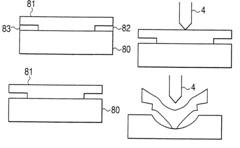
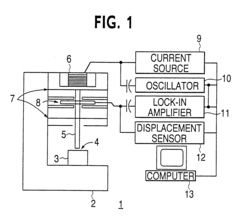
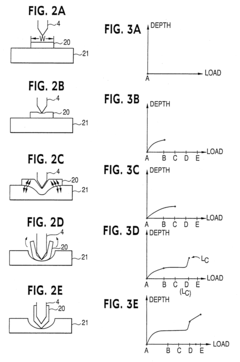
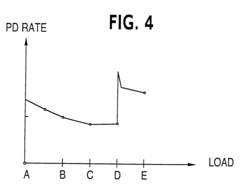
- A nondestructive depth sensing indentation technique using a nanoindentation apparatus with a variable load to measure adhesion strength by detecting the critical load and penetration depth rate, allowing for in-situ testing of thin films on substrates without damaging the film, and calculating adhesion strength through critical stress and shear force calculations.
Material Compatibility Standards for EHD Systems
Material compatibility represents a fundamental prerequisite for achieving reliable adhesion strength in electrohydrodynamically printed layers. The establishment of comprehensive compatibility standards ensures that substrate materials, printing inks, and processing conditions work synergistically to produce consistent and measurable adhesion performance. These standards must address both chemical and physical compatibility aspects that directly influence the interfacial bonding mechanisms between printed layers and underlying substrates.
Chemical compatibility standards focus on molecular-level interactions between printing materials and substrates. Surface energy matching criteria define acceptable ranges for substrate surface tension relative to ink formulations, typically requiring surface energy differences within 10-15 mN/m for optimal wetting and adhesion. Solvent compatibility matrices establish guidelines for preventing substrate degradation or swelling during the printing process, particularly critical for polymer substrates exposed to organic solvents in EHD inks.
Physical compatibility encompasses dimensional stability requirements and thermal expansion coefficient matching. Standards specify maximum allowable thermal expansion mismatches, typically limiting differences to less than 50 ppm/°C to prevent delamination during temperature cycling. Surface roughness compatibility ranges are defined based on printing resolution requirements, with optimal Ra values typically falling between 0.1-2.0 μm depending on the specific EHD printing parameters and desired adhesion strength.
Electrical compatibility standards address conductivity requirements for both substrates and inks in EHD systems. Substrate resistivity ranges are specified to ensure proper electric field distribution during printing while preventing charge accumulation that could compromise layer adhesion. Dielectric constant matching requirements help optimize field uniformity and droplet formation consistency.
Environmental compatibility standards establish testing protocols for material performance under various atmospheric conditions. Humidity tolerance specifications define acceptable moisture absorption rates for substrates and printed materials, while temperature stability ranges ensure maintained adhesion strength across operational temperature spans. These standards also incorporate aging requirements to validate long-term material compatibility and adhesion durability.
Standardized testing methodologies provide quantitative frameworks for evaluating material compatibility, including contact angle measurements, surface energy analysis, and accelerated aging protocols. These testing standards ensure reproducible compatibility assessments across different EHD printing systems and applications, enabling reliable prediction of adhesion strength performance based on material selection criteria.
Chemical compatibility standards focus on molecular-level interactions between printing materials and substrates. Surface energy matching criteria define acceptable ranges for substrate surface tension relative to ink formulations, typically requiring surface energy differences within 10-15 mN/m for optimal wetting and adhesion. Solvent compatibility matrices establish guidelines for preventing substrate degradation or swelling during the printing process, particularly critical for polymer substrates exposed to organic solvents in EHD inks.
Physical compatibility encompasses dimensional stability requirements and thermal expansion coefficient matching. Standards specify maximum allowable thermal expansion mismatches, typically limiting differences to less than 50 ppm/°C to prevent delamination during temperature cycling. Surface roughness compatibility ranges are defined based on printing resolution requirements, with optimal Ra values typically falling between 0.1-2.0 μm depending on the specific EHD printing parameters and desired adhesion strength.
Electrical compatibility standards address conductivity requirements for both substrates and inks in EHD systems. Substrate resistivity ranges are specified to ensure proper electric field distribution during printing while preventing charge accumulation that could compromise layer adhesion. Dielectric constant matching requirements help optimize field uniformity and droplet formation consistency.
Environmental compatibility standards establish testing protocols for material performance under various atmospheric conditions. Humidity tolerance specifications define acceptable moisture absorption rates for substrates and printed materials, while temperature stability ranges ensure maintained adhesion strength across operational temperature spans. These standards also incorporate aging requirements to validate long-term material compatibility and adhesion durability.
Standardized testing methodologies provide quantitative frameworks for evaluating material compatibility, including contact angle measurements, surface energy analysis, and accelerated aging protocols. These testing standards ensure reproducible compatibility assessments across different EHD printing systems and applications, enabling reliable prediction of adhesion strength performance based on material selection criteria.
Quality Control Framework for EHD Manufacturing
Establishing a comprehensive quality control framework for electrohydrodynamic (EHD) manufacturing requires systematic integration of real-time monitoring, standardized testing protocols, and automated feedback mechanisms. The framework must address the unique challenges of EHD printing processes, where multiple variables including electric field strength, material properties, and environmental conditions directly impact layer adhesion quality.
The foundation of effective quality control lies in implementing multi-stage inspection protocols that span from raw material characterization to final product validation. Pre-processing quality gates should include ink viscosity verification, conductivity measurements, and substrate surface preparation validation. These initial checkpoints ensure consistent starting conditions that are critical for reproducible adhesion performance across production batches.
In-process monitoring represents the most critical component of the quality framework, requiring real-time assessment of printing parameters and immediate detection of deviations. Advanced sensor integration enables continuous tracking of voltage stability, flow rate consistency, and droplet formation characteristics. Machine learning algorithms can analyze these data streams to predict potential adhesion failures before they manifest in the final product.
Post-processing quality assessment must incorporate both destructive and non-destructive testing methodologies to validate adhesion strength without compromising production efficiency. Statistical process control techniques should be employed to establish control limits and trigger corrective actions when adhesion measurements fall outside acceptable ranges. This approach ensures consistent product quality while minimizing waste and rework costs.
The framework should also include comprehensive documentation systems that maintain traceability throughout the manufacturing process. Digital quality records enable rapid root cause analysis when adhesion issues occur and support continuous improvement initiatives. Integration with enterprise resource planning systems facilitates seamless data flow between quality control operations and broader manufacturing management functions.
Automated feedback loops constitute the final element of the quality control framework, enabling real-time process adjustments based on adhesion strength measurements. These closed-loop systems can automatically modify printing parameters such as voltage, speed, or material flow rates to maintain optimal adhesion performance without human intervention, significantly improving manufacturing consistency and reducing quality-related production delays.
The foundation of effective quality control lies in implementing multi-stage inspection protocols that span from raw material characterization to final product validation. Pre-processing quality gates should include ink viscosity verification, conductivity measurements, and substrate surface preparation validation. These initial checkpoints ensure consistent starting conditions that are critical for reproducible adhesion performance across production batches.
In-process monitoring represents the most critical component of the quality framework, requiring real-time assessment of printing parameters and immediate detection of deviations. Advanced sensor integration enables continuous tracking of voltage stability, flow rate consistency, and droplet formation characteristics. Machine learning algorithms can analyze these data streams to predict potential adhesion failures before they manifest in the final product.
Post-processing quality assessment must incorporate both destructive and non-destructive testing methodologies to validate adhesion strength without compromising production efficiency. Statistical process control techniques should be employed to establish control limits and trigger corrective actions when adhesion measurements fall outside acceptable ranges. This approach ensures consistent product quality while minimizing waste and rework costs.
The framework should also include comprehensive documentation systems that maintain traceability throughout the manufacturing process. Digital quality records enable rapid root cause analysis when adhesion issues occur and support continuous improvement initiatives. Integration with enterprise resource planning systems facilitates seamless data flow between quality control operations and broader manufacturing management functions.
Automated feedback loops constitute the final element of the quality control framework, enabling real-time process adjustments based on adhesion strength measurements. These closed-loop systems can automatically modify printing parameters such as voltage, speed, or material flow rates to maintain optimal adhesion performance without human intervention, significantly improving manufacturing consistency and reducing quality-related production delays.
Unlock deeper insights with Patsnap Eureka Quick Research — get a full tech report to explore trends and direct your research. Try now!
Generate Your Research Report Instantly with AI Agent
Supercharge your innovation with Patsnap Eureka AI Agent Platform!