Scramjet Applications in Global Defense Systems
AUG 13, 20258 MIN READ
Generate Your Research Report Instantly with AI Agent
PatSnap Eureka helps you evaluate technical feasibility & market potential.
Scramjet Tech Evolution
Scramjet technology has undergone significant evolution since its inception in the 1950s. The development trajectory can be divided into several key phases, each marked by notable advancements and breakthroughs in the field of hypersonic propulsion.
The initial conceptualization phase occurred in the 1950s and 1960s, with pioneering work by Antonio Ferri and Frederick S. Billig laying the theoretical foundation for scramjet engines. During this period, the focus was primarily on understanding the fundamental principles of supersonic combustion and its potential applications in aerospace.
The 1970s and 1980s saw the emergence of experimental programs aimed at validating scramjet concepts. Notable among these was NASA's Hypersonic Research Engine (HRE) project, which conducted ground tests of a scramjet engine design. This phase was crucial in demonstrating the feasibility of sustained supersonic combustion.
The 1990s marked a significant leap forward with the initiation of flight test programs. The Russian CIAM/NASA test flights in 1991 and 1998 achieved brief periods of scramjet operation at hypersonic speeds. Concurrently, the U.S. Navy's Hypersonic Flight Demonstration program (HyFly) began exploring scramjet applications for missile propulsion.
The early 2000s witnessed a surge in scramjet research and development globally. The NASA X-43A program achieved a major milestone in 2004 by demonstrating sustained scramjet-powered flight at Mach 9.6. This success was followed by the X-51 WaveRider program, which achieved longer duration scramjet flight in 2010 and subsequent years.
Recent years have seen an intensification of scramjet development efforts, particularly in the context of defense applications. Countries like the United States, Russia, China, and India have accelerated their hypersonic weapons programs, many of which incorporate scramjet technology. The focus has shifted towards integrating scramjets into operational weapon systems and exploring their potential for long-range strike capabilities.
Looking ahead, the evolution of scramjet technology is expected to continue along several trajectories. Efforts are underway to improve the reliability and efficiency of scramjet engines, extend their operational envelope to higher Mach numbers, and develop more advanced materials capable of withstanding extreme temperatures. Additionally, there is growing interest in exploring dual-use applications of scramjet technology, including potential civilian uses in high-speed transportation and space access.
The initial conceptualization phase occurred in the 1950s and 1960s, with pioneering work by Antonio Ferri and Frederick S. Billig laying the theoretical foundation for scramjet engines. During this period, the focus was primarily on understanding the fundamental principles of supersonic combustion and its potential applications in aerospace.
The 1970s and 1980s saw the emergence of experimental programs aimed at validating scramjet concepts. Notable among these was NASA's Hypersonic Research Engine (HRE) project, which conducted ground tests of a scramjet engine design. This phase was crucial in demonstrating the feasibility of sustained supersonic combustion.
The 1990s marked a significant leap forward with the initiation of flight test programs. The Russian CIAM/NASA test flights in 1991 and 1998 achieved brief periods of scramjet operation at hypersonic speeds. Concurrently, the U.S. Navy's Hypersonic Flight Demonstration program (HyFly) began exploring scramjet applications for missile propulsion.
The early 2000s witnessed a surge in scramjet research and development globally. The NASA X-43A program achieved a major milestone in 2004 by demonstrating sustained scramjet-powered flight at Mach 9.6. This success was followed by the X-51 WaveRider program, which achieved longer duration scramjet flight in 2010 and subsequent years.
Recent years have seen an intensification of scramjet development efforts, particularly in the context of defense applications. Countries like the United States, Russia, China, and India have accelerated their hypersonic weapons programs, many of which incorporate scramjet technology. The focus has shifted towards integrating scramjets into operational weapon systems and exploring their potential for long-range strike capabilities.
Looking ahead, the evolution of scramjet technology is expected to continue along several trajectories. Efforts are underway to improve the reliability and efficiency of scramjet engines, extend their operational envelope to higher Mach numbers, and develop more advanced materials capable of withstanding extreme temperatures. Additionally, there is growing interest in exploring dual-use applications of scramjet technology, including potential civilian uses in high-speed transportation and space access.
Defense Market Analysis
The global defense market for scramjet applications is experiencing significant growth, driven by increasing investments in hypersonic technologies and the need for advanced propulsion systems in military aircraft and missiles. Scramjet engines, capable of operating at hypersonic speeds, have become a focal point for defense organizations worldwide, particularly in the development of high-speed strike weapons and reconnaissance platforms.
The United States, China, and Russia are currently leading the scramjet market, with substantial investments in research and development. These nations are actively pursuing scramjet-powered hypersonic weapons and aircraft, recognizing their potential to revolutionize military capabilities. Other countries, including India, Japan, and several European nations, are also increasing their efforts in this field, albeit at a slower pace.
The defense market for scramjet applications can be segmented into two primary categories: hypersonic missiles and hypersonic aircraft. Hypersonic missiles represent the largest and most immediate market opportunity, with several countries developing and testing scramjet-powered missiles for strategic deterrence and tactical strike capabilities. Hypersonic aircraft, while still in the early stages of development, hold promise for future reconnaissance and rapid response missions.
Key drivers of the scramjet defense market include the escalating arms race among major powers, the need for penetrating adversary air defenses, and the desire to maintain technological superiority in military capabilities. Additionally, the potential dual-use applications of scramjet technology in commercial aerospace and space sectors are attracting interest from both government and private sector investors.
However, the market faces several challenges, including the high costs associated with research and development, technical complexities in achieving sustained hypersonic flight, and concerns over arms control and strategic stability. These factors may impact the rate of adoption and deployment of scramjet-powered systems in the near term.
Despite these challenges, the scramjet defense market is projected to grow substantially over the next decade. As technologies mature and production scales up, costs are expected to decrease, potentially leading to wider adoption across various military platforms. The market is also likely to see increased collaboration between nations and defense contractors, as well as spillover effects into civilian aerospace applications.
The United States, China, and Russia are currently leading the scramjet market, with substantial investments in research and development. These nations are actively pursuing scramjet-powered hypersonic weapons and aircraft, recognizing their potential to revolutionize military capabilities. Other countries, including India, Japan, and several European nations, are also increasing their efforts in this field, albeit at a slower pace.
The defense market for scramjet applications can be segmented into two primary categories: hypersonic missiles and hypersonic aircraft. Hypersonic missiles represent the largest and most immediate market opportunity, with several countries developing and testing scramjet-powered missiles for strategic deterrence and tactical strike capabilities. Hypersonic aircraft, while still in the early stages of development, hold promise for future reconnaissance and rapid response missions.
Key drivers of the scramjet defense market include the escalating arms race among major powers, the need for penetrating adversary air defenses, and the desire to maintain technological superiority in military capabilities. Additionally, the potential dual-use applications of scramjet technology in commercial aerospace and space sectors are attracting interest from both government and private sector investors.
However, the market faces several challenges, including the high costs associated with research and development, technical complexities in achieving sustained hypersonic flight, and concerns over arms control and strategic stability. These factors may impact the rate of adoption and deployment of scramjet-powered systems in the near term.
Despite these challenges, the scramjet defense market is projected to grow substantially over the next decade. As technologies mature and production scales up, costs are expected to decrease, potentially leading to wider adoption across various military platforms. The market is also likely to see increased collaboration between nations and defense contractors, as well as spillover effects into civilian aerospace applications.
Scramjet Challenges
Scramjet technology, while promising for hypersonic flight applications in global defense systems, faces numerous technical challenges that hinder its widespread adoption and operational deployment. One of the primary obstacles is the extreme thermal management requirements. At hypersonic speeds, the intense friction with the atmosphere generates temperatures that can exceed 2,000°C, pushing the limits of current materials and cooling systems.
Another significant challenge lies in the combustion process within the scramjet engine. Achieving stable and efficient combustion at supersonic speeds is exceptionally difficult due to the extremely short residence time of air and fuel in the combustion chamber. This necessitates rapid mixing and ignition, which current designs struggle to accomplish consistently across a wide range of flight conditions.
The inlet design of scramjet engines presents another hurdle. Creating an inlet that can efficiently compress incoming air at various speeds and altitudes while minimizing drag and shock wave interactions is a complex engineering task. The inlet must also be able to withstand extreme heat and pressure variations without compromising structural integrity.
Fuel selection and management pose additional challenges. Scramjets require fuels with high energy density and rapid ignition characteristics. However, these fuels must also be stable enough to withstand the intense heat experienced during hypersonic flight. Developing fuel systems that can reliably deliver and control fuel flow under such extreme conditions remains a significant technical challenge.
Control and stability issues are also paramount. Maintaining stable flight at hypersonic speeds requires sophisticated control systems that can react to minute changes in atmospheric conditions and vehicle dynamics. The development of robust, responsive control algorithms and actuators capable of operating in extreme environments is an ongoing area of research.
Furthermore, the integration of scramjet propulsion systems with airframe designs presents its own set of challenges. Balancing aerodynamic efficiency, thermal protection, and propulsion requirements while maintaining overall vehicle performance is a complex optimization problem that requires advanced modeling and testing capabilities.
Lastly, the lack of adequate ground testing facilities for full-scale scramjet engines hampers development efforts. Simulating hypersonic flight conditions on the ground is extremely difficult and expensive, limiting the ability to thoroughly test and validate scramjet designs before flight testing.
Another significant challenge lies in the combustion process within the scramjet engine. Achieving stable and efficient combustion at supersonic speeds is exceptionally difficult due to the extremely short residence time of air and fuel in the combustion chamber. This necessitates rapid mixing and ignition, which current designs struggle to accomplish consistently across a wide range of flight conditions.
The inlet design of scramjet engines presents another hurdle. Creating an inlet that can efficiently compress incoming air at various speeds and altitudes while minimizing drag and shock wave interactions is a complex engineering task. The inlet must also be able to withstand extreme heat and pressure variations without compromising structural integrity.
Fuel selection and management pose additional challenges. Scramjets require fuels with high energy density and rapid ignition characteristics. However, these fuels must also be stable enough to withstand the intense heat experienced during hypersonic flight. Developing fuel systems that can reliably deliver and control fuel flow under such extreme conditions remains a significant technical challenge.
Control and stability issues are also paramount. Maintaining stable flight at hypersonic speeds requires sophisticated control systems that can react to minute changes in atmospheric conditions and vehicle dynamics. The development of robust, responsive control algorithms and actuators capable of operating in extreme environments is an ongoing area of research.
Furthermore, the integration of scramjet propulsion systems with airframe designs presents its own set of challenges. Balancing aerodynamic efficiency, thermal protection, and propulsion requirements while maintaining overall vehicle performance is a complex optimization problem that requires advanced modeling and testing capabilities.
Lastly, the lack of adequate ground testing facilities for full-scale scramjet engines hampers development efforts. Simulating hypersonic flight conditions on the ground is extremely difficult and expensive, limiting the ability to thoroughly test and validate scramjet designs before flight testing.
Current Scramjet Designs
01 Scramjet engine design and configuration
Scramjet engines are designed for hypersonic flight, utilizing supersonic airflow for combustion. Key aspects include inlet design, combustion chamber configuration, and nozzle optimization to achieve efficient propulsion at high speeds. Advanced materials and cooling systems are employed to withstand extreme temperatures.- Scramjet engine design and configuration: Scramjet engines are designed for hypersonic flight, utilizing supersonic combustion. The engine configuration typically includes an inlet to compress incoming air, a combustion chamber where fuel is injected and burned, and a nozzle to accelerate exhaust gases. Various designs focus on optimizing airflow, fuel injection, and combustion efficiency for high-speed flight.
- Fuel injection and mixing systems: Efficient fuel injection and mixing are crucial for scramjet performance. Advanced systems are developed to ensure rapid and uniform fuel distribution within the supersonic airflow. These may include multiple injection points, specialized nozzle designs, or plasma-assisted fuel injection to enhance combustion efficiency and stability at hypersonic speeds.
- Thermal management and cooling techniques: Scramjets operate at extreme temperatures, necessitating advanced thermal management systems. Innovations in this area include active cooling systems, heat-resistant materials, and regenerative cooling techniques. These systems aim to protect engine components and maintain structural integrity during sustained hypersonic flight.
- Integration with aircraft and propulsion systems: Scramjet integration with aircraft design and other propulsion systems is a key area of development. This includes combined cycle engines that incorporate turbine or rocket engines for low-speed operation, as well as airframe-integrated scramjet designs that optimize vehicle aerodynamics and propulsion efficiency for hypersonic flight regimes.
- Control systems and flight management: Advanced control systems are essential for managing scramjet operation across a wide range of flight conditions. These systems regulate fuel flow, adjust engine geometry, and optimize performance parameters in real-time. Innovations focus on adaptive control algorithms, sensor technologies, and integrated flight management systems for hypersonic vehicles.
02 Fuel injection and mixing in scramjets
Efficient fuel injection and mixing are crucial for scramjet performance. Various techniques are employed, including staged injection, wall injection, and strut-based systems. These methods aim to enhance fuel-air mixing and combustion efficiency in the supersonic airflow, optimizing thrust generation.Expand Specific Solutions03 Thermal management and cooling systems
Scramjets operate at extremely high temperatures, necessitating advanced thermal management solutions. Cooling systems may include regenerative cooling, film cooling, and ablative materials. These techniques protect engine components and maintain structural integrity during hypersonic flight.Expand Specific Solutions04 Integration of scramjets with aircraft and spacecraft
Scramjet engines are integrated into various aerospace vehicles for hypersonic flight applications. This includes design considerations for airframe integration, propulsion system transitions, and overall vehicle aerodynamics. Combined cycle propulsion systems may incorporate scramjets with other engine types for multi-mode operation.Expand Specific Solutions05 Scramjet testing and performance analysis
Specialized facilities and methods are used for testing scramjet engines and components. This includes wind tunnels, shock tubes, and flight test vehicles. Advanced instrumentation and diagnostic techniques are employed to analyze engine performance, combustion efficiency, and flow characteristics in hypersonic conditions.Expand Specific Solutions
Key Defense Contractors
The scramjet technology for global defense systems is in an early development stage, with significant potential for growth. The market size is relatively small but expanding rapidly due to increasing interest from major defense contractors and government agencies. Technologically, scramjets are still maturing, with key players like Northrop Grumman, Raytheon, and Airbus leading research efforts. National research institutions, such as the National University of Defense Technology in China and the Israel Institute for Biological Research, are also contributing to advancements. The competitive landscape is characterized by a mix of established aerospace companies and specialized research organizations, with collaboration between industry and government entities driving innovation in this complex field.
Raytheon Co.
Technical Solution: Raytheon has developed advanced scramjet propulsion systems for hypersonic weapons and aircraft. Their technology focuses on integrating scramjet engines with missile systems for long-range strike capabilities. Raytheon's scramjet design utilizes a hydrocarbon fuel that can be stored at room temperature, improving operational flexibility[1]. The company has successfully tested scramjet-powered vehicles reaching speeds over Mach 5, demonstrating sustained hypersonic flight[2]. Raytheon's scramjet technology incorporates advanced materials and cooling systems to withstand extreme temperatures, enabling longer flight durations and increased range for defense applications[3].
Strengths: Proven hypersonic flight capabilities, integration with existing missile systems, use of storable hydrocarbon fuel. Weaknesses: High development costs, complex thermal management requirements.
Government of the United States of America
Technical Solution: The US government, through agencies like DARPA and NASA, has been at the forefront of scramjet research for defense applications. Their approach involves collaborative efforts with industry partners and academic institutions to advance scramjet technology. The X-51 Waverider program demonstrated successful scramjet-powered flight for over 200 seconds at Mach 5+, setting new records for sustained air-breathing hypersonic propulsion[7]. Current focus areas include improving scramjet engine efficiency, developing advanced cooling systems, and integrating scramjet technology into various defense platforms. The government is also investing in ground test facilities to simulate hypersonic flight conditions for scramjet engine development[8].
Strengths: Extensive research infrastructure, collaborative approach with industry, successful flight demonstrations. Weaknesses: Long development timelines, high program costs, challenges in transitioning to operational systems.
Breakthrough Propulsion
Method for using variable supersonic Mach number air heater utilizing supersonic combustion
PatentInactiveUS7296396B1
Innovation
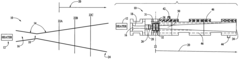
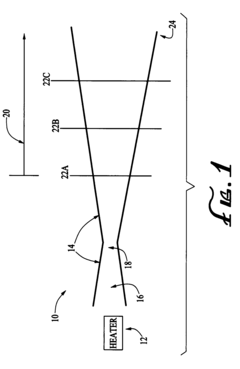
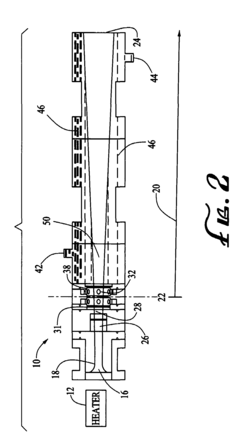
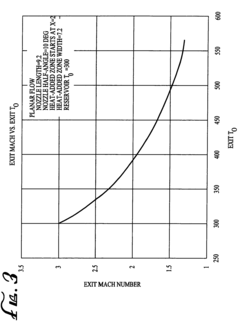
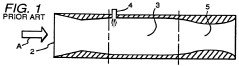
- A supersonic combustion heater apparatus that varies exit plane Mach numbers through strategic fuel injection and flame stabilization in a fixed geometry nozzle, enhancing high enthalpy flow and flame stability without using expensive film cooled nozzles, allowing for mode transition testing in air-breathing propulsion systems.
Apparatus for supersonic combustion in a restricted length
PatentInactiveUS5253474A
Innovation
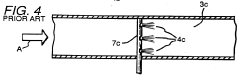
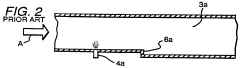
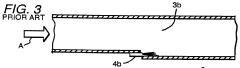
- A supersonic combustor design featuring a backward-facing step with a forward-facing ramp and axial or normal fuel injection, where the ramp converges into the combustion cavity to ensure fuel penetration and mixing, and optionally spanwise channels to enhance shear mixing, allowing for rapid combustion within a distance of one foot or less.
Geopolitical Implications
The application of scramjet technology in global defense systems has significant geopolitical implications, reshaping the balance of power and strategic considerations among nations. As countries develop and deploy scramjet-powered hypersonic weapons, the global security landscape is undergoing a profound transformation.
The advent of scramjet-powered hypersonic missiles has the potential to alter traditional deterrence strategies. These weapons' ability to travel at speeds exceeding Mach 5 and maneuver unpredictably challenges existing missile defense systems, potentially rendering them obsolete. This technological leap may force nations to reassess their defense postures and invest heavily in new countermeasures.
Scramjet technology is likely to intensify arms races and fuel geopolitical tensions. Nations possessing this capability may gain a significant military advantage, prompting others to accelerate their own hypersonic weapons programs. This could lead to increased defense spending and a shift in global power dynamics, particularly between major powers such as the United States, China, and Russia.
The proliferation of scramjet-powered weapons may also impact international treaties and agreements. Existing frameworks governing missile technology and arms control may need to be reevaluated or renegotiated to address the unique challenges posed by hypersonic weapons. This could lead to diplomatic tensions and potentially destabilize longstanding arms control regimes.
Regional security dynamics are likely to be affected by the introduction of scramjet-powered defense systems. Countries with this technology may gain increased leverage in territorial disputes or regional conflicts. Neighboring states may feel compelled to seek similar capabilities or align themselves with nations possessing such advanced weaponry, potentially reshaping alliances and strategic partnerships.
The development of scramjet technology may also have economic implications, influencing global trade and technological cooperation. Nations with advanced scramjet capabilities may gain economic advantages through technology transfers or arms sales. Conversely, concerns over technology proliferation may lead to increased export controls and restrictions on scientific collaboration in related fields.
As scramjet technology matures, its potential dual-use applications in civilian aerospace may further complicate geopolitical considerations. Nations leading in scramjet research and development may gain advantages in future space exploration and commercial hypersonic flight, potentially extending their geopolitical influence beyond traditional military spheres.
The advent of scramjet-powered hypersonic missiles has the potential to alter traditional deterrence strategies. These weapons' ability to travel at speeds exceeding Mach 5 and maneuver unpredictably challenges existing missile defense systems, potentially rendering them obsolete. This technological leap may force nations to reassess their defense postures and invest heavily in new countermeasures.
Scramjet technology is likely to intensify arms races and fuel geopolitical tensions. Nations possessing this capability may gain a significant military advantage, prompting others to accelerate their own hypersonic weapons programs. This could lead to increased defense spending and a shift in global power dynamics, particularly between major powers such as the United States, China, and Russia.
The proliferation of scramjet-powered weapons may also impact international treaties and agreements. Existing frameworks governing missile technology and arms control may need to be reevaluated or renegotiated to address the unique challenges posed by hypersonic weapons. This could lead to diplomatic tensions and potentially destabilize longstanding arms control regimes.
Regional security dynamics are likely to be affected by the introduction of scramjet-powered defense systems. Countries with this technology may gain increased leverage in territorial disputes or regional conflicts. Neighboring states may feel compelled to seek similar capabilities or align themselves with nations possessing such advanced weaponry, potentially reshaping alliances and strategic partnerships.
The development of scramjet technology may also have economic implications, influencing global trade and technological cooperation. Nations with advanced scramjet capabilities may gain economic advantages through technology transfers or arms sales. Conversely, concerns over technology proliferation may lead to increased export controls and restrictions on scientific collaboration in related fields.
As scramjet technology matures, its potential dual-use applications in civilian aerospace may further complicate geopolitical considerations. Nations leading in scramjet research and development may gain advantages in future space exploration and commercial hypersonic flight, potentially extending their geopolitical influence beyond traditional military spheres.
Scramjet Test Facilities
Scramjet test facilities play a crucial role in the development and validation of scramjet technologies for global defense systems. These specialized facilities are designed to simulate the extreme conditions encountered during hypersonic flight, allowing researchers and engineers to test and refine scramjet engines and components.
Ground-based test facilities are essential for evaluating scramjet performance before progressing to more costly and risky flight tests. These facilities typically include wind tunnels capable of generating hypersonic airflow, often utilizing shock tubes or expansion tunnels to achieve the required high-speed conditions. The most advanced scramjet test facilities can simulate Mach numbers ranging from 5 to 15, replicating the intense heat and pressure experienced during hypersonic flight.
Key components of scramjet test facilities include fuel injection systems, combustion chambers, and nozzles designed to withstand extreme temperatures and pressures. Sophisticated instrumentation and diagnostic tools are employed to measure and analyze various parameters such as thrust, fuel efficiency, and combustion stability. High-speed imaging systems and advanced sensors are utilized to capture detailed data on flow characteristics and combustion processes.
Several countries have invested in developing state-of-the-art scramjet test facilities to support their hypersonic weapons programs. The United States operates multiple facilities, including the NASA Langley Research Center's 8-Foot High Temperature Tunnel and the AEDC Hypervelocity Wind Tunnel 9. Russia has its Central Institute of Aviation Motors (CIAM) facility, while China has made significant advancements with its JF-12 hypersonic shock tunnel.
Challenges in scramjet testing include accurately replicating flight conditions, maintaining test duration, and scaling effects. Many facilities can only sustain hypersonic flow for brief periods, limiting the duration of experiments. Researchers must also account for differences between ground-based tests and actual flight conditions, necessitating careful interpretation and extrapolation of results.
Advancements in computational fluid dynamics (CFD) and numerical simulation techniques have complemented physical testing, allowing for more efficient design iterations and reducing the number of required physical tests. However, experimental validation remains crucial for verifying simulation results and ensuring the reliability of scramjet technologies for defense applications.
As global interest in hypersonic weapons continues to grow, investment in scramjet test facilities is likely to increase. Future developments may focus on improving test duration, enhancing measurement capabilities, and developing more sophisticated scaling methodologies to better bridge the gap between ground-based testing and actual flight conditions.
Ground-based test facilities are essential for evaluating scramjet performance before progressing to more costly and risky flight tests. These facilities typically include wind tunnels capable of generating hypersonic airflow, often utilizing shock tubes or expansion tunnels to achieve the required high-speed conditions. The most advanced scramjet test facilities can simulate Mach numbers ranging from 5 to 15, replicating the intense heat and pressure experienced during hypersonic flight.
Key components of scramjet test facilities include fuel injection systems, combustion chambers, and nozzles designed to withstand extreme temperatures and pressures. Sophisticated instrumentation and diagnostic tools are employed to measure and analyze various parameters such as thrust, fuel efficiency, and combustion stability. High-speed imaging systems and advanced sensors are utilized to capture detailed data on flow characteristics and combustion processes.
Several countries have invested in developing state-of-the-art scramjet test facilities to support their hypersonic weapons programs. The United States operates multiple facilities, including the NASA Langley Research Center's 8-Foot High Temperature Tunnel and the AEDC Hypervelocity Wind Tunnel 9. Russia has its Central Institute of Aviation Motors (CIAM) facility, while China has made significant advancements with its JF-12 hypersonic shock tunnel.
Challenges in scramjet testing include accurately replicating flight conditions, maintaining test duration, and scaling effects. Many facilities can only sustain hypersonic flow for brief periods, limiting the duration of experiments. Researchers must also account for differences between ground-based tests and actual flight conditions, necessitating careful interpretation and extrapolation of results.
Advancements in computational fluid dynamics (CFD) and numerical simulation techniques have complemented physical testing, allowing for more efficient design iterations and reducing the number of required physical tests. However, experimental validation remains crucial for verifying simulation results and ensuring the reliability of scramjet technologies for defense applications.
As global interest in hypersonic weapons continues to grow, investment in scramjet test facilities is likely to increase. Future developments may focus on improving test duration, enhancing measurement capabilities, and developing more sophisticated scaling methodologies to better bridge the gap between ground-based testing and actual flight conditions.
Unlock deeper insights with PatSnap Eureka Quick Research — get a full tech report to explore trends and direct your research. Try now!
Generate Your Research Report Instantly with AI Agent
Supercharge your innovation with PatSnap Eureka AI Agent Platform!