

Solid State Transformer Integration with Distributed Storage Units: Benefits
JUN 4, 20269 MIN READ
Generate Your Research Report Instantly with AI Agent
Patsnap Eureka helps you evaluate technical feasibility & market potential.
SST-DSU Integration Background and Technical Objectives
The integration of Solid State Transformers with Distributed Storage Units represents a paradigm shift in modern electrical grid infrastructure, emerging from the convergence of power electronics advancement and distributed energy resource proliferation. This technological fusion addresses critical challenges in grid modernization, renewable energy integration, and energy storage optimization that have become increasingly prominent as electrical systems evolve toward greater decentralization and intelligence.
Traditional power distribution systems, built around conventional electromagnetic transformers and centralized generation models, face significant limitations in accommodating the bidirectional power flows, variable generation patterns, and dynamic load requirements characteristic of modern smart grids. The historical development of power systems has progressed from simple radial distribution networks to complex, interconnected systems requiring sophisticated control and management capabilities.
Solid State Transformers have evolved from early power electronic concepts in the 1970s to sophisticated multi-stage conversion systems capable of providing voltage transformation, power factor correction, and advanced grid services simultaneously. The technology leverages high-frequency switching devices, typically silicon carbide or gallium nitride semiconductors, to achieve compact, lightweight, and highly controllable power conversion with enhanced functionality compared to traditional transformers.
Distributed Storage Units have similarly evolved from centralized utility-scale installations to diverse, geographically dispersed systems including residential battery systems, commercial energy storage, and grid-scale installations. These units serve multiple functions including peak shaving, frequency regulation, renewable energy smoothing, and backup power provision, creating complex operational requirements for integration and coordination.
The primary technical objective of SST-DSU integration centers on creating a unified, intelligent power management ecosystem that maximizes the operational benefits of both technologies while addressing their individual limitations. This integration aims to establish seamless bidirectional power flow control, enabling distributed storage units to operate as both energy sources and loads depending on grid conditions and economic signals.
Advanced control algorithms and communication protocols form the foundation for achieving optimal coordination between SSTs and DSUs, enabling real-time optimization of energy flows, voltage regulation, and grid stability services. The integration seeks to enhance overall system efficiency, reliability, and flexibility while reducing infrastructure costs and environmental impact through improved renewable energy utilization and reduced transmission losses.
Traditional power distribution systems, built around conventional electromagnetic transformers and centralized generation models, face significant limitations in accommodating the bidirectional power flows, variable generation patterns, and dynamic load requirements characteristic of modern smart grids. The historical development of power systems has progressed from simple radial distribution networks to complex, interconnected systems requiring sophisticated control and management capabilities.
Solid State Transformers have evolved from early power electronic concepts in the 1970s to sophisticated multi-stage conversion systems capable of providing voltage transformation, power factor correction, and advanced grid services simultaneously. The technology leverages high-frequency switching devices, typically silicon carbide or gallium nitride semiconductors, to achieve compact, lightweight, and highly controllable power conversion with enhanced functionality compared to traditional transformers.
Distributed Storage Units have similarly evolved from centralized utility-scale installations to diverse, geographically dispersed systems including residential battery systems, commercial energy storage, and grid-scale installations. These units serve multiple functions including peak shaving, frequency regulation, renewable energy smoothing, and backup power provision, creating complex operational requirements for integration and coordination.
The primary technical objective of SST-DSU integration centers on creating a unified, intelligent power management ecosystem that maximizes the operational benefits of both technologies while addressing their individual limitations. This integration aims to establish seamless bidirectional power flow control, enabling distributed storage units to operate as both energy sources and loads depending on grid conditions and economic signals.
Advanced control algorithms and communication protocols form the foundation for achieving optimal coordination between SSTs and DSUs, enabling real-time optimization of energy flows, voltage regulation, and grid stability services. The integration seeks to enhance overall system efficiency, reliability, and flexibility while reducing infrastructure costs and environmental impact through improved renewable energy utilization and reduced transmission losses.
Market Demand for Grid-Scale Energy Storage Solutions
The global energy storage market is experiencing unprecedented growth driven by the accelerating transition toward renewable energy sources and the urgent need for grid modernization. Traditional power grids face increasing challenges in managing the intermittent nature of solar and wind generation, creating substantial demand for advanced storage solutions that can provide grid stabilization services.
Grid-scale energy storage systems have emerged as critical infrastructure components for maintaining power quality and reliability. The integration of solid state transformers with distributed storage units addresses multiple market needs simultaneously, including voltage regulation, frequency response, and peak load management. This convergence technology offers utilities enhanced flexibility in managing distributed energy resources while reducing operational costs.
Market drivers include stringent renewable energy mandates, aging grid infrastructure requiring modernization, and growing concerns about grid resilience against extreme weather events. Utilities are increasingly seeking solutions that can provide multiple grid services from a single platform, making integrated SST-storage systems particularly attractive for their multifunctional capabilities.
The distributed storage segment is gaining momentum as utilities recognize the benefits of deploying smaller, strategically located storage units rather than centralized facilities. This approach enables better load balancing, reduces transmission losses, and improves local grid stability. Solid state transformers enhance these benefits by providing advanced power conversion and control capabilities at the distribution level.
Commercial and industrial customers represent another significant demand driver, seeking energy storage solutions that can reduce demand charges, provide backup power, and enable participation in grid services markets. The combination of SST technology with distributed storage offers these customers sophisticated energy management capabilities while contributing to overall grid stability.
Regulatory frameworks worldwide are increasingly supportive of energy storage deployment, with many jurisdictions implementing policies that recognize storage as a grid asset eligible for capacity payments and ancillary service revenues. This regulatory evolution is creating new revenue streams that improve the economic viability of integrated SST-storage systems.
The market demand is further amplified by the declining costs of battery technologies and the increasing sophistication of power electronics. These technological advances make distributed storage solutions more economically competitive while expanding their potential applications across various grid segments and customer classes.
Grid-scale energy storage systems have emerged as critical infrastructure components for maintaining power quality and reliability. The integration of solid state transformers with distributed storage units addresses multiple market needs simultaneously, including voltage regulation, frequency response, and peak load management. This convergence technology offers utilities enhanced flexibility in managing distributed energy resources while reducing operational costs.
Market drivers include stringent renewable energy mandates, aging grid infrastructure requiring modernization, and growing concerns about grid resilience against extreme weather events. Utilities are increasingly seeking solutions that can provide multiple grid services from a single platform, making integrated SST-storage systems particularly attractive for their multifunctional capabilities.
The distributed storage segment is gaining momentum as utilities recognize the benefits of deploying smaller, strategically located storage units rather than centralized facilities. This approach enables better load balancing, reduces transmission losses, and improves local grid stability. Solid state transformers enhance these benefits by providing advanced power conversion and control capabilities at the distribution level.
Commercial and industrial customers represent another significant demand driver, seeking energy storage solutions that can reduce demand charges, provide backup power, and enable participation in grid services markets. The combination of SST technology with distributed storage offers these customers sophisticated energy management capabilities while contributing to overall grid stability.
Regulatory frameworks worldwide are increasingly supportive of energy storage deployment, with many jurisdictions implementing policies that recognize storage as a grid asset eligible for capacity payments and ancillary service revenues. This regulatory evolution is creating new revenue streams that improve the economic viability of integrated SST-storage systems.
The market demand is further amplified by the declining costs of battery technologies and the increasing sophistication of power electronics. These technological advances make distributed storage solutions more economically competitive while expanding their potential applications across various grid segments and customer classes.
Current SST Technology Status and Integration Challenges
Solid State Transformers represent a paradigm shift from conventional electromagnetic transformers, leveraging power electronics and semiconductor devices to achieve enhanced functionality and control capabilities. Current SST implementations primarily utilize silicon-based power semiconductors, including IGBTs and MOSFETs, operating at switching frequencies ranging from 10-100 kHz. These devices enable bidirectional power flow, voltage regulation, and harmonic filtering capabilities that traditional transformers cannot provide.
The integration architecture of SSTs with distributed storage units faces several technical complexities. Most existing SST designs employ multi-stage conversion topologies, typically incorporating AC-DC-AC conversion stages with intermediate DC links. This configuration allows for seamless integration with battery energy storage systems, which naturally operate at DC voltage levels. However, the multi-stage approach introduces additional conversion losses, typically ranging from 2-5% per conversion stage.
Power density remains a critical challenge for SST deployment. Current commercial SST prototypes achieve power densities of 1-3 kW/L, significantly lower than conventional transformers' 10-15 kW/L. This limitation stems from the need for extensive cooling systems, electromagnetic interference shielding, and protection circuits required for semiconductor-based systems. The thermal management complexity increases substantially when integrating distributed storage units due to additional heat generation from battery management systems and DC-DC converters.
Control system integration presents another significant challenge. SSTs require sophisticated real-time control algorithms to manage power flow, voltage regulation, and grid synchronization simultaneously. When coupled with distributed storage units, the control complexity multiplies as the system must coordinate charging and discharging cycles, state-of-charge monitoring, and grid support functions. Current control systems struggle with latency issues, particularly during rapid grid transients or fault conditions.
Reliability and fault tolerance mechanisms in integrated SST-storage systems remain underdeveloped. Unlike passive transformers with decades of operational data, SST systems lack comprehensive failure mode analysis and predictive maintenance protocols. The integration with storage units introduces additional failure points, including battery degradation, thermal runaway risks, and power electronics component aging. Current protection schemes often rely on conservative operating margins, limiting system efficiency and performance optimization potential.
The integration architecture of SSTs with distributed storage units faces several technical complexities. Most existing SST designs employ multi-stage conversion topologies, typically incorporating AC-DC-AC conversion stages with intermediate DC links. This configuration allows for seamless integration with battery energy storage systems, which naturally operate at DC voltage levels. However, the multi-stage approach introduces additional conversion losses, typically ranging from 2-5% per conversion stage.
Power density remains a critical challenge for SST deployment. Current commercial SST prototypes achieve power densities of 1-3 kW/L, significantly lower than conventional transformers' 10-15 kW/L. This limitation stems from the need for extensive cooling systems, electromagnetic interference shielding, and protection circuits required for semiconductor-based systems. The thermal management complexity increases substantially when integrating distributed storage units due to additional heat generation from battery management systems and DC-DC converters.
Control system integration presents another significant challenge. SSTs require sophisticated real-time control algorithms to manage power flow, voltage regulation, and grid synchronization simultaneously. When coupled with distributed storage units, the control complexity multiplies as the system must coordinate charging and discharging cycles, state-of-charge monitoring, and grid support functions. Current control systems struggle with latency issues, particularly during rapid grid transients or fault conditions.
Reliability and fault tolerance mechanisms in integrated SST-storage systems remain underdeveloped. Unlike passive transformers with decades of operational data, SST systems lack comprehensive failure mode analysis and predictive maintenance protocols. The integration with storage units introduces additional failure points, including battery degradation, thermal runaway risks, and power electronics component aging. Current protection schemes often rely on conservative operating margins, limiting system efficiency and performance optimization potential.
Existing SST-Storage Integration Solutions
01 Enhanced Grid Stability and Power Quality Control
Solid state transformers integrated with distributed storage units provide improved grid stability through advanced power quality control mechanisms. The integration enables real-time voltage regulation, frequency stabilization, and harmonic filtering capabilities. This combination allows for better management of power fluctuations and maintains consistent power delivery even during grid disturbances or varying load conditions.- Power conversion and voltage regulation in solid state transformers with storage integration: Solid state transformers can be integrated with distributed storage units to provide enhanced power conversion capabilities and voltage regulation. The integration allows for bidirectional power flow management, enabling the storage units to charge during low demand periods and discharge during peak demand. This configuration improves overall system efficiency and provides better voltage stability across the distribution network.
- Grid stabilization and frequency control through distributed storage coordination: The combination of solid state transformers with distributed storage units enables advanced grid stabilization and frequency control mechanisms. The storage units can respond rapidly to grid disturbances, providing frequency regulation services and maintaining system stability. This integration supports grid resilience by offering fast response times for load balancing and power quality improvement.
- Energy management and optimization algorithms for integrated systems: Advanced energy management systems are employed to optimize the operation of solid state transformers integrated with distributed storage units. These systems utilize sophisticated algorithms to predict energy demand, manage charging and discharging cycles, and optimize energy flow between the grid and storage units. The integration enables intelligent load forecasting and automated energy dispatch for maximum efficiency.
- Modular architecture and scalable deployment configurations: Solid state transformer integration with distributed storage units benefits from modular architecture designs that allow for scalable deployment. The modular approach enables flexible system sizing and easy expansion based on load requirements. This configuration supports various deployment scenarios from residential to industrial applications, providing adaptable solutions for different power capacity needs.
- Enhanced power quality and harmonic mitigation capabilities: The integration of solid state transformers with distributed storage units provides superior power quality management and harmonic mitigation capabilities. The combined system can actively filter harmonics, compensate for reactive power, and maintain consistent power quality standards. This integration reduces power disturbances and improves the overall reliability of the electrical distribution system.
02 Bidirectional Power Flow Management
The integration facilitates efficient bidirectional power flow between the grid, storage systems, and local loads. This capability enables energy storage units to both charge from and discharge to the grid through the solid state transformer, optimizing energy utilization and supporting grid services such as peak shaving and load balancing. The system can dynamically switch between different operational modes based on grid conditions and energy demands.Expand Specific Solutions03 Smart Grid Integration and Communication Capabilities
The combined system provides advanced communication and control interfaces that enable seamless integration with smart grid infrastructure. This includes real-time monitoring, remote control capabilities, and data exchange with grid operators. The integration supports advanced grid functionalities such as demand response, distributed energy resource management, and coordinated control of multiple storage units across the network.Expand Specific Solutions04 Energy Efficiency Optimization and Loss Reduction
The integration of solid state transformers with distributed storage units significantly improves overall system efficiency by reducing conversion losses and optimizing energy transfer paths. The solid state technology eliminates traditional transformer losses while the storage integration allows for energy optimization strategies that minimize waste and maximize utilization of renewable energy sources. This results in improved economic performance and reduced environmental impact.Expand Specific Solutions05 Modular Architecture and Scalability Benefits
The integrated system offers modular design advantages that enable flexible deployment and easy scalability to meet varying power requirements. This architecture allows for distributed installation across different grid locations while maintaining coordinated operation. The modular approach facilitates maintenance, upgrades, and expansion of both transformer and storage capacities without significant system disruption, making it suitable for various applications from residential to industrial scale implementations.Expand Specific Solutions
Key Players in SST and Distributed Storage Markets
The solid state transformer (SST) integration with distributed storage units represents an emerging technology sector in the early commercialization stage, with significant growth potential driven by grid modernization and renewable energy integration demands. The market is experiencing rapid expansion as utilities and industrial players recognize the benefits of enhanced power quality, bidirectional power flow, and improved grid flexibility. Technology maturity varies significantly across market participants, with established grid operators like State Grid Corp. of China and power technology specialists such as Huawei Digital Power Technologies leading development efforts. Chinese companies including NR Electric Co., Ltd. and Nanjing Nari Jibao Electric Co. Ltd. demonstrate strong capabilities in power electronics and grid automation, while technology giants like Microsoft Corp. and VMware LLC contribute advanced software integration solutions. The competitive landscape shows a convergence of traditional power equipment manufacturers, digital technology providers, and research institutions, indicating the interdisciplinary nature of SST technology development and its integration with modern energy storage systems.
State Grid Corp. of China
Technical Solution: State Grid has developed comprehensive solid state transformer (SST) integration solutions with distributed energy storage systems for smart grid applications. Their approach focuses on medium-voltage distribution networks where SSTs provide galvanic isolation, voltage regulation, and power quality enhancement while seamlessly integrating with battery energy storage systems, supercapacitors, and flywheel storage units. The integration enables bidirectional power flow control, grid stabilization during renewable energy fluctuations, and enhanced power quality through active filtering capabilities. Their SST-storage hybrid systems demonstrate improved grid resilience, reduced transmission losses by up to 15%, and enhanced voltage stability across distribution networks. The technology supports multiple storage technologies simultaneously, allowing for optimized energy management based on grid conditions and storage characteristics.
Strengths: Extensive grid infrastructure experience, proven large-scale deployment capabilities, comprehensive system integration expertise. Weaknesses: Limited global market presence, slower innovation cycles compared to private companies.
Huawei Digital Power Technologies Co., Ltd.
Technical Solution: Huawei Digital Power has developed advanced SST solutions integrated with distributed storage units for data centers and industrial applications. Their SmartLi energy storage system combined with solid state transformers provides intelligent power management with efficiency rates exceeding 95%. The integrated solution features AI-powered energy optimization algorithms that dynamically balance load distribution between grid supply and storage units based on real-time demand patterns. Their SST-storage integration supports seamless islanding capabilities, enabling critical loads to maintain operation during grid outages. The system incorporates advanced thermal management and predictive maintenance features, extending equipment lifespan while reducing operational costs. Huawei's solution demonstrates particular strength in telecommunications infrastructure and industrial facilities requiring high reliability and power quality.
Strengths: Strong R&D capabilities, advanced AI integration, proven reliability in telecommunications. Weaknesses: Geopolitical restrictions in some markets, limited presence in utility-scale applications.
Core Patents in SST-DSU Integration Technologies
Solid-state transformer in-grid operations and maintenance circuit and method therefor, controller, and storage medium
PatentWO2025148799A1
Innovation
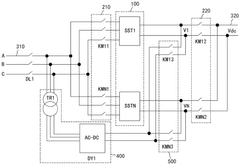
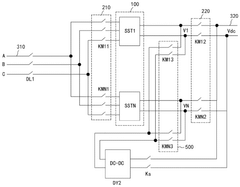
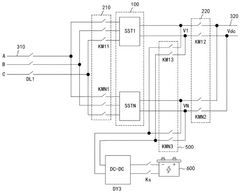
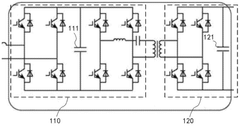
- The circuit consisting of multiple solid-state transformer singles is used to connect parallel to the input and output side switches and auxiliary charging circuits to realize the disconnection and impact-free recovery of some singles. The auxiliary charging circuit is used to charge the singles to ensure that the system can still operate normally during maintenance or replacement.
Grid Code Compliance for SST-Storage Integration
Grid code compliance represents a critical regulatory framework that governs the integration of Solid State Transformers with distributed storage units into existing electrical networks. These standards establish mandatory technical requirements that ensure system reliability, safety, and interoperability across diverse grid architectures. The regulatory landscape encompasses voltage regulation parameters, frequency response characteristics, fault ride-through capabilities, and power quality specifications that SST-storage systems must satisfy.
Modern grid codes typically mandate specific voltage tolerance ranges, often requiring systems to operate within ±10% of nominal voltage levels while maintaining continuous operation. SST-storage integration systems must demonstrate compliance with reactive power compensation requirements, typically providing power factor correction capabilities between 0.85 leading and 0.85 lagging. These systems must also satisfy harmonic distortion limits, generally maintaining total harmonic distortion below 5% for voltage and 8% for current under normal operating conditions.
Frequency response compliance demands that integrated SST-storage systems provide primary frequency regulation within seconds of grid disturbances. The systems must demonstrate capability to inject or absorb active power proportional to frequency deviations, typically responding to frequency changes exceeding ±0.2 Hz from nominal values. Advanced grid codes increasingly require fast frequency response capabilities, with full power delivery within 2-3 seconds of frequency events.
Fault ride-through requirements mandate that SST-storage systems remain connected during grid disturbances, supporting grid stability during critical events. Low voltage ride-through specifications typically require systems to withstand voltage dips to 15% of nominal voltage for up to 625 milliseconds. High voltage ride-through capabilities must accommodate voltage rises up to 110% of nominal values for extended periods.
Communication protocol compliance ensures seamless integration with grid management systems through standardized interfaces such as IEC 61850, DNP3, or Modbus protocols. These standards facilitate real-time monitoring, control, and data exchange between SST-storage systems and grid operators. Cybersecurity compliance frameworks, including NERC CIP standards, establish mandatory protection measures against cyber threats targeting critical grid infrastructure.
Regional variations in grid codes present implementation challenges, with European EN 50549 standards differing from IEEE 1547 requirements in North America. Emerging markets often adopt hybrid approaches, combining established international standards with local grid characteristics and operational requirements.
Modern grid codes typically mandate specific voltage tolerance ranges, often requiring systems to operate within ±10% of nominal voltage levels while maintaining continuous operation. SST-storage integration systems must demonstrate compliance with reactive power compensation requirements, typically providing power factor correction capabilities between 0.85 leading and 0.85 lagging. These systems must also satisfy harmonic distortion limits, generally maintaining total harmonic distortion below 5% for voltage and 8% for current under normal operating conditions.
Frequency response compliance demands that integrated SST-storage systems provide primary frequency regulation within seconds of grid disturbances. The systems must demonstrate capability to inject or absorb active power proportional to frequency deviations, typically responding to frequency changes exceeding ±0.2 Hz from nominal values. Advanced grid codes increasingly require fast frequency response capabilities, with full power delivery within 2-3 seconds of frequency events.
Fault ride-through requirements mandate that SST-storage systems remain connected during grid disturbances, supporting grid stability during critical events. Low voltage ride-through specifications typically require systems to withstand voltage dips to 15% of nominal voltage for up to 625 milliseconds. High voltage ride-through capabilities must accommodate voltage rises up to 110% of nominal values for extended periods.
Communication protocol compliance ensures seamless integration with grid management systems through standardized interfaces such as IEC 61850, DNP3, or Modbus protocols. These standards facilitate real-time monitoring, control, and data exchange between SST-storage systems and grid operators. Cybersecurity compliance frameworks, including NERC CIP standards, establish mandatory protection measures against cyber threats targeting critical grid infrastructure.
Regional variations in grid codes present implementation challenges, with European EN 50549 standards differing from IEEE 1547 requirements in North America. Emerging markets often adopt hybrid approaches, combining established international standards with local grid characteristics and operational requirements.
Environmental Impact of SST-DSU Deployment
The deployment of Solid State Transformer integrated with Distributed Storage Units represents a significant advancement in environmental sustainability within power grid infrastructure. This technology combination substantially reduces carbon emissions through enhanced energy efficiency and optimized renewable energy integration. SST-DSU systems achieve efficiency rates exceeding 98%, compared to conventional transformer systems operating at 95-97% efficiency, resulting in measurable reductions in energy losses and associated greenhouse gas emissions.
The environmental benefits extend beyond operational efficiency improvements. SST-DSU deployment facilitates increased penetration of renewable energy sources by providing grid stabilization capabilities and energy buffering functions. This enhanced renewable integration capacity directly correlates with reduced reliance on fossil fuel-based power generation, contributing to long-term decarbonization objectives. Studies indicate that widespread SST-DSU adoption could reduce grid-level carbon emissions by 15-25% in regions with high renewable energy potential.
Material sustainability considerations reveal both positive and challenging aspects of SST-DSU deployment. While these systems utilize advanced semiconductor materials and rare earth elements in their construction, their extended operational lifespan of 25-30 years, compared to 15-20 years for conventional systems, results in reduced material turnover rates. The modular design characteristics of SST-DSU systems enable component-level maintenance and replacement, minimizing waste generation and supporting circular economy principles.
The technology's impact on electromagnetic emissions presents notable environmental advantages. SST systems generate significantly lower electromagnetic interference compared to traditional transformers, reducing potential effects on local ecosystems and wildlife. Additionally, the compact form factor of SST-DSU installations requires smaller physical footprints, minimizing land use requirements and preserving natural habitats.
Lifecycle assessment studies demonstrate that despite higher initial manufacturing emissions, SST-DSU systems achieve carbon neutrality within 3-5 years of operation through their superior efficiency and renewable energy facilitation capabilities. The technology's contribution to grid resilience also reduces the environmental impact of power outages and system failures, which often necessitate backup generation from high-emission sources.
The environmental benefits extend beyond operational efficiency improvements. SST-DSU deployment facilitates increased penetration of renewable energy sources by providing grid stabilization capabilities and energy buffering functions. This enhanced renewable integration capacity directly correlates with reduced reliance on fossil fuel-based power generation, contributing to long-term decarbonization objectives. Studies indicate that widespread SST-DSU adoption could reduce grid-level carbon emissions by 15-25% in regions with high renewable energy potential.
Material sustainability considerations reveal both positive and challenging aspects of SST-DSU deployment. While these systems utilize advanced semiconductor materials and rare earth elements in their construction, their extended operational lifespan of 25-30 years, compared to 15-20 years for conventional systems, results in reduced material turnover rates. The modular design characteristics of SST-DSU systems enable component-level maintenance and replacement, minimizing waste generation and supporting circular economy principles.
The technology's impact on electromagnetic emissions presents notable environmental advantages. SST systems generate significantly lower electromagnetic interference compared to traditional transformers, reducing potential effects on local ecosystems and wildlife. Additionally, the compact form factor of SST-DSU installations requires smaller physical footprints, minimizing land use requirements and preserving natural habitats.
Lifecycle assessment studies demonstrate that despite higher initial manufacturing emissions, SST-DSU systems achieve carbon neutrality within 3-5 years of operation through their superior efficiency and renewable energy facilitation capabilities. The technology's contribution to grid resilience also reduces the environmental impact of power outages and system failures, which often necessitate backup generation from high-emission sources.
Unlock deeper insights with Patsnap Eureka Quick Research — get a full tech report to explore trends and direct your research. Try now!
Generate Your Research Report Instantly with AI Agent
Supercharge your innovation with Patsnap Eureka AI Agent Platform!