

Solutions to Short Circuit Challenges in Solid State Transformer Operation
JUN 4, 20269 MIN READ
Generate Your Research Report Instantly with AI Agent
Patsnap Eureka helps you evaluate technical feasibility & market potential.
SST Short Circuit Background and Protection Goals
Solid State Transformers represent a paradigm shift from conventional electromagnetic transformers, utilizing power electronic converters and high-frequency magnetic components to achieve voltage transformation, galvanic isolation, and advanced grid functionalities. The evolution of SST technology has been driven by the increasing demand for smart grid applications, renewable energy integration, and improved power quality management. However, the semiconductor-based nature of SSTs introduces unique vulnerabilities, particularly regarding short circuit fault conditions that can cause catastrophic failures within microseconds.
The historical development of SST technology reveals a consistent challenge in managing fault conditions effectively. Unlike traditional transformers that possess inherent current-limiting characteristics due to their magnetic coupling and impedance properties, SSTs rely entirely on active protection mechanisms. Early SST implementations in the 1970s and 1980s primarily focused on basic functionality, with limited consideration for comprehensive fault protection strategies. The technology gained renewed interest in the 2000s as power semiconductor capabilities advanced, yet short circuit protection remained a critical bottleneck.
Contemporary SST architectures face escalating complexity in fault management due to multi-stage conversion topologies, bidirectional power flow capabilities, and integration with distributed energy resources. The fundamental challenge lies in the inherently low impedance path that power semiconductors present during normal operation, which becomes a liability during fault conditions. When short circuits occur, the rapid rise in current can exceed semiconductor safe operating areas within tens of microseconds, demanding protection response times that challenge conventional protection philosophies.
The primary protection goals for SST short circuit management encompass multiple interconnected objectives. Immediate semiconductor protection requires fault detection and isolation within 2-10 microseconds to prevent device destruction, significantly faster than traditional protection systems. System-level protection must ensure continued operation of unaffected portions of the SST while isolating faulted sections, maintaining power supply continuity wherever possible.
Grid stability preservation represents another critical protection goal, requiring SSTs to support grid fault ride-through capabilities while managing their own internal protection needs. This dual requirement often creates conflicting demands between self-preservation and grid support functions. Additionally, protection coordination with upstream and downstream protection devices becomes complex due to the SST's ability to control fault current contribution actively.
Equipment preservation extends beyond immediate semiconductor protection to include magnetic components, capacitors, and auxiliary systems that may experience stress during fault conditions. The protection strategy must also facilitate rapid system recovery and restoration while providing comprehensive fault diagnosis capabilities for maintenance and reliability improvement purposes.
The historical development of SST technology reveals a consistent challenge in managing fault conditions effectively. Unlike traditional transformers that possess inherent current-limiting characteristics due to their magnetic coupling and impedance properties, SSTs rely entirely on active protection mechanisms. Early SST implementations in the 1970s and 1980s primarily focused on basic functionality, with limited consideration for comprehensive fault protection strategies. The technology gained renewed interest in the 2000s as power semiconductor capabilities advanced, yet short circuit protection remained a critical bottleneck.
Contemporary SST architectures face escalating complexity in fault management due to multi-stage conversion topologies, bidirectional power flow capabilities, and integration with distributed energy resources. The fundamental challenge lies in the inherently low impedance path that power semiconductors present during normal operation, which becomes a liability during fault conditions. When short circuits occur, the rapid rise in current can exceed semiconductor safe operating areas within tens of microseconds, demanding protection response times that challenge conventional protection philosophies.
The primary protection goals for SST short circuit management encompass multiple interconnected objectives. Immediate semiconductor protection requires fault detection and isolation within 2-10 microseconds to prevent device destruction, significantly faster than traditional protection systems. System-level protection must ensure continued operation of unaffected portions of the SST while isolating faulted sections, maintaining power supply continuity wherever possible.
Grid stability preservation represents another critical protection goal, requiring SSTs to support grid fault ride-through capabilities while managing their own internal protection needs. This dual requirement often creates conflicting demands between self-preservation and grid support functions. Additionally, protection coordination with upstream and downstream protection devices becomes complex due to the SST's ability to control fault current contribution actively.
Equipment preservation extends beyond immediate semiconductor protection to include magnetic components, capacitors, and auxiliary systems that may experience stress during fault conditions. The protection strategy must also facilitate rapid system recovery and restoration while providing comprehensive fault diagnosis capabilities for maintenance and reliability improvement purposes.
Market Demand for Reliable SST Systems
The global power infrastructure is undergoing a fundamental transformation driven by the increasing integration of renewable energy sources, the proliferation of electric vehicles, and the growing demand for efficient power distribution systems. Solid State Transformers represent a critical enabling technology for next-generation smart grids, offering superior controllability, bidirectional power flow capabilities, and enhanced grid stability compared to conventional electromagnetic transformers. However, the widespread adoption of SST technology remains contingent upon addressing reliability concerns, particularly those related to short circuit protection and fault management.
The renewable energy sector constitutes one of the primary drivers for reliable SST systems. Wind farms, solar installations, and distributed energy resources require sophisticated power conversion and grid integration capabilities that SSTs can provide. These applications demand systems capable of withstanding various fault conditions while maintaining operational continuity. The intermittent nature of renewable sources necessitates robust protection mechanisms to handle sudden power fluctuations and grid disturbances without compromising system integrity.
Electric vehicle charging infrastructure represents another significant market segment driving demand for reliable SST technology. Fast-charging stations require high-power density converters capable of handling multiple charging events simultaneously while providing galvanic isolation and protection against electrical faults. The automotive industry's transition toward electrification has created substantial market pressure for SST systems that can operate reliably under diverse environmental conditions and fault scenarios.
Industrial applications, particularly in manufacturing and data centers, require uninterrupted power supply with precise voltage regulation and fault tolerance. These sectors demand SST systems with advanced short circuit protection capabilities to prevent costly downtime and equipment damage. The increasing digitization of industrial processes has heightened the need for power systems that can maintain operational stability even during electrical disturbances.
The telecommunications and aerospace industries also contribute to market demand for reliable SST systems. These sectors require compact, lightweight power conversion solutions with exceptional reliability standards. Short circuit protection becomes particularly critical in these applications where system failures can have severe operational and safety implications.
Market growth is further accelerated by regulatory initiatives promoting grid modernization and energy efficiency standards. Government policies supporting smart grid development and renewable energy integration create favorable conditions for SST adoption, provided that reliability and safety requirements are adequately addressed through robust short circuit protection mechanisms.
The renewable energy sector constitutes one of the primary drivers for reliable SST systems. Wind farms, solar installations, and distributed energy resources require sophisticated power conversion and grid integration capabilities that SSTs can provide. These applications demand systems capable of withstanding various fault conditions while maintaining operational continuity. The intermittent nature of renewable sources necessitates robust protection mechanisms to handle sudden power fluctuations and grid disturbances without compromising system integrity.
Electric vehicle charging infrastructure represents another significant market segment driving demand for reliable SST technology. Fast-charging stations require high-power density converters capable of handling multiple charging events simultaneously while providing galvanic isolation and protection against electrical faults. The automotive industry's transition toward electrification has created substantial market pressure for SST systems that can operate reliably under diverse environmental conditions and fault scenarios.
Industrial applications, particularly in manufacturing and data centers, require uninterrupted power supply with precise voltage regulation and fault tolerance. These sectors demand SST systems with advanced short circuit protection capabilities to prevent costly downtime and equipment damage. The increasing digitization of industrial processes has heightened the need for power systems that can maintain operational stability even during electrical disturbances.
The telecommunications and aerospace industries also contribute to market demand for reliable SST systems. These sectors require compact, lightweight power conversion solutions with exceptional reliability standards. Short circuit protection becomes particularly critical in these applications where system failures can have severe operational and safety implications.
Market growth is further accelerated by regulatory initiatives promoting grid modernization and energy efficiency standards. Government policies supporting smart grid development and renewable energy integration create favorable conditions for SST adoption, provided that reliability and safety requirements are adequately addressed through robust short circuit protection mechanisms.
Current SST Short Circuit Challenges and Limitations
Solid State Transformers face significant short circuit challenges that fundamentally differ from conventional electromagnetic transformers due to their semiconductor-based architecture. The primary limitation stems from the inherently low short circuit tolerance of power electronic devices, particularly wide bandgap semiconductors like SiC and GaN MOSFETs, which cannot withstand overcurrent conditions for extended periods without permanent damage.
Current protection mechanisms in SST systems exhibit response time limitations that create vulnerability windows during fault conditions. Traditional circuit breakers and fuses designed for conventional transformers are inadequate for SST applications, as semiconductor devices require fault clearing within microseconds rather than milliseconds. This temporal mismatch between fault occurrence and protection activation represents a critical operational constraint.
The multi-stage power conversion architecture of SSTs introduces additional complexity in fault propagation and isolation. Short circuits can occur at multiple points including the AC-DC rectifier stage, DC-DC isolation stage, and DC-AC inverter stage, each requiring distinct protection strategies. The bidirectional power flow capability further complicates fault detection and localization, as conventional directional protection schemes may not adequately address reverse power flow scenarios.
Thermal management challenges become particularly acute during short circuit events, as the rapid energy dissipation in semiconductor junctions can exceed safe operating temperatures within microseconds. The compact design of SST systems limits heat dissipation capabilities compared to conventional transformers, making thermal protection coordination critical for system survival.
Grid integration presents additional constraints, as SST systems must maintain grid stability during fault conditions while protecting internal components. The fast dynamic response of SSTs, while advantageous for normal operation, can introduce instability during transient fault conditions if not properly controlled. Current grid codes and protection standards are primarily designed for conventional transformers, creating regulatory and technical gaps for SST deployment.
Energy storage integration within SST systems, while offering operational benefits, introduces additional short circuit paths and protection coordination challenges. The interaction between energy storage discharge characteristics and semiconductor protection requirements creates complex operational scenarios that current protection schemes struggle to address effectively.
Current protection mechanisms in SST systems exhibit response time limitations that create vulnerability windows during fault conditions. Traditional circuit breakers and fuses designed for conventional transformers are inadequate for SST applications, as semiconductor devices require fault clearing within microseconds rather than milliseconds. This temporal mismatch between fault occurrence and protection activation represents a critical operational constraint.
The multi-stage power conversion architecture of SSTs introduces additional complexity in fault propagation and isolation. Short circuits can occur at multiple points including the AC-DC rectifier stage, DC-DC isolation stage, and DC-AC inverter stage, each requiring distinct protection strategies. The bidirectional power flow capability further complicates fault detection and localization, as conventional directional protection schemes may not adequately address reverse power flow scenarios.
Thermal management challenges become particularly acute during short circuit events, as the rapid energy dissipation in semiconductor junctions can exceed safe operating temperatures within microseconds. The compact design of SST systems limits heat dissipation capabilities compared to conventional transformers, making thermal protection coordination critical for system survival.
Grid integration presents additional constraints, as SST systems must maintain grid stability during fault conditions while protecting internal components. The fast dynamic response of SSTs, while advantageous for normal operation, can introduce instability during transient fault conditions if not properly controlled. Current grid codes and protection standards are primarily designed for conventional transformers, creating regulatory and technical gaps for SST deployment.
Energy storage integration within SST systems, while offering operational benefits, introduces additional short circuit paths and protection coordination challenges. The interaction between energy storage discharge characteristics and semiconductor protection requirements creates complex operational scenarios that current protection schemes struggle to address effectively.
Existing SST Short Circuit Protection Solutions
01 Short circuit protection mechanisms and detection methods
Various protection mechanisms are employed to detect and respond to short circuit conditions in solid state transformers. These include current sensing circuits, voltage monitoring systems, and fault detection algorithms that can quickly identify abnormal operating conditions. The protection systems typically incorporate fast-acting switches or circuit breakers that can isolate the transformer from the power system within microseconds of detecting a fault condition.- Short circuit protection mechanisms and detection methods: Various protection mechanisms are employed to detect and respond to short circuit conditions in solid state transformers. These include current sensing circuits, voltage monitoring systems, and fault detection algorithms that can quickly identify abnormal operating conditions. The protection systems typically involve real-time monitoring of electrical parameters and automatic shutdown or isolation procedures when short circuit conditions are detected.
- Power semiconductor switching devices for fault handling: Power semiconductor devices such as IGBTs, MOSFETs, and thyristors are utilized in solid state transformers to handle short circuit conditions. These devices are designed with specific current and voltage ratings to withstand fault currents for limited durations. Advanced gate drive circuits and control strategies are implemented to ensure safe operation during fault conditions and prevent device damage.
- Control algorithms and fault response strategies: Sophisticated control algorithms are developed to manage solid state transformer operation during short circuit events. These strategies include current limiting techniques, coordinated shutdown sequences, and fault isolation methods. The control systems incorporate predictive algorithms and machine learning approaches to enhance fault detection accuracy and response time.
- Circuit topology and design considerations for fault tolerance: Specific circuit topologies and design methodologies are employed to enhance the fault tolerance of solid state transformers. These include redundant circuit paths, modular designs that allow for graceful degradation, and specialized transformer winding configurations. The designs focus on minimizing the impact of short circuit faults on overall system operation and maintaining power quality.
- Thermal management and overcurrent protection systems: Thermal management systems and overcurrent protection mechanisms are critical for handling the thermal stress generated during short circuit conditions. These systems include advanced cooling techniques, thermal monitoring sensors, and current limiting reactors. The protection systems are designed to prevent thermal runaway and ensure safe operation under fault conditions while maintaining the integrity of the power conversion system.
02 Power semiconductor device protection during short circuits
Power semiconductor devices such as IGBTs, MOSFETs, and thyristors used in solid state transformers require specialized protection during short circuit events. Protection methods include gate drive circuits with desaturation detection, active clamping circuits, and soft turn-off mechanisms to prevent device destruction. These protection schemes help maintain the integrity of the power conversion stages during fault conditions.Expand Specific Solutions03 Control system response to short circuit faults
The control systems of solid state transformers implement sophisticated algorithms to manage short circuit conditions. These include fault ride-through capabilities, coordinated protection schemes, and communication protocols with grid protection systems. The control strategies often involve immediate shutdown procedures, fault isolation techniques, and automatic restart sequences once the fault is cleared.Expand Specific Solutions04 Circuit topology modifications for short circuit resilience
Specific circuit topologies and design modifications enhance the short circuit withstand capability of solid state transformers. These include the use of current limiting reactors, fault current limiting circuits, and redundant power paths. Design considerations also encompass the selection of appropriate semiconductor ratings and the implementation of distributed protection schemes across multiple conversion stages.Expand Specific Solutions05 Isolation and recovery procedures after short circuit events
Post-fault isolation and system recovery procedures are critical for maintaining power system stability after short circuit events in solid state transformers. These procedures include automatic reclosing sequences, system health diagnostics, and gradual power restoration protocols. The recovery systems often incorporate communication with grid operators and coordination with other protection devices to ensure safe and reliable restoration of service.Expand Specific Solutions
Key Players in SST and Power Electronics Industry
The solid state transformer (SST) market addressing short circuit challenges is in a rapidly evolving growth phase, driven by increasing demand for smart grid infrastructure and renewable energy integration. The market demonstrates significant potential with a diverse competitive landscape spanning established industrial giants and specialized technology companies. Technology maturity varies considerably across players, with companies like Siemens AG, ABB Ltd., and Schneider Electric leveraging decades of power electronics expertise, while Huawei Digital Power Technologies and Delta Electronics bring advanced digital integration capabilities. Research institutions including Illinois Institute of Technology and China Electric Power Research Institute contribute fundamental innovations, while emerging players like Atom Power focus on intelligent circuit protection solutions. The competitive dynamics reflect a transition from traditional electromechanical systems toward digitally-enhanced solid state solutions, with major corporations investing heavily in R&D to overcome technical challenges including short circuit protection, thermal management, and cost optimization for commercial viability.
Huawei Digital Power Technologies Co., Ltd.
Technical Solution: Huawei Digital Power has developed innovative solid state transformer protection schemes focusing on AI-driven fault prediction and ultra-fast protection mechanisms. Their SST solutions incorporate machine learning algorithms for real-time fault analysis and predictive protection, enabling proactive short circuit prevention. The company's designs feature modular converter architectures with distributed protection systems, utilizing advanced SiC and GaN power devices with integrated protection circuits. Huawei's approach includes intelligent current limiting algorithms, adaptive protection settings, and cloud-based monitoring systems that can adjust protection parameters based on operating conditions and historical fault data.
Strengths: Advanced AI integration, rapid innovation cycles, cost-effective solutions for emerging markets. Weaknesses: Limited long-term operational data, potential supply chain constraints.
ABB Ltd.
Technical Solution: ABB has developed advanced solid state transformer solutions incorporating intelligent protection systems with fast-acting semiconductor switches and current limiting circuits. Their SST designs feature multi-level converter topologies with distributed control architecture that enables rapid fault detection and isolation within microseconds. The company implements dual-stage protection mechanisms including hardware-based overcurrent protection and software-based predictive fault analysis. ABB's SST systems utilize silicon carbide (SiC) power devices with integrated gate drivers that provide enhanced short circuit withstand capability and faster switching speeds, reducing fault current magnitude and duration significantly.
Strengths: Market-leading experience in power electronics, robust protection algorithms, proven track record in grid applications. Weaknesses: Higher initial costs, complex system integration requirements.
Core Innovations in SST Fault Current Limiting
Solid-state transformer having uninterrupted operation ability under ac/DC fault and control method thereof
PatentActiveUS20220166343A1
Innovation
- A hybrid modular multilevel solid-state transformer with isolated dual-active-bridge converters and a three-phase full-bridge inverter, utilizing half-bridge and full-bridge submodules interconnected via DC capacitors, allows for uninterrupted operation under AC/DC faults by locking faulty ports and maintaining stable voltage and power flow through advanced control strategies.
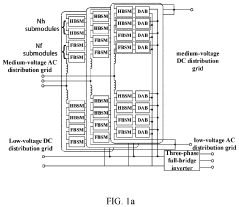
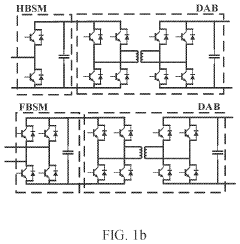
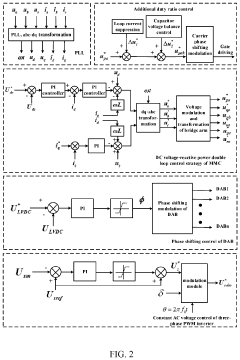
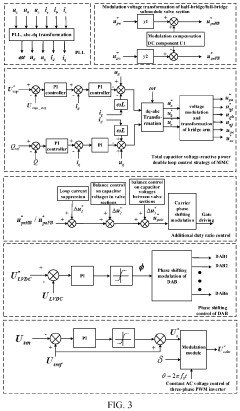
Solid-state circuit breaker
PatentPendingEP4586428A1
Innovation
- A solid-state circuit breaker design incorporating a first switch, a second switch, a capacitor, and diodes, along with a transient voltage suppressor and inductors, provides fast response and bidirectional protection by discharging capacitors to short-circuit loads, forming free-wheeling circuits to manage inductive energy, and using intelligent mechanical switches for selective protection.


Grid Code Requirements for SST Integration
The integration of Solid State Transformers into existing electrical grids requires strict adherence to established grid codes and regulatory frameworks. These requirements serve as fundamental guidelines that ensure SST systems can operate safely and reliably within the broader electrical infrastructure while maintaining grid stability and power quality standards.
Grid codes typically mandate specific performance criteria for fault ride-through capabilities, particularly during short circuit events. SSTs must demonstrate the ability to remain connected and operational during voltage sags, frequency deviations, and transient disturbances that commonly occur in power systems. The IEEE 1547 standard and IEC 61727 provide comprehensive frameworks for distributed energy resource interconnection, which directly apply to SST installations.
Harmonic distortion limits represent another critical compliance area for SST integration. Grid codes specify maximum allowable total harmonic distortion levels, typically requiring THD values below 5% for voltage and 8% for current under normal operating conditions. SSTs must incorporate advanced filtering and control algorithms to meet these stringent requirements while maintaining high power conversion efficiency.
Power factor requirements mandate that SSTs maintain specific reactive power capabilities across their operational range. Most grid codes require power factor values between 0.85 leading and 0.85 lagging, with some jurisdictions demanding unity power factor operation during peak demand periods. This necessitates sophisticated reactive power control systems within SST designs.
Protection coordination requirements ensure that SST protection systems integrate seamlessly with existing grid protection schemes. This includes proper coordination of overcurrent protection, differential protection, and communication protocols with utility control systems. SSTs must provide adequate telemetry and remote monitoring capabilities to support grid operators' situational awareness needs.
Voltage regulation compliance requires SSTs to maintain output voltage within specified tolerance bands, typically ±5% of nominal voltage under steady-state conditions. Additionally, dynamic voltage support capabilities during grid disturbances are increasingly mandated, requiring SSTs to provide fast voltage regulation response times typically within 100 milliseconds of disturbance detection.
Grid codes typically mandate specific performance criteria for fault ride-through capabilities, particularly during short circuit events. SSTs must demonstrate the ability to remain connected and operational during voltage sags, frequency deviations, and transient disturbances that commonly occur in power systems. The IEEE 1547 standard and IEC 61727 provide comprehensive frameworks for distributed energy resource interconnection, which directly apply to SST installations.
Harmonic distortion limits represent another critical compliance area for SST integration. Grid codes specify maximum allowable total harmonic distortion levels, typically requiring THD values below 5% for voltage and 8% for current under normal operating conditions. SSTs must incorporate advanced filtering and control algorithms to meet these stringent requirements while maintaining high power conversion efficiency.
Power factor requirements mandate that SSTs maintain specific reactive power capabilities across their operational range. Most grid codes require power factor values between 0.85 leading and 0.85 lagging, with some jurisdictions demanding unity power factor operation during peak demand periods. This necessitates sophisticated reactive power control systems within SST designs.
Protection coordination requirements ensure that SST protection systems integrate seamlessly with existing grid protection schemes. This includes proper coordination of overcurrent protection, differential protection, and communication protocols with utility control systems. SSTs must provide adequate telemetry and remote monitoring capabilities to support grid operators' situational awareness needs.
Voltage regulation compliance requires SSTs to maintain output voltage within specified tolerance bands, typically ±5% of nominal voltage under steady-state conditions. Additionally, dynamic voltage support capabilities during grid disturbances are increasingly mandated, requiring SSTs to provide fast voltage regulation response times typically within 100 milliseconds of disturbance detection.
Safety Standards for High Power SST Applications
Safety standards for high power solid state transformer applications represent a critical framework for ensuring reliable and secure operation in electrical power systems. The development of comprehensive safety protocols has become increasingly important as SST technology advances toward higher power ratings and more complex operational scenarios, particularly when addressing short circuit challenges that pose significant risks to both equipment and personnel.
Current international safety standards for high power SST applications are primarily governed by IEEE 1547 series for distributed energy resources, IEC 61850 for communication protocols in electrical substations, and IEC 62040 series for uninterruptible power systems. These standards establish fundamental requirements for electrical safety, electromagnetic compatibility, and operational reliability. However, the unique characteristics of SST technology, including high-frequency switching operations and complex control systems, necessitate specialized safety considerations beyond conventional transformer standards.
The safety framework for high power SST applications encompasses multiple protection layers, including hardware-based protection circuits, software-implemented safety algorithms, and system-level monitoring protocols. Hardware protection typically involves fast-acting circuit breakers, surge protection devices, and isolation transformers designed to handle the specific fault characteristics of solid state systems. These components must respond within microseconds to prevent cascading failures during short circuit events.
Software-based safety systems play an equally crucial role, implementing predictive fault detection algorithms and real-time monitoring of critical parameters such as semiconductor junction temperatures, current harmonics, and insulation resistance. These systems must comply with functional safety standards such as IEC 61508, ensuring that safety-related control functions achieve appropriate safety integrity levels for high power applications.
Electromagnetic compatibility requirements present unique challenges for high power SST safety standards, as the high-frequency switching operations can generate significant electromagnetic interference. Safety protocols must address both conducted and radiated emissions while maintaining immunity to external electromagnetic disturbances that could compromise protection system functionality.
Personnel safety considerations include specific requirements for arc flash protection, given the different fault characteristics of SST systems compared to conventional transformers. Training requirements and maintenance procedures must account for the hybrid nature of SST technology, combining high-voltage electrical systems with sophisticated electronic control systems that require specialized expertise for safe operation and maintenance.
Current international safety standards for high power SST applications are primarily governed by IEEE 1547 series for distributed energy resources, IEC 61850 for communication protocols in electrical substations, and IEC 62040 series for uninterruptible power systems. These standards establish fundamental requirements for electrical safety, electromagnetic compatibility, and operational reliability. However, the unique characteristics of SST technology, including high-frequency switching operations and complex control systems, necessitate specialized safety considerations beyond conventional transformer standards.
The safety framework for high power SST applications encompasses multiple protection layers, including hardware-based protection circuits, software-implemented safety algorithms, and system-level monitoring protocols. Hardware protection typically involves fast-acting circuit breakers, surge protection devices, and isolation transformers designed to handle the specific fault characteristics of solid state systems. These components must respond within microseconds to prevent cascading failures during short circuit events.
Software-based safety systems play an equally crucial role, implementing predictive fault detection algorithms and real-time monitoring of critical parameters such as semiconductor junction temperatures, current harmonics, and insulation resistance. These systems must comply with functional safety standards such as IEC 61508, ensuring that safety-related control functions achieve appropriate safety integrity levels for high power applications.
Electromagnetic compatibility requirements present unique challenges for high power SST safety standards, as the high-frequency switching operations can generate significant electromagnetic interference. Safety protocols must address both conducted and radiated emissions while maintaining immunity to external electromagnetic disturbances that could compromise protection system functionality.
Personnel safety considerations include specific requirements for arc flash protection, given the different fault characteristics of SST systems compared to conventional transformers. Training requirements and maintenance procedures must account for the hybrid nature of SST technology, combining high-voltage electrical systems with sophisticated electronic control systems that require specialized expertise for safe operation and maintenance.
Unlock deeper insights with Patsnap Eureka Quick Research — get a full tech report to explore trends and direct your research. Try now!
Generate Your Research Report Instantly with AI Agent
Supercharge your innovation with Patsnap Eureka AI Agent Platform!