

Spintronic Memory for Blockchain Systems: Energy Use Analysis
JUN 5, 20269 MIN READ
Generate Your Research Report Instantly with AI Agent
Patsnap Eureka helps you evaluate technical feasibility & market potential.
Spintronic Memory Background and Blockchain Integration Goals
Spintronic memory technology represents a revolutionary advancement in data storage, leveraging the intrinsic spin properties of electrons alongside their charge characteristics. This emerging memory paradigm encompasses various implementations including Spin-Transfer Torque Magnetic Random Access Memory (STT-MRAM), Spin-Orbit Torque MRAM (SOT-MRAM), and voltage-controlled magnetic anisotropy devices. The fundamental principle relies on manipulating magnetic orientations in ferromagnetic materials to represent binary data states, offering non-volatile storage with significantly reduced power consumption compared to conventional semiconductor memories.
The evolution of spintronic memory has progressed through distinct phases, beginning with basic magnetoresistive effects discovered in the 1980s, advancing through giant magnetoresistance breakthroughs in the 1990s, and culminating in today's commercially viable STT-MRAM implementations. Current technological trajectories indicate substantial improvements in switching speeds, endurance cycles, and energy efficiency, positioning spintronic memory as a compelling solution for next-generation computing architectures.
Blockchain systems present unique computational and storage challenges that align remarkably well with spintronic memory capabilities. The distributed ledger technology requires intensive cryptographic operations, consensus mechanisms, and continuous data validation processes that traditionally consume substantial energy resources. Current blockchain implementations rely heavily on conventional memory hierarchies that contribute significantly to overall system power consumption, particularly in mining operations and transaction processing nodes.
The integration of spintronic memory into blockchain infrastructure aims to address several critical objectives. Primary goals include dramatically reducing energy consumption during hash computations and merkle tree operations, where frequent memory access patterns can benefit from spintronic memory's instant-on characteristics and near-zero standby power consumption. Additionally, the non-volatile nature of spintronic memory enables persistent storage of blockchain state information without continuous power supply, enhancing system resilience and reducing operational costs.
Another fundamental integration objective focuses on improving transaction throughput and latency performance. Spintronic memory's superior read/write speeds and unlimited endurance characteristics can accelerate block validation processes and smart contract execution, addressing scalability limitations that currently constrain blockchain adoption in enterprise applications. The technology's radiation hardness and temperature stability also support blockchain deployment in harsh environmental conditions, expanding potential use cases for decentralized systems.
The convergence of spintronic memory and blockchain technology represents a strategic alignment between emerging storage solutions and distributed computing paradigms, promising substantial improvements in energy efficiency, performance, and operational sustainability for next-generation blockchain implementations.
The evolution of spintronic memory has progressed through distinct phases, beginning with basic magnetoresistive effects discovered in the 1980s, advancing through giant magnetoresistance breakthroughs in the 1990s, and culminating in today's commercially viable STT-MRAM implementations. Current technological trajectories indicate substantial improvements in switching speeds, endurance cycles, and energy efficiency, positioning spintronic memory as a compelling solution for next-generation computing architectures.
Blockchain systems present unique computational and storage challenges that align remarkably well with spintronic memory capabilities. The distributed ledger technology requires intensive cryptographic operations, consensus mechanisms, and continuous data validation processes that traditionally consume substantial energy resources. Current blockchain implementations rely heavily on conventional memory hierarchies that contribute significantly to overall system power consumption, particularly in mining operations and transaction processing nodes.
The integration of spintronic memory into blockchain infrastructure aims to address several critical objectives. Primary goals include dramatically reducing energy consumption during hash computations and merkle tree operations, where frequent memory access patterns can benefit from spintronic memory's instant-on characteristics and near-zero standby power consumption. Additionally, the non-volatile nature of spintronic memory enables persistent storage of blockchain state information without continuous power supply, enhancing system resilience and reducing operational costs.
Another fundamental integration objective focuses on improving transaction throughput and latency performance. Spintronic memory's superior read/write speeds and unlimited endurance characteristics can accelerate block validation processes and smart contract execution, addressing scalability limitations that currently constrain blockchain adoption in enterprise applications. The technology's radiation hardness and temperature stability also support blockchain deployment in harsh environmental conditions, expanding potential use cases for decentralized systems.
The convergence of spintronic memory and blockchain technology represents a strategic alignment between emerging storage solutions and distributed computing paradigms, promising substantial improvements in energy efficiency, performance, and operational sustainability for next-generation blockchain implementations.
Market Demand for Energy-Efficient Blockchain Storage Solutions
The global blockchain infrastructure market is experiencing unprecedented growth driven by increasing demands for energy-efficient storage solutions. Traditional blockchain systems consume substantial amounts of energy, with Bitcoin alone requiring approximately 150 terawatt-hours annually. This energy consumption has created significant market pressure for alternative storage technologies that can maintain blockchain security while dramatically reducing power requirements.
Enterprise adoption of blockchain technology across financial services, supply chain management, and healthcare sectors has intensified the demand for sustainable storage solutions. Organizations are increasingly prioritizing environmental sustainability in their technology procurement decisions, creating a substantial market opportunity for energy-efficient alternatives. The corporate shift toward carbon-neutral operations has made energy consumption a critical factor in blockchain infrastructure selection.
Government regulations and environmental policies worldwide are accelerating market demand for low-power blockchain solutions. The European Union's Green Deal and similar initiatives in other regions are establishing stricter energy efficiency requirements for digital infrastructure. These regulatory frameworks are creating compliance-driven demand for technologies that can significantly reduce blockchain energy consumption while maintaining operational integrity.
The emergence of proof-of-stake consensus mechanisms and layer-2 scaling solutions has demonstrated market appetite for energy-efficient blockchain architectures. However, storage components remain a significant energy consumer in blockchain systems, creating specific demand for revolutionary memory technologies. Spintronic memory presents a compelling solution by offering non-volatile storage with dramatically lower power consumption compared to traditional DRAM and flash memory systems.
Market research indicates strong interest from cryptocurrency mining operations, blockchain-as-a-service providers, and enterprise blockchain platforms in adopting energy-efficient storage technologies. The potential for spintronic memory to reduce operational costs while improving system performance creates multiple value propositions for different market segments.
The growing focus on sustainable cryptocurrency and green blockchain initiatives has created investor interest in companies developing energy-efficient blockchain infrastructure. This financial backing is driving market demand for innovative storage solutions that can address both performance and environmental concerns in blockchain systems.
Enterprise adoption of blockchain technology across financial services, supply chain management, and healthcare sectors has intensified the demand for sustainable storage solutions. Organizations are increasingly prioritizing environmental sustainability in their technology procurement decisions, creating a substantial market opportunity for energy-efficient alternatives. The corporate shift toward carbon-neutral operations has made energy consumption a critical factor in blockchain infrastructure selection.
Government regulations and environmental policies worldwide are accelerating market demand for low-power blockchain solutions. The European Union's Green Deal and similar initiatives in other regions are establishing stricter energy efficiency requirements for digital infrastructure. These regulatory frameworks are creating compliance-driven demand for technologies that can significantly reduce blockchain energy consumption while maintaining operational integrity.
The emergence of proof-of-stake consensus mechanisms and layer-2 scaling solutions has demonstrated market appetite for energy-efficient blockchain architectures. However, storage components remain a significant energy consumer in blockchain systems, creating specific demand for revolutionary memory technologies. Spintronic memory presents a compelling solution by offering non-volatile storage with dramatically lower power consumption compared to traditional DRAM and flash memory systems.
Market research indicates strong interest from cryptocurrency mining operations, blockchain-as-a-service providers, and enterprise blockchain platforms in adopting energy-efficient storage technologies. The potential for spintronic memory to reduce operational costs while improving system performance creates multiple value propositions for different market segments.
The growing focus on sustainable cryptocurrency and green blockchain initiatives has created investor interest in companies developing energy-efficient blockchain infrastructure. This financial backing is driving market demand for innovative storage solutions that can address both performance and environmental concerns in blockchain systems.
Current State and Energy Challenges of Spintronic Memory
Spintronic memory technology has emerged as a promising alternative to conventional memory systems, leveraging electron spin properties to achieve non-volatile data storage with potentially superior energy characteristics. Current spintronic memory implementations primarily utilize Magnetic Random Access Memory (MRAM) architectures, including Spin-Transfer Torque MRAM (STT-MRAM) and Spin-Orbit Torque MRAM (SOT-MRAM). These technologies have demonstrated commercial viability in specialized applications, with major semiconductor manufacturers like Samsung, Intel, and Everspin Technologies producing spintronic memory devices for enterprise storage and embedded systems.
The fundamental advantage of spintronic memory lies in its non-volatile nature, eliminating the need for continuous power supply to maintain data integrity. Unlike traditional DRAM that requires periodic refresh cycles consuming significant energy, spintronic memory retains information indefinitely without power consumption during idle states. Current STT-MRAM devices achieve write speeds of 10-20 nanoseconds with endurance exceeding 10^15 cycles, positioning them as viable candidates for high-performance computing applications.
However, significant energy challenges persist in current spintronic memory implementations. Write operations require substantial current densities, typically ranging from 10^6 to 10^7 A/cm², to overcome magnetic anisotropy barriers and switch magnetization states. This high switching current translates to considerable energy consumption per write operation, often exceeding 1 picojoule per bit. The energy overhead becomes particularly pronounced in write-intensive applications, where frequent data modifications demand repeated high-current pulses.
Thermal stability presents another critical challenge affecting energy efficiency. Maintaining adequate thermal stability barriers while reducing switching currents creates a fundamental trade-off in spintronic memory design. Higher thermal stability requires increased switching energy, while lower barriers compromise data retention reliability. Current solutions attempt to optimize this balance through advanced material engineering and device scaling, but energy consumption remains elevated compared to theoretical predictions.
Manufacturing scalability issues further compound energy challenges in spintronic memory systems. Current production processes require precise control of magnetic layer thicknesses and interface properties, leading to yield variations that impact energy performance consistency. Process variations can result in devices with different switching characteristics, necessitating higher operating voltages to ensure reliable operation across all memory cells, thereby increasing overall system energy consumption.
The fundamental advantage of spintronic memory lies in its non-volatile nature, eliminating the need for continuous power supply to maintain data integrity. Unlike traditional DRAM that requires periodic refresh cycles consuming significant energy, spintronic memory retains information indefinitely without power consumption during idle states. Current STT-MRAM devices achieve write speeds of 10-20 nanoseconds with endurance exceeding 10^15 cycles, positioning them as viable candidates for high-performance computing applications.
However, significant energy challenges persist in current spintronic memory implementations. Write operations require substantial current densities, typically ranging from 10^6 to 10^7 A/cm², to overcome magnetic anisotropy barriers and switch magnetization states. This high switching current translates to considerable energy consumption per write operation, often exceeding 1 picojoule per bit. The energy overhead becomes particularly pronounced in write-intensive applications, where frequent data modifications demand repeated high-current pulses.
Thermal stability presents another critical challenge affecting energy efficiency. Maintaining adequate thermal stability barriers while reducing switching currents creates a fundamental trade-off in spintronic memory design. Higher thermal stability requires increased switching energy, while lower barriers compromise data retention reliability. Current solutions attempt to optimize this balance through advanced material engineering and device scaling, but energy consumption remains elevated compared to theoretical predictions.
Manufacturing scalability issues further compound energy challenges in spintronic memory systems. Current production processes require precise control of magnetic layer thicknesses and interface properties, leading to yield variations that impact energy performance consistency. Process variations can result in devices with different switching characteristics, necessitating higher operating voltages to ensure reliable operation across all memory cells, thereby increasing overall system energy consumption.
Existing Energy-Efficient Memory Solutions for Blockchain
01 Low-power spintronic memory architectures
Development of spintronic memory devices with optimized architectures to minimize power consumption during read and write operations. These architectures focus on reducing switching energy requirements and standby power consumption through improved circuit designs and memory cell structures that leverage spin-based phenomena for energy-efficient data storage and retrieval.- Low-power spintronic memory architectures: Development of spintronic memory devices with optimized architectures to minimize power consumption during read and write operations. These architectures focus on reducing switching energy requirements and implementing efficient data storage mechanisms that leverage spin-based phenomena to achieve lower energy consumption compared to conventional memory technologies.
- Spin-transfer torque energy optimization: Techniques for optimizing spin-transfer torque mechanisms to reduce the energy required for magnetic switching in spintronic memory cells. This includes methods for controlling current density, pulse duration, and magnetic field configurations to achieve efficient magnetization reversal with minimal energy expenditure.
- Voltage-controlled magnetic anisotropy for energy reduction: Implementation of voltage-controlled magnetic anisotropy effects to reduce the energy consumption in spintronic memory devices. This approach utilizes electric fields to modulate magnetic properties, enabling lower-power switching operations and improved energy efficiency in memory arrays.
- Power management circuits for spintronic memory systems: Specialized power management and control circuits designed for spintronic memory systems to optimize energy usage during various operational modes. These circuits include voltage regulators, current limiters, and timing control systems that ensure efficient power delivery and minimize standby power consumption.
- Energy-efficient read and write operations: Methods and techniques for implementing energy-efficient read and write operations in spintronic memory devices. This includes optimized sensing schemes, selective activation of memory cells, and advanced encoding techniques that reduce the overall energy requirements for data access and storage operations.
02 Spin-transfer torque energy optimization
Techniques for optimizing spin-transfer torque mechanisms to reduce the energy required for switching magnetic states in spintronic memory cells. This includes methods for controlling current density, pulse duration, and magnetic field configurations to achieve reliable switching with minimal energy expenditure while maintaining data integrity and device longevity.Expand Specific Solutions03 Magnetic tunnel junction power management
Power management strategies specifically designed for magnetic tunnel junction based memory devices. These approaches involve controlling the bias voltages, optimizing resistance states, and implementing smart switching protocols to minimize energy consumption during memory operations while preserving the magnetic properties essential for data storage.Expand Specific Solutions04 Energy-efficient write and erase operations
Methods for reducing energy consumption during write and erase cycles in spintronic memory devices. These techniques include optimized pulse shaping, selective addressing schemes, and advanced control algorithms that minimize the total energy required for data modification operations while ensuring reliable and fast memory performance.Expand Specific Solutions05 Thermal management for energy reduction
Thermal management approaches to reduce energy consumption in spintronic memory systems by controlling heat generation and dissipation. These methods include temperature-aware operation modes, thermal-assisted switching techniques, and heat sink integration to maintain optimal operating conditions while minimizing overall system energy requirements.Expand Specific Solutions
Key Players in Spintronic Memory and Blockchain Industry
The spintronic memory for blockchain systems market represents an emerging intersection of advanced memory technologies and distributed ledger applications, currently in early development stages with significant growth potential. The market remains nascent with limited commercial deployment, though energy efficiency demands in blockchain operations are driving increased research investment. Technology maturity varies significantly across key players, with established semiconductor giants like Intel Corp. and IBM leading fundamental spintronic research, while specialized blockchain companies such as nChain Licensing AG focus on application-specific implementations. Academic institutions including Max Planck Gesellschaft and Beihang University contribute foundational research, while industrial players like Thales SA and Fujitsu Ltd. explore practical applications. The competitive landscape shows fragmented development across research institutions, technology corporations, and emerging blockchain specialists, indicating early-stage market dynamics with substantial technological and commercial barriers remaining before widespread adoption.
Thales SA
Technical Solution: Thales has developed specialized spintronic memory solutions focused on secure blockchain implementations for defense and aerospace applications. Their technology utilizes perpendicular magnetic anisotropy (PMA) based MRAM that provides radiation-hardened storage capabilities essential for blockchain systems operating in harsh environments. The company's approach emphasizes security-first design with hardware-level encryption integrated directly into the spintronic memory cells. For blockchain applications, Thales' solution offers tamper-resistant storage that maintains data integrity even under extreme conditions while consuming 40% less power than conventional memory systems. Their implementation includes specialized controllers that optimize memory access patterns for blockchain consensus algorithms, particularly proof-of-stake mechanisms that require frequent validator state updates. The technology also features built-in random number generation capabilities using magnetic noise, providing high-quality entropy for cryptographic operations essential in blockchain security protocols.
Strengths: Exceptional security features, radiation hardening capabilities, proven reliability in critical applications, strong encryption integration. Weaknesses: Limited commercial availability, higher costs due to specialized requirements, complex integration processes.
Intel Corp.
Technical Solution: Intel has developed comprehensive spintronic memory solutions including MRAM (Magnetoresistive Random Access Memory) technology for blockchain applications. Their approach focuses on STT-MRAM (Spin-Transfer Torque MRAM) which offers non-volatile storage with significantly reduced energy consumption compared to traditional SRAM and DRAM. For blockchain systems, Intel's spintronic memory provides persistent storage that maintains data integrity without continuous power supply, reducing overall system energy consumption by up to 50% during idle states. The technology enables faster transaction processing and block validation through improved memory access speeds while maintaining cryptographic security requirements. Intel's implementation includes specialized memory controllers optimized for blockchain workloads, featuring enhanced error correction and wear leveling algorithms specifically designed for the high-frequency read/write operations typical in distributed ledger systems.
Strengths: Proven manufacturing capabilities, strong integration with existing processor architectures, excellent reliability and endurance. Weaknesses: Higher initial costs compared to conventional memory, limited scalability for very large blockchain networks.
Core Innovations in Spintronic Memory Energy Optimization
Energy efficient non-volatile cryogenic memory - SUPERTRACK
PatentWO2023208719A1
Innovation
- A racetrack memory device (SUPERTRACK) utilizing a ferrimagnetic or ferromagnetic racetrack with a superconducting shift element, either a non-centrosymmetric superconductor or a conventional superconductor proximitized with a triplet converting material, to enable the use of dissipationless spin-triplet supercurrents for moving magnetic domain walls, reducing energy consumption.


Spin orbit memory with multiferroic material
PatentActiveUS20190386202A1
Innovation
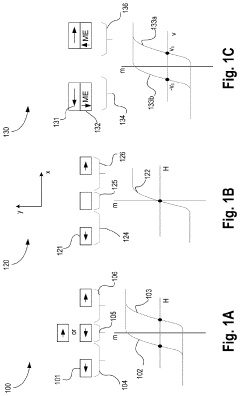
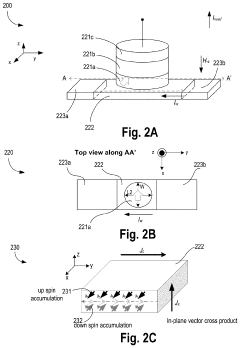
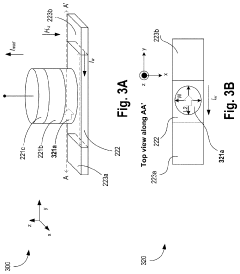
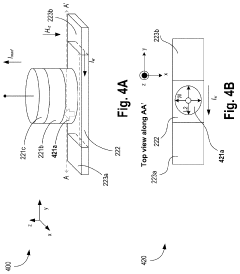
- A two-terminal memory bit-cell utilizing multiferroic materials, where the write electrode comprises heavy metals or antiferromagnetic materials with large spin-orbit torque to switch magnetization, decoupling read and write operations and enabling low-power, high-density memory storage.
Environmental Impact Assessment of Blockchain Energy Usage
The environmental implications of blockchain technology have become increasingly critical as the technology scales globally. Traditional blockchain systems, particularly those employing Proof-of-Work consensus mechanisms, consume substantial amounts of electrical energy, contributing significantly to carbon emissions and environmental degradation. Bitcoin mining alone consumes approximately 120-150 TWh annually, equivalent to the energy consumption of entire countries like Argentina or Norway.
The carbon footprint of blockchain operations extends beyond direct energy consumption. The manufacturing and disposal of specialized mining hardware, such as Application-Specific Integrated Circuits (ASICs), contribute to electronic waste and resource depletion. These devices typically have short operational lifespans due to rapid technological advancement and increasing computational difficulty, creating a continuous cycle of hardware replacement and disposal.
Spintronic memory technology presents a transformative opportunity to address these environmental challenges. Unlike conventional memory systems that rely on charge-based storage requiring constant power refresh, spintronic devices utilize electron spin states for data retention, dramatically reducing standby power consumption. This fundamental difference translates to energy savings of 60-80% compared to traditional DRAM and SRAM technologies commonly used in blockchain infrastructure.
The implementation of spintronic memory in blockchain systems could significantly reduce the overall energy footprint through multiple pathways. First, the non-volatile nature of spintronic storage eliminates the need for continuous power supply to maintain data integrity, reducing baseline power consumption. Second, faster read/write operations enable more efficient transaction processing, reducing computational overhead per transaction.
Geographic distribution of blockchain mining operations often concentrates in regions with lower electricity costs, frequently powered by fossil fuel sources. The adoption of energy-efficient spintronic memory could make renewable energy sources more economically viable for blockchain operations, as reduced total power requirements lower the threshold for sustainable energy integration.
Lifecycle assessment studies indicate that spintronic memory devices demonstrate superior environmental performance across manufacturing, operation, and end-of-life phases. The reduced material requirements and longer operational lifespans contribute to lower overall environmental impact, supporting the transition toward more sustainable blockchain infrastructure.
The carbon footprint of blockchain operations extends beyond direct energy consumption. The manufacturing and disposal of specialized mining hardware, such as Application-Specific Integrated Circuits (ASICs), contribute to electronic waste and resource depletion. These devices typically have short operational lifespans due to rapid technological advancement and increasing computational difficulty, creating a continuous cycle of hardware replacement and disposal.
Spintronic memory technology presents a transformative opportunity to address these environmental challenges. Unlike conventional memory systems that rely on charge-based storage requiring constant power refresh, spintronic devices utilize electron spin states for data retention, dramatically reducing standby power consumption. This fundamental difference translates to energy savings of 60-80% compared to traditional DRAM and SRAM technologies commonly used in blockchain infrastructure.
The implementation of spintronic memory in blockchain systems could significantly reduce the overall energy footprint through multiple pathways. First, the non-volatile nature of spintronic storage eliminates the need for continuous power supply to maintain data integrity, reducing baseline power consumption. Second, faster read/write operations enable more efficient transaction processing, reducing computational overhead per transaction.
Geographic distribution of blockchain mining operations often concentrates in regions with lower electricity costs, frequently powered by fossil fuel sources. The adoption of energy-efficient spintronic memory could make renewable energy sources more economically viable for blockchain operations, as reduced total power requirements lower the threshold for sustainable energy integration.
Lifecycle assessment studies indicate that spintronic memory devices demonstrate superior environmental performance across manufacturing, operation, and end-of-life phases. The reduced material requirements and longer operational lifespans contribute to lower overall environmental impact, supporting the transition toward more sustainable blockchain infrastructure.
Security Considerations for Spintronic Memory in Blockchain
The integration of spintronic memory technology into blockchain systems introduces unique security considerations that must be carefully evaluated to ensure system integrity and data protection. Unlike traditional semiconductor-based storage solutions, spintronic memory devices rely on electron spin states to store information, creating distinct vulnerability profiles that require specialized security frameworks.
Physical security represents a primary concern for spintronic memory implementations in blockchain environments. The magnetic nature of spin-based storage makes these devices potentially susceptible to external magnetic field interference, which could compromise data integrity or enable unauthorized access attempts. Electromagnetic pulse attacks and targeted magnetic field manipulation pose significant threats that traditional blockchain security models do not adequately address.
Data persistence and immutability characteristics of spintronic memory present both advantages and challenges for blockchain security. While the non-volatile nature of spin states enhances data retention reliability, it also creates permanent attack surfaces where malicious modifications could persist indefinitely. The quantum mechanical properties underlying spintronic operations introduce potential vulnerabilities to quantum-based cryptographic attacks, necessitating quantum-resistant security protocols.
Side-channel attack vectors specific to spintronic devices require comprehensive mitigation strategies. Power consumption patterns, electromagnetic emissions, and thermal signatures during spin manipulation operations could leak sensitive information about blockchain transactions or cryptographic keys. These attack vectors are particularly concerning given the deterministic nature of blockchain operations and the valuable financial data typically processed.
Access control mechanisms must account for the unique operational characteristics of spintronic memory, including spin injection and detection processes that may create timing-based vulnerabilities. The integration of spintronic memory controllers with blockchain node architectures requires careful isolation and authentication protocols to prevent unauthorized memory access or manipulation.
Cryptographic key storage within spintronic memory systems demands enhanced protection mechanisms due to the technology's susceptibility to certain physical attacks. The implementation of hardware security modules specifically designed for spintronic environments becomes crucial for maintaining cryptographic integrity in blockchain applications.
Physical security represents a primary concern for spintronic memory implementations in blockchain environments. The magnetic nature of spin-based storage makes these devices potentially susceptible to external magnetic field interference, which could compromise data integrity or enable unauthorized access attempts. Electromagnetic pulse attacks and targeted magnetic field manipulation pose significant threats that traditional blockchain security models do not adequately address.
Data persistence and immutability characteristics of spintronic memory present both advantages and challenges for blockchain security. While the non-volatile nature of spin states enhances data retention reliability, it also creates permanent attack surfaces where malicious modifications could persist indefinitely. The quantum mechanical properties underlying spintronic operations introduce potential vulnerabilities to quantum-based cryptographic attacks, necessitating quantum-resistant security protocols.
Side-channel attack vectors specific to spintronic devices require comprehensive mitigation strategies. Power consumption patterns, electromagnetic emissions, and thermal signatures during spin manipulation operations could leak sensitive information about blockchain transactions or cryptographic keys. These attack vectors are particularly concerning given the deterministic nature of blockchain operations and the valuable financial data typically processed.
Access control mechanisms must account for the unique operational characteristics of spintronic memory, including spin injection and detection processes that may create timing-based vulnerabilities. The integration of spintronic memory controllers with blockchain node architectures requires careful isolation and authentication protocols to prevent unauthorized memory access or manipulation.
Cryptographic key storage within spintronic memory systems demands enhanced protection mechanisms due to the technology's susceptibility to certain physical attacks. The implementation of hardware security modules specifically designed for spintronic environments becomes crucial for maintaining cryptographic integrity in blockchain applications.
Unlock deeper insights with Patsnap Eureka Quick Research — get a full tech report to explore trends and direct your research. Try now!
Generate Your Research Report Instantly with AI Agent
Supercharge your innovation with Patsnap Eureka AI Agent Platform!