Throttle Body Optimization for High-Efficiency Two-Stroke Engines
JUL 18, 20259 MIN READ
Generate Your Research Report Instantly with AI Agent
PatSnap Eureka helps you evaluate technical feasibility & market potential.
Two-Stroke Engine Evolution and Throttle Body Goals
Two-stroke engines have undergone significant evolution since their inception in the late 19th century. Initially developed for simplicity and high power-to-weight ratios, these engines found widespread use in motorcycles, small vehicles, and portable power tools. The early designs, while efficient for their time, faced challenges in emissions control and fuel efficiency.
As environmental concerns grew in the latter half of the 20th century, two-stroke engines faced increasing scrutiny due to their higher emissions compared to four-stroke counterparts. This led to a period of rapid innovation, focusing on improving fuel delivery, combustion efficiency, and exhaust gas management. The introduction of direct fuel injection systems in the 1990s marked a significant leap forward, addressing many of the traditional drawbacks of two-stroke engines.
In recent years, the push for higher efficiency and lower emissions has driven further advancements in two-stroke engine technology. Modern designs incorporate sophisticated electronic control systems, advanced materials, and optimized combustion chamber geometries. These improvements have allowed two-stroke engines to remain competitive in certain applications, particularly where power density and simplicity are paramount.
The throttle body plays a crucial role in the performance and efficiency of two-stroke engines. As the primary mechanism for controlling air and fuel mixture, its optimization directly impacts engine output, fuel consumption, and emissions. The goals for throttle body optimization in high-efficiency two-stroke engines are multifaceted and ambitious.
Firstly, there is a drive to achieve more precise control over the air-fuel mixture across all operating conditions. This involves developing throttle bodies that can rapidly adjust to changing engine demands, ensuring optimal combustion at all times. Secondly, engineers aim to minimize throttling losses, which are particularly significant in two-stroke engines due to their unique scavenging process.
Another key objective is to improve the atomization of fuel, especially in engines that still rely on carburetion or indirect injection. Better fuel atomization leads to more complete combustion, reducing emissions and improving fuel efficiency. Additionally, there is a focus on integrating advanced sensors and actuators within the throttle body to enable real-time adjustments based on engine performance and environmental conditions.
Ultimately, the goal of throttle body optimization in two-stroke engines is to bridge the efficiency gap with four-stroke engines while maintaining the inherent advantages of the two-stroke design. This involves a holistic approach that considers not just the throttle body in isolation, but its interaction with other engine components and control systems.
As environmental concerns grew in the latter half of the 20th century, two-stroke engines faced increasing scrutiny due to their higher emissions compared to four-stroke counterparts. This led to a period of rapid innovation, focusing on improving fuel delivery, combustion efficiency, and exhaust gas management. The introduction of direct fuel injection systems in the 1990s marked a significant leap forward, addressing many of the traditional drawbacks of two-stroke engines.
In recent years, the push for higher efficiency and lower emissions has driven further advancements in two-stroke engine technology. Modern designs incorporate sophisticated electronic control systems, advanced materials, and optimized combustion chamber geometries. These improvements have allowed two-stroke engines to remain competitive in certain applications, particularly where power density and simplicity are paramount.
The throttle body plays a crucial role in the performance and efficiency of two-stroke engines. As the primary mechanism for controlling air and fuel mixture, its optimization directly impacts engine output, fuel consumption, and emissions. The goals for throttle body optimization in high-efficiency two-stroke engines are multifaceted and ambitious.
Firstly, there is a drive to achieve more precise control over the air-fuel mixture across all operating conditions. This involves developing throttle bodies that can rapidly adjust to changing engine demands, ensuring optimal combustion at all times. Secondly, engineers aim to minimize throttling losses, which are particularly significant in two-stroke engines due to their unique scavenging process.
Another key objective is to improve the atomization of fuel, especially in engines that still rely on carburetion or indirect injection. Better fuel atomization leads to more complete combustion, reducing emissions and improving fuel efficiency. Additionally, there is a focus on integrating advanced sensors and actuators within the throttle body to enable real-time adjustments based on engine performance and environmental conditions.
Ultimately, the goal of throttle body optimization in two-stroke engines is to bridge the efficiency gap with four-stroke engines while maintaining the inherent advantages of the two-stroke design. This involves a holistic approach that considers not just the throttle body in isolation, but its interaction with other engine components and control systems.
Market Demand Analysis for High-Efficiency Engines
The market demand for high-efficiency engines, particularly in the two-stroke segment, has been steadily growing in recent years. This trend is driven by several factors, including increasing environmental regulations, rising fuel costs, and a growing emphasis on sustainability across various industries.
In the automotive sector, there is a renewed interest in two-stroke engines due to their potential for improved power-to-weight ratios and reduced emissions when optimized with modern technologies. The motorcycle industry, especially in emerging markets, continues to rely heavily on two-stroke engines for their simplicity and cost-effectiveness. There is a significant demand for engines that can meet stricter emission standards while maintaining performance.
The marine industry represents another substantial market for high-efficiency two-stroke engines. Recreational boating and small commercial vessels are seeking more fuel-efficient options to reduce operating costs and environmental impact. The demand for cleaner, more efficient engines in this sector is expected to grow as regulations tighten globally.
In the power equipment market, including lawn and garden tools, chainsaws, and portable generators, there is a strong push for engines that offer improved fuel efficiency and reduced emissions. Consumers and professionals alike are seeking products that provide longer run times and lower operating costs.
The industrial sector, particularly in applications such as small-scale power generation and pumping systems, shows increasing interest in optimized two-stroke engines. These engines offer advantages in terms of power density and simplicity, making them attractive for compact and mobile applications.
Market analysis indicates that the global demand for high-efficiency engines is projected to grow at a compound annual growth rate (CAGR) of 5-7% over the next five years. This growth is expected to be particularly strong in Asia-Pacific and Latin American regions, where rapid industrialization and urbanization are driving the need for more efficient power solutions.
The throttle body optimization for high-efficiency two-stroke engines addresses a critical component of engine performance and efficiency. As manufacturers strive to meet increasingly stringent emissions standards and consumer demands for better fuel economy, the market for advanced throttle body technologies is expanding. This includes electronic throttle control systems, variable geometry designs, and materials that can withstand higher temperatures and pressures.
In conclusion, the market demand for high-efficiency engines, particularly those with optimized throttle bodies for two-stroke applications, is robust and growing. This demand spans multiple industries and is driven by a combination of regulatory pressures, economic factors, and consumer preferences for more sustainable and efficient power solutions.
In the automotive sector, there is a renewed interest in two-stroke engines due to their potential for improved power-to-weight ratios and reduced emissions when optimized with modern technologies. The motorcycle industry, especially in emerging markets, continues to rely heavily on two-stroke engines for their simplicity and cost-effectiveness. There is a significant demand for engines that can meet stricter emission standards while maintaining performance.
The marine industry represents another substantial market for high-efficiency two-stroke engines. Recreational boating and small commercial vessels are seeking more fuel-efficient options to reduce operating costs and environmental impact. The demand for cleaner, more efficient engines in this sector is expected to grow as regulations tighten globally.
In the power equipment market, including lawn and garden tools, chainsaws, and portable generators, there is a strong push for engines that offer improved fuel efficiency and reduced emissions. Consumers and professionals alike are seeking products that provide longer run times and lower operating costs.
The industrial sector, particularly in applications such as small-scale power generation and pumping systems, shows increasing interest in optimized two-stroke engines. These engines offer advantages in terms of power density and simplicity, making them attractive for compact and mobile applications.
Market analysis indicates that the global demand for high-efficiency engines is projected to grow at a compound annual growth rate (CAGR) of 5-7% over the next five years. This growth is expected to be particularly strong in Asia-Pacific and Latin American regions, where rapid industrialization and urbanization are driving the need for more efficient power solutions.
The throttle body optimization for high-efficiency two-stroke engines addresses a critical component of engine performance and efficiency. As manufacturers strive to meet increasingly stringent emissions standards and consumer demands for better fuel economy, the market for advanced throttle body technologies is expanding. This includes electronic throttle control systems, variable geometry designs, and materials that can withstand higher temperatures and pressures.
In conclusion, the market demand for high-efficiency engines, particularly those with optimized throttle bodies for two-stroke applications, is robust and growing. This demand spans multiple industries and is driven by a combination of regulatory pressures, economic factors, and consumer preferences for more sustainable and efficient power solutions.
Current Throttle Body Technology Challenges
The optimization of throttle bodies for high-efficiency two-stroke engines faces several significant challenges in the current technological landscape. One of the primary issues is achieving precise air-fuel mixture control across a wide range of engine speeds and loads. Two-stroke engines, by nature, have a shorter cycle time compared to four-stroke engines, making it more difficult to maintain optimal air-fuel ratios consistently.
Another challenge lies in the design of throttle body geometry to minimize flow restrictions while maximizing throttle response. The rapid intake and exhaust cycles of two-stroke engines require throttle bodies that can quickly and efficiently manage airflow without creating bottlenecks or turbulence that could impede engine performance.
The integration of electronic throttle control systems (ETC) in two-stroke engines presents its own set of challenges. While ETC offers improved precision and responsiveness, it requires sophisticated algorithms and sensors to accurately interpret and respond to rapidly changing engine conditions. This is particularly crucial in high-performance applications where throttle response and power delivery are critical.
Durability and reliability of throttle body components in the harsh operating environment of two-stroke engines pose another significant challenge. The increased frequency of intake cycles and exposure to fuel-oil mixtures can accelerate wear and degradation of throttle body components, necessitating the development of more robust materials and designs.
Emissions control is an increasingly important factor in throttle body design for two-stroke engines. Stricter environmental regulations require innovative solutions to reduce unburned fuel emissions, which are typically higher in two-stroke engines. This challenge involves not only optimizing the throttle body itself but also considering its interaction with other engine components such as direct injection systems and exhaust gas recirculation.
The miniaturization of throttle bodies for compact two-stroke engines, particularly in applications like small motorcycles or handheld power tools, presents unique design challenges. Engineers must balance the need for compact design with the requirements for adequate airflow and precise control, often within tight spatial constraints.
Lastly, the cost-effectiveness of advanced throttle body technologies remains a significant hurdle, especially for mass-market applications. Developing throttle bodies that offer high performance and efficiency while remaining economically viable for large-scale production is an ongoing challenge for manufacturers in this field.
Another challenge lies in the design of throttle body geometry to minimize flow restrictions while maximizing throttle response. The rapid intake and exhaust cycles of two-stroke engines require throttle bodies that can quickly and efficiently manage airflow without creating bottlenecks or turbulence that could impede engine performance.
The integration of electronic throttle control systems (ETC) in two-stroke engines presents its own set of challenges. While ETC offers improved precision and responsiveness, it requires sophisticated algorithms and sensors to accurately interpret and respond to rapidly changing engine conditions. This is particularly crucial in high-performance applications where throttle response and power delivery are critical.
Durability and reliability of throttle body components in the harsh operating environment of two-stroke engines pose another significant challenge. The increased frequency of intake cycles and exposure to fuel-oil mixtures can accelerate wear and degradation of throttle body components, necessitating the development of more robust materials and designs.
Emissions control is an increasingly important factor in throttle body design for two-stroke engines. Stricter environmental regulations require innovative solutions to reduce unburned fuel emissions, which are typically higher in two-stroke engines. This challenge involves not only optimizing the throttle body itself but also considering its interaction with other engine components such as direct injection systems and exhaust gas recirculation.
The miniaturization of throttle bodies for compact two-stroke engines, particularly in applications like small motorcycles or handheld power tools, presents unique design challenges. Engineers must balance the need for compact design with the requirements for adequate airflow and precise control, often within tight spatial constraints.
Lastly, the cost-effectiveness of advanced throttle body technologies remains a significant hurdle, especially for mass-market applications. Developing throttle bodies that offer high performance and efficiency while remaining economically viable for large-scale production is an ongoing challenge for manufacturers in this field.
Existing Throttle Body Optimization Solutions
01 Improved throttle body design
Enhanced throttle body designs focus on optimizing airflow and reducing turbulence. These improvements may include streamlined internal geometries, advanced manufacturing techniques, and innovative materials to minimize friction and increase overall efficiency.- Improved throttle body design: Enhancements in throttle body design focus on optimizing airflow and reducing turbulence. This includes modifications to the shape and size of the throttle bore, as well as improvements in the throttle plate design. These changes result in more efficient air intake and better overall engine performance.
- Electronic throttle control systems: Implementation of electronic throttle control systems improves throttle body efficiency by providing more precise control over airflow. These systems use sensors and actuators to adjust throttle position based on various engine parameters, resulting in improved fuel economy and reduced emissions.
- Integrated throttle body components: Integrating additional components into the throttle body assembly, such as idle air control valves or sensors, can enhance overall efficiency. This integration reduces the number of separate parts, minimizes potential leak points, and improves the system's response time.
- Material selection for throttle bodies: The choice of materials used in throttle body construction can significantly impact efficiency. Lightweight materials with low thermal expansion coefficients and high durability can improve performance and longevity. Advanced materials may also offer better heat dissipation properties.
- Throttle body cleaning and maintenance: Regular cleaning and maintenance of throttle bodies are crucial for maintaining efficiency. This includes removing carbon deposits, ensuring proper lubrication of moving parts, and checking for wear or damage. Proper maintenance helps maintain optimal airflow and prevents performance degradation over time.
02 Electronic throttle control systems
Integration of electronic throttle control systems allows for more precise regulation of airflow. These systems utilize sensors and actuators to adjust throttle position based on various engine parameters, resulting in improved fuel efficiency and performance.Expand Specific Solutions03 Throttle body cleaning and maintenance
Regular cleaning and maintenance of throttle bodies can significantly improve their efficiency. This includes removing carbon deposits, adjusting idle speed, and ensuring proper sealing to maintain optimal airflow and prevent leaks.Expand Specific Solutions04 Variable geometry throttle bodies
Throttle bodies with variable geometry features allow for dynamic adjustment of airflow characteristics. These designs can optimize performance across different engine speeds and load conditions, improving overall efficiency and responsiveness.Expand Specific Solutions05 Integration of auxiliary systems
Incorporating auxiliary systems into the throttle body design can enhance overall efficiency. This may include integrating idle air control valves, air temperature sensors, or fuel injection components directly into the throttle body assembly for improved coordination and reduced complexity.Expand Specific Solutions
Key Players in Two-Stroke Engine Industry
The throttle body optimization for high-efficiency two-stroke engines market is in a growth phase, driven by increasing demand for improved engine performance and fuel efficiency. The global market size is estimated to be in the hundreds of millions of dollars, with steady growth projected. Technologically, the field is advancing rapidly, with companies like Andreas Stihl AG & Co. KG, Mikuni Corp., and Husqvarna AB leading innovation. These firms are developing sophisticated electronic throttle control systems and integrating advanced materials to enhance durability and responsiveness. Emerging players such as Chery Automobile Co., Ltd. and BYD Co., Ltd. are also making significant strides, particularly in electric and hybrid applications of throttle body technology for two-stroke engines.
Andreas Stihl AG & Co. KG
Technical Solution: Stihl has developed an innovative throttle body optimization system for their high-efficiency two-stroke engines, particularly in chainsaws and other handheld power equipment. Their approach involves a variable geometry throttle body that adapts to different engine loads and speeds. This system incorporates electronic control units to precisely adjust the throttle opening, fuel injection timing, and air-fuel mixture[1]. The optimized design includes a streamlined airflow path and reduced turbulence, resulting in improved combustion efficiency and reduced emissions[3]. Stihl's throttle body also features a integrated anti-icing mechanism to prevent performance issues in cold weather conditions[5].
Strengths: Improved fuel efficiency, reduced emissions, and enhanced performance across various operating conditions. Weaknesses: Increased complexity and potential higher manufacturing costs compared to traditional throttle bodies.
Mikuni Corp.
Technical Solution: Mikuni has developed a high-performance throttle body system for two-stroke engines, focusing on motorcycles and marine applications. Their design incorporates a dual-stage throttle valve mechanism that provides precise control over air intake at both low and high engine speeds[2]. The throttle body features a specially designed venturi shape that optimizes air velocity and fuel atomization, resulting in improved combustion efficiency[4]. Mikuni's system also includes an advanced idle air control (IAC) system that maintains stable idle speeds under varying load conditions[6]. The throttle body is constructed using lightweight materials to reduce overall engine weight while maintaining durability.
Strengths: Excellent throttle response, improved fuel atomization, and stable idle performance. Weaknesses: May require more frequent maintenance due to the complexity of the dual-stage mechanism.
Core Innovations in Throttle Body Design
Throttle body and powered two-wheeled vehicle provided therewith
PatentWO2010113981A1
Innovation
- A throttle body design featuring butterfly-type first and second throttle valves with a tubular portion, through hole, and branch pipe to improve intake air flow between the valves, ensuring efficient air introduction into an auxiliary passage, which enhances fuel atomization and efficiency.
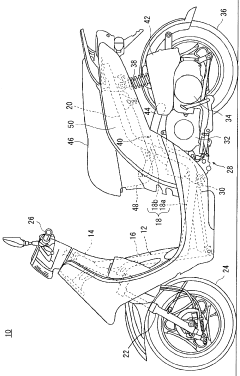
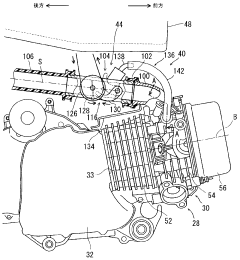
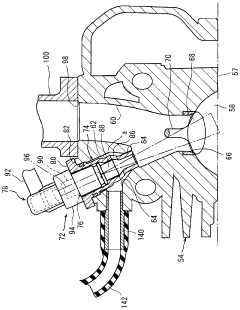
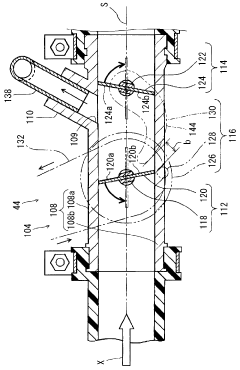
Throttle body for two-wheeled vehicle
PatentInactiveUS7370845B2
Innovation
- The throttle body is redesigned with an engine side mounting pipe sleeve formed in an oval or elliptic shape, with short axis portions aligned along the throttle valve shaft, reducing the side mounting pitch and total width, and thinning the thickness between the suction air passage and the engine side mounting pipe sleeve, improving molding and assembly processes while reducing weight and material costs.


Emissions Regulations Impact
Emissions regulations have significantly impacted the development and optimization of throttle bodies for high-efficiency two-stroke engines. These regulations, aimed at reducing harmful emissions and improving air quality, have forced engine manufacturers to adapt their designs and technologies to meet increasingly stringent standards.
The introduction of stricter emissions standards, such as Euro 5 and Euro 6 in Europe, and Tier 4 Final in the United States, has necessitated substantial changes in throttle body design and operation. These regulations have set lower limits for pollutants such as carbon monoxide (CO), hydrocarbons (HC), nitrogen oxides (NOx), and particulate matter (PM). As a result, manufacturers have had to implement advanced technologies and strategies to ensure compliance while maintaining engine performance and efficiency.
One of the key impacts of emissions regulations on throttle body optimization has been the increased focus on precise fuel metering and air-fuel mixture control. Traditional carburetors have largely been replaced by electronic fuel injection systems, which offer greater control over fuel delivery and mixture formation. This shift has led to the development of more sophisticated throttle bodies with integrated sensors and actuators, capable of real-time adjustments based on engine operating conditions.
Emissions regulations have also driven the adoption of variable valve timing (VVT) systems in two-stroke engines. These systems allow for optimized air intake and exhaust timing, reducing emissions and improving fuel efficiency. Throttle bodies have been redesigned to work in conjunction with VVT systems, incorporating features such as variable intake runner lengths and adjustable intake port timing.
The need to reduce raw emissions has led to the implementation of exhaust gas recirculation (EGR) systems in two-stroke engines. This has required throttle bodies to be designed with additional ports or passages to accommodate EGR flow, further complicating their construction and control strategies. Additionally, the integration of catalytic converters and particulate filters in the exhaust system has necessitated changes in throttle body design to ensure proper exhaust gas temperatures and flow characteristics.
Emissions regulations have also pushed manufacturers to explore alternative fuel technologies, such as direct injection systems for two-stroke engines. This has led to the development of specialized throttle bodies capable of handling high-pressure fuel delivery and precise mixture formation. These advanced throttle bodies often incorporate multiple injectors and complex internal geometries to optimize fuel atomization and distribution.
Furthermore, the emphasis on reducing emissions has driven the adoption of electronic throttle control (ETC) systems, also known as drive-by-wire technology. These systems replace mechanical linkages with electronic actuators, allowing for more precise throttle control and integration with engine management systems. This has enabled manufacturers to implement sophisticated control algorithms that optimize throttle response while minimizing emissions across various operating conditions.
The introduction of stricter emissions standards, such as Euro 5 and Euro 6 in Europe, and Tier 4 Final in the United States, has necessitated substantial changes in throttle body design and operation. These regulations have set lower limits for pollutants such as carbon monoxide (CO), hydrocarbons (HC), nitrogen oxides (NOx), and particulate matter (PM). As a result, manufacturers have had to implement advanced technologies and strategies to ensure compliance while maintaining engine performance and efficiency.
One of the key impacts of emissions regulations on throttle body optimization has been the increased focus on precise fuel metering and air-fuel mixture control. Traditional carburetors have largely been replaced by electronic fuel injection systems, which offer greater control over fuel delivery and mixture formation. This shift has led to the development of more sophisticated throttle bodies with integrated sensors and actuators, capable of real-time adjustments based on engine operating conditions.
Emissions regulations have also driven the adoption of variable valve timing (VVT) systems in two-stroke engines. These systems allow for optimized air intake and exhaust timing, reducing emissions and improving fuel efficiency. Throttle bodies have been redesigned to work in conjunction with VVT systems, incorporating features such as variable intake runner lengths and adjustable intake port timing.
The need to reduce raw emissions has led to the implementation of exhaust gas recirculation (EGR) systems in two-stroke engines. This has required throttle bodies to be designed with additional ports or passages to accommodate EGR flow, further complicating their construction and control strategies. Additionally, the integration of catalytic converters and particulate filters in the exhaust system has necessitated changes in throttle body design to ensure proper exhaust gas temperatures and flow characteristics.
Emissions regulations have also pushed manufacturers to explore alternative fuel technologies, such as direct injection systems for two-stroke engines. This has led to the development of specialized throttle bodies capable of handling high-pressure fuel delivery and precise mixture formation. These advanced throttle bodies often incorporate multiple injectors and complex internal geometries to optimize fuel atomization and distribution.
Furthermore, the emphasis on reducing emissions has driven the adoption of electronic throttle control (ETC) systems, also known as drive-by-wire technology. These systems replace mechanical linkages with electronic actuators, allowing for more precise throttle control and integration with engine management systems. This has enabled manufacturers to implement sophisticated control algorithms that optimize throttle response while minimizing emissions across various operating conditions.
Performance Testing Methodologies
Performance testing methodologies for throttle body optimization in high-efficiency two-stroke engines require a comprehensive approach to evaluate the impact of design changes on engine performance. These methodologies typically involve a combination of bench testing, dynamometer testing, and real-world performance evaluations.
Bench testing is often the first step in the performance evaluation process. This involves using specialized equipment to measure airflow characteristics, pressure drops, and throttle response in a controlled laboratory environment. Flow benches are commonly employed to quantify the airflow capacity of the throttle body at various throttle positions. These tests help engineers understand how changes in throttle body design affect air delivery to the engine.
Dynamometer testing provides a more holistic view of engine performance. In this phase, the engine is mounted on a dynamometer, which measures power output, torque, and fuel consumption across a range of operating conditions. Engineers can evaluate how throttle body modifications impact engine performance metrics such as horsepower, torque curves, and throttle response. This testing also allows for the assessment of emissions and fuel efficiency under various load conditions.
Real-world performance testing is crucial for validating laboratory results and ensuring that throttle body optimizations translate to tangible improvements in actual operating conditions. This may involve installing the modified throttle body on a test vehicle and conducting road tests to evaluate acceleration, top speed, and overall drivability. Data logging systems are often used to capture real-time performance metrics during these tests.
Computational Fluid Dynamics (CFD) simulations have become an increasingly important tool in throttle body optimization. These simulations allow engineers to model airflow through the throttle body and predict performance impacts before physical prototypes are built. CFD analysis can help identify areas of turbulence, pressure drops, and other flow characteristics that may not be easily observable in physical testing.
To ensure consistency and reliability, performance testing methodologies often include standardized test protocols. These protocols define specific test conditions, measurement techniques, and data analysis methods. For example, SAE J1349 is a widely used standard for engine power testing that specifies ambient conditions, fuel properties, and correction factors for comparing results across different test environments.
Repeatability and reproducibility are key considerations in performance testing methodologies. Multiple test runs are typically conducted to account for variability and ensure statistically significant results. Advanced data acquisition systems are employed to capture high-resolution performance data, allowing for detailed analysis of transient behaviors and subtle performance changes.
In conclusion, effective performance testing methodologies for throttle body optimization in high-efficiency two-stroke engines combine rigorous laboratory testing, sophisticated simulation techniques, and real-world validation. This multi-faceted approach enables engineers to make data-driven decisions in the pursuit of optimal throttle body designs that maximize engine efficiency and performance.
Bench testing is often the first step in the performance evaluation process. This involves using specialized equipment to measure airflow characteristics, pressure drops, and throttle response in a controlled laboratory environment. Flow benches are commonly employed to quantify the airflow capacity of the throttle body at various throttle positions. These tests help engineers understand how changes in throttle body design affect air delivery to the engine.
Dynamometer testing provides a more holistic view of engine performance. In this phase, the engine is mounted on a dynamometer, which measures power output, torque, and fuel consumption across a range of operating conditions. Engineers can evaluate how throttle body modifications impact engine performance metrics such as horsepower, torque curves, and throttle response. This testing also allows for the assessment of emissions and fuel efficiency under various load conditions.
Real-world performance testing is crucial for validating laboratory results and ensuring that throttle body optimizations translate to tangible improvements in actual operating conditions. This may involve installing the modified throttle body on a test vehicle and conducting road tests to evaluate acceleration, top speed, and overall drivability. Data logging systems are often used to capture real-time performance metrics during these tests.
Computational Fluid Dynamics (CFD) simulations have become an increasingly important tool in throttle body optimization. These simulations allow engineers to model airflow through the throttle body and predict performance impacts before physical prototypes are built. CFD analysis can help identify areas of turbulence, pressure drops, and other flow characteristics that may not be easily observable in physical testing.
To ensure consistency and reliability, performance testing methodologies often include standardized test protocols. These protocols define specific test conditions, measurement techniques, and data analysis methods. For example, SAE J1349 is a widely used standard for engine power testing that specifies ambient conditions, fuel properties, and correction factors for comparing results across different test environments.
Repeatability and reproducibility are key considerations in performance testing methodologies. Multiple test runs are typically conducted to account for variability and ensure statistically significant results. Advanced data acquisition systems are employed to capture high-resolution performance data, allowing for detailed analysis of transient behaviors and subtle performance changes.
In conclusion, effective performance testing methodologies for throttle body optimization in high-efficiency two-stroke engines combine rigorous laboratory testing, sophisticated simulation techniques, and real-world validation. This multi-faceted approach enables engineers to make data-driven decisions in the pursuit of optimal throttle body designs that maximize engine efficiency and performance.
Unlock deeper insights with PatSnap Eureka Quick Research — get a full tech report to explore trends and direct your research. Try now!
Generate Your Research Report Instantly with AI Agent
Supercharge your innovation with PatSnap Eureka AI Agent Platform!