Introduction – What Is ULED and Why Is It Important?
ULED (Ultra Light Emitting Diode) is Hisense’s proprietary display technology that enhances standard LED-LCD panels through a suite of hardware and software innovations. These enhancements include dynamic backlight control, local dimming, quantum dot color filters, and advanced motion smoothing. ULED isn’t a panel type like OLED or QLED, but rather a marketing term for a combination of technologies that aim to improve picture quality—making ULED displays brighter, more colorful, and more responsive than traditional LED displays.
As display demands evolve in gaming, home entertainment, and commercial applications, ULED emerges as a cost-effective and high-performance contender.
How ULED Works – Blending Multiple Display Enhancements
ULED relies on a mix of techniques to improve brightness, contrast, motion handling, and color accuracy. Key features include:
- Full Array Local Dimming (FALD): for precise black levels and dynamic contrast.
- Quantum Dot Color: wider and richer color gamut.
- Ultra Smooth Motion: frame interpolation for fast-paced content.
- AI Picture Adjustment: real-time optimization of brightness, sharpness, and tone.
By integrating these capabilities, ULED delivers a premium viewing experience at a more accessible price point compared to OLED or MicroLED alternatives.
Key Applications by Sector
To better understand the growing influence of ULED technology, we’ve categorized its key use cases and research directions across five major sectors.
🔹 Home Entertainment & Consumer Electronics
ULED is widely adopted in 4K and 8K televisions, delivering deep blacks, vivid colors, and smooth motion. It’s particularly attractive for users seeking high performance without the OLED price tag. Want to elevate your living room experience or build a next-gen gaming setup? These articles provide practical insights into how ULED enhances home entertainment:
- ULED Technology Advances: Revolutionizing Display Quality
- ULED for Home Theaters: Best Practices
- ULED Displays: Enhancing Visual Experiences
- How to Optimize ULED for Gaming Experiences?
- Future Trends in ULED Television Technologies
🔹 Commercial & Professional Display Solutions
From digital signage to conference rooms, ULED is gaining ground in professional environments where clarity and durability matter.
If you’re planning a professional display upgrade or large-scale deployment, the following reads explore ULED’s potential in enterprise and automotive sectors:
- Harnessing ULED for Commercial Signage Solutions
- Enhancing User Experience with ULED Interfaces
- ULED in Digital Signage: Trends and Innovations
- How to Integrate ULED into Enterprise Solutions?
- ULED Displays in Automotive Infotainment: A Guide
🔹 Healthcare, Education & Collaborative Spaces
ULED displays are entering new frontiers like healthcare visualization, educational displays, and collaborative environments, offering clarity and reliability.
Learn how ULED supports precise visuals, user engagement, and long-term durability in learning and care environments:
- Leveraging ULED for Healthcare Display Technologies
- ULED for Interactive Advertising Solutions
- ULED in Visual Merchandising: A Strategic Overview
- Harnessing ULED for Educational Display Solutions
- How to Transform Learning Environments with ULED?
🔹 Emerging Technology & Innovation
ULED is increasingly being combined with AR, AI, and smart home ecosystems—opening the door to new display paradigms and user-centric innovation.

Explore how ULED is evolving at the frontier of digital transformation, from immersive storytelling to intelligent home devices:
- The Role of ULED in Augmented Reality Displays
- ULED in Next‑Gen Smart Home Devices
- ULED and the Future of Visual Storytelling
- ULED: Cutting‑Edge Applications in Tech Ecosystems
- How to Integrate AI with ULED Displays?
🔹 Energy Efficiency & Sustainability
ULED innovations also contribute to improved energy efficiency and extended panel life, supporting greener and more sustainable electronics.
For those focused on eco-design and energy-conscious technologies, the articles below examine how ULED contributes to sustainable progress:
- ULED and Its Impact on Energy Consumption
- Improving Energy Efficiency in ULED Displays
- ULED Displays: Impact on Eye Comfort
- ULED’s Contribution to Sustainable Electronics Design
- The Environmental Impact of ULED Manufacturing
Technology Insights via PatSnap Eureka AI Agent
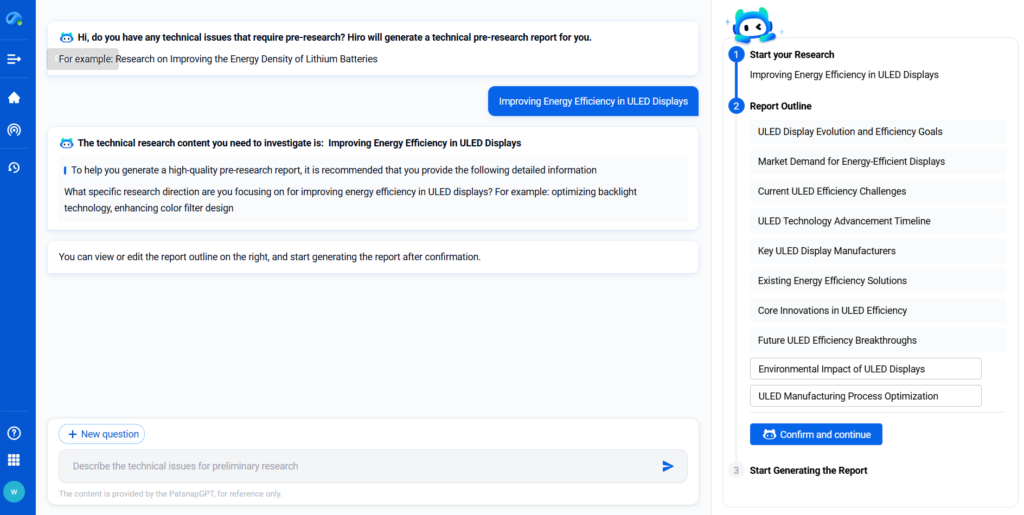
Using Eureka’s AI-driven tools, we mapped ULED’s innovation blueprint.
- Enterprise Technology Focus
Eureka identifies key technical priorities in ULED development through patent clustering. Leading themes include:
- Quantum Dot Color Management
- Adaptive Brightness & Contrast Algorithms
- Ultra High Dynamic Range (HDR)
- Motion Interpolation & AI Image Scaling
- Low-Power LED Backlight Systems
- Innovation Strategy & R&D Trends
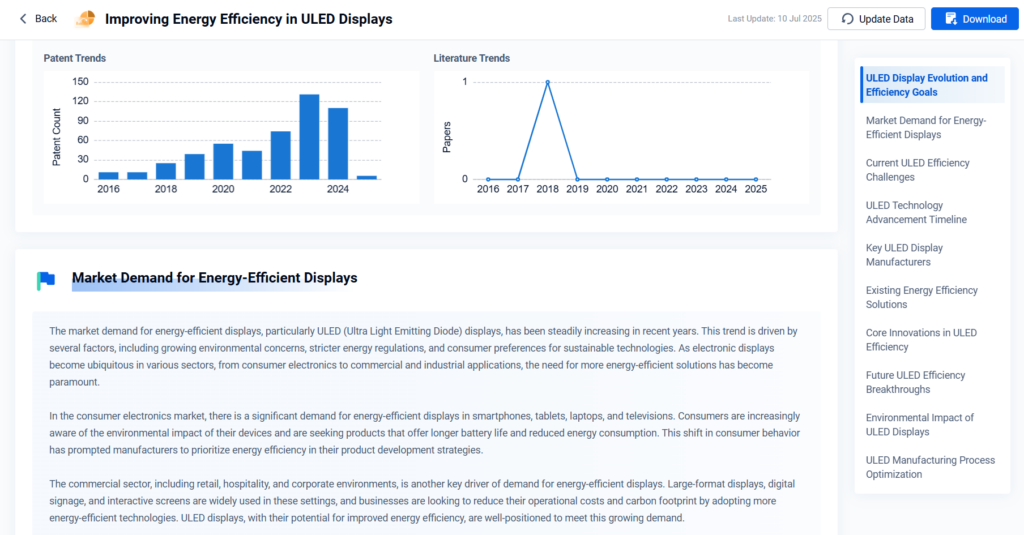
Through Eureka’s timeline view, we see a shift from early quantum dot work to smart display ecosystems, AI-driven tuning, and IoT integration in recent patents.

- Research Collaboration & Competitive Intelligence
Eureka reveals how ULED technology is evolving through joint innovation across display manufacturers, semiconductor companies, and AI firms—offering benchmarking insights against OLED, QLED, and MicroLED competitors.
Advantages & Limitations of ULED
ULED displays provide a well-rounded set of benefits that position them as strong alternatives to both budget and premium display technologies:
Key Advantages:
- Excellent brightness and HDR performance make ULED ideal for bright-room environments.
- Quantum dot layers deliver vivid color reproduction and wide color gamut coverage.
- Local dimming capabilities improve perceived contrast and black detail.
- Improved power efficiency compared to traditional LED panels.
- Reduced risk of burn-in compared to OLED, making it more durable for static images.
- Cost-effective alternative to OLED and MicroLED for large-format displays.
However, ULED is not without its limitations:
- Blacks are not as pure or infinite as OLED, especially in edge-lit variants.
- Viewing angles may be narrower than OLED, depending on panel technology used (e.g., VA vs IPS).
- The term “ULED” can be cULED displays provide a well-rounded set of benefits that position them as strong alternatives to both budget and premium display technologies:Key Advantages:
- Excellent brightness and HDR performance make ULED ideal for bright-room environments.
- Quantum dot layers deliver vivid color reproduction and wide color gamut coverage.
- Local dimming capabilities improve perceived contrast and black detail.
- Improved power efficiency compared to traditional LED panels.
- Reduced risk of burn-in compared to OLED, making it more durable for static images.
- Cost-effective alternative to OLED and MicroLED for large-format displays. However, ULED is not without its limitations:
- Blacks are not as pure or infinite as OLED, especially in edge-lit variants.
- Viewing angles may be narrower than OLED, depending on panel technology used (e.g., VA vs IPS).
- The term “ULED” can be confusing due to its proprietary nature—consumers may find it difficult to compare with more standardized technologies like QLED or OLED.
- Panel quality and feature integration can vary across models and regions.
The Future of ULED
ULED is moving well beyond its roots in flat-screen TVs. As AI optimization and real-time visual processing become more integral to display tech, ULED systems are incorporating smarter algorithms for scene recognition, adaptive tone mapping, and voice-activated controls.
In addition:
- Emerging markets are seeing growth in affordable ULED solutions for education and healthcare.
- Automotive applications are beginning to adopt ULED for dashboard displays and infotainment systems.
- Innovations in quantum dot films and micro-lens arrays will continue to push ULED performance closer to OLED-level contrast and fidelity.
- As energy efficiency standards tighten globally, ULED’s power optimization features give it a strategic advantage.
ULED is also likely to play a larger role in hybrid display ecosystems that blend LED, quantum dot, AI, and connectivity tools into cohesive smart environments.
Conclusion – Why ULED Matters in Display Evolution
ULED technology bridges the gap between affordability and performance. Its intelligent combination of hardware and software advancements delivers premium visuals at accessible prices. As industries demand smarter, greener, and more immersive displays, ULED offers a scalable and future-ready solution that meets a wide range of user needs—from immersive home theaters to energy-efficient enterprise installations.
Supercharge Your Display Innovation Journey with PatSnap Eureka AI Agent
From quantum dots to AI-based image tuning and next-gen LED structures, the future of display technology is rapidly unfolding. PatSnap Eureka, our AI-powered innovation intelligence platform, helps R&D and IP professionals navigate this complexity with real-time patent mapping, technology insights, and competitive benchmarking.
Whether you’re refining ULED brightness, optimizing contrast algorithms, or exploring sustainable materials, Eureka delivers strategic clarity—fast.
Try PatSnap Eureka AI Agent today and unlock the full potential of your display innovation pipeline.