
Speech coding apparatus with perceptual weighting and method therefor
a speech coding and perceptual weighting technology, applied in the field of speech coding methods and apparatuses, can solve the problems of reducing the auditory effect or hearing of people, difficult to quantize or code a time varying coefficient that is under 1 kbps, and affecting the quality of speech regenerated,
Patent Information
- Authority / Receiving Office
- US · United States
- Patent Type
- Patents(United States)
- Current Assignee / Owner
- Publication Date
- 2009-10-13
- Estimated Expiration
- Not applicable · inactive patent
Smart Images
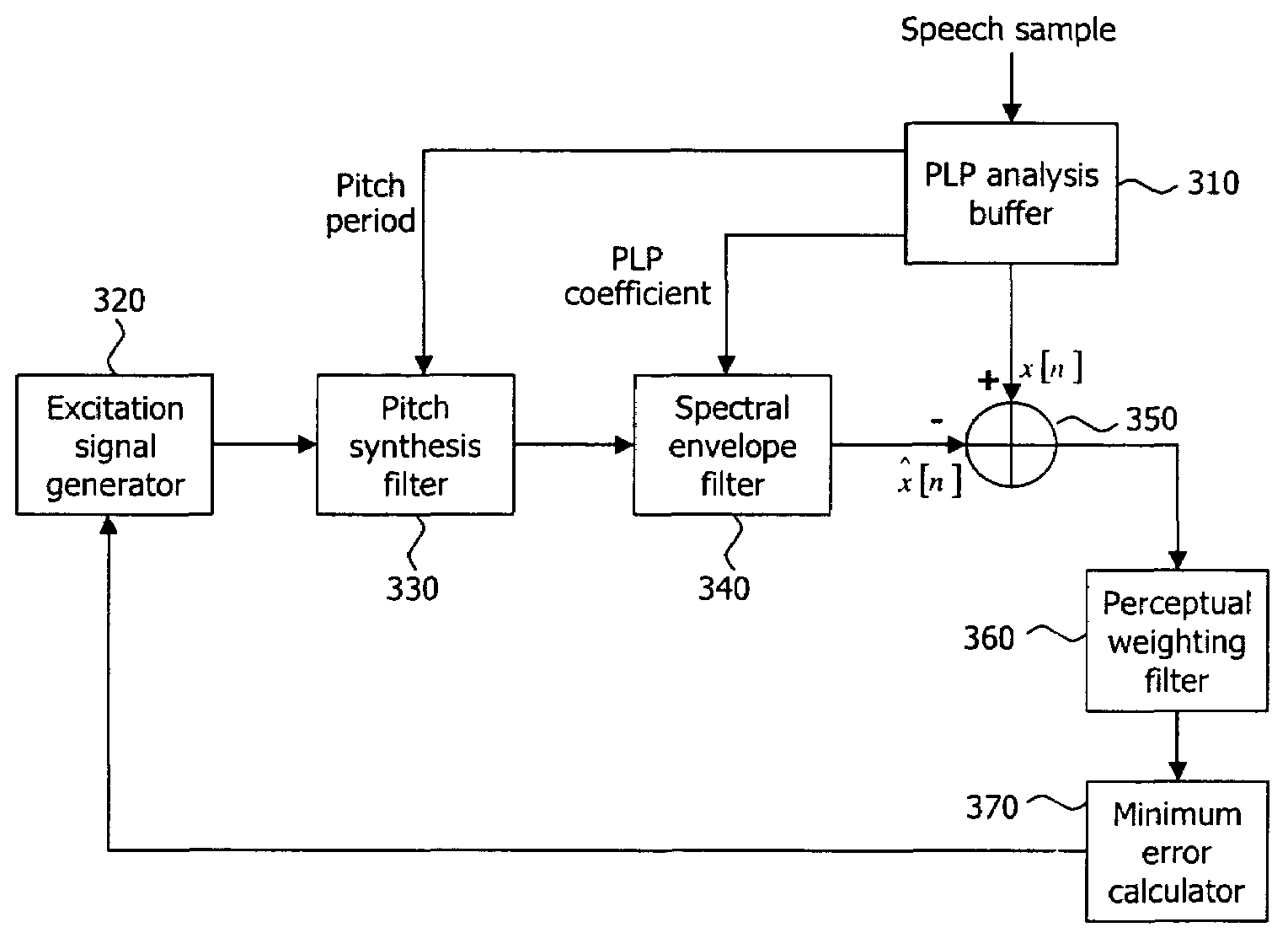
Figure 1 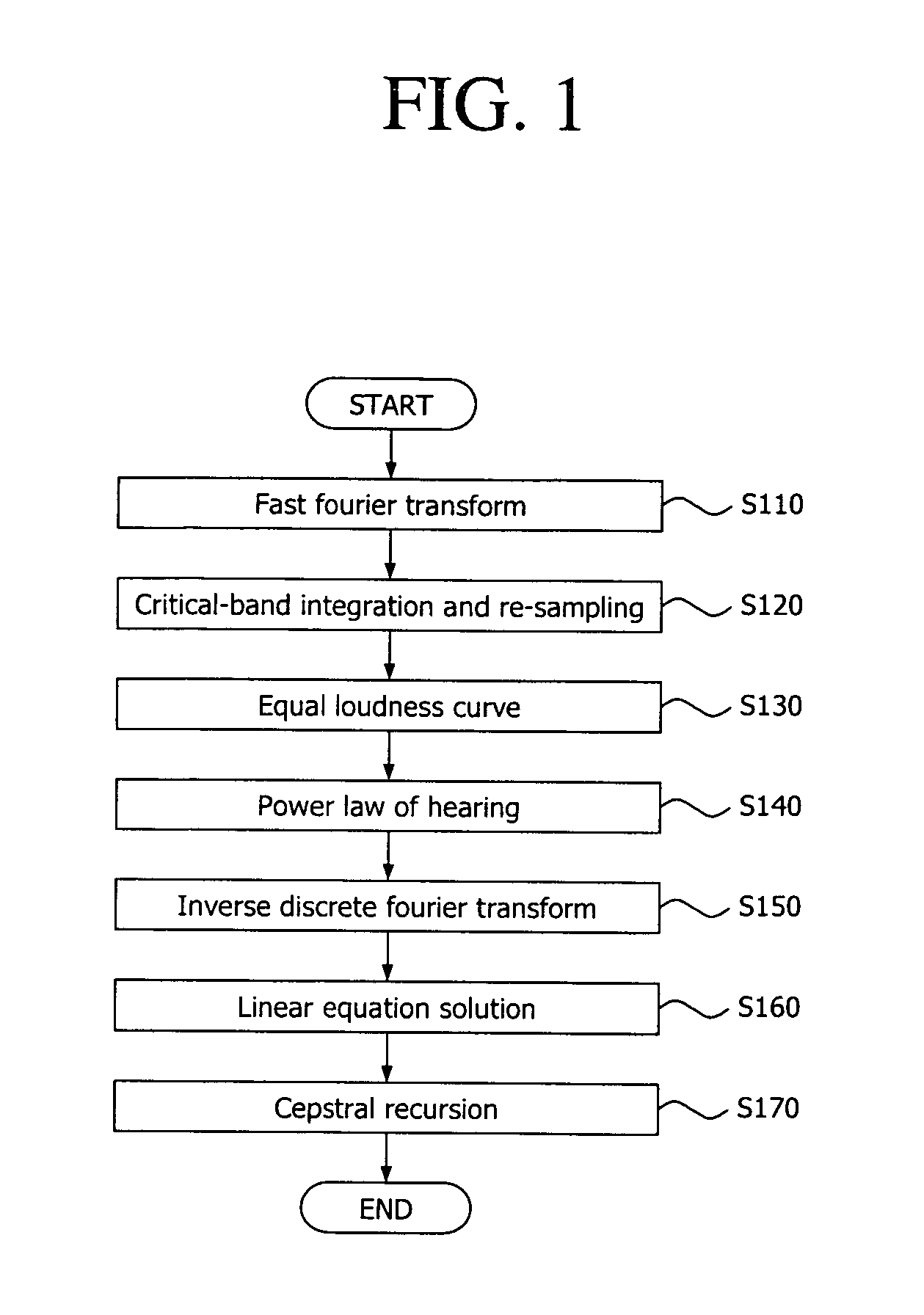
Figure 2 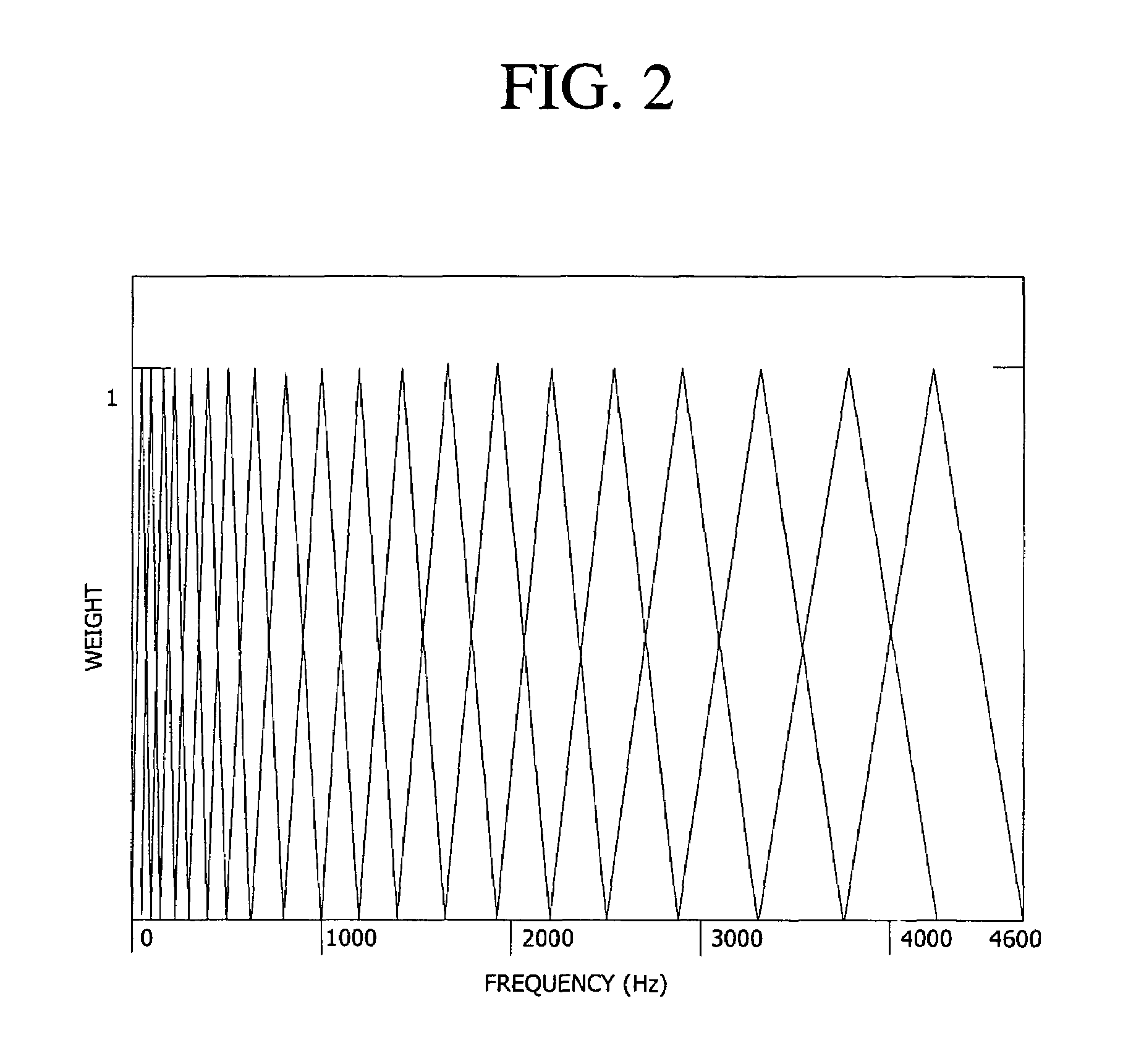
Figure 3
Abstract
Description
[0001] This application claims priority to Korean Application No. 10-2004-010577 filed in Korea on Dec. 14, 2004, the entire contents of which is incorporated by reference in its entirety.BACKGROUND OF THE INVENTION
[0002] 1. Field of the Invention
[0003] The present invention relates to a speech coding method and apparatus that uses a perceptual linear prediction (PLP) and an analysis-by-synthesis method to code / decode speech data.
[0004] 2. Description of the Related Art
[0005] Speech processing systems include communication systems in which speech data is processed and transmitted between different users, etc. Speech processing systems also include equipment such as a digital audio tape recorder in which speech data is processed and stored in the recorder. The speech data is compressed (coded) and decompressed (decoded) using a variety of methods.
[0006] Various speech coders have been designed for voice communication in the related art. In particular, a linear prediction analysis-by-synthe...
Examples
Embodiment Construction
[0021]Reference will now be made in detail to the preferred embodiments of the present invention, examples of which are illustrated in the accompanying drawings.
[0022]In the present invention, the auditory effect is considered by using a perceptual linear prediction (PLP) method, which improves the recovered tone quality and the transmission rate of the coding apparatus. In more detail, FIG. 1 illustrates the PLP method in accordance with one embodiment of the present invention.
[0023]As shown in FIG. 1, a fast Fourier transform (FFT) process is performed on an input speech signal to thereby disperse the input signal (step S110). The FFT process is an algorithm used to increase the calculating speed efficiency by using the periodicity of the trigonometric function in calculating a dispersion fourier transform, which performs a calculation by simply dispersing the fourier transform. In other words, the fast fourier transform uses the term θ(−φ2πrole / N)(k=0˜N−1), which is produced when...