
Passive time-reversal underwater acoustic communication method based on indirect channel function tracking
A channel function, underwater acoustic communication technology, applied to the shaping network in the transmitter/receiver, baseband system components, etc. Small amount of calculation, the effect of reducing the order
Patent Information
- Authority / Receiving Office
- CN · China
- Patent Type
- Applications(China)
- Current Assignee / Owner
- Publication Date
- 2014-04-02
Smart Images
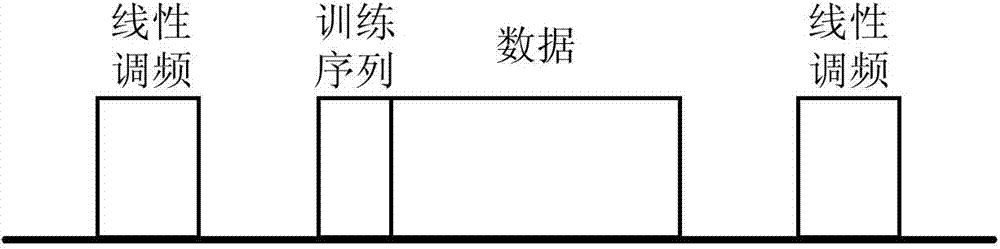
Figure 1 
Figure 2 
Figure 3
Abstract
Description
technical field
[0001] The invention relates to the field of underwater acoustic communication, and mainly relates to a passive time-reverse underwater acoustic communication method based on indirect channel function tracking. Background technique
[0002] Due to the rich dynamic process in the water body, the effect of the acoustic boundary, the refraction caused by the gradient of the sound velocity profile in the water body, and the scattering of particles, the underwater acoustic channel often manifests as serious multipath delay spread, Doppler frequency shift spread and so on. The fast time-varying characteristics cause severe intersymbol interference. Traditional communication technology uses equalization technology to combat inter-symbol interference caused by multipath. For underwater acoustic channels with severe delay expansion, the order of traditional equalizers is on the order of hundreds, and the amount of calculation is huge. Time counter technology is an ef...
Examples
Embodiment Construction
[0014] The present invention will be described in detail below in conjunction with the accompanying drawings.
[0015] The transmit signal structure is as figure 1 As shown, it consists of pre-chirp signal, training sequence, data and post-chirp signal. Among them, the selection of the chirp signal satisfies BT>100, (B is its bandwidth, T is its pulse time width).
[0016] Denote the transmitted signal as s(t), then the signal received by the i-th array element can be expressed as
[0017] r i ( t ) = s ( t ) ⊗ h i ( t ) - - - ( 1 )
[0018] Among them, h i (t) is the channel impulse response from the transmitting source to the i-th array element; Re...