
Greedy algorithm-based self-adapting compression perception signal restoring method
A compressed sensing and signal recovery technology, applied in the field of signal processing, which can solve problems that are difficult to directly apply to unknown sparsity, unknown signal sparsity, and inappropriate computational convex relaxation methods.
Patent Information
- Authority / Receiving Office
- CN · China
- Current Assignee / Owner
- Publication Date
- 2015-04-01
- Estimated Expiration
- Not applicable · inactive patent
Smart Images
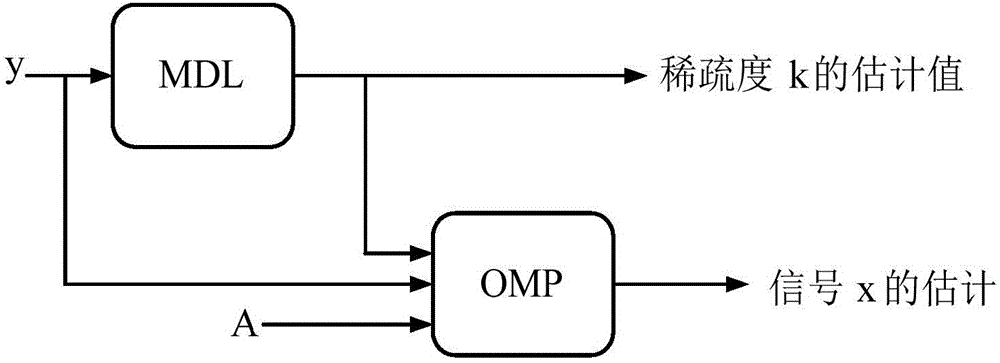
Figure 1 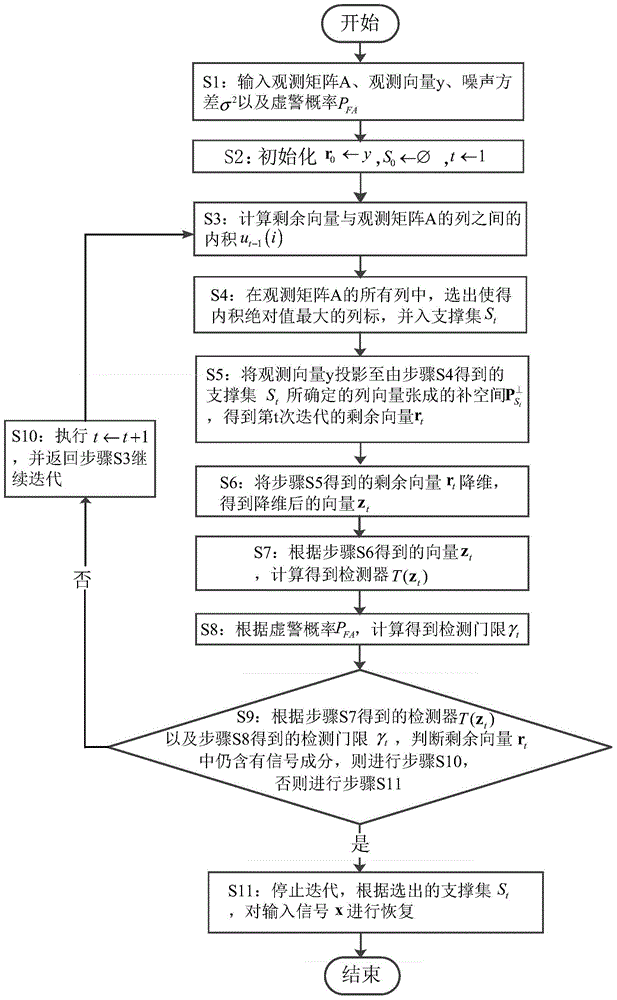
Figure 2 
Figure 3
Abstract
Description
technical field
[0001] The invention belongs to the field of signal processing, and in particular relates to an adaptive compressed sensing method. Background technique
[0002] Compressed sensing, a signal processing method for dealing with sparse vectors, is one of the most important theories proposed in this century. Compressive sensing technology can restore sparse signals from fewer sample points than the Nyquist sampling rate, that is, y=Ax+e, where, is the observation vector, through the observation matrix For a k-sparse signal Observation, where the dimension of the observation vector y is much smaller than the dimension of the signal x, m<n, compressed sensing technology can recover the signal x from the observation vector y. According to the compressed sensing technology, the signal can be directly compressed when it is acquired, which saves the complexity of sampling and saves storage space. The so-called sparse signal means that most of the positions of...
Examples
Embodiment Construction
[0065] The idea of the present invention is: the adaptive compressed sensing signal recovery method based on the greedy algorithm is based on the OMP algorithm, and a judgment residual vector r is designed t Is there still a detector T(z with signal component in t ); Through the hypothesis testing model in signal detection theory, the detector T(z t ); and through the false alarm probability P FA Get the detector T(z t ) threshold γ t ; when the detector T(z t ) is less than a given threshold γ t , namely T(z t )≤γ t , then it can be judged that there is no signal component in the remaining vector, then the algorithm stops iterating and obtains the recovery value of the signal; the following is the adaptive compressed sensing signal recovery method based on the greedy algorithm proposed by the present invention, which is called Detection-based Orthogonal Matching Pursuit, DOMP, the process of the algorithm scheme is as follows figure 2 As shown, the specific steps a...