
Design method for arc height of end-non-isomorphic few-leaf root-strengthening-type steel plate spring
A leaf spring and reinforced technology, applied in springs, leaf springs, springs/shock absorbers, etc., can solve problems such as difficult analysis and calculation, complex structure types of leaf springs, etc.
Patent Information
- Authority / Receiving Office
- CN · China
- Patent Type
- Applications(China)
- Current Assignee / Owner
- Publication Date
- 2017-01-04
- Estimated Expiration
- Not applicable · inactive patent
Smart Images
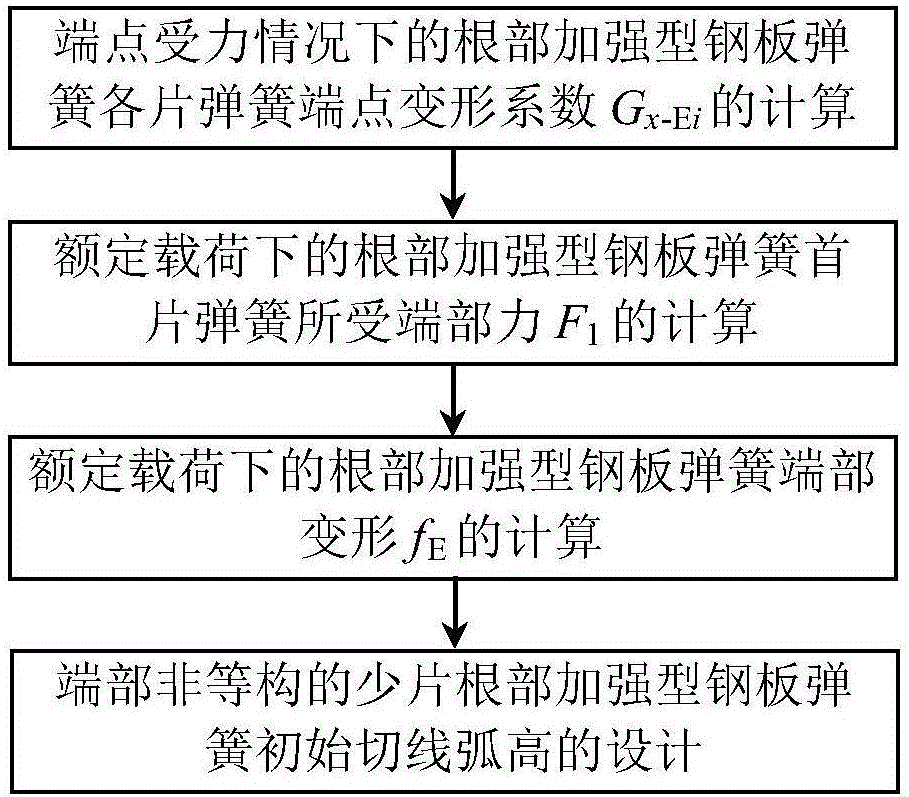
Figure 1 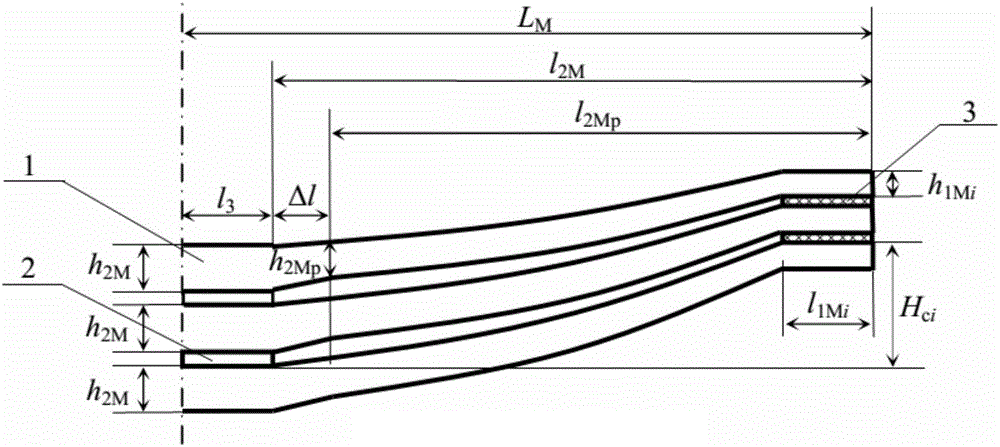
Figure 2 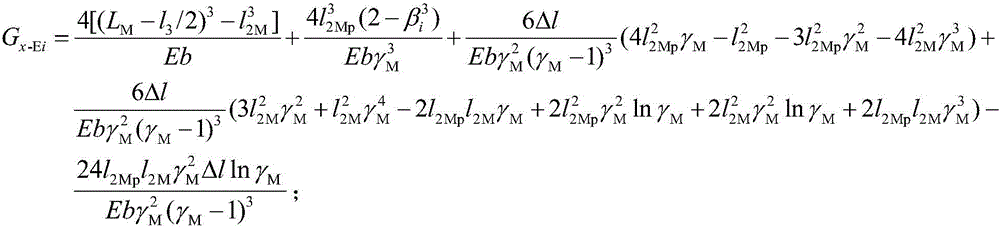
Figure 3
Abstract
Description
technical field
[0001] The invention relates to a vehicle suspension leaf spring, in particular to a method for designing the arc height of a leaf spring of a few-piece root-reinforced type with non-isomorphic ends. Background technique
[0002] With the rapid development of energy saving, comfort, light weight and safety of automobiles, leaf springs with variable cross-sections have light weight, high material utilization, no friction or small friction between sheets, low vibration and noise, and long service life. Advantages, it is increasingly concerned by vehicle suspension experts, manufacturers and vehicle manufacturers, and has been widely used in vehicle suspension systems. Usually, in order to meet the design requirements of processing technology, stress intensity, stiffness and lug thickness, a small number of variable cross-section leaf springs are processed into parabolic, oblique, root reinforced, end reinforced, and both ends reinforced types. In addition, due...
Examples
Embodiment 1
[0028] Embodiment 1: The sheet number N=2 of a certain few-sheet root-reinforced variable-section leaf spring, wherein, half the length L of each leaf spring M =575mm, width b=60mm, thickness h of the straight section at the root 2M =11mm, the end thickness h of the oblique line segment 2Mp =10.20mm, half of the installation distance l 3 = 55mm, the length of the oblique line segment Δl = 30mm, the distance from the root of the oblique line segment to the end point of the spring l 2M =L M -l 3 =520mm, the distance from the root of the parabola to the end point of the spring l 2Mp =L M -l 3 -Δl=490mm, modulus of elasticity E=200GPa, thickness ratio of the oblique segment of each leaf spring γ M = h 2Mp / h 2M =0.93; Thickness h of the straight end section of the first piece of spring 1M1 =7mm, the thickness ratio of the parabola segment β 1 = h 1M1 / h 2Mp =0.69; the thickness h of the straight section at the end of the second leaf spring 1M2 =6mm, the thickness rat...
Embodiment 2
[0048] Embodiment 2: The sheet number N=2 of a certain few-sheet root-reinforced variable-section leaf spring, wherein, half the length L of each leaf spring M =600mm, width b=60mm, thickness h of the straight section at the root 2M = 12mm, the end thickness h of the oblique line segment 2Mp =11mm, half of the installation distance l 3 = 60mm, the length of the slanted line Δl = 30mm, the distance from the root of the slanted line to the end of the spring l 2M =L M -l 3 =540mm, the distance from the root of the parabola to the end point of the spring l 2Mp =L M -l 3 -Δl=510mm, modulus of elasticity E=200GPa, thickness ratio of the oblique segment of each leaf spring γ M = h 2Mp / h 2M =0.92; Thickness h of the straight end section of the first leaf spring 1M1 = 7mm, the thickness ratio of the parabola segment β 1 = h 1M1 / h 2Mp =0.64; the thickness h of the straight section at the end of the second leaf spring 1M2 =6mm, the thickness ratio of the parabola segment ...