
A Quick Calculation Method for Non-uniform Oil-Water Contact Reservoir Reserves
A technology for calculation of oil-water interface and reserves, applied in design optimization/simulation, special data processing applications, etc., can solve problems such as adaptability and deviation between the results of rapid calculation of reserves and the actual situation, so as to achieve good operability and reduce uncertainty Sexuality and risk factor, the effect of improving applicability
Patent Information
- Authority / Receiving Office
- CN · China
- Patent Type
- Patents(China)
- Current Assignee / Owner
- Publication Date
- 2020-03-17
Smart Images
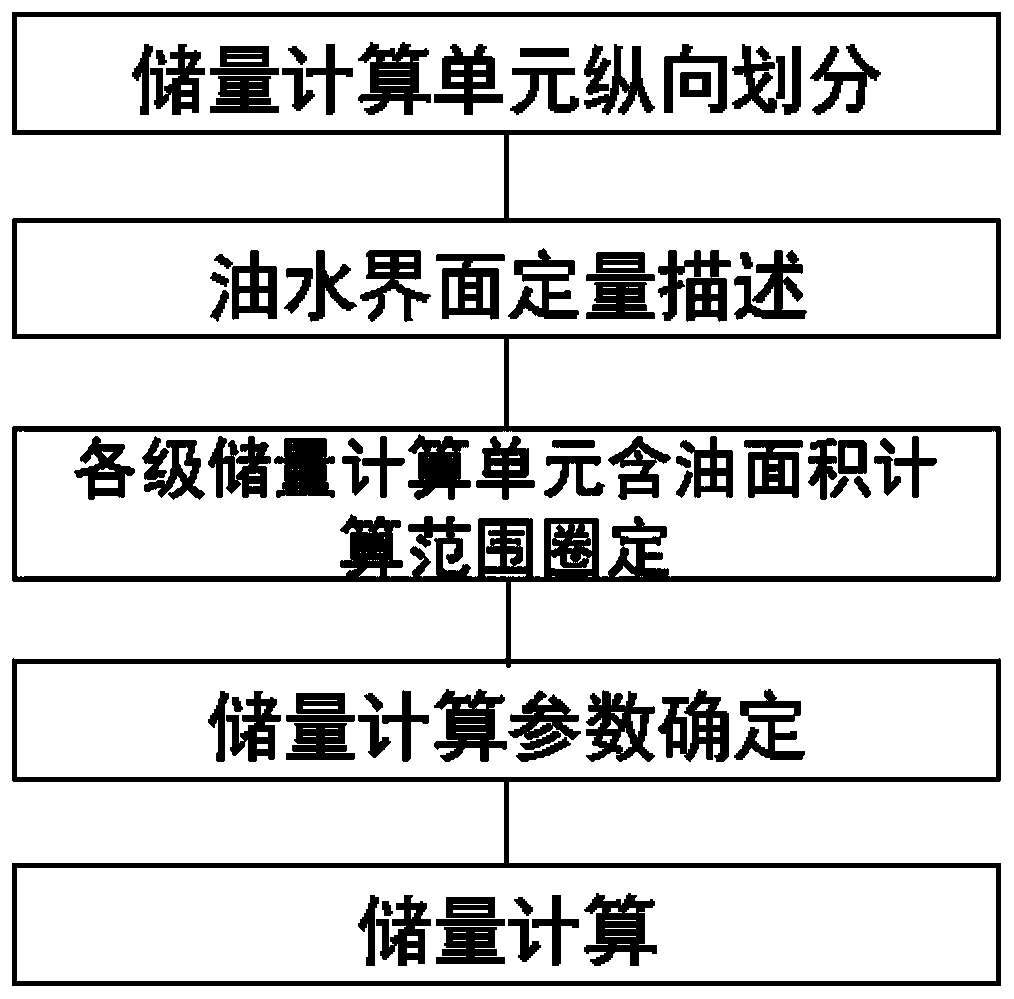
Figure 1 
Figure 2 
Figure 3
Abstract
Description
technical field
[0001] The invention relates to the field of reserve evaluation and calculation of oil reservoirs, in particular to a quick calculation method for reserves of non-uniform oil-water interface reservoirs. Background technique
[0002] Oilfield oil and gas geological reserves calculation and research run through the entire life cycle of oilfield exploration and development. However, in the initial stage of oilfield exploration and development or during the acquisition and evaluation of oil and gas resource projects, limited by the degree of data collection and research time, it is impossible to obtain rich seismic, Well logging and other single well data make it impossible to carry out 3D geological modeling of reservoirs and detailed evaluation of reserves. Therefore, the rapid evaluation of reserves is an important research content in the initial stage of oilfield exploration and development and in the evaluation process of oil and gas resource project acquisi...
Examples
Embodiment
[0059] Such as figure 1 As shown in , a fast calculation method for non-uniform oil-water contact reservoir reserves, including:
[0060] On the basis of the comparative study on the sub-layer division of the reservoir, analyze the relationship between the sub-layer reservoirs and interlayers to divide the reserve calculation unit; The interface description method is used to quantitatively describe the oil-water distribution range; according to the quantitative description results of oil-water distribution, combined with the delineation principle of the oil-bearing area range of reserves at all levels, the calculation range of reserves at all levels is determined; the effective thickness, porosity, and original oil-bearing area of each reserve calculation unit are counted and calculated. Reserve calculation parameters such as saturation, original crude oil volume factor, and gas-oil ratio; finally, the volumetric method is used to calculate the reserves of each reserve calcu...