
Interconnection-line-free island micro-grid frequency static-error-free control method based on harmonic injection
A harmonic injection and control method technology, applied in the field of microgrid, can solve the problems of increasing cost, affecting flexibility, affecting system flexibility, etc., achieving cost saving, reducing complexity, and broad application prospects
Patent Information
- Authority / Receiving Office
- CN · China
- Patent Type
- Applications(China)
- Current Assignee / Owner
- Publication Date
- 2017-05-31
Smart Images
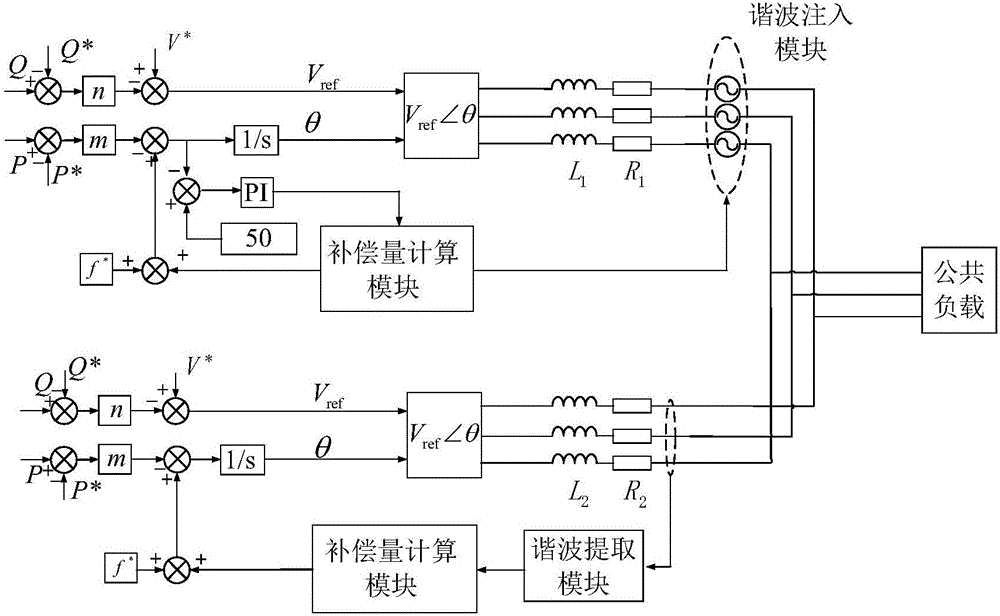
Figure 1 
Figure 2 
Figure 3
Abstract
Description
technical field
[0001] The invention relates to the field of micro-grids, in particular to a method for controlling the frequency of isolated island micro-grids without interconnection lines. Background technique
[0002] With the increasingly serious energy and environmental problems in recent years, the microgrid technology has been developed on a large scale. Since the inverters in the microgrid mostly use droop control, when they operate in the island mode, the inherent characteristics of droop control will lead to When the load is not at the rated value, the system voltage amplitude and frequency deviate from the given static difference, which is a major difficulty in microgrid control. Most of the existing frequency control methods are for the operation of a single inverter, and a few control methods that consider the parallel connection of multiple inverters also need to introduce additional interconnection lines, which increases the cost and affects the system flexib...
Examples
Embodiment Construction
[0037] The present invention will be further described below in conjunction with accompanying drawing:
[0038] Such as figure 1 Shown, method step of the present invention is as follows:
[0039] Step 1, build a parallel system of two inverters controlled by the P-f / Q-v droop control algorithm;
[0040] Step 2, according to the droop relationship of the traditional P-f / Q-v droop control algorithm, namely f=f * -m(P-P * ), V=V * -n(Q-Q * ) to control the output voltage amplitude and frequency of the inverter, where f is the output voltage frequency, f * is the rated frequency of droop control, m is the active power droop coefficient, P is the output active power of the inverter, P * is the rated active power of droop control; V is the output voltage amplitude, V * is the rated voltage amplitude of the droop control, n is the reactive power droop coefficient, Q is the output reactive power of the inverter, Q * Rated reactive power for droop control;
[0041] Step 3: Ma...