
A Coal and Gas Outburst Prediction Method Based on Sparse Inverse Covariance
A gas outburst and prediction method technology, applied in the field of coal mine safety production, can solve problems such as low prediction accuracy, low calculation efficiency, and difficulty in characterization of coal and gas data
Patent Information
- Authority / Receiving Office
- CN · China
- Patent Type
- Patents(China)
- Current Assignee / Owner
- Publication Date
- 2021-03-30
Smart Images
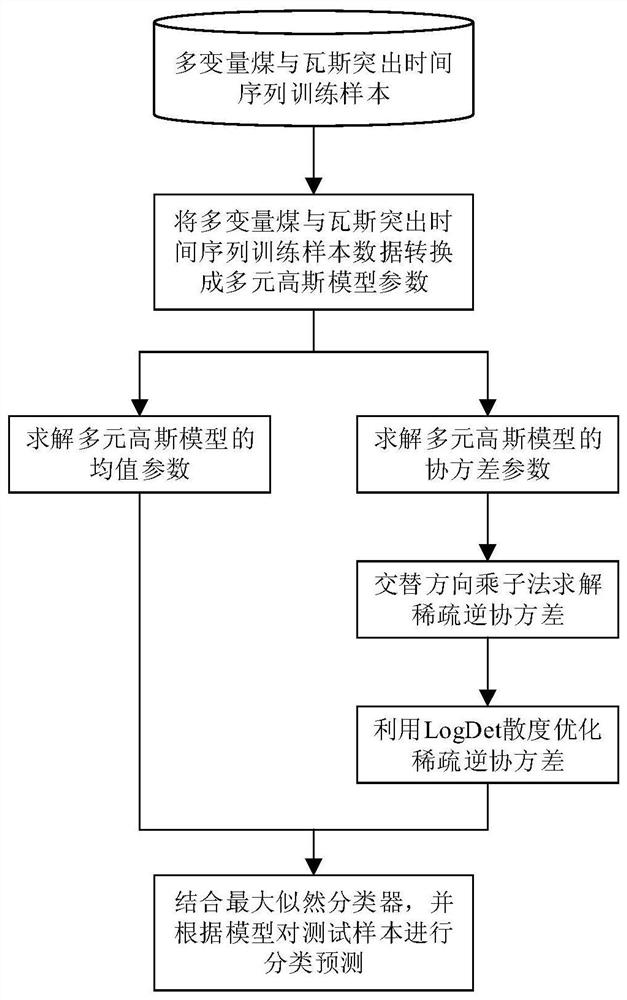
Figure 1 
Figure 2 
Figure 3
Abstract
Description
technical field
[0001] The invention relates to the field of coal mine safety production, in particular to a coal and gas outburst prediction method based on sparse inverse covariance. Background technique
[0002] Coal is the main energy source and important raw material in the development of my country's national economy. However, the safety situation of my country's coal production is still very severe. Mine gas, coal dust, fire, flood and roof accidents are the five natural disasters in coal mines, among which gas is the number one "killer" of coal mines, and coal and gas outburst are the most frequently occurring gas disaster accidents and the number of people injured is large One of the typical dynamic disasters. Therefore, it is of great practical significance to quickly and accurately predict coal and gas outburst, which can not only improve the safety of coal mine production, but also generate huge economic and social benefits.
[0003] At present, various sensors...
Examples
Embodiment Construction
[0044] refer to figure 1 , in this embodiment, a coal and gas outburst prediction method based on sparse inverse covariance is carried out as follows:
[0045] Step 1: Obtain a set of coal and gas outburst data as training samples. The data in the coal mine monitoring system are all collected by sensors. Correspondingly, the coal and gas outburst data are also collected by many sensors in different time periods. Therefore, coal and gas outburst data have multivariate and time attributes, which is called multivariate time series data in technical terms. A group of training samples obtained in the present embodiment is formed by coal and gas outburst feature data T={T 1 , T 2 ,...,T i ,...,T N} and classification label data Y={y 1 ,y 2 ,...,y i ,···,y N} composition, where, T i represents the i-th coal and gas outburst feature data, and T i =[T i 1 , T i 2 ,...,T i p ...,T i D ],T i p Represents the i-th coal and gas outburst characteristic data T i In the ...