
A Multilateral Adaptive Sliding Mode Control Method for Nonlinear Teleoperation System
An adaptive sliding mode and operating system technology, applied in the direction of adaptive control, general control system, control/adjustment system, etc., can solve problems such as uncertainty and nonlinearity, and achieve stability, avoid transmission, and improve position The effect of tracking performance
Patent Information
- Authority / Receiving Office
- CN · China
- Patent Type
- Patents(China)
- Current Assignee / Owner
- Publication Date
- 2020-09-11
Smart Images
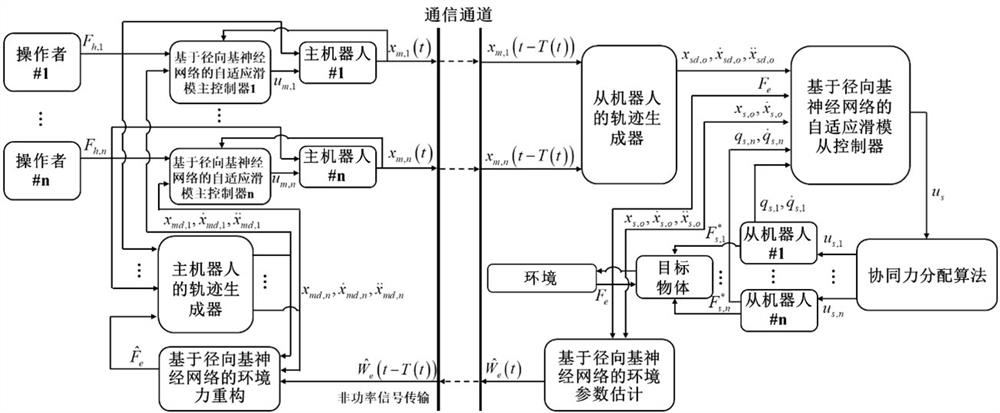
Figure 1 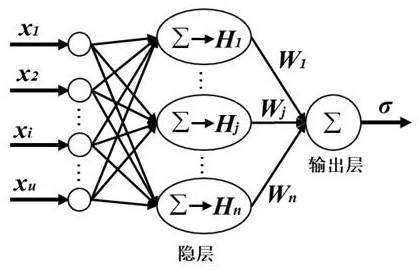
Figure 2 
Figure 3
Abstract
Description
technical field
[0001] The invention belongs to the field of teleoperation control, and specifically relates to a multilateral adaptive sliding mode control method for a nonlinear teleoperation system, which can simultaneously ensure the stability and transparency of the nonlinear teleoperation system and the coordinated operation of multiple master-slave robots . Background technique
[0002] With the development of complex and fine-grained tasks, teleoperation technology relying on human-computer interaction has been continuously used in industrial environments, especially the development of multilateral teleoperation technology relying on multi-master-slave The operator operates multiple master robots at the master end to realize the cooperative control of multiple slave robots and complete complex or fine tasks. It is an important supporting technology in the application field and has been widely studied.
[0003] However, the transmission of signals in the communicati...
Examples
Embodiment Construction
[0019] In order to make the object, technical solution and advantages of the present invention clearer, the present invention will be further described in detail below in conjunction with the accompanying drawings and embodiments. It should be understood that the specific embodiments described here are only used to explain the present invention, not to limit the present invention. In addition, the technical features involved in the various embodiments of the present invention described below can be combined with each other as long as they do not constitute a conflict with each other.
[0020] Now in conjunction with embodiment, accompanying drawing, the present invention will be further described:
[0021] Implementation technical scheme of the present invention is:
[0022] 1) Establish the dynamic model of the nonlinear multilateral teleoperation system, specifically:
[0023] 1-1) Establish a dynamic model of multi-master robot, multi-slave robot and environment interacti...