
Risk identification method based on complex network analysis
A technology for complex network and risk identification, applied in instruments, data processing applications, forecasting, etc., can solve the problems of lack of time dynamic characteristics, correlation and comparative analysis, etc.
Patent Information
- Authority / Receiving Office
- CN · China
- Patent Type
- Applications(China)
- Current Assignee / Owner
- Publication Date
- 2020-02-28
Smart Images
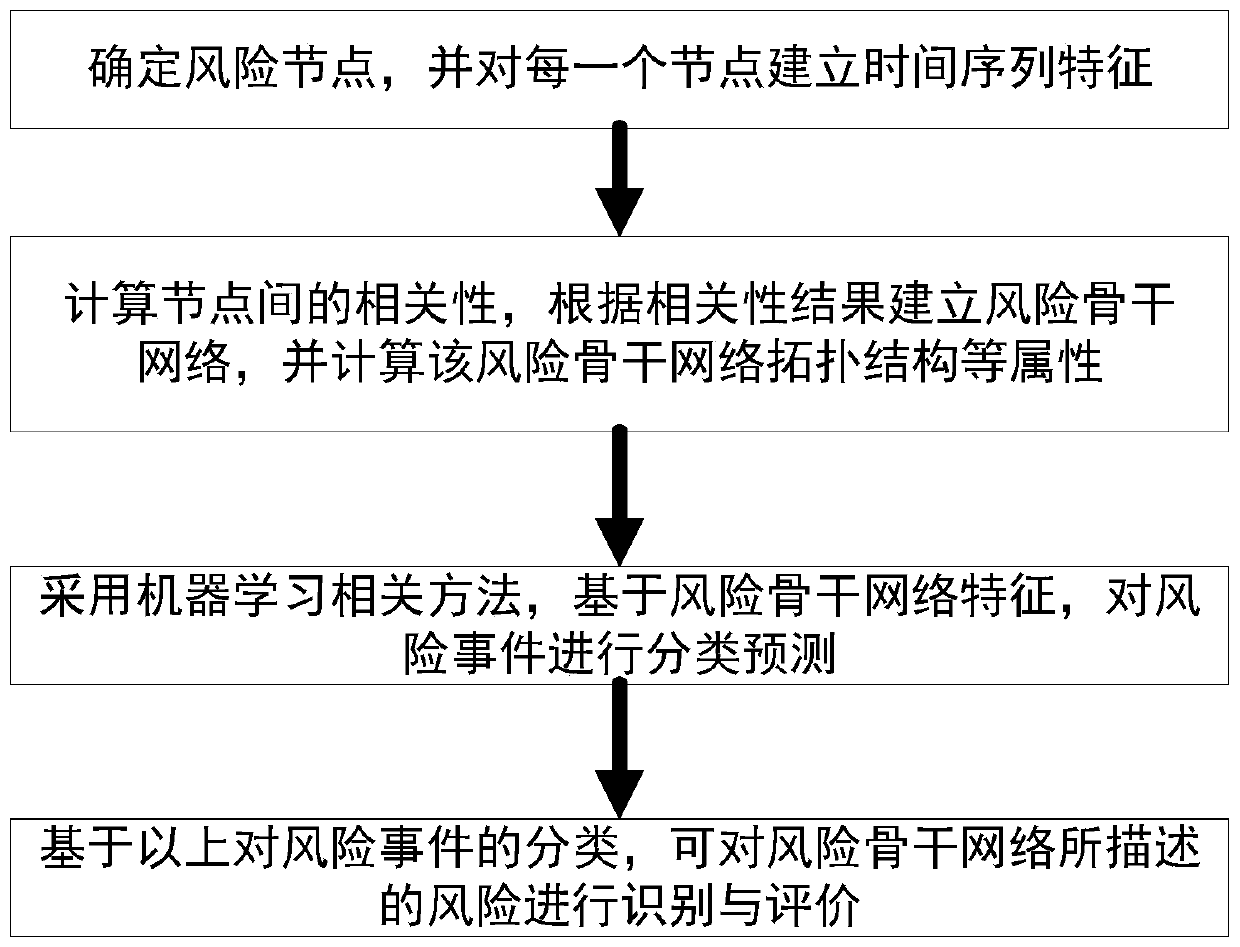
Figure 1
Abstract
Description
Technical field
[0001] The present invention proposes a risk identification method based on complex network analysis, which involves risk identification, network science and other technical fields. Background technique
[0002] Risk refers to the possibility or uncertainty of a certain loss or undesired result in a certain time period or point in a certain environment. Risk is an objective existence, and the loss caused by the occurrence of risk can be prevented or reduced by adopting preventive measures, but the risk cannot be eliminated.
[0003] Risks are common in all areas of life. For example, fishermen in the maritime industry may encounter the risk of empty hunting and ship overturning due to bad weather and other reasons when they go fishing. In the financial industry, there is also the risk that investors cannot recover their principal when buying stocks and other products. ; Even ordinary people may encounter risks brought by disasters in their lives, such as earthquak...
Examples
Embodiment Construction
[0052] In order to make the technical problems and technical solutions to be solved by the present invention clearer, a detailed description will be given below in conjunction with the drawings and specific implementation cases. It should be understood that the implementation examples described here are only used to illustrate and explain the present invention, not to limit the present invention.
[0053] The purpose of the present invention is to solve the problem of risk identification in the context of complex systems and network structures. Existing methods rarely consider the problem of risk identification from the perspective of removing the global system. The evaluation method has better local evaluation effects, but The assessment of global risk requires relatively high experience. When the global segmentation and decoupling method is better, the risk identification results obtained are relatively good. Once the decoupling efficiency is low, the traditional methods have sh...