
Connection device for connecting conductor end
A technology for connecting equipment and connecting conductors, applied in the direction of connection, conductive connection, electrical component connection, etc., can solve problems such as difficult manipulation
Patent Information
- Authority / Receiving Office
- CN · China
- Patent Type
- Applications(China)
- Current Assignee / Owner
- Publication Date
- 2020-07-28
Smart Images
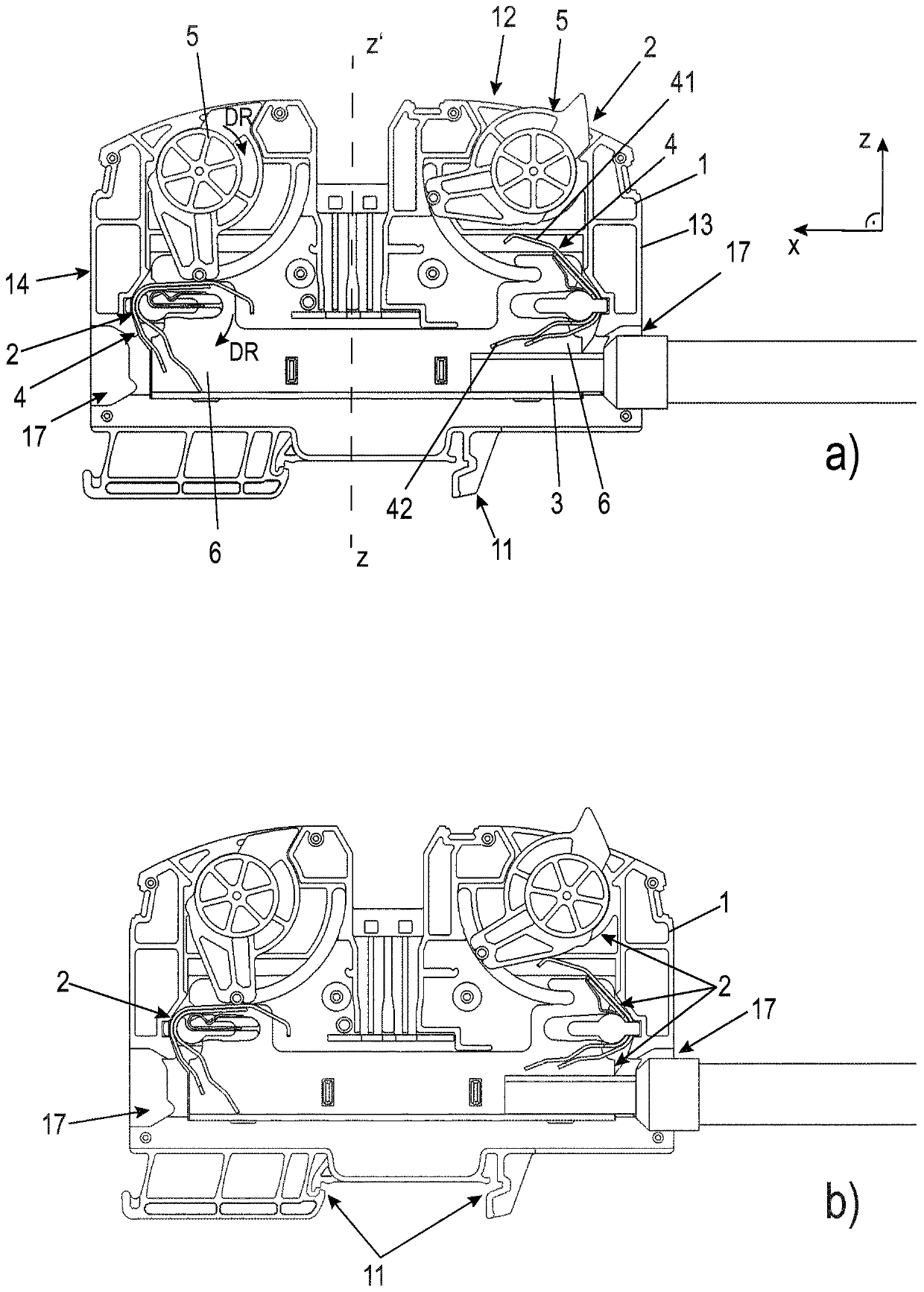
Figure 1 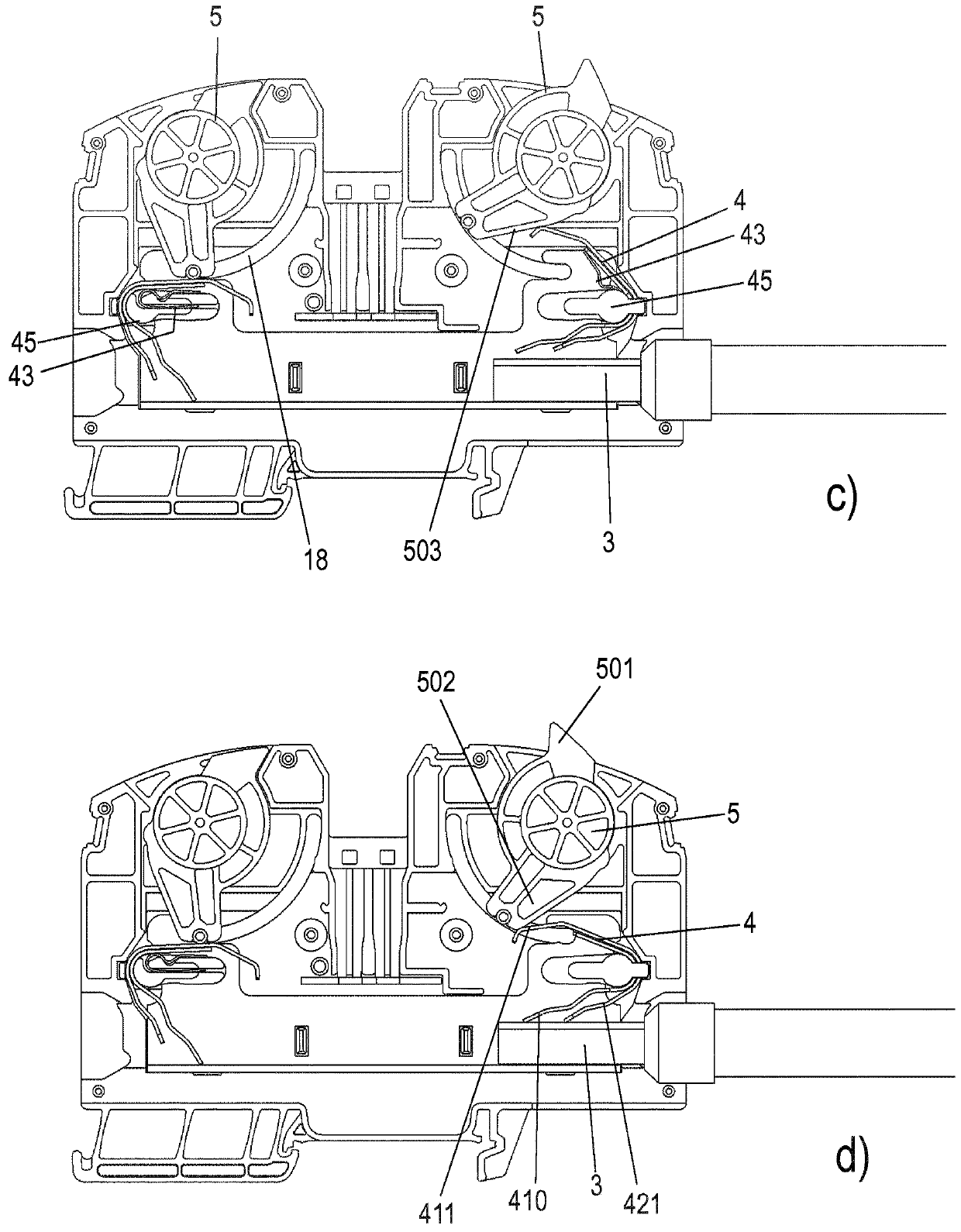
Figure 2 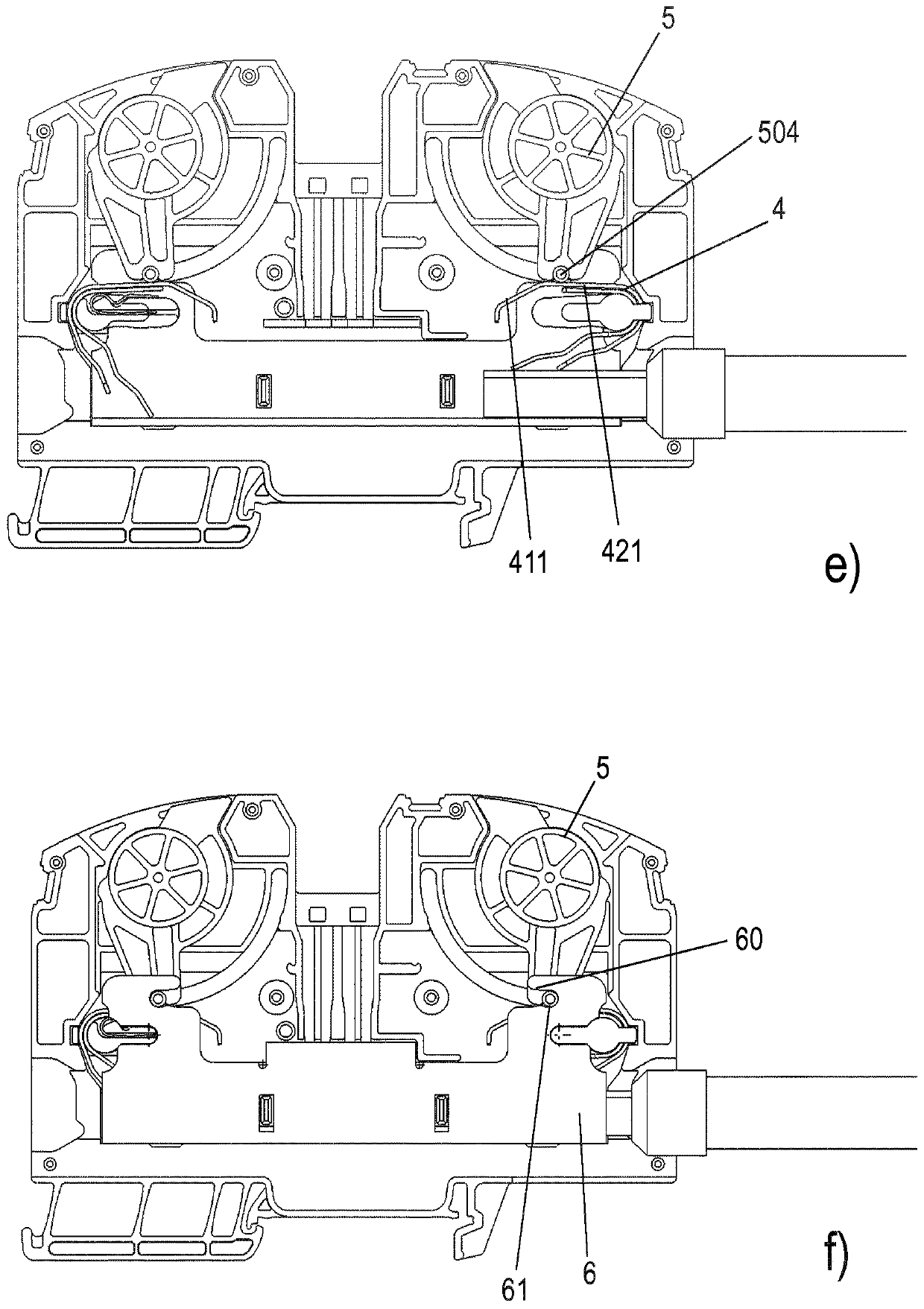
Figure 3
Abstract
Description
technical field
[0001] The invention relates to a connecting device for connecting conductor ends according to the preamble of claim 1 . Background technique
[0002] Such connecting devices are known from the prior art. However, the known connecting devices are difficult to handle with regard to their handling and their structural design precisely when contacting conductors with larger diameters and therefore require improvement. Contents of the invention
[0003] Against this background, the object of the present invention is to provide a connection device which is improved in terms of operation and structural construction.
[0004] The present invention achieves the object through the technical solution of claim 1 .
[0005] The invention provides a connecting device for connecting conductor ends, which has a housing and a busbar section, a clamping spring arrangement and a torsion bar arrangement in the housing, wherein the clamping The spring device can be pivoted ...
Examples
Embodiment Construction
[0031] For simplicity, in figure 1 The Cartesian coordinate system X / Z is marked in , where the direction perpendicular to the paper plane is marked as "Y direction". The conductor insertion direction is marked below as "X direction".
[0032] figure 1 The housing 1 is shown, which is designed here as a clamping housing. One or more (here two) connecting devices 2 for connecting corresponding conductor ends 3 are arranged in the housing. here, in figure 1 Only one of these conductor ends 3 is shown in . The conductor end 3 can be a (preferably de-insulated) single or multi-conductor or stranded conductor or can be, for example, a crimped wire end made of a material that conducts electricity well, such as copper.
[0033] The housing 1 is made of an electrically insulating material, in particular a non-conductive plastic. The housing 1 is designed here in the shape of a plate and is preferably arranged perpendicular to the conductor insertion direction in the Y direction....