
Data acquisition and man-machine collaborative labeling method based on edge calculation
A data collection and edge computing technology, applied in computing, other database retrieval, electronic digital data processing, etc., can solve the problems of low data collection and labeling efficiency, troublesome data processing, and more storage space, etc. Comprehensive, simplifies the effect of tedious work
Patent Information
- Authority / Receiving Office
- CN · China
- Patent Type
- Applications(China)
- Current Assignee / Owner
- Publication Date
- 2021-06-15
Smart Images
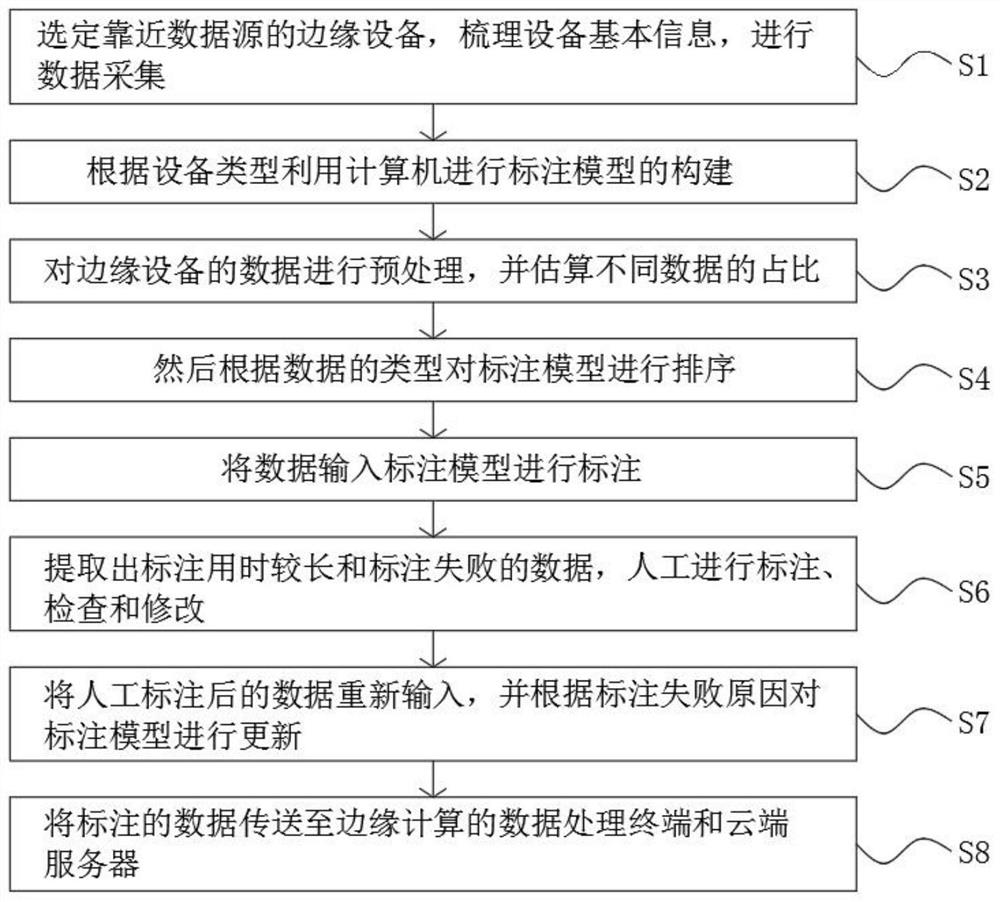
Figure 1
Abstract
Description
technical field
[0001] The invention relates to the technical field of edge computing, in particular to a method for data collection and man-machine collaborative labeling based on edge computing. Background technique
[0002] Edge computing refers to an open platform that integrates network, computing, storage, and application core capabilities on the side close to the source of objects or data to provide the nearest end services, and its applications are initiated on the edge side to generate faster network services. Response to meet the basic needs of the industry in terms of real-time business, application intelligence, security and privacy protection, etc. Edge computing is between physical entities and industrial connections, or at the top of physical entities, while cloud computing can still access the history of edge computing Data, labeling the data can make the data more convenient to analyze and use;
[0003] However, the current data collection and labeling of e...
Examples
Embodiment
[0042] Example: such as figure 1 As shown, the present invention provides a technical solution, a data collection and human-machine collaborative labeling method based on edge computing, including the following steps:
[0043] S1. Select an edge device close to the data source, sort out the basic information of the device, and collect data;
[0044] S2. Using a computer to construct a labeling model according to the type of equipment;
[0045] S3. Preprocess the data of the edge device and estimate the proportion of different data;
[0046] S4, and then sort the labeling models according to the type of data;
[0047] S5. Input data into the labeling model for labeling;
[0048] S6. Extract the data that took a long time to label and failed to label, and manually label, check and modify;
[0049] S7. Re-input the manually labeled data, and update the labeling model according to the cause of labeling failure;
[0050] S8. Transmitting the marked data to the edge computing d...