
E-commerce platform potential customer recommendation method and system based on comprehensive similarity
A technology of comprehensive similarity and e-commerce platform, applied in the field of potential customer recommendation and system of e-commerce platform based on comprehensive similarity, can solve the problems of ignoring high-level structure, insufficient information utilization, and only using category attributes, etc. Achieve the effect of improving accuracy and avoiding parameter adjustment
Patent Information
- Authority / Receiving Office
- CN · China
- Patent Type
- Applications(China)
- Current Assignee / Owner
- Publication Date
- 2022-04-22
Smart Images
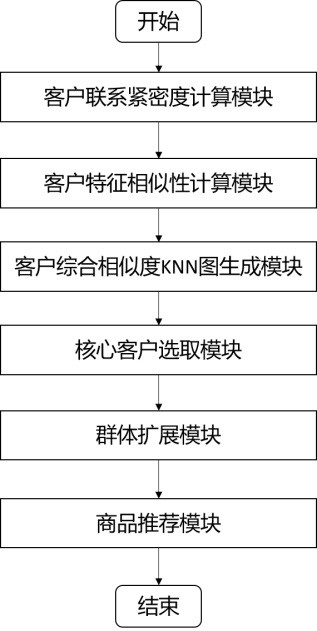
Figure 1 
Figure 2 
Figure 3
Abstract
Description
technical field
[0001] The invention relates to a method and system for recommending potential customers of an e-commerce platform based on comprehensive similarity. Background technique
[0002] Due to the interaction between social members in work, study, life, entertainment and other activities, a certain stable relationship is gradually formed, and then a social network is formed. With the rapid development of Internet technology, people introduced the concept of early social network into the Internet, and created an online social network oriented to social network services. Representative products of online social networks include domestic WeChat, Weibo, Taobao, and foreign Facebook and Twitter. The vigorous development of online social networks has greatly changed people's lifestyles. For example, online shopping has become a mainstream shopping method, and more than 80% of Internet customers often use online shopping. Internet users can use social networks to make f...
Examples
Embodiment Construction
[0022] The technical solution of the present invention will be specifically described below in conjunction with the accompanying drawings.
[0023] Such as figure 1 As shown, this example provides a method for recommending potential customers of an e-commerce platform based on comprehensive similarity, which is characterized in that it includes the following steps:
[0024] Step S1, first select a motif, find out all instances of the motif in the social network, and construct the customer's high-order adjacency matrix; then, perform random walks on the customer's low-order adjacency matrix and high-order adjacency matrix respectively , to obtain the customer sequence; finally, use the Skip-gram model to train the customer sequence to obtain the customer's representation vector, and calculate the relationship between customers according to the customer's representation vector;
[0025] Step S2, calculating the degree of similarity between the features carried by the customers;...