
Adjusting a digital representation of a head region
a digital representation and head region technology, applied in image analysis, image enhancement, kernel methods, etc., can solve the problems that the image or three-dimensional representation (image) of the head region would be relatively expensive in terms of computational resources, and achieve high accuracy, improved balance, and high detail
Patent Information
- Authority / Receiving Office
- US · United States
- Patent Type
- Patents(United States)
- Current Assignee / Owner
- Publication Date
- 2020-08-11
Smart Images
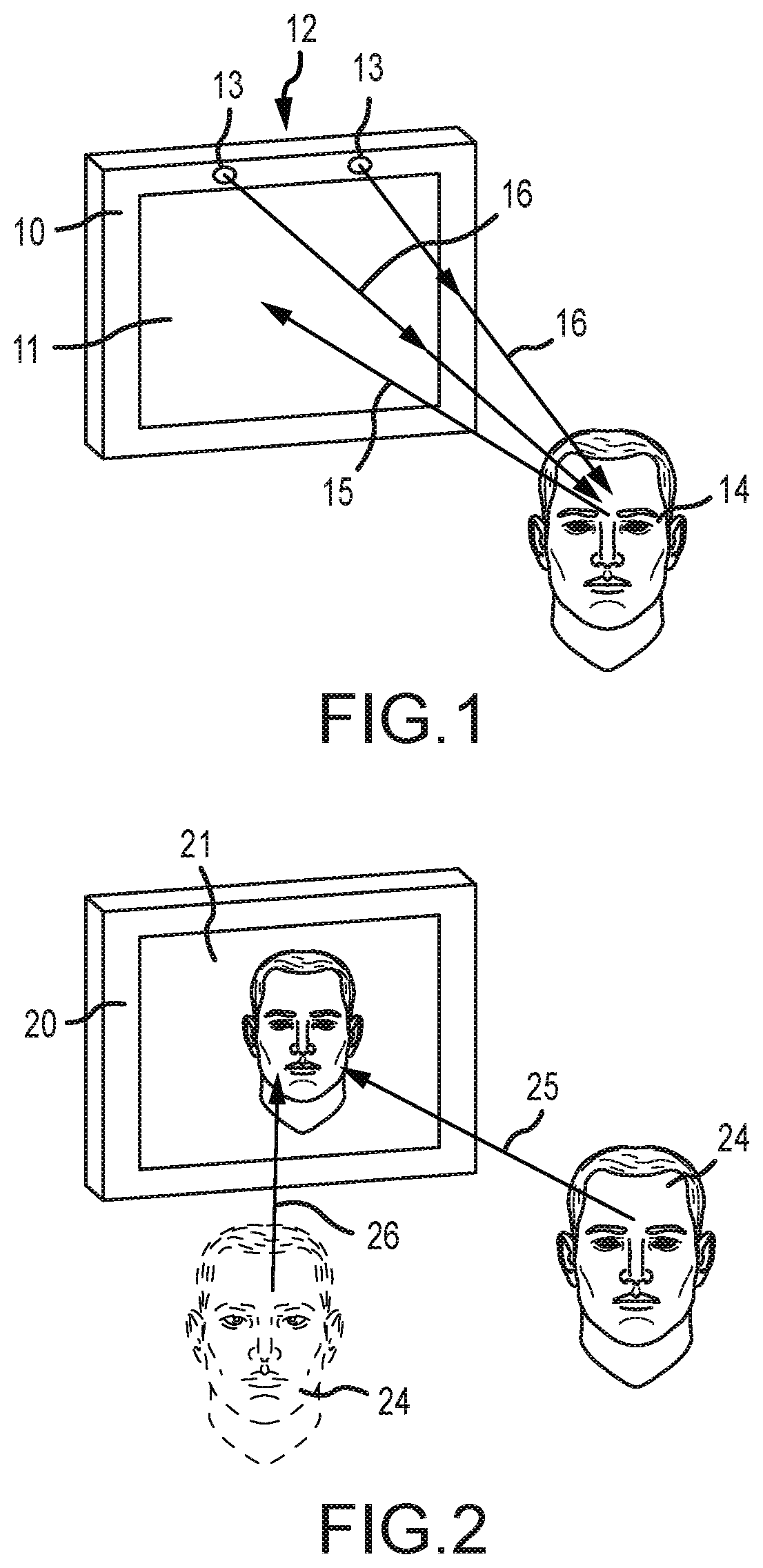
Figure 1 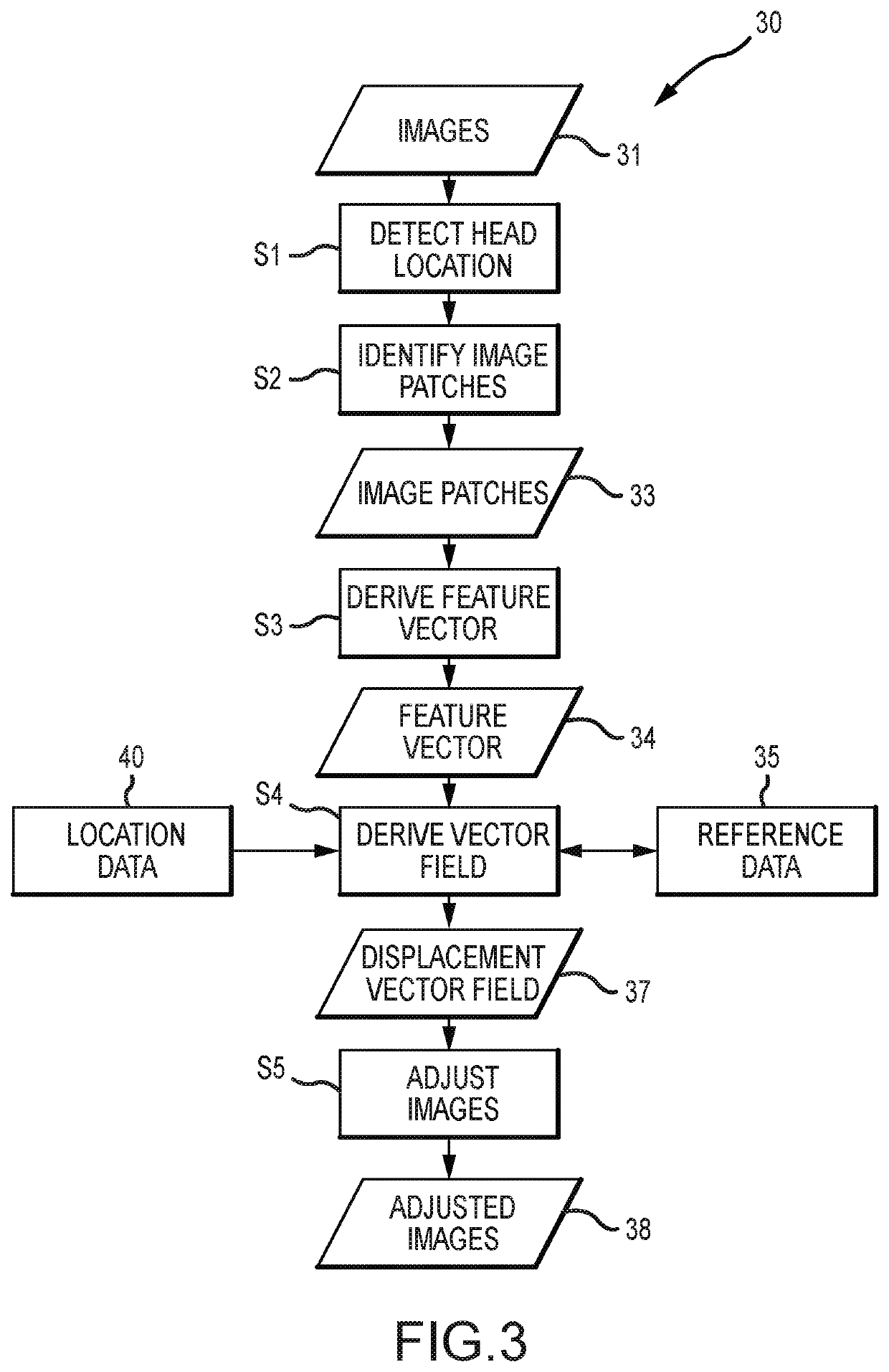
Figure 2 
Figure 3
Abstract
Description
TECHNICAL FIELD
[0001] This application relates to adjusting a digital representation, such as an image or a three-dimensional geometrical representation, of a head region, particularly a facial and / or neck region. The application relates particularly to adjusting target features of the digital representation of the head region, for example to correct a perceived gaze direction of eyes, or to modify the texture and / or shape of features such as the nose, mouth, chin or neck.BACKGROUND
[0002] In many systems, images of a head, which may comprise single images at different times, or stereoscopic pairs of images or other multi-view images, may be captured in one device and displayed on a different device for viewing by an observer. One non-limitative example is a system for performing teleconferencing between two telecommunications devices. In that case, each device may capture images of the observer of that device and transmit them to the other device over a telecommunications network for ...
Examples
Embodiment Construction
[0029]FIG. 1 and FIG. 2 illustrate how incorrect gaze is perceived when a stereoscopic pair of images of a head is captured by the device 10 shown in FIG. 1 which will be referred to as the source device 10, and displayed on a different device 20 shown in FIG. 2 which will be referred to as the destination device 20. Capturing of a stereoscopic pair of images is shown as an example. A similar effect can occur when a monocular image is captured and when more than two views of the head are captured. A similar effect can also occur when alternative or additional sensing techniques are used to build a digital representation of the head (e.g. where a depth sensor such as a time-of-flight camera is used to obtain three-dimensional geometrical information about positions on the surface of the head).
[0030]In the embodiment shown, the capture device 10 includes a display 11 and a camera system 12. In this particular example, the camera system comprises two cameras 13 in order to capture the ...