
Method for adaptively modifying the observed collective behavior of individual sensor nodes based on broadcasting of parameters
a sensor node and adaptive modification technology, applied in the field of computer and communication networks, can solve the problems of inability to accurately control the actual number or layout of the sensors deployed, network redundancy, lack of precise control, etc., and achieve the effect of rapid adaptation of individual sensor node behavior and faster convergence process
Patent Information
- Authority / Receiving Office
- US · United States
- Patent Type
- Applications(United States)
- Current Assignee / Owner
- Publication Date
- 2008-08-28
- Estimated Expiration
- Not applicable · inactive patent
Smart Images
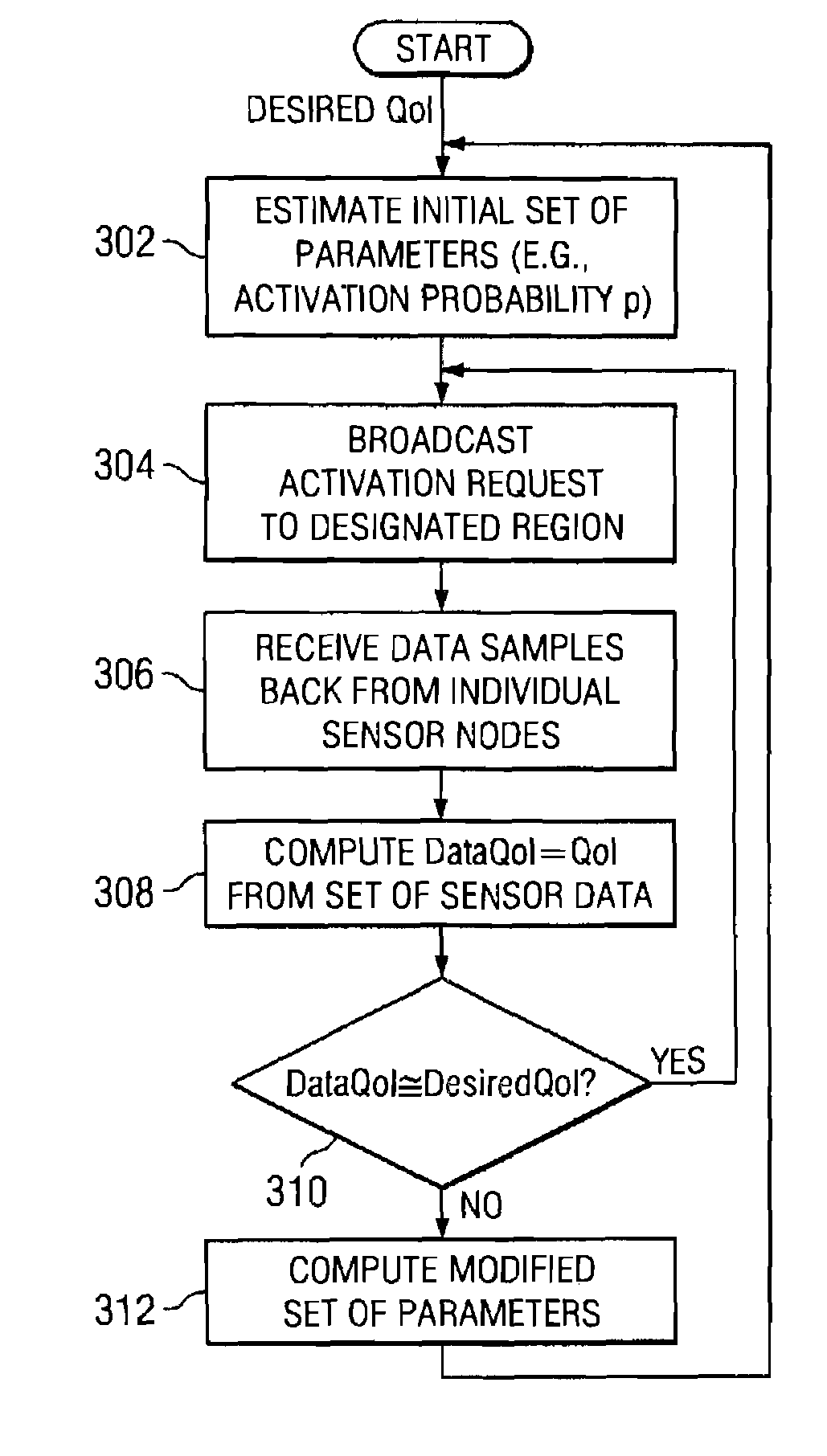
Figure 1 
Figure 2 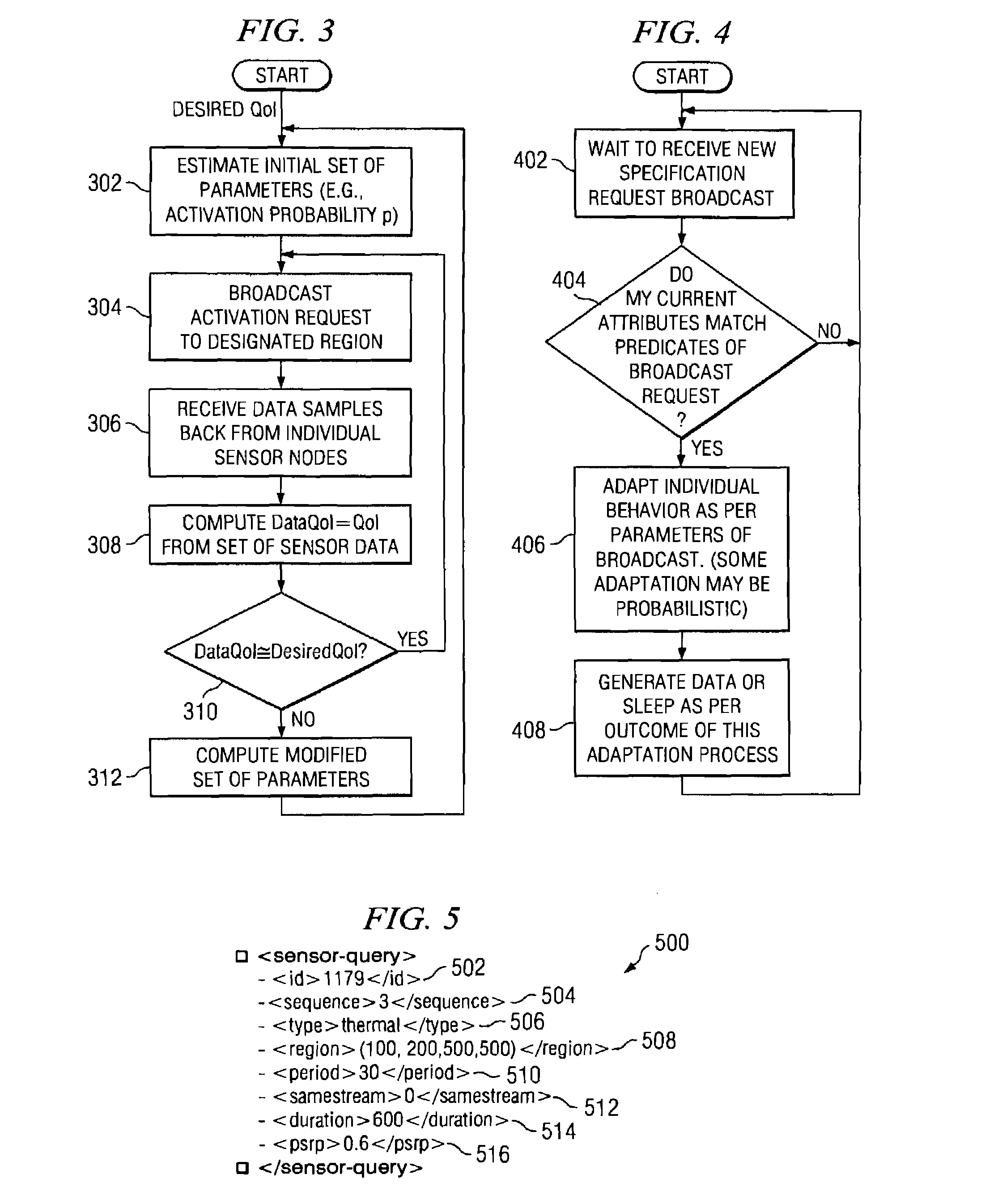
Figure 3
Abstract
Description
BACKGROUND OF THE INVENTION
[0001] 1. Field of the Invention
[0002] The present invention relates generally to computer and communications networks, and more specifically to the emerging field of “sensor networks”, typically consisting of a large number of individual “sensor” devices, which send back samples of some environmental state to certain designated nodes.
[0003] 2. Description of the Related Art
[0004] Sensor networks are an emerging and very promising new category of computer networks, characterized by the development of very-low cost sensor devices with combined sensing and communication (often wireless) capabilities. Most applications of sensor networks rely on combining information from multiple sensor devices to establish or infer some composite state or event of the sensed environment (often called the “sensing field”). Examples include the desire to “compute an average of readings taken by 10 different temperature sensors,” or to “compute the minimum out of 30 distinct humid...
Examples
Embodiment Construction
[0029]The present invention provides a “closed loop” control mechanism for continually maintaining the Quality of Information (QoI) requirements of an application, while avoiding the unnecessary activation of additional available nodes or the redundant setting of node parameters. The mechanism of the present invention provides a gateway node for propagating an initial set of parameters for an implicitly specified group of sensor nodes, without being directly aware of the presence or absence of individual nodes in that group. The parameters may define initial values of the content (initial values of “what”) that are propagated to remote sensor nodes in the field. The gateway node then iteratively continues to monitor the QoI that results from prior parameter settings, and alters the settings (future values of “what”) to try to attain the QoI objective. As a result of this continual monitoring and adjustment of propagated parameters, the mechanism of the present invention may ensure t...