
RFID Intelligent Traffic Signaling
a technology of intelligent traffic signaling and traffic signal control, applied in the field of electric communication, can solve problems such as increased traffic congestion and accidents, and achieve the effect of managing the efficiency of a traffic signal controlled intersection and ensuring the safety of vehicles
Patent Information
- Authority / Receiving Office
- US · United States
- Patent Type
- Applications(United States)
- Current Assignee / Owner
- Publication Date
- 2009-09-17
Smart Images
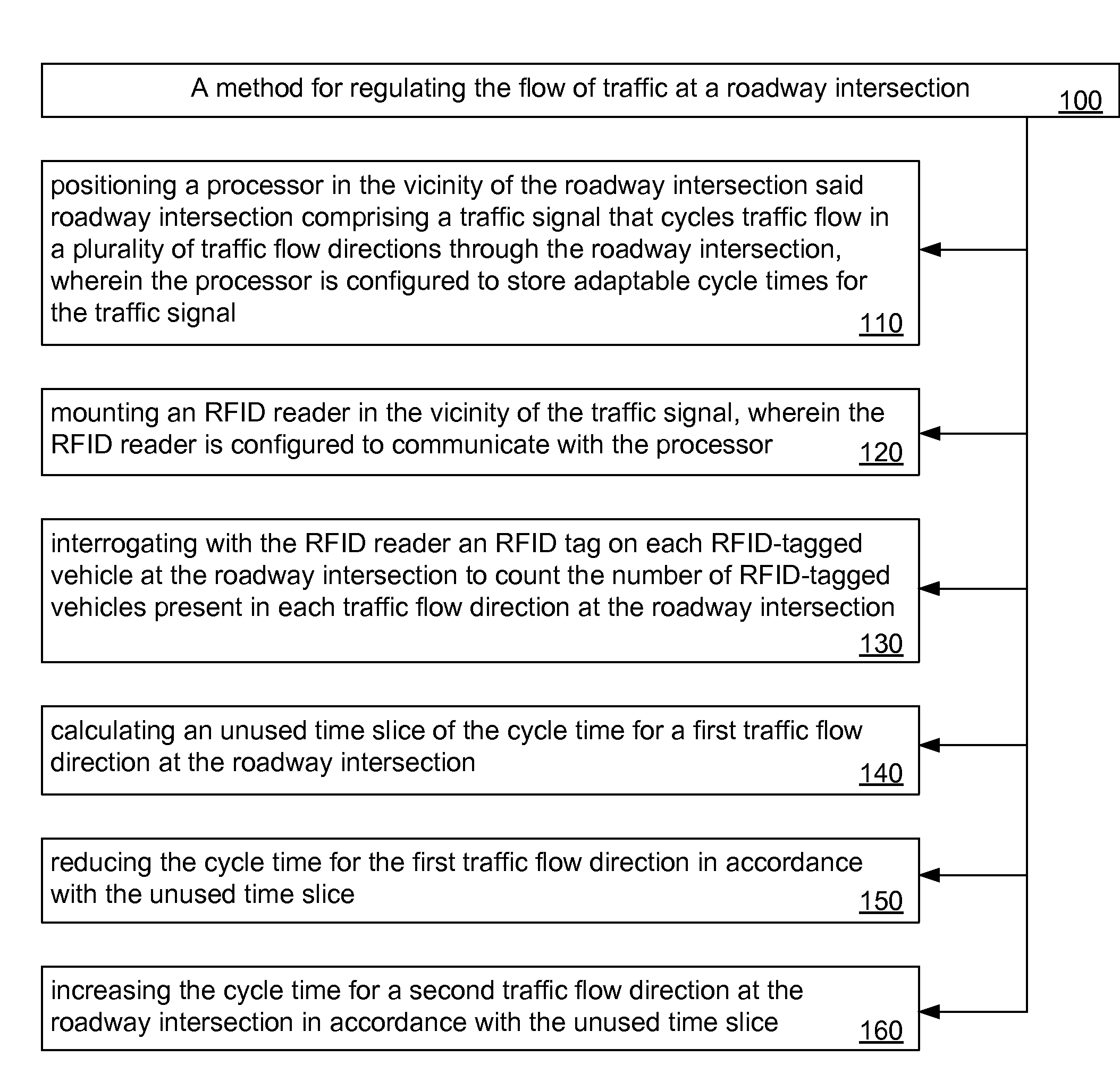
Figure 1 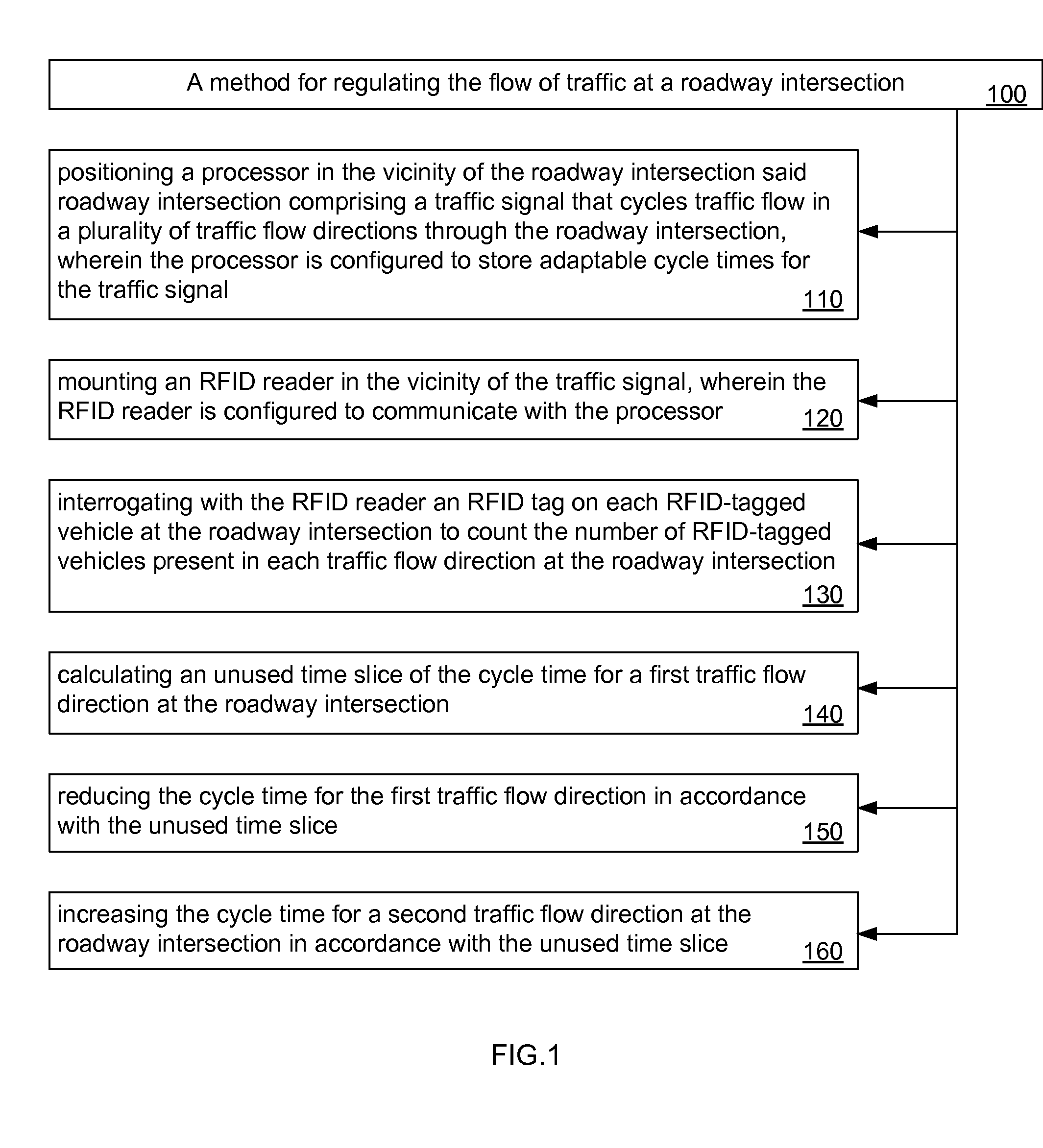
Figure 2 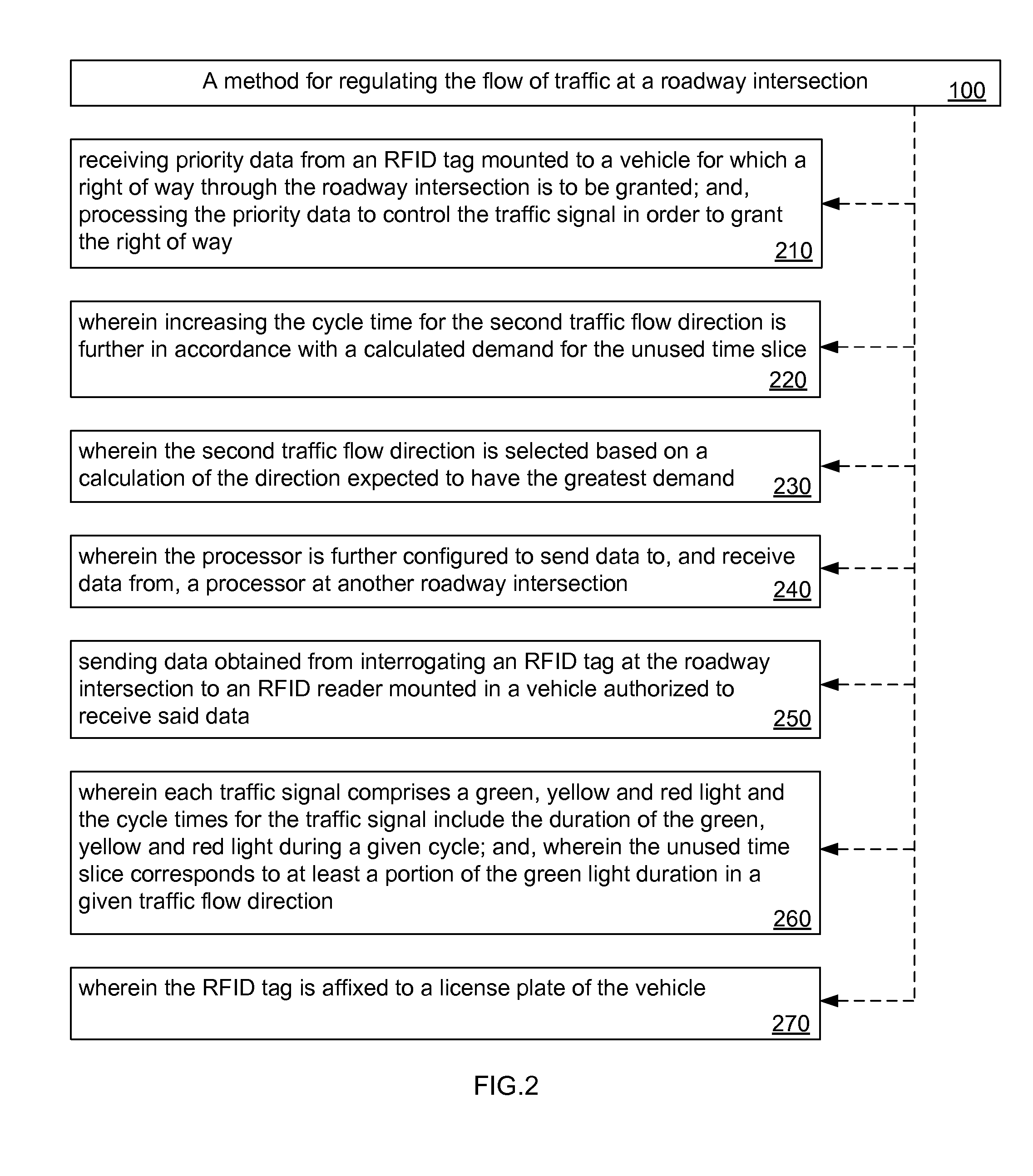
Figure 3
Abstract
Description
CROSS-REFERENCE TO RELATED APPLICATIONS
[0001] This application is a continuation-in-part of application Ser. No. 11 / 558,178, filed 9 Nov. 2006, which is hereby incorporated by reference herein.TECHNICAL FIELD
[0002] In the field of electrical communications, a method and system employing a traffic control indicator normally under a local controller that is responsive to a traffic detector wherein the number of vehicles detected in an area determines the percentage of a complete cycle allowed for a particular indicator phase.BACKGROUND ART
[0003] Automobiles are a part of everyday life in urban and suburban communities. Traffic lights dot the landscape in urban centers and the surrounding communities, and control the flow of traffic on roads, large and small. Drivers must pay attention to traffic signals, and failure to heed them, results in increased traffic congestion and accidents.
[0004] While traffic controls are a necessary part of any road and highway system, measures are taken to tr...
Examples
example 1
Process: Scenario without the Invention
[0043]FIG. 4 illustrates an intersection (415) with multiple traffic signals (403), (413), (401), and (414) controlling multiple directions of travel through the intersection (415). The traffic regulation process that would occur in the absence of the present invention involves control of the intersection (415) by a traffic signal (401) that allocates 30 seconds for a vehicle to make a left turn. While traffic signal (401) is green for a left turn, traffic signal (403) is red to prevent traffic flow from crossing the travel direction of any left turning vehicles. After the vehicle with an RFID tag (402) completes a left turn at the intersection (415), 25 seconds remain unused, and the traffic signal (401) remains green for additional cars to make a left turn, if any were present. When the 25 seconds expires, the traffic signal (401) switches to red for a left turn direction and the traffic signal (403) switches to green in the crosswise directi...
example 2
Process: Scenario with the Invention
[0044]In regard to FIG. 4, traffic signals (403), (413), (401), and (414) contain signal RFID readers (R). The processor (408) is at the side of the roadway near the intersection (415).
[0045]Vehicles with RFID tags (404), (405), (406), and (407) are traveling west (to the left); and the vehicle (402) is a vehicle traveling east (to the right) and turning left at the signal.
[0046]Traffic signal (401) containing RFID reader (R) allocates 30 seconds for the vehicle (402) to make a left turn. When the traffic signal (401) containing RFID reader (R) finds no vehicles in the middle lane, then, the traffic signal (403) containing RFID reader (R), which is the direction that would be authorized to advance in next sequence for the traffic signal, reads and calculates that there are four vehicles (404, 405, 406 and 407) waiting to advance through the intersection (415) in that direction.
[0047]The processor (408) is provided with the information from signal ...