
Copolymers and coprepolymers formed from mono-substituted fluorinated oxetane monomers and tetrahydrofuran
a technology of fluorinated oxetane monomers and coprepolymers, which is applied in the field of polymer compositions, can solve the problems of difficult application, unsuitable coatings for flexible substrates, and difficult processing of plastics, and achieve low glass transition temperature, good hydrophobic properties, and low surface energy
Patent Information
- Authority / Receiving Office
- US · United States
- Patent Type
- Patents(United States)
- Current Assignee / Owner
- Publication Date
- 2002-04-30
- Estimated Expiration
- Not applicable · inactive patent
Smart Images
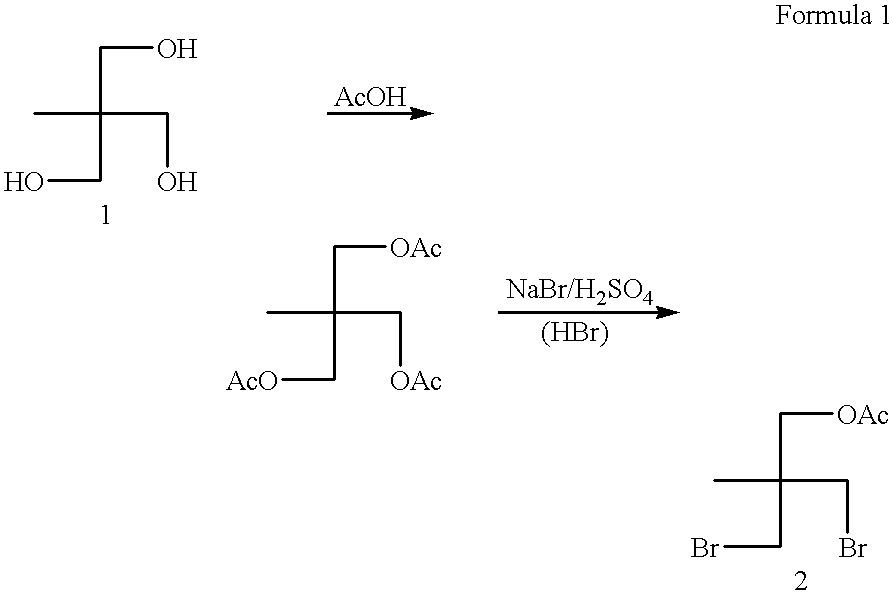
Figure 1 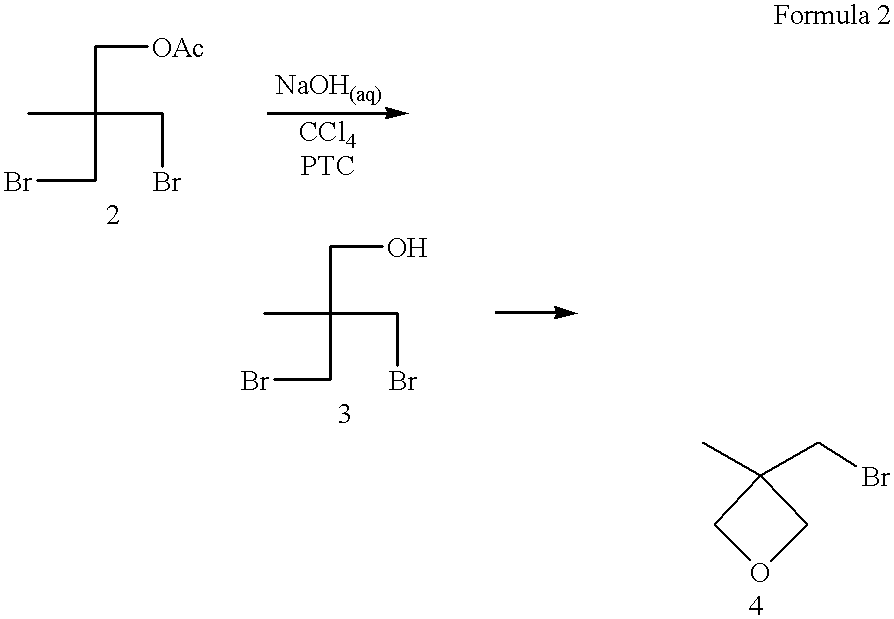
Figure 2 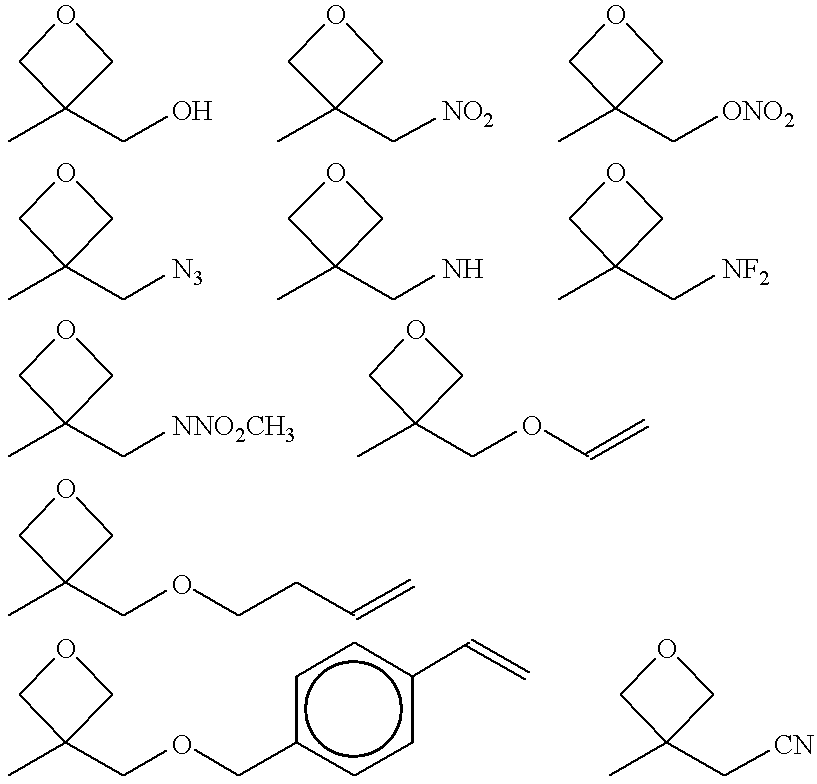
Figure 3
Abstract
Description
FIELDThis invention relates to prepolymer compositions and the polymers derived therefrom, oxetane monomers having asymmetric mono-substituted pendant fluorinated alkoxymethylene groups as the prepolymer precursors, methods of preparing the precursor monomers and methods of polymerization of the prepolymers to form fluorinated elastomers. The hydroxy-terminated prepolymers have a polyether backbone and are useful, inter alia, for the preparation of polyurethane elastomers, thermoset plastics and coatings. These compositions exhibit hydrophobic properties, very low surface energies, low glass transition temperatures, low di-electric constants, high abrasion resistance and tear strength, low coefficient of friction, high adhesion and low refractive indices.Fluorinated ElastomersFluorinated polymers enjoy widespread use as hydrophobic, oleophobic coatings. These materials exhibit excellent environmental stability, high hydrophobicity, low surface energy and a low coefficient of frictio...
Examples
example a1
Preparation of 3-bromo-2-bromomethyl-2-methylpropyl Acetate
In a 12L flask equipped with an overhead stirrer, reflux condenser, and addition funnel was placed 1,1,1-tris(hydroxymethyl)ethane (TME, 1.000 Kg, 8.32 mol) and glacial acetic acid (3.750 L). The mixture was allowed to stir until partial dissolution of the TME had occurred and then the sodium bromide (2.568 Kg, 24.96 mol) was added with vigorous stirring. The sulfuric acid (1.718 Kg, 16.64 mol) was then slowly added over 6 hours. After the addition was complete, the reaction mixture was heated to 120.degree. C. for 48 hours. At this time GC evidence indicated that the reaction was complete and the mixture was cooled to room temperature and quenched with 7L of ice water. The organic and aqueous phases were separated and the organic was washed with water, 0.5N NaOH (until neutral pH), brine, and then dried over MgSO.sub.4 to yield the product as a clear colorless oil in 92% yield (2.206 Kg): IR (KBr) 2980-2800, 1744, 1374, 124...
example a2
Preparation of BrMMO Pre-monomer 3-Bromomethyl-3-methyloxetane
In a 50 L flask equipped with an overhead stirrer and reflux condenser was placed 3-bromo-2-bromomethyl-2-methylpropyl acetate (2.206 Kg, 7.66 mol), 3M NaOH (7.67 L, 22.98 mol), tetrabutylammonium bromide (123.47 g, 0.383 mol), and CCl.sub.4 (7.66 L). The resulting heterogeneous solution was then refluxed at 70.degree. C. overnight. At this time GC evidence indicated that the reaction was complete. The reaction was then cooled to room temperature. The organic and aqueous phases were separated, the organic phase was washed with water and brine, and then dried over MgSO.sub.4. Removal of the solvent gave the product as a clear, light yellow oil (1.224 Kg) in 97% yield. Distillation gave a clear, colorless oil (1.189 Kg) in 94% yield, bp 46.degree. C. / 0.3 mm Hg; IR (KBr) 2980-2800, 1242, 1201, 1147, 704 cm.sup.-1 ; .sup.1 H NMR .delta. 1.44 (s, 3H), 3.65 (s, 2H), 4.40 (d, J=5.8 Hz, 2H), 4.45 (d, J=5.8 Hz, 2H) .sup.13 C NMR 2...
example a3
Preparation of Pre-monomer p-Toluenesulfonate of 3-Hydroxymethyl-3-methyloxetane
A solution of 3-hydroxymethyl-3-methyloxetane (612 g, 6 mol) in pyridine (800 ml) was cooled to -10.degree. C. and treated, slowly, with a solution of p-toluenesufonyl chloride (1364 g, 7 mol) in pyridine (700 ml). The rate of addition was maintained so that the contents of the flask were kept below -5.degree. C. Upon complete addition, the solution temperature was held at -5.degree. C. for 30 minutes and then at room temperature for 2 hours. The contents of the flask were quenched by pouring it into ice water (10 L), and the precipitated solid was filtered, washed with water and dried in air. The purity of the product as determined by GLC analysis was >98%. By this method, 1352 g of the desired product was obtained, representing an 88% yield.
The yield and purity of the bromomethyl and arylsulfonate premonomer product are extremely high and these examples clearly show how easily and inexpensively the mon...