
Decoder and decoding method for low-density parity check codes constructed based on reed-solomon codes
a parity check and decoding method technology, applied in the field of decoders in communication systems and storage systems, can solve the problems of increasing the complexity of the silicon area of the fully-parallel ldpc decoder, and increasing the complexity of the code length. the effect of increasing the complexity of the multi-mode function implementation
Patent Information
- Authority / Receiving Office
- US · United States
- Patent Type
- Patents(United States)
- Current Assignee / Owner
- Publication Date
- 2013-10-01
Smart Images
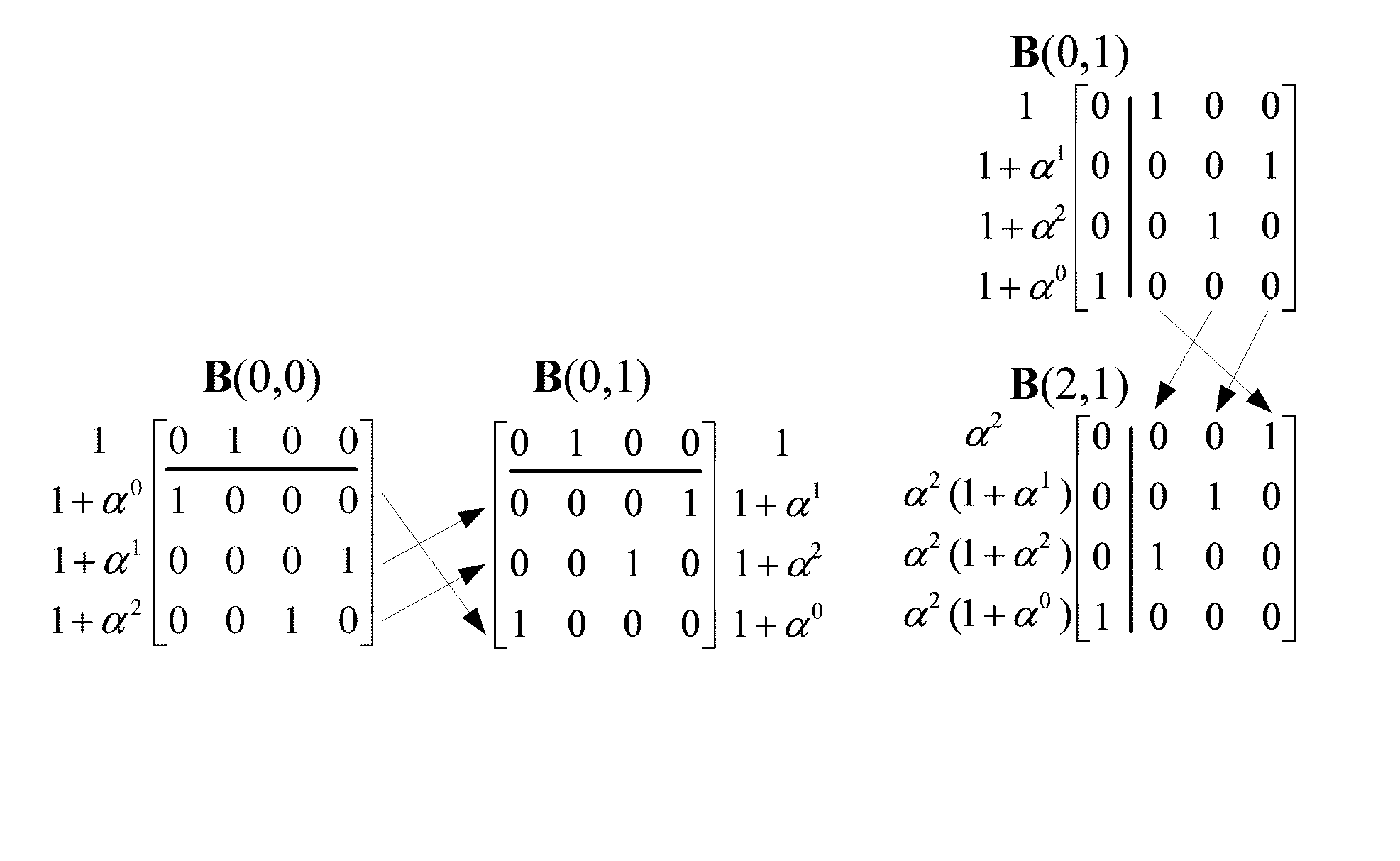
Figure 1 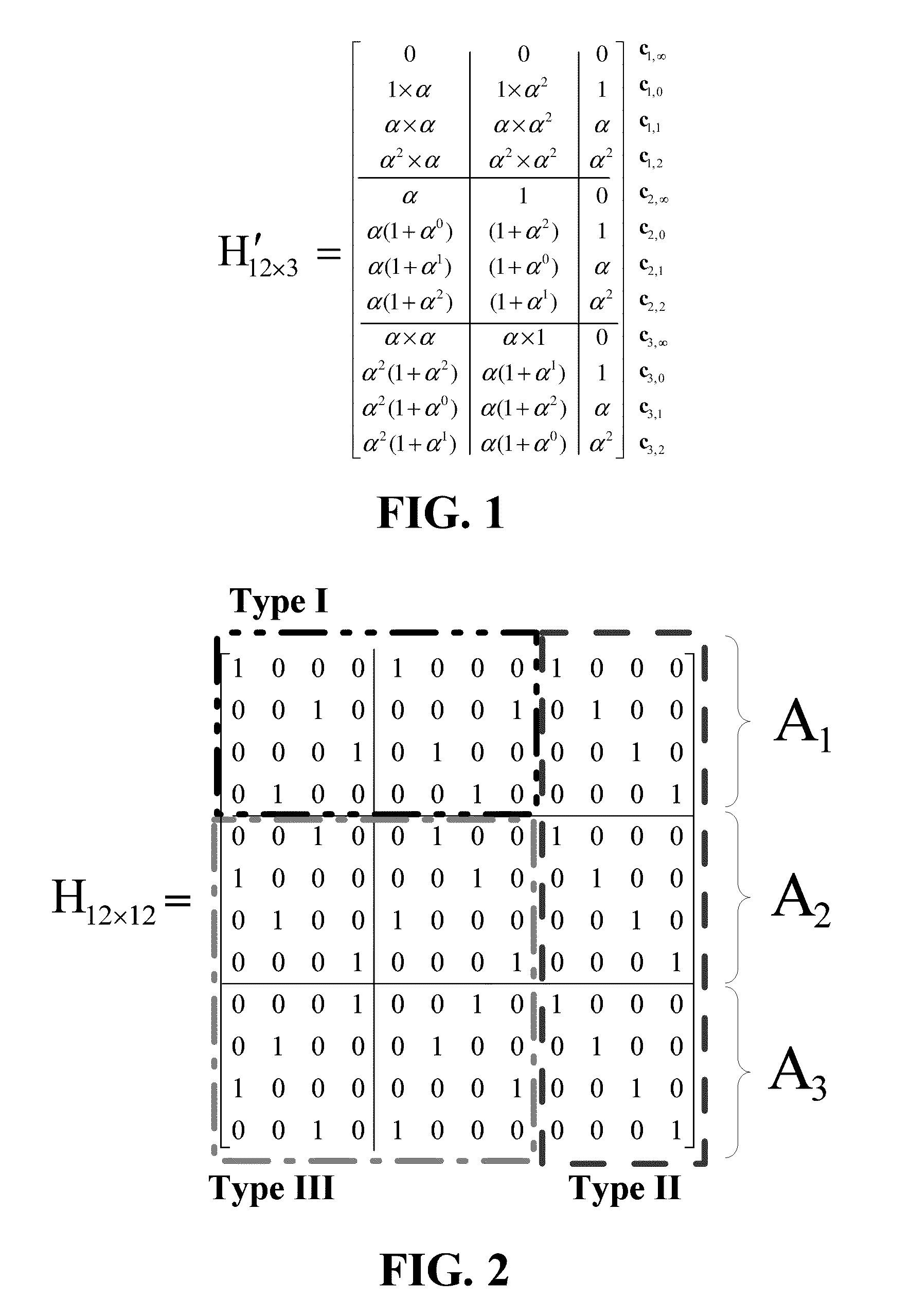
Figure 2 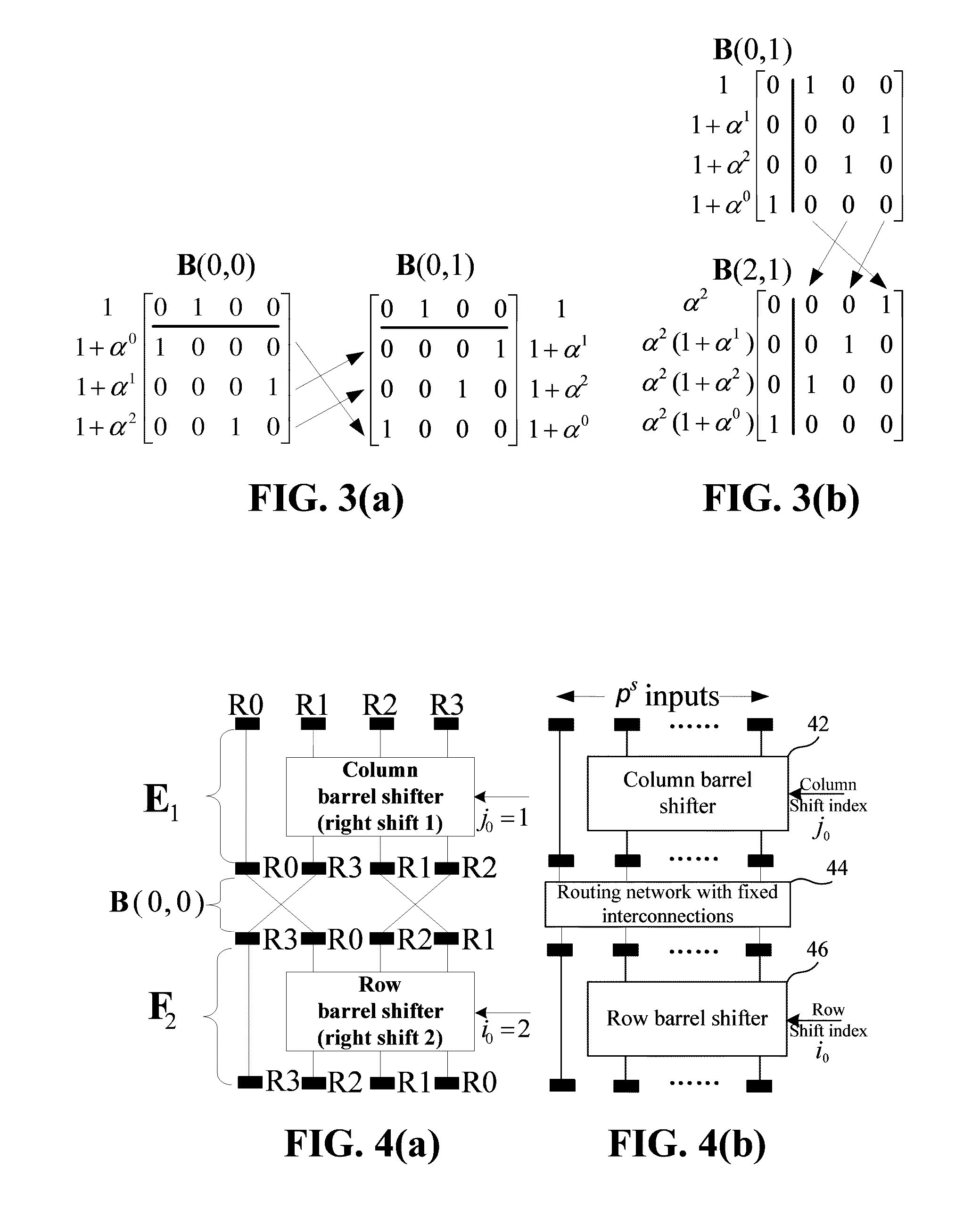
Figure 3
Abstract
Description
BACKGROUND OF THE INVENTION
[0001] 1. Field of the Invention
[0002] The present invention is related to decoders in communication systems and storage systems. More specifically, the present invention relates to decoders and decoding methods for low-density parity check codes constructed based on Reed-Solomon codes.
[0003] 2. Description of the Prior Art
[0004] Research into low-density parity-check (LDPC) codes has attracted a tremendous amount of interest as a result of their near-capacity performance and their potential for highly-parallel decoder implementation. LDPC codes for several applications such as optical communications, and image transmission over wireless channels have previously been discussed. Many recent communication standards, such as IEEE 802.3an and 802.16e (WiMAX) have included LDPC codes. The LDPC code adopted in IEEE 802.3an is a regular code which is constructed based on a Reed-Solomon (RS) code with two information symbols. Construction methods of LDPC codes based s...
Examples
Embodiment Construction
I. Introduction
[0028]The following description is organized as follows. First, the structural properties of the parity-check matrices are introduced and the permutator architecture for the RS-LDPC codes is proposed. Then, the shuffled MPD and the associated BER results for the RS-LDPC codes are presented. Thereafter, the proposed decoder architecture is presented. The implementation results and comparison of the proposed decoder with other related works are then described.
II. Permutator Architecture for RS-LDPC Codes
A. LDPC Codes Based on Shortened RS Codes
[0029]Consider the Galois field GF(ps), where p is a prime and s is a positive integer. If we let α be a primitive element of GF(ps), with a positive integer ρ, where 2≦ρ≦ps, we can construct an RS code over GF(ps), whose generator polynomial is given by:
g(X)=(X+α)(X−α2) . . . (X−αρ−2)=g0+g1X+g2X2+ . . . +Xρ−2, (1)
[0030]where gi εGF(ps). The ρ−1 coefficients of g(X) are nonzero. If we shorten the RS code by deleting the first (ps...