
Printer architecture enabling narrow or wide front facing orientation
a printing machine and front facing technology, applied in electrographic processes, instruments, transportation and packaging, etc., can solve the problems of large projected footprint that is not ideal for stated orientation considerations, e-w printer configuration, and insufficient desk or space efficiency in most applications, so as to achieve greater flexibility for customers
Patent Information
- Authority / Receiving Office
- US · United States
- Patent Type
- Patents(United States)
- Current Assignee / Owner
- Publication Date
- 2014-12-16
- Estimated Expiration
- Not applicable · inactive patent
Smart Images
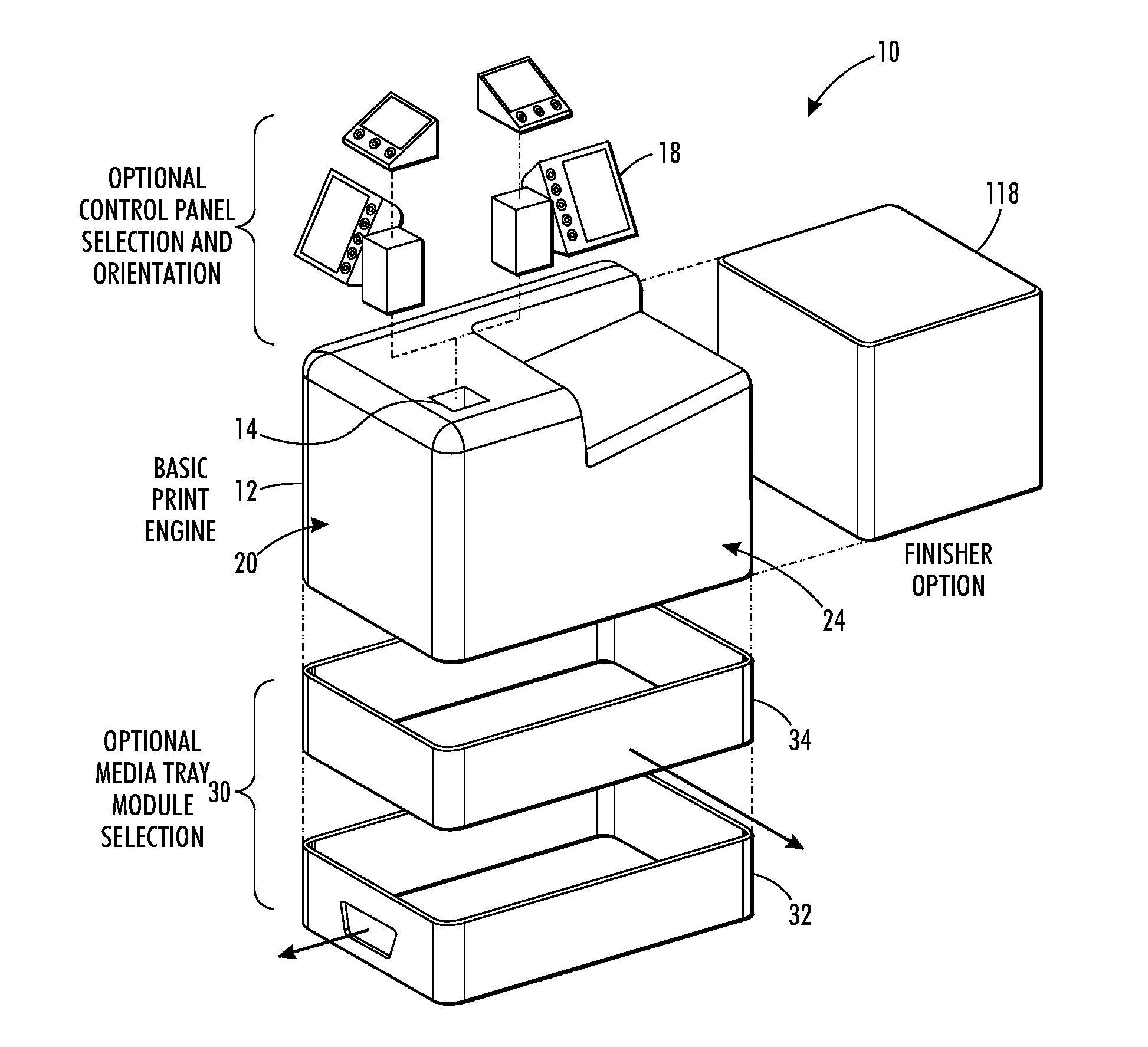
Figure 1 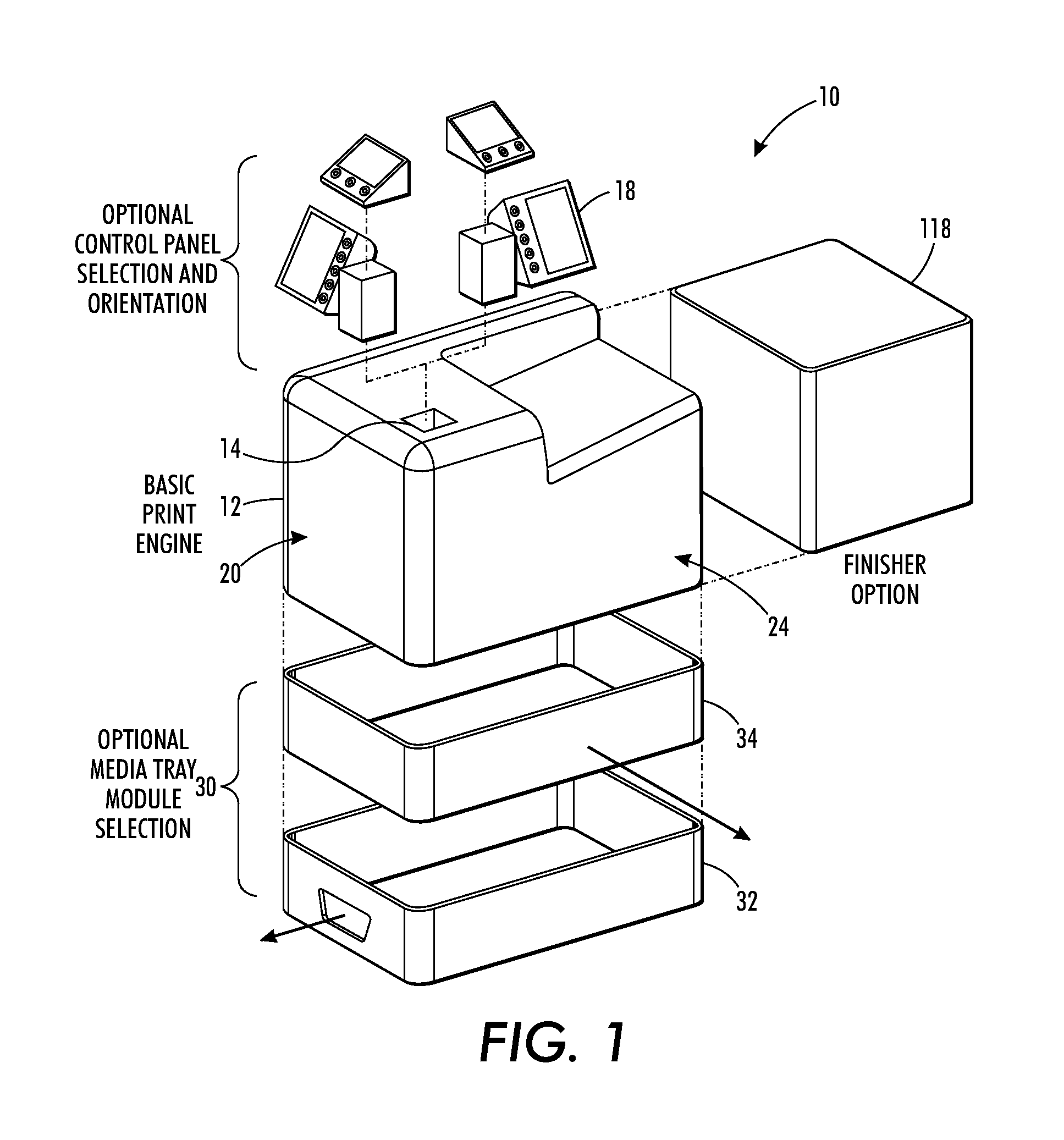
Figure 2 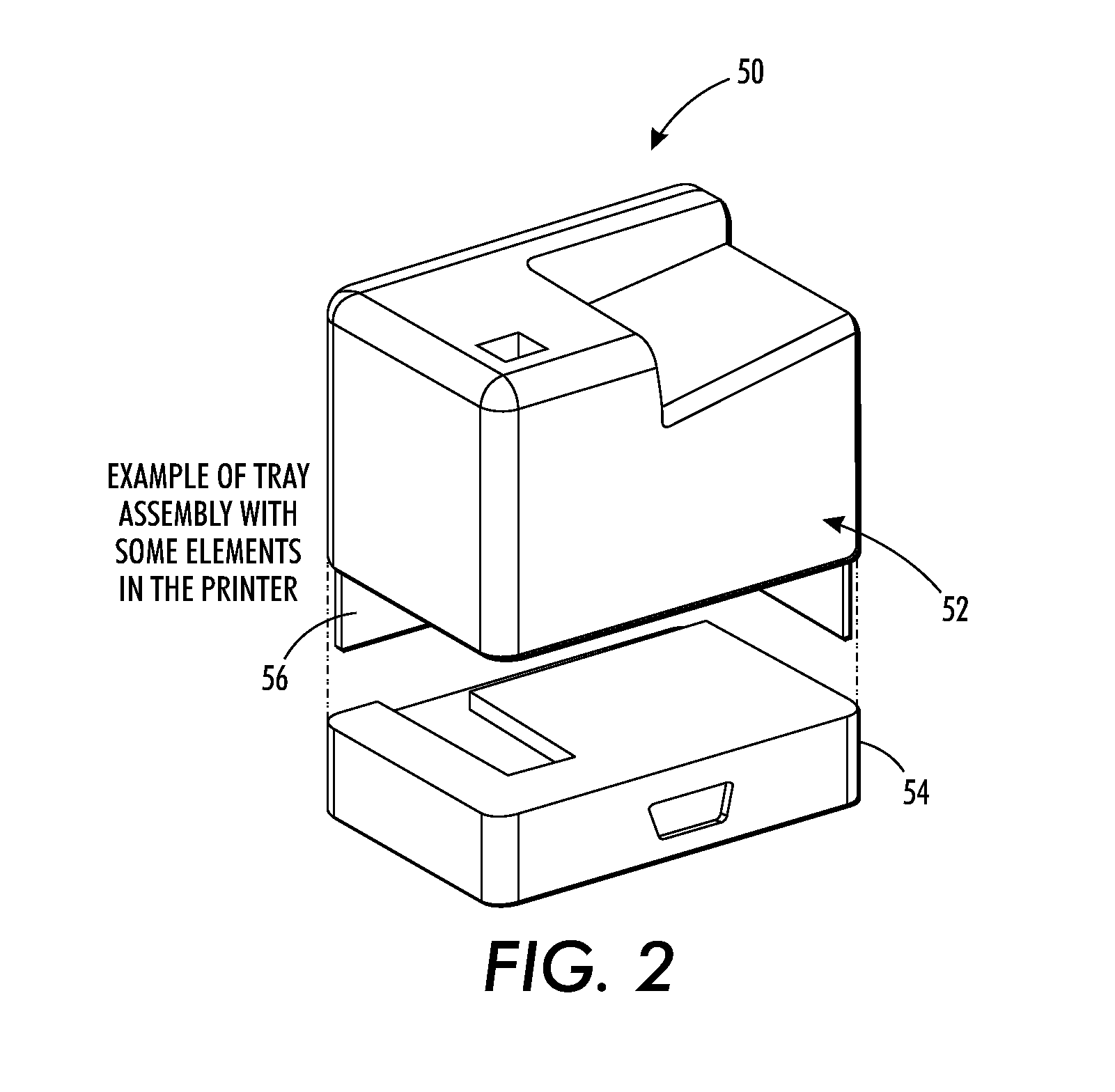
Figure 3
Abstract
Description
BACKGROUND
[0001] Printers and related products, such as MFP's, have an architecture that defines the placement orientation of the unit relative to user access. For example, generally a printer is configured such that the most significant interactions, such as operation or setting selection via control panel or display and adding media to the input tray, faces what would be considered the front of the unit. Printers do not typically have a square footprint so the placement orientation, driven by primary user interfaces, determines which of the narrow or wide surfaces is the unit front. The aspect ratio is often an outcome of the paper path, its direction generally along the long axis. A narrow front with the paper path front to back, is often preferred for desks and limited table space. The wider orientation with a left-right paper path, is more flexible for auto document scanners and when equipping the unit with optional finishers (including, for example, sorting devices, collating d...
Examples
Embodiment Construction
[0019]The present disclosure sets forth a module printer wherein the printer can be configured to address user orientation preference or requirements by attaching or positioning primary subsystems, such as the user control panel, for example, a touch screen display, etc., to the surface desired as the front of the device. A control panel can be minimalist, as simple as a few buttons and small text display. The trend is to more friendly and functional control interfaces such as larger touch screens which may be used alone or in combination with physical buttons. The present concept accommodates desired configurations by allowing different panels to be used, as appropriate to the feature set and price point of the end product. Media input tray assemblies can then be selected to face the front of the device. Orientation of media input access, such as with a slide out paper tray, is defined by the tray housing structure and the direction of tray insertion and withdrawal from either a na...