
Computationally efficient modeling of imagery using scaled, extracted principal components
a scaled, computationally efficient technology, applied in computing, instruments, electrical appliances, etc., can solve the problems of inability to handle voxels, fixed basis of jpeg and others cannot handle the expanded feature set associated with hyperspectral imagery, and standard compression has not been thought suitable for principal component image modeling and compression, etc., to reduce computation and the number of bits required, the effect of reducing the overhead of the computer
Patent Information
- Authority / Receiving Office
- US · United States
- Patent Type
- Patents(United States)
- Current Assignee / Owner
- Publication Date
- 2011-03-29
- Estimated Expiration
- Not applicable · inactive patent
Smart Images
Figure 1 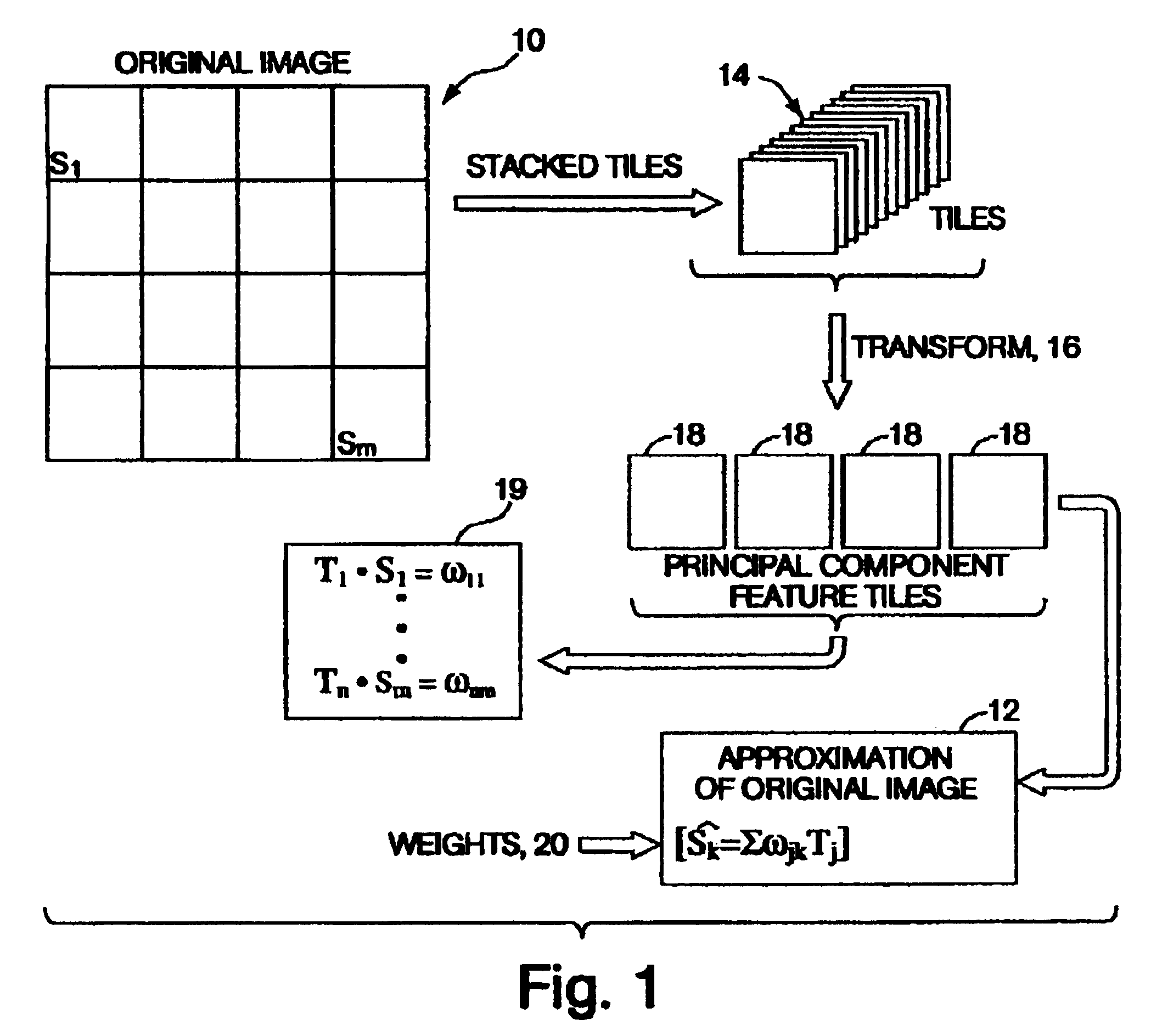
Figure 2 
Figure 3
Abstract
Description
CROSS REFERENCE TO RELATED APPLICATIONS
[0001] This application claims rights under U.S. Provisional Application Ser. No. 60 / 353,476, filed Mar. 31, 2002.
[0002] This application is a Reissue application of U.S. Ser. No. 10 / 334,816, filed Dec. 31, 2002, now U.S. Pat. No. 7,113,654, granted Sep. 26, 2006, which claims the benefit of Provisional Application No. 60 / 353,476, filed Jan. 31, 2002.STATEMENT OF GOVERNMENT INTEREST
[0003] This invention was made with U.S. Government support under Contract No. DAAL01-96-2-0002 with the Army Research Laboratory, and the U.S. Government has certain rights in the invention.FIELD OF INVENTION
[0004] This invention relates to image processing and more particularly to an efficient system for image modeling and compression.BACKGROUND OF THE INVENTION
[0005] The extraction of principal components from images is well known, with one extraction technique using neural networks as described in U.S. Pat. No. 5,377,305. Principal components are those which have self...
Examples
Embodiment Construction
[0029]Referring to FIG. 1, modeling and compression of an original image 10 is illustrated in which after the subject process is performed an approximation 12 of the original image is generated. The original image is divided up into 1−M segments with each of the segments being reflected in a different tile 14, with the tiled being shown as stacked. These tiles are of the same scale as the original image.
[0030]In order to extract principal components relating to features of the image, a transform 16 is applied to tiles 14 which results in a reduced set of tiles 18 referred herein as principal component feature tiles. These tiles are utilized to characterize features in the original image with the transform being one of a number of transforms which extract principal components. As mentioned hereinbefore U.S. Pat. No. 5,377,305 incorporated herein by reference and assigned to the assignee hereof describes a neural network technique for deriving principal components.
[0031]The principal ...