AGM Battery Performance in Fast-Changing Load Conditions
AUG 7, 20259 MIN READ
Generate Your Research Report Instantly with AI Agent
Patsnap Eureka helps you evaluate technical feasibility & market potential.
AGM Battery Evolution and Objectives
Absorbed Glass Mat (AGM) batteries have undergone significant evolution since their inception in the 1980s. Initially developed for military aircraft, these batteries have found widespread application in various industries due to their superior performance characteristics. The primary objective of AGM battery technology has been to provide a reliable, maintenance-free power source capable of delivering high currents on demand while maintaining a long service life.
The evolution of AGM batteries has been driven by the increasing demand for more efficient and durable energy storage solutions. Early AGM designs focused on improving the electrolyte absorption capabilities of the glass mat separators, leading to enhanced cycle life and reduced internal resistance. Subsequent developments aimed at optimizing the lead alloy composition and grid design to further improve performance and longevity.
In recent years, the focus has shifted towards enhancing AGM battery performance under fast-changing load conditions. This objective has become increasingly important due to the proliferation of advanced electronic systems in automotive and industrial applications. The ability to rapidly respond to fluctuating power demands while maintaining voltage stability is crucial for modern energy storage systems.
To address these challenges, researchers and manufacturers have been exploring various avenues for improvement. One key area of focus has been the development of advanced electrode materials and structures that can facilitate rapid charge and discharge cycles without compromising battery life. Additionally, efforts have been made to optimize the internal design of AGM batteries to reduce voltage drop under high-current situations.
The integration of smart battery management systems (BMS) has also played a crucial role in enhancing AGM battery performance. These systems enable real-time monitoring and control of battery parameters, allowing for more efficient energy utilization and improved overall system reliability. Furthermore, advancements in manufacturing processes have led to more consistent and higher-quality AGM batteries, contributing to better performance in demanding applications.
Looking ahead, the objectives for AGM battery technology continue to evolve. There is a growing emphasis on developing AGM batteries with higher energy density, faster charging capabilities, and improved thermal management. These advancements aim to meet the increasing power demands of electric vehicles, renewable energy storage systems, and other emerging applications.
Another important objective is to enhance the environmental sustainability of AGM batteries. This includes efforts to improve recyclability, reduce the use of toxic materials, and extend battery lifespan to minimize waste. As environmental regulations become more stringent, the development of eco-friendly AGM batteries is likely to become a key focus area for manufacturers and researchers alike.
The evolution of AGM batteries has been driven by the increasing demand for more efficient and durable energy storage solutions. Early AGM designs focused on improving the electrolyte absorption capabilities of the glass mat separators, leading to enhanced cycle life and reduced internal resistance. Subsequent developments aimed at optimizing the lead alloy composition and grid design to further improve performance and longevity.
In recent years, the focus has shifted towards enhancing AGM battery performance under fast-changing load conditions. This objective has become increasingly important due to the proliferation of advanced electronic systems in automotive and industrial applications. The ability to rapidly respond to fluctuating power demands while maintaining voltage stability is crucial for modern energy storage systems.
To address these challenges, researchers and manufacturers have been exploring various avenues for improvement. One key area of focus has been the development of advanced electrode materials and structures that can facilitate rapid charge and discharge cycles without compromising battery life. Additionally, efforts have been made to optimize the internal design of AGM batteries to reduce voltage drop under high-current situations.
The integration of smart battery management systems (BMS) has also played a crucial role in enhancing AGM battery performance. These systems enable real-time monitoring and control of battery parameters, allowing for more efficient energy utilization and improved overall system reliability. Furthermore, advancements in manufacturing processes have led to more consistent and higher-quality AGM batteries, contributing to better performance in demanding applications.
Looking ahead, the objectives for AGM battery technology continue to evolve. There is a growing emphasis on developing AGM batteries with higher energy density, faster charging capabilities, and improved thermal management. These advancements aim to meet the increasing power demands of electric vehicles, renewable energy storage systems, and other emerging applications.
Another important objective is to enhance the environmental sustainability of AGM batteries. This includes efforts to improve recyclability, reduce the use of toxic materials, and extend battery lifespan to minimize waste. As environmental regulations become more stringent, the development of eco-friendly AGM batteries is likely to become a key focus area for manufacturers and researchers alike.
Market Demand Analysis for AGM Batteries
The market demand for AGM (Absorbent Glass Mat) batteries in fast-changing load conditions has been experiencing significant growth in recent years. This surge is primarily driven by the increasing adoption of renewable energy systems, the expansion of electric vehicle markets, and the growing need for reliable backup power solutions in various industries.
In the renewable energy sector, AGM batteries are gaining traction due to their ability to handle rapid charge and discharge cycles associated with solar and wind power systems. As more countries and businesses invest in sustainable energy solutions, the demand for high-performance energy storage systems capable of managing intermittent power generation has risen substantially.
The automotive industry represents another major market for AGM batteries, particularly in start-stop vehicle applications. With stringent emissions regulations and the push for improved fuel efficiency, automakers are increasingly incorporating start-stop technology into their vehicles. AGM batteries are well-suited for these systems due to their ability to withstand frequent cycling and provide consistent power output under varying load conditions.
In the telecommunications sector, AGM batteries are becoming the preferred choice for backup power systems. The rapid expansion of 5G networks and the increasing reliance on uninterrupted communication services have created a strong demand for reliable energy storage solutions that can handle sudden power fluctuations and maintain network uptime.
The data center industry is another key driver of AGM battery demand. As businesses increasingly rely on cloud computing and data-intensive operations, the need for robust uninterruptible power supply (UPS) systems has grown. AGM batteries are favored in this application due to their low maintenance requirements, long service life, and ability to provide stable power during rapid load changes.
The marine and recreational vehicle markets also contribute to the growing demand for AGM batteries. These applications require energy storage solutions that can withstand vibration, provide deep-cycle capabilities, and operate reliably in various environmental conditions.
Market analysts project that the global AGM battery market will continue to expand at a compound annual growth rate (CAGR) of over 5% in the coming years. This growth is expected to be fueled by advancements in AGM battery technology, increasing awareness of their benefits, and the ongoing electrification trend across multiple industries.
However, challenges such as the high initial cost of AGM batteries compared to traditional lead-acid batteries and competition from emerging battery technologies like lithium-ion may impact market growth. Manufacturers are focusing on improving AGM battery performance and reducing production costs to maintain their competitive edge in the rapidly evolving energy storage landscape.
In the renewable energy sector, AGM batteries are gaining traction due to their ability to handle rapid charge and discharge cycles associated with solar and wind power systems. As more countries and businesses invest in sustainable energy solutions, the demand for high-performance energy storage systems capable of managing intermittent power generation has risen substantially.
The automotive industry represents another major market for AGM batteries, particularly in start-stop vehicle applications. With stringent emissions regulations and the push for improved fuel efficiency, automakers are increasingly incorporating start-stop technology into their vehicles. AGM batteries are well-suited for these systems due to their ability to withstand frequent cycling and provide consistent power output under varying load conditions.
In the telecommunications sector, AGM batteries are becoming the preferred choice for backup power systems. The rapid expansion of 5G networks and the increasing reliance on uninterrupted communication services have created a strong demand for reliable energy storage solutions that can handle sudden power fluctuations and maintain network uptime.
The data center industry is another key driver of AGM battery demand. As businesses increasingly rely on cloud computing and data-intensive operations, the need for robust uninterruptible power supply (UPS) systems has grown. AGM batteries are favored in this application due to their low maintenance requirements, long service life, and ability to provide stable power during rapid load changes.
The marine and recreational vehicle markets also contribute to the growing demand for AGM batteries. These applications require energy storage solutions that can withstand vibration, provide deep-cycle capabilities, and operate reliably in various environmental conditions.
Market analysts project that the global AGM battery market will continue to expand at a compound annual growth rate (CAGR) of over 5% in the coming years. This growth is expected to be fueled by advancements in AGM battery technology, increasing awareness of their benefits, and the ongoing electrification trend across multiple industries.
However, challenges such as the high initial cost of AGM batteries compared to traditional lead-acid batteries and competition from emerging battery technologies like lithium-ion may impact market growth. Manufacturers are focusing on improving AGM battery performance and reducing production costs to maintain their competitive edge in the rapidly evolving energy storage landscape.
AGM Technology Challenges in Dynamic Loads
Absorptive Glass Mat (AGM) batteries have gained significant popularity in various applications due to their superior performance and maintenance-free characteristics. However, when subjected to fast-changing load conditions, AGM batteries face several technological challenges that can impact their performance and longevity.
One of the primary challenges is the rapid charge and discharge cycles that occur in dynamic load environments. These sudden fluctuations can lead to increased internal resistance and accelerated degradation of the battery's active materials. The electrolyte absorption capacity of the glass mat may be compromised under extreme conditions, potentially resulting in electrolyte stratification and reduced overall efficiency.
Thermal management presents another significant hurdle for AGM batteries in fast-changing load scenarios. The rapid energy transfer during high-current charge and discharge events generates substantial heat, which can accelerate chemical reactions within the battery and potentially lead to thermal runaway if not properly managed. This challenge is particularly pronounced in compact designs where heat dissipation is limited.
The battery management system (BMS) faces increased complexity when dealing with dynamic loads. Accurate state of charge (SOC) and state of health (SOH) estimation become more challenging due to the rapidly changing current profiles. This can lead to suboptimal charging strategies and potentially reduce the battery's cycle life if not addressed effectively.
Voltage stability is another critical concern in fast-changing load conditions. AGM batteries may struggle to maintain a stable voltage output during rapid load transitions, potentially leading to voltage sags or spikes that can affect the performance of connected equipment. This challenge is particularly relevant in applications such as uninterruptible power supplies (UPS) or automotive start-stop systems.
The mechanical stress induced by rapid charge and discharge cycles can also pose challenges to AGM battery design. The expansion and contraction of active materials during these cycles can lead to grid corrosion, plate deformation, and potential separator damage over time. Addressing these mechanical stresses while maintaining the compact and sealed nature of AGM batteries requires innovative design solutions.
Optimizing the charge acceptance rate of AGM batteries in dynamic load environments is another significant challenge. While AGM batteries generally have good charge acceptance characteristics, rapid and frequent charging events can lead to increased gassing and potential dry-out of the electrolyte if not carefully managed. This challenge necessitates advanced charging algorithms that can adapt to varying load conditions while maximizing charging efficiency and battery longevity.
In conclusion, while AGM batteries offer numerous advantages, their performance in fast-changing load conditions presents several technological challenges that require ongoing research and development efforts to overcome. Addressing these challenges will be crucial for expanding the application range of AGM batteries and improving their overall performance in dynamic load environments.
One of the primary challenges is the rapid charge and discharge cycles that occur in dynamic load environments. These sudden fluctuations can lead to increased internal resistance and accelerated degradation of the battery's active materials. The electrolyte absorption capacity of the glass mat may be compromised under extreme conditions, potentially resulting in electrolyte stratification and reduced overall efficiency.
Thermal management presents another significant hurdle for AGM batteries in fast-changing load scenarios. The rapid energy transfer during high-current charge and discharge events generates substantial heat, which can accelerate chemical reactions within the battery and potentially lead to thermal runaway if not properly managed. This challenge is particularly pronounced in compact designs where heat dissipation is limited.
The battery management system (BMS) faces increased complexity when dealing with dynamic loads. Accurate state of charge (SOC) and state of health (SOH) estimation become more challenging due to the rapidly changing current profiles. This can lead to suboptimal charging strategies and potentially reduce the battery's cycle life if not addressed effectively.
Voltage stability is another critical concern in fast-changing load conditions. AGM batteries may struggle to maintain a stable voltage output during rapid load transitions, potentially leading to voltage sags or spikes that can affect the performance of connected equipment. This challenge is particularly relevant in applications such as uninterruptible power supplies (UPS) or automotive start-stop systems.
The mechanical stress induced by rapid charge and discharge cycles can also pose challenges to AGM battery design. The expansion and contraction of active materials during these cycles can lead to grid corrosion, plate deformation, and potential separator damage over time. Addressing these mechanical stresses while maintaining the compact and sealed nature of AGM batteries requires innovative design solutions.
Optimizing the charge acceptance rate of AGM batteries in dynamic load environments is another significant challenge. While AGM batteries generally have good charge acceptance characteristics, rapid and frequent charging events can lead to increased gassing and potential dry-out of the electrolyte if not carefully managed. This challenge necessitates advanced charging algorithms that can adapt to varying load conditions while maximizing charging efficiency and battery longevity.
In conclusion, while AGM batteries offer numerous advantages, their performance in fast-changing load conditions presents several technological challenges that require ongoing research and development efforts to overcome. Addressing these challenges will be crucial for expanding the application range of AGM batteries and improving their overall performance in dynamic load environments.
Current AGM Solutions for Load Fluctuations
01 Electrode design and composition
Improving AGM battery performance through optimized electrode design and composition. This includes developing advanced materials for electrodes, enhancing the structure of plates, and incorporating additives to improve conductivity and capacity. These innovations aim to increase the battery's overall efficiency and lifespan.- Electrode design optimization: Improving AGM battery performance through optimized electrode design, including modifications to electrode structure, material composition, and surface treatments. These enhancements aim to increase the active surface area, improve charge/discharge efficiency, and extend battery life.
- Electrolyte composition and additives: Enhancing AGM battery performance by optimizing electrolyte composition and incorporating performance-boosting additives. This approach focuses on improving ionic conductivity, reducing internal resistance, and mitigating unwanted side reactions to enhance overall battery efficiency and longevity.
- Separator technology advancements: Developing advanced separator materials and designs to improve AGM battery performance. These innovations aim to enhance electrolyte retention, prevent short circuits, and facilitate better ion transport between electrodes, resulting in improved battery capacity and cycle life.
- Thermal management systems: Implementing effective thermal management systems to optimize AGM battery performance across various operating conditions. These systems help maintain optimal battery temperature, prevent overheating, and ensure consistent performance in different environments.
- Battery management and monitoring: Developing advanced battery management and monitoring systems to optimize AGM battery performance. These systems include intelligent charging algorithms, state-of-charge estimation, and predictive maintenance features to maximize battery efficiency, lifespan, and reliability.
02 Electrolyte management
Enhancing AGM battery performance by optimizing electrolyte distribution and retention. This involves improving the absorption glass mat's properties, developing novel electrolyte compositions, and implementing advanced filling techniques. These methods aim to ensure better ion transport and prevent electrolyte stratification, leading to improved battery performance and longevity.Expand Specific Solutions03 Thermal management systems
Implementing effective thermal management solutions to enhance AGM battery performance. This includes developing cooling systems, heat dissipation techniques, and temperature control mechanisms. By maintaining optimal operating temperatures, these innovations help prevent thermal runaway, extend battery life, and improve overall efficiency.Expand Specific Solutions04 Charging and discharging optimization
Improving AGM battery performance through advanced charging and discharging strategies. This involves developing intelligent charging algorithms, implementing pulse charging techniques, and optimizing discharge profiles. These methods aim to enhance charge acceptance, reduce sulfation, and extend the battery's cycle life.Expand Specific Solutions05 Battery management systems
Enhancing AGM battery performance through sophisticated battery management systems. This includes developing advanced monitoring and control technologies, implementing predictive maintenance algorithms, and integrating smart balancing techniques. These systems aim to optimize battery usage, prevent overcharging or deep discharging, and extend the overall lifespan of AGM batteries.Expand Specific Solutions
Key AGM Battery Manufacturers
The AGM battery performance in fast-changing load conditions market is in a growth phase, driven by increasing demand for reliable energy storage solutions in various sectors. The market size is expanding, with a projected CAGR of 5-7% over the next five years. Technologically, AGM batteries are relatively mature, but innovations continue to improve their performance. Companies like Clarios Germany, Stryten Energy, and Hoppecke Batterien are leading the charge in advancing AGM technology, focusing on enhancing cycle life, charge acceptance, and deep-discharge recovery. Emerging players such as ArcActive and StoreDot are also contributing to the field with novel approaches to electrode design and fast-charging capabilities, indicating a competitive and dynamic market landscape.
Stryten Energy LLC
Technical Solution: Stryten Energy has developed a high-performance AGM battery solution tailored for fast-changing load conditions. Their approach involves using advanced lead alloys and a proprietary plate design that enhances the battery's ability to handle rapid charge and discharge cycles. Stryten's AGM batteries incorporate a fine-fiber glass mat separator that improves electrolyte retention and distribution, leading to better performance in high-vibration environments[3]. The company has also implemented a unique grid design that reduces internal resistance, allowing for faster charge acceptance and improved power delivery under varying load conditions[4].
Strengths: High vibration resistance, excellent charge acceptance, and improved cycle life. Weaknesses: May have slightly lower energy density compared to some competitors, and potentially higher manufacturing costs due to advanced materials.
Hoppecke Batterien GmbH & Co. KG
Technical Solution: Hoppecke has engineered an innovative AGM battery solution for fast-changing load conditions, focusing on optimizing the internal structure and chemistry of the battery. Their approach includes the use of a high-purity lead alloy and a patented plate design that maximizes surface area for improved reaction kinetics. Hoppecke's AGM batteries feature a specialized electrolyte with additives that enhance charge acceptance and reduce sulfation, a common issue in batteries subjected to partial state of charge operations[5]. The company has also developed an advanced Battery Management System (BMS) that monitors and optimizes battery performance in real-time, adapting to varying load conditions[6].
Strengths: Excellent performance in partial state of charge operations, advanced BMS integration, and improved longevity. Weaknesses: Potentially higher cost due to advanced materials and BMS integration, and may require specialized maintenance procedures.
Core AGM Innovations for Load Management
Method for Charging a Battery Having a Plurality of Battery Cells
PatentActiveUS20180134168A1
Innovation
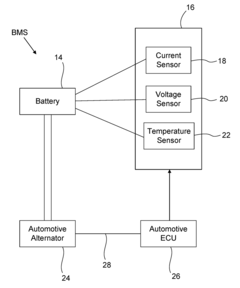
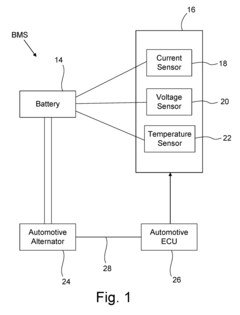
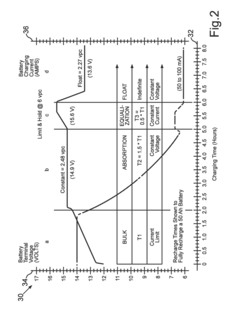
- A battery management system (BMS) that dynamically controls the charging process using sensors for real-time monitoring of battery current, voltage, and temperature, implementing a multi-stage charging strategy including bulk charging, absorption, equalization, and float phases, with adaptive voltage and current adjustments to optimize charging efficiency and prevent overcharging and undercharging.
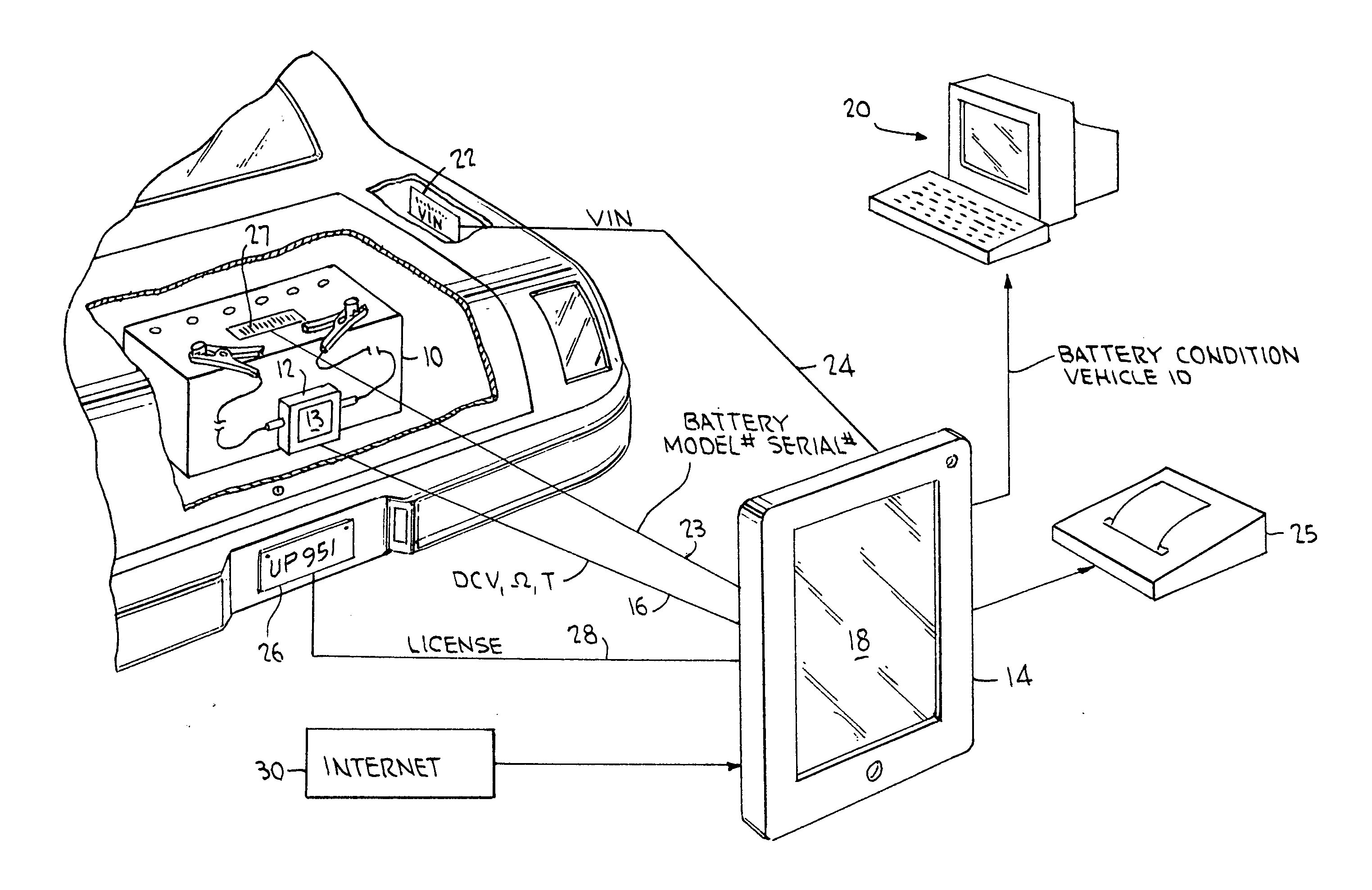
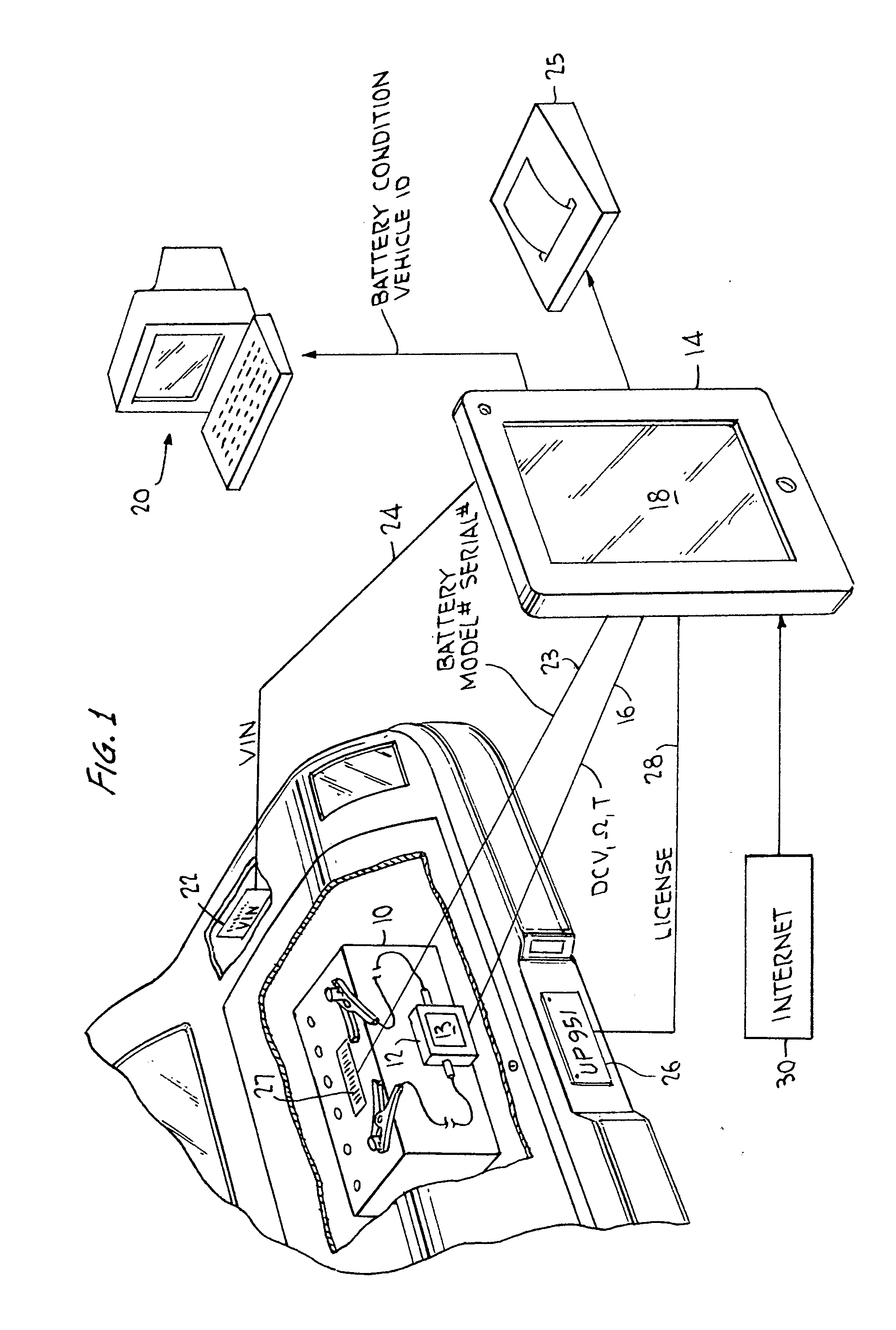
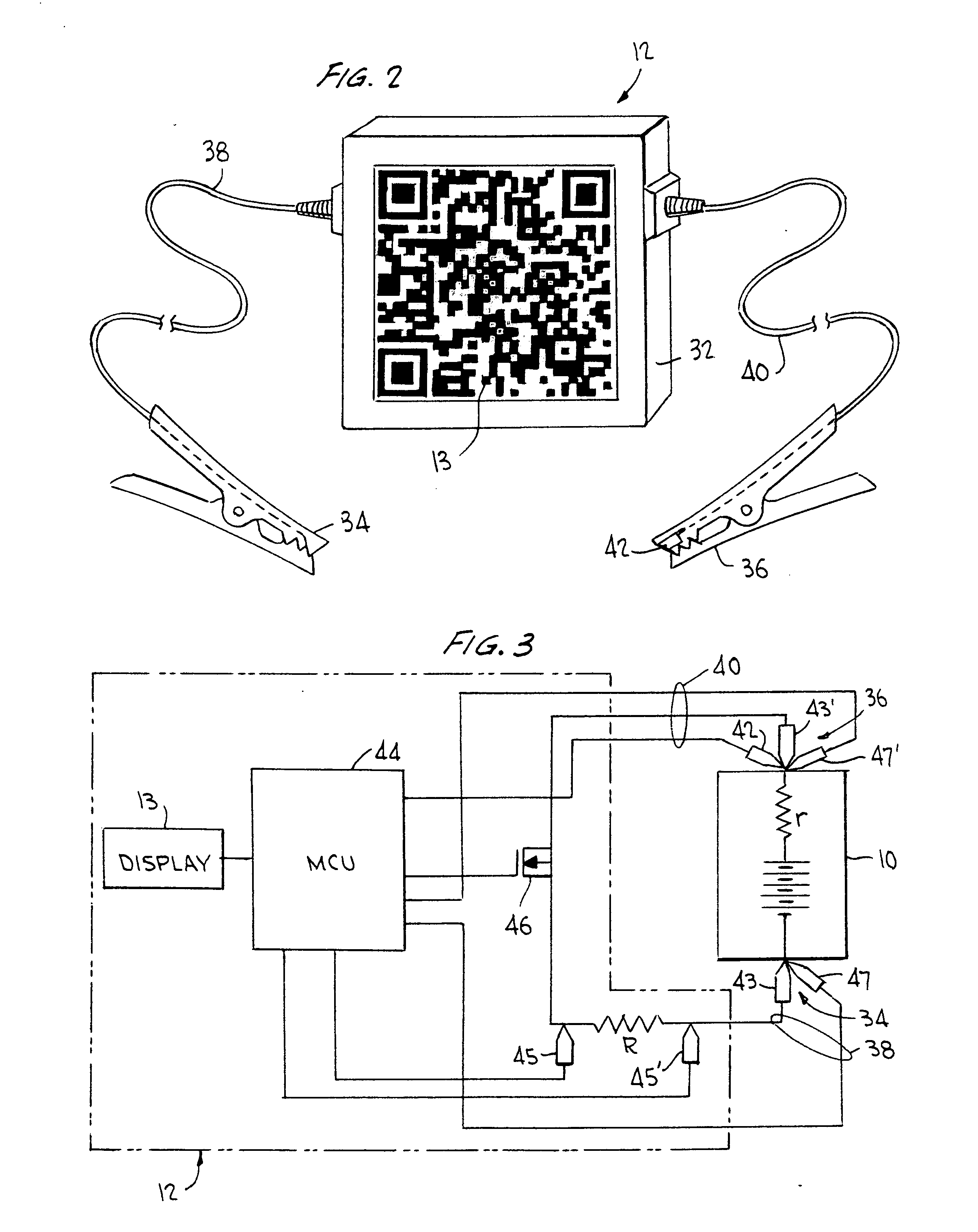
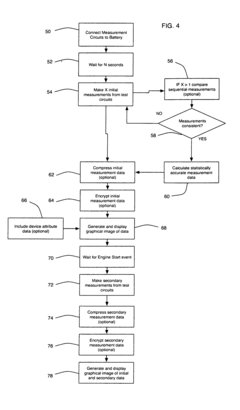
Tester for equipment, apparatus or component with distributed processing function
PatentActiveUS20140374475A1
Innovation
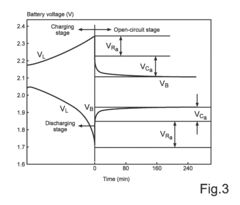
- A simplified testing device that measures basic battery parameters and transmits raw data to a smart device for analysis, leveraging the smart device's user interface, memory, and communication capabilities to input context information and perform qualitative analysis, thereby reducing the need for complex user interfaces and dedicated analysis hardware.
Environmental Impact of AGM Batteries
The environmental impact of AGM (Absorbent Glass Mat) batteries in fast-changing load conditions is a critical consideration for their widespread adoption and sustainable use. These batteries, known for their high performance and reliability, have both positive and negative effects on the environment throughout their lifecycle.
AGM batteries contribute to reduced environmental pollution compared to traditional lead-acid batteries. Their sealed design prevents electrolyte leakage, minimizing the risk of soil and water contamination. This feature is particularly beneficial in applications with frequent load changes, as it ensures environmental safety even under stress.
The manufacturing process of AGM batteries has a lower environmental footprint than that of conventional batteries. The production requires less energy and generates fewer emissions, aligning with global efforts to reduce industrial carbon footprints. However, the production of glass mat separators does involve resource consumption and energy use, which should be considered in overall environmental assessments.
In terms of operational efficiency, AGM batteries excel in fast-changing load conditions, which indirectly benefits the environment. Their ability to handle rapid charge and discharge cycles without significant degradation leads to longer battery life. This extended lifespan reduces the frequency of battery replacements, thereby decreasing the overall demand for new battery production and associated environmental impacts.
The recycling potential of AGM batteries is a significant environmental advantage. Nearly 99% of the materials in these batteries can be recycled, including lead, plastic, and the glass mat. This high recyclability reduces the need for raw material extraction and minimizes waste. However, the recycling process itself requires energy and can produce emissions, necessitating careful management.
Under fast-changing load conditions, AGM batteries demonstrate superior performance in terms of energy efficiency. This efficiency translates to reduced energy waste and lower overall power consumption, indirectly decreasing the environmental impact associated with energy production.
Despite these benefits, there are environmental concerns related to AGM batteries. The lead content, while sealed and manageable during use, poses potential risks if not properly handled at the end of the battery's life. Improper disposal can lead to lead contamination in soil and water sources. Additionally, the production and disposal of the glass mat material, while less problematic than other battery components, still contribute to the overall environmental footprint.
In conclusion, while AGM batteries offer several environmental advantages, especially in fast-changing load conditions, their impact is not entirely benign. Continued research into more environmentally friendly materials and improved recycling processes is essential to further mitigate their environmental impact and enhance their sustainability profile in diverse applications.
AGM batteries contribute to reduced environmental pollution compared to traditional lead-acid batteries. Their sealed design prevents electrolyte leakage, minimizing the risk of soil and water contamination. This feature is particularly beneficial in applications with frequent load changes, as it ensures environmental safety even under stress.
The manufacturing process of AGM batteries has a lower environmental footprint than that of conventional batteries. The production requires less energy and generates fewer emissions, aligning with global efforts to reduce industrial carbon footprints. However, the production of glass mat separators does involve resource consumption and energy use, which should be considered in overall environmental assessments.
In terms of operational efficiency, AGM batteries excel in fast-changing load conditions, which indirectly benefits the environment. Their ability to handle rapid charge and discharge cycles without significant degradation leads to longer battery life. This extended lifespan reduces the frequency of battery replacements, thereby decreasing the overall demand for new battery production and associated environmental impacts.
The recycling potential of AGM batteries is a significant environmental advantage. Nearly 99% of the materials in these batteries can be recycled, including lead, plastic, and the glass mat. This high recyclability reduces the need for raw material extraction and minimizes waste. However, the recycling process itself requires energy and can produce emissions, necessitating careful management.
Under fast-changing load conditions, AGM batteries demonstrate superior performance in terms of energy efficiency. This efficiency translates to reduced energy waste and lower overall power consumption, indirectly decreasing the environmental impact associated with energy production.
Despite these benefits, there are environmental concerns related to AGM batteries. The lead content, while sealed and manageable during use, poses potential risks if not properly handled at the end of the battery's life. Improper disposal can lead to lead contamination in soil and water sources. Additionally, the production and disposal of the glass mat material, while less problematic than other battery components, still contribute to the overall environmental footprint.
In conclusion, while AGM batteries offer several environmental advantages, especially in fast-changing load conditions, their impact is not entirely benign. Continued research into more environmentally friendly materials and improved recycling processes is essential to further mitigate their environmental impact and enhance their sustainability profile in diverse applications.
AGM Battery Safety Standards
AGM battery safety standards play a crucial role in ensuring the reliable and secure operation of these energy storage devices, particularly in fast-changing load conditions. These standards encompass a wide range of safety aspects, including electrical safety, thermal management, and mechanical integrity.
One of the primary safety concerns for AGM batteries in dynamic load environments is the prevention of thermal runaway. Safety standards mandate the implementation of robust thermal management systems to dissipate heat effectively and maintain optimal operating temperatures. This includes specifications for cooling mechanisms, temperature monitoring, and automatic shutdown protocols in case of overheating.
Electrical safety standards for AGM batteries focus on preventing short circuits, overcharging, and over-discharging. These standards require the integration of advanced battery management systems (BMS) capable of monitoring cell voltages, current flow, and state of charge in real-time. The BMS must be able to respond rapidly to fluctuations in load conditions, adjusting charging and discharging parameters accordingly to protect the battery from damage.
Mechanical safety standards address the structural integrity of AGM batteries under various stress conditions. This includes requirements for robust casing materials, impact resistance, and vibration tolerance. These standards are particularly important for applications in automotive and industrial settings where batteries may be subjected to physical stresses.
Safety standards also cover the proper handling, transportation, and disposal of AGM batteries. This includes guidelines for packaging, labeling, and shipping to minimize the risk of accidents during transit. End-of-life management standards ensure that batteries are recycled or disposed of in an environmentally responsible manner, reducing the potential for hazardous material contamination.
To address the specific challenges of fast-changing load conditions, safety standards for AGM batteries incorporate requirements for rapid response capabilities. This includes specifications for high-speed current interruption devices and advanced load balancing systems. These features help prevent sudden voltage spikes or current surges that could compromise battery safety or performance.
Compliance with these safety standards is typically verified through rigorous testing procedures. These may include accelerated life cycle tests, extreme temperature exposure, short circuit simulations, and mechanical stress tests. Certification processes ensure that AGM batteries meet or exceed the required safety benchmarks before they can be deployed in critical applications.
As technology evolves and new challenges emerge, AGM battery safety standards are continuously updated. Industry bodies and regulatory agencies collaborate to refine existing standards and develop new ones to address emerging risks and improve overall battery safety in fast-changing load environments.
One of the primary safety concerns for AGM batteries in dynamic load environments is the prevention of thermal runaway. Safety standards mandate the implementation of robust thermal management systems to dissipate heat effectively and maintain optimal operating temperatures. This includes specifications for cooling mechanisms, temperature monitoring, and automatic shutdown protocols in case of overheating.
Electrical safety standards for AGM batteries focus on preventing short circuits, overcharging, and over-discharging. These standards require the integration of advanced battery management systems (BMS) capable of monitoring cell voltages, current flow, and state of charge in real-time. The BMS must be able to respond rapidly to fluctuations in load conditions, adjusting charging and discharging parameters accordingly to protect the battery from damage.
Mechanical safety standards address the structural integrity of AGM batteries under various stress conditions. This includes requirements for robust casing materials, impact resistance, and vibration tolerance. These standards are particularly important for applications in automotive and industrial settings where batteries may be subjected to physical stresses.
Safety standards also cover the proper handling, transportation, and disposal of AGM batteries. This includes guidelines for packaging, labeling, and shipping to minimize the risk of accidents during transit. End-of-life management standards ensure that batteries are recycled or disposed of in an environmentally responsible manner, reducing the potential for hazardous material contamination.
To address the specific challenges of fast-changing load conditions, safety standards for AGM batteries incorporate requirements for rapid response capabilities. This includes specifications for high-speed current interruption devices and advanced load balancing systems. These features help prevent sudden voltage spikes or current surges that could compromise battery safety or performance.
Compliance with these safety standards is typically verified through rigorous testing procedures. These may include accelerated life cycle tests, extreme temperature exposure, short circuit simulations, and mechanical stress tests. Certification processes ensure that AGM batteries meet or exceed the required safety benchmarks before they can be deployed in critical applications.
As technology evolves and new challenges emerge, AGM battery safety standards are continuously updated. Industry bodies and regulatory agencies collaborate to refine existing standards and develop new ones to address emerging risks and improve overall battery safety in fast-changing load environments.
Unlock deeper insights with Patsnap Eureka Quick Research — get a full tech report to explore trends and direct your research. Try now!
Generate Your Research Report Instantly with AI Agent
Supercharge your innovation with Patsnap Eureka AI Agent Platform!