

Applying Kalman Filter For Noise Reduction In Data
SEP 5, 20259 MIN READ
Generate Your Research Report Instantly with AI Agent
Patsnap Eureka helps you evaluate technical feasibility & market potential.
Kalman Filter Evolution and Objectives
The Kalman filter, developed by Rudolf E. Kálmán in 1960, represents a significant milestone in the field of signal processing and control systems. Initially designed for aerospace applications during the Apollo program, this mathematical algorithm has evolved substantially over the past six decades to become a fundamental tool for noise reduction across numerous domains.
The evolution of Kalman filtering began with the basic linear Kalman filter, which provided optimal estimates for linear systems with Gaussian noise. As technological demands grew, extensions such as the Extended Kalman Filter (EKF) emerged in the 1970s to address nonlinear system dynamics through linearization techniques. The 1990s witnessed the development of the Unscented Kalman Filter (UKF), which improved estimation accuracy for highly nonlinear systems without requiring explicit Jacobian matrices.
Recent advancements include the Ensemble Kalman Filter (EnKF) for high-dimensional systems and the Cubature Kalman Filter (CKF) for enhanced numerical stability. The integration of machine learning techniques with traditional Kalman filtering has created hybrid approaches that adapt to complex, time-varying noise characteristics that traditional filters struggle to handle effectively.
The primary objective of applying Kalman filters for noise reduction is to extract meaningful signals from noisy measurements by optimally combining predictions from system models with incoming measurements. This recursive estimation process aims to minimize the mean squared error between the true state and the estimated state, providing the statistically optimal solution under specific assumptions.
In data processing applications, Kalman filtering seeks to achieve several key objectives: reducing random fluctuations in sensor data without introducing significant lag, preserving important signal transitions and features, adapting to changing noise characteristics, and operating efficiently in real-time environments with computational constraints.
The technology aims to address challenges in diverse fields including autonomous navigation, financial forecasting, biomedical signal processing, and industrial control systems. Each application domain presents unique requirements regarding filter performance, computational efficiency, and robustness to model uncertainties.
Looking forward, the evolution of Kalman filtering technology is increasingly focused on developing more adaptive variants that can automatically tune their parameters based on observed data characteristics, reducing the need for expert configuration while improving performance across varying operational conditions. The integration with artificial intelligence approaches represents a promising frontier for enhancing noise reduction capabilities in increasingly complex data environments.
The evolution of Kalman filtering began with the basic linear Kalman filter, which provided optimal estimates for linear systems with Gaussian noise. As technological demands grew, extensions such as the Extended Kalman Filter (EKF) emerged in the 1970s to address nonlinear system dynamics through linearization techniques. The 1990s witnessed the development of the Unscented Kalman Filter (UKF), which improved estimation accuracy for highly nonlinear systems without requiring explicit Jacobian matrices.
Recent advancements include the Ensemble Kalman Filter (EnKF) for high-dimensional systems and the Cubature Kalman Filter (CKF) for enhanced numerical stability. The integration of machine learning techniques with traditional Kalman filtering has created hybrid approaches that adapt to complex, time-varying noise characteristics that traditional filters struggle to handle effectively.
The primary objective of applying Kalman filters for noise reduction is to extract meaningful signals from noisy measurements by optimally combining predictions from system models with incoming measurements. This recursive estimation process aims to minimize the mean squared error between the true state and the estimated state, providing the statistically optimal solution under specific assumptions.
In data processing applications, Kalman filtering seeks to achieve several key objectives: reducing random fluctuations in sensor data without introducing significant lag, preserving important signal transitions and features, adapting to changing noise characteristics, and operating efficiently in real-time environments with computational constraints.
The technology aims to address challenges in diverse fields including autonomous navigation, financial forecasting, biomedical signal processing, and industrial control systems. Each application domain presents unique requirements regarding filter performance, computational efficiency, and robustness to model uncertainties.
Looking forward, the evolution of Kalman filtering technology is increasingly focused on developing more adaptive variants that can automatically tune their parameters based on observed data characteristics, reducing the need for expert configuration while improving performance across varying operational conditions. The integration with artificial intelligence approaches represents a promising frontier for enhancing noise reduction capabilities in increasingly complex data environments.
Market Applications for Noise Reduction Technologies
Noise reduction technologies powered by Kalman filtering have found extensive applications across diverse market sectors, transforming how industries handle data processing challenges. In healthcare, these technologies have revolutionized medical imaging systems, enabling clearer MRI and CT scan results with significantly reduced artifacts. Hospitals and diagnostic centers increasingly adopt Kalman filter-based solutions to enhance diagnostic accuracy, with the medical imaging market projected to reach $45 billion by 2025, where noise reduction technologies represent a critical competitive advantage.
The automotive industry has embraced Kalman filtering for sensor fusion in advanced driver-assistance systems (ADAS) and autonomous vehicles. These applications require real-time processing of multiple sensor inputs while filtering environmental noise to make split-second driving decisions. Major manufacturers like Tesla, BMW, and Toyota have integrated sophisticated Kalman filter algorithms into their sensor suites, creating a market segment expected to grow at 22% annually through 2028.
Financial technology represents another significant application area, where Kalman filters help process market data by reducing noise in time series analysis. Trading algorithms and risk management systems employ these filters to distinguish meaningful market signals from random fluctuations. High-frequency trading firms particularly value this technology for its ability to process massive data streams with minimal latency, providing competitive advantages in microsecond-sensitive trading environments.
In telecommunications, Kalman filtering addresses signal processing challenges in wireless networks, particularly in 5G infrastructure. Network operators utilize these algorithms to optimize signal quality, manage interference, and enhance bandwidth efficiency. As global 5G deployments accelerate, the demand for advanced noise reduction technologies continues to expand proportionally, creating a specialized market niche for algorithm developers and signal processing specialists.
Industrial IoT applications represent a rapidly growing market for Kalman filter implementations. Manufacturing facilities deploy sensor networks that generate enormous data volumes requiring real-time filtering to enable predictive maintenance and process optimization. The industrial analytics market, heavily dependent on clean sensor data, has seen compound annual growth exceeding 15% since 2020, with noise reduction technologies playing an increasingly central role.
Consumer electronics manufacturers have also recognized the value of Kalman filtering in products ranging from smartphones to wearable fitness devices. These applications benefit from improved motion sensing, voice recognition, and environmental monitoring capabilities. The technology enables more accurate step counting in fitness trackers, better voice assistant performance in smart speakers, and enhanced image stabilization in smartphone cameras.
The automotive industry has embraced Kalman filtering for sensor fusion in advanced driver-assistance systems (ADAS) and autonomous vehicles. These applications require real-time processing of multiple sensor inputs while filtering environmental noise to make split-second driving decisions. Major manufacturers like Tesla, BMW, and Toyota have integrated sophisticated Kalman filter algorithms into their sensor suites, creating a market segment expected to grow at 22% annually through 2028.
Financial technology represents another significant application area, where Kalman filters help process market data by reducing noise in time series analysis. Trading algorithms and risk management systems employ these filters to distinguish meaningful market signals from random fluctuations. High-frequency trading firms particularly value this technology for its ability to process massive data streams with minimal latency, providing competitive advantages in microsecond-sensitive trading environments.
In telecommunications, Kalman filtering addresses signal processing challenges in wireless networks, particularly in 5G infrastructure. Network operators utilize these algorithms to optimize signal quality, manage interference, and enhance bandwidth efficiency. As global 5G deployments accelerate, the demand for advanced noise reduction technologies continues to expand proportionally, creating a specialized market niche for algorithm developers and signal processing specialists.
Industrial IoT applications represent a rapidly growing market for Kalman filter implementations. Manufacturing facilities deploy sensor networks that generate enormous data volumes requiring real-time filtering to enable predictive maintenance and process optimization. The industrial analytics market, heavily dependent on clean sensor data, has seen compound annual growth exceeding 15% since 2020, with noise reduction technologies playing an increasingly central role.
Consumer electronics manufacturers have also recognized the value of Kalman filtering in products ranging from smartphones to wearable fitness devices. These applications benefit from improved motion sensing, voice recognition, and environmental monitoring capabilities. The technology enables more accurate step counting in fitness trackers, better voice assistant performance in smart speakers, and enhanced image stabilization in smartphone cameras.
Current Challenges in Data Filtering Techniques
Despite significant advancements in data filtering techniques, several persistent challenges continue to impede the effective application of Kalman filters for noise reduction in data. One fundamental challenge is parameter tuning, as determining optimal values for process and measurement noise covariance matrices remains largely empirical. Engineers often resort to trial-and-error approaches or simplified assumptions that may not accurately reflect the true noise characteristics, leading to suboptimal filter performance in real-world applications.
Non-linearity presents another significant obstacle. While the standard Kalman filter is designed for linear systems, many real-world phenomena exhibit non-linear behavior. Although extensions like Extended Kalman Filter (EKF) and Unscented Kalman Filter (UKF) exist, they introduce approximation errors and increased computational complexity, particularly in highly non-linear systems where linearization assumptions break down.
Computational efficiency remains a critical concern, especially in resource-constrained environments or real-time applications. The matrix operations required for Kalman filtering, particularly matrix inversions and multiplications, scale cubically with state dimension, making high-dimensional state estimation computationally prohibitive for many practical applications.
Model mismatch represents a persistent challenge where the mathematical model underlying the Kalman filter fails to accurately represent the actual system dynamics. This discrepancy can lead to filter divergence, where estimation errors grow unbounded over time, rendering the filter outputs unreliable or even harmful for decision-making processes.
Handling non-Gaussian noise distributions poses additional difficulties. The Kalman filter's optimality guarantees rely on the assumption of Gaussian noise, but real-world noise often follows different distributions or contains outliers. When these assumptions are violated, filter performance degrades significantly, potentially leading to biased estimates.
Adaptive filtering capabilities remain underdeveloped in many implementations. Environmental conditions and noise characteristics often change dynamically, requiring filters to adapt their parameters in real-time. Current adaptive techniques often struggle to balance responsiveness with stability, particularly in rapidly changing environments.
Multi-sensor fusion introduces challenges in synchronization and data association. When integrating data from multiple sensors with different sampling rates, resolutions, and error characteristics, maintaining temporal coherence and properly weighting contributions from each source becomes increasingly complex, especially in distributed sensing applications.
Human expertise dependency continues to be a limitation, as successful implementation often requires significant domain knowledge and experience. This dependency creates barriers to wider adoption across industries and applications where specialized expertise may be limited or unavailable.
Non-linearity presents another significant obstacle. While the standard Kalman filter is designed for linear systems, many real-world phenomena exhibit non-linear behavior. Although extensions like Extended Kalman Filter (EKF) and Unscented Kalman Filter (UKF) exist, they introduce approximation errors and increased computational complexity, particularly in highly non-linear systems where linearization assumptions break down.
Computational efficiency remains a critical concern, especially in resource-constrained environments or real-time applications. The matrix operations required for Kalman filtering, particularly matrix inversions and multiplications, scale cubically with state dimension, making high-dimensional state estimation computationally prohibitive for many practical applications.
Model mismatch represents a persistent challenge where the mathematical model underlying the Kalman filter fails to accurately represent the actual system dynamics. This discrepancy can lead to filter divergence, where estimation errors grow unbounded over time, rendering the filter outputs unreliable or even harmful for decision-making processes.
Handling non-Gaussian noise distributions poses additional difficulties. The Kalman filter's optimality guarantees rely on the assumption of Gaussian noise, but real-world noise often follows different distributions or contains outliers. When these assumptions are violated, filter performance degrades significantly, potentially leading to biased estimates.
Adaptive filtering capabilities remain underdeveloped in many implementations. Environmental conditions and noise characteristics often change dynamically, requiring filters to adapt their parameters in real-time. Current adaptive techniques often struggle to balance responsiveness with stability, particularly in rapidly changing environments.
Multi-sensor fusion introduces challenges in synchronization and data association. When integrating data from multiple sensors with different sampling rates, resolutions, and error characteristics, maintaining temporal coherence and properly weighting contributions from each source becomes increasingly complex, especially in distributed sensing applications.
Human expertise dependency continues to be a limitation, as successful implementation often requires significant domain knowledge and experience. This dependency creates barriers to wider adoption across industries and applications where specialized expertise may be limited or unavailable.
Contemporary Kalman Filter Implementation Approaches
01 Application of Kalman filters in audio signal processing
Kalman filters are effectively used in audio signal processing to reduce noise in sound signals. These implementations help in enhancing audio quality by filtering out background noise while preserving the original signal characteristics. The technology is particularly valuable in telecommunications, hearing aids, and audio recording equipment where clear sound reproduction is essential. Advanced algorithms optimize the filter parameters based on the specific noise characteristics of the environment.- Kalman filtering for audio signal noise reduction: Kalman filters are applied to audio signal processing to reduce noise in sound signals. This approach involves modeling the audio signal as a state-space system and using the Kalman algorithm to estimate the clean signal from noisy observations. The technique is particularly effective for speech enhancement, hearing aids, and audio communication systems where background noise needs to be suppressed while preserving the quality of the original signal.
- Kalman filtering in image and video processing: Kalman filters are implemented in image and video processing applications to reduce visual noise and enhance image quality. The filter works by tracking pixel values across frames and estimating their true values by filtering out random variations. This approach is particularly valuable in low-light imaging, medical imaging, surveillance systems, and video stabilization where noise can significantly degrade visual information.
- Adaptive Kalman filtering techniques: Adaptive Kalman filtering involves dynamically adjusting filter parameters based on changing noise characteristics. These techniques automatically tune the process and measurement noise covariances to optimize performance in non-stationary environments. Innovations include fuzzy logic controllers, neural network integration, and real-time parameter estimation methods that allow the filter to adapt to varying signal conditions and noise profiles without manual intervention.
- Kalman filtering for sensor fusion and navigation systems: Kalman filters are extensively used in sensor fusion applications to combine data from multiple sensors while reducing noise and improving accuracy. This approach is particularly important in navigation systems, autonomous vehicles, and robotics where data from accelerometers, gyroscopes, GPS, and other sensors must be integrated. The filter estimates the true state of a system by optimally combining noisy measurements from different sources with different error characteristics.
- Extended and Unscented Kalman Filter variants: Extended and Unscented Kalman Filters are advanced variants designed to handle non-linear systems where traditional Kalman filters perform poorly. The Extended Kalman Filter uses local linearization of non-linear models, while the Unscented Kalman Filter employs a deterministic sampling approach to better capture non-linear transformations. These variants provide more accurate noise reduction in complex systems with non-linear dynamics or measurement relationships.
02 Kalman filtering for image and video noise reduction
Kalman filtering techniques are applied to image and video processing to reduce visual noise and enhance clarity. These implementations track pixel values across frames and estimate the true signal by filtering out random variations. The approach is particularly effective for low-light conditions, motion compensation, and real-time video processing applications. Adaptive variants of the filter can adjust to changing scene conditions and varying noise levels to maintain optimal image quality.Expand Specific Solutions03 Sensor data fusion using Kalman filtering
Kalman filters are implemented in sensor fusion applications to combine data from multiple sensors while reducing noise and improving accuracy. This approach is particularly valuable in navigation systems, autonomous vehicles, and robotics where data from various sensors (such as accelerometers, gyroscopes, and GPS) must be integrated. The filter estimates the true state of a system by weighing the reliability of different sensor inputs and accounting for measurement uncertainties.Expand Specific Solutions04 Adaptive and extended Kalman filter implementations
Advanced implementations of Kalman filters include adaptive and extended variants that can handle non-linear systems and changing noise characteristics. Adaptive Kalman filters automatically adjust their parameters based on observed data, while extended Kalman filters linearize non-linear systems around the current estimate. These sophisticated implementations improve performance in complex environments with varying noise profiles and system dynamics, making them suitable for challenging applications in aerospace, robotics, and industrial control systems.Expand Specific Solutions05 Real-time Kalman filtering for communication systems
Real-time implementations of Kalman filters are used in communication systems to reduce noise and improve signal quality. These applications focus on efficient algorithms that can operate with minimal latency while effectively filtering out interference and noise. The technology is particularly valuable in wireless communications, satellite systems, and mobile networks where signal integrity must be maintained despite challenging channel conditions. Optimized implementations balance computational complexity with filtering performance to enable practical deployment in resource-constrained devices.Expand Specific Solutions
Leading Organizations in Kalman Filter Implementation
The Kalman Filter noise reduction technology market is currently in a growth phase, with increasing applications across automotive, telecommunications, healthcare, and aerospace sectors. The market is expanding due to rising demand for precision data processing in IoT devices and autonomous systems. Leading players include established industrial giants like Robert Bosch GmbH and Siemens AG, who leverage Kalman filtering in their automation and control systems, alongside tech innovators like QUALCOMM incorporating these algorithms in signal processing applications. Academic institutions such as Beihang University and research organizations like The Charles Stark Draper Laboratory contribute significant advancements in theoretical frameworks. The technology has reached moderate maturity in traditional applications but continues to evolve for emerging fields like AI-enhanced predictive analytics and real-time sensor fusion systems.
Robert Bosch GmbH
Technical Solution: Bosch has developed advanced Kalman filter implementations for automotive sensor fusion applications. Their approach combines multi-sensor data from radar, lidar, and camera systems to create precise environmental models for ADAS and autonomous driving. Bosch's implementation features adaptive noise covariance matrices that automatically adjust based on driving conditions and sensor reliability assessments. Their system employs a distributed Kalman filter architecture where preprocessing occurs at individual sensors before central fusion, reducing bandwidth requirements while maintaining accuracy. Bosch has also pioneered the integration of Kalman filters with machine learning techniques, where neural networks help identify optimal filter parameters in complex scenarios, resulting in up to 40% improvement in tracking accuracy compared to traditional methods.
Strengths: Highly optimized for automotive applications with robust performance in varied environmental conditions; excellent integration with existing Bosch sensor ecosystem. Weaknesses: Computationally intensive implementation may require dedicated hardware; proprietary nature limits academic collaboration and transparency.
Siemens AG
Technical Solution: Siemens has implemented sophisticated Kalman filtering techniques across its industrial automation and healthcare divisions. In industrial settings, their approach focuses on distributed Kalman filter networks for large-scale systems monitoring, where multiple localized filters communicate to form a cohesive system state estimation. Their implementation features fault-tolerant algorithms that can maintain operation even when sensors fail or provide corrupted data. For medical imaging, Siemens employs specialized non-linear variants of Kalman filters to reduce noise in real-time imaging applications, particularly in MRI and CT scanning. Their proprietary "Adaptive Precision Kalman" technology dynamically adjusts filter parameters based on signal characteristics, achieving noise reduction of up to 60% while preserving critical diagnostic details. Siemens has also pioneered hybrid approaches combining Kalman filters with wavelet transforms for multi-resolution analysis of complex signals.
Strengths: Highly scalable implementation suitable for enterprise-level industrial systems; excellent performance in mission-critical applications with redundancy features. Weaknesses: Complex configuration requirements demand specialized expertise; significant computational overhead for large-scale deployments.
Critical Patents and Research in Kalman Filtering
Kalman filter for channel estimation in OFDM systems
PatentInactiveUS20070133696A1
Innovation
- A simplified scalar Kalman filter is applied to the Least-Square estimated channel frequency responses to reduce noise effects, using specific filter equations and constants that are modulation-mode dependent, allowing for efficient noise reduction and ICI mitigation through repeated Kalman filtering across OFDM symbols.


Kalman filter approach to processing electormacgnetic data
PatentInactiveUS20070239403A1
Innovation
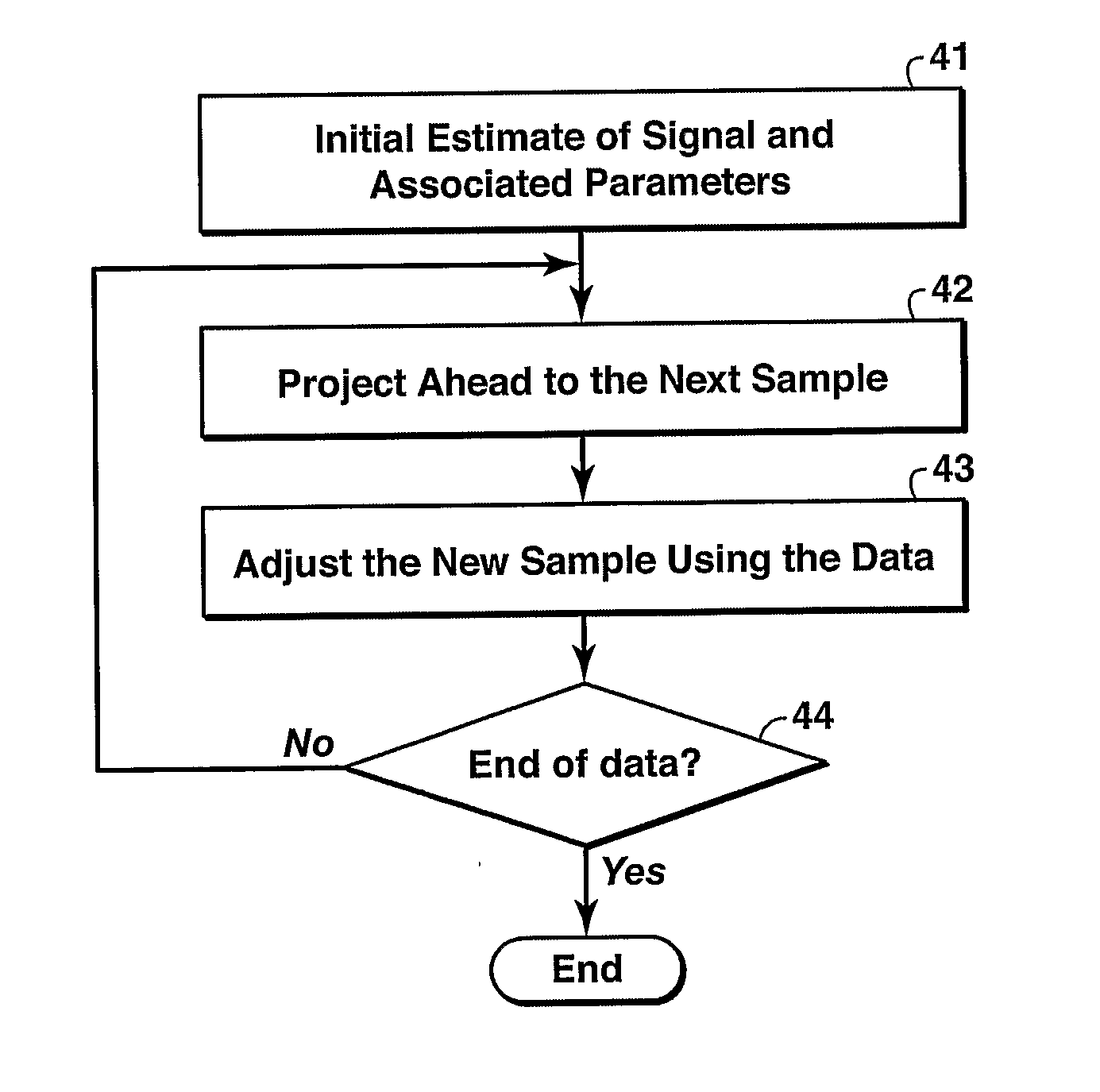
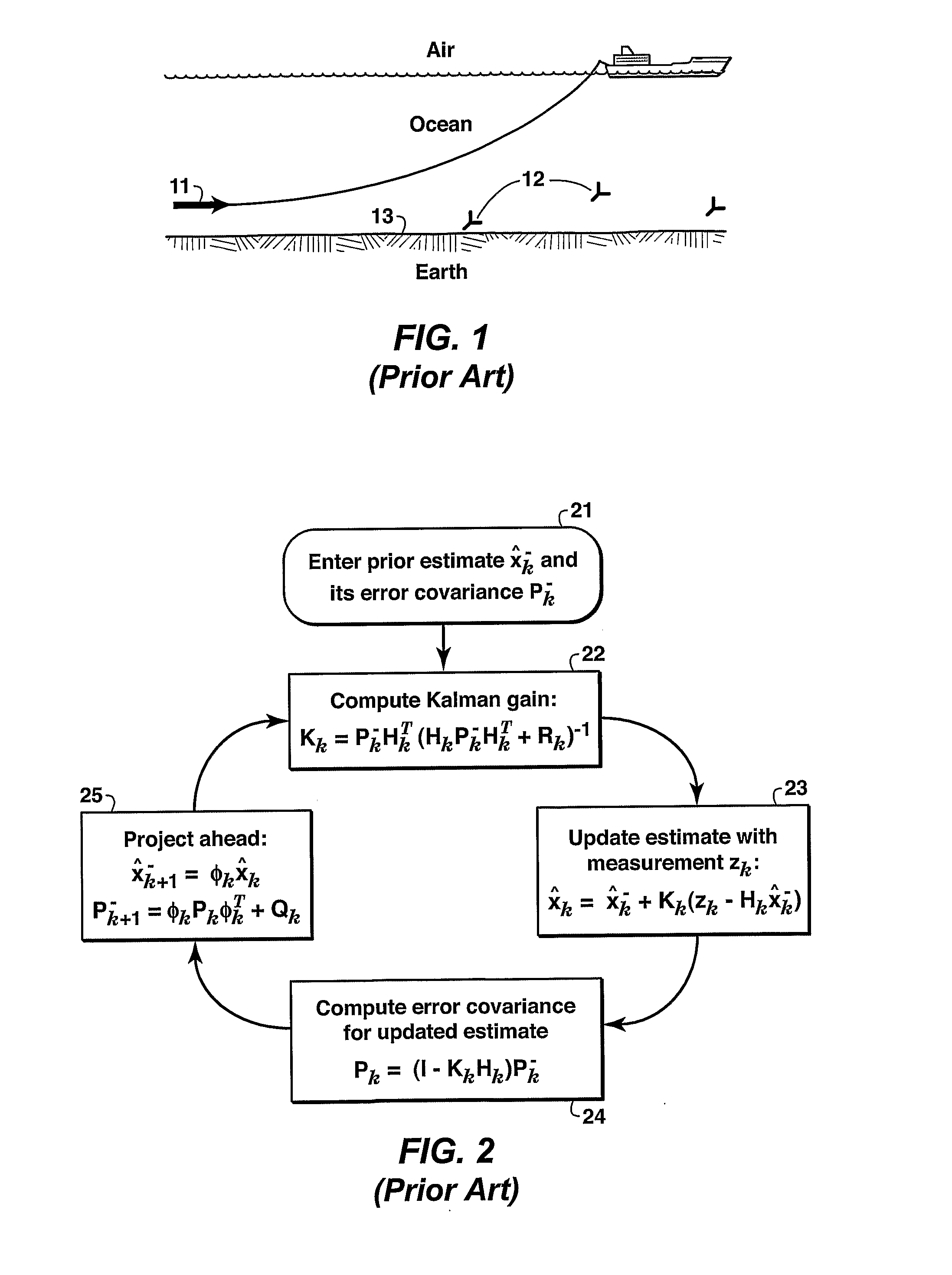
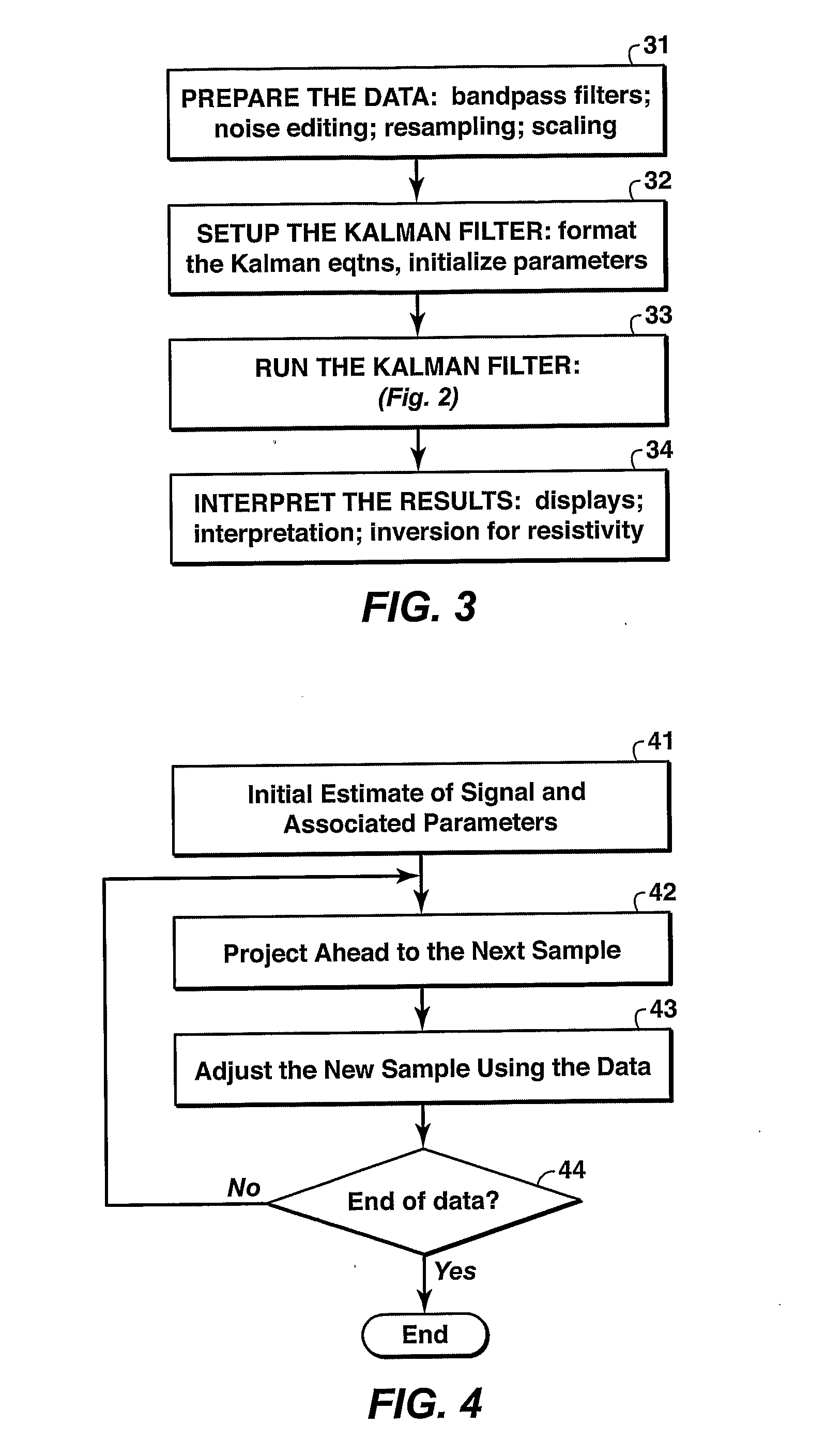
- A method utilizing a modified Kalman filter algorithm to track amplitude and phase changes of periodic electromagnetic signals, incorporating state and measurement equations, and noise covariance matrices to process data over large windows, thereby improving signal recovery from noise.
Computational Efficiency Considerations
The implementation of Kalman filters for noise reduction necessitates careful consideration of computational efficiency, particularly in resource-constrained environments or real-time applications. The computational complexity of standard Kalman filter operations scales with O(n³), where n represents the state vector dimension, primarily due to matrix inversion operations required during the update phase. This can become prohibitively expensive for high-dimensional systems or applications requiring rapid processing.
Several optimization strategies have emerged to address these computational challenges. Matrix factorization techniques, such as Cholesky decomposition or QR factorization, can significantly reduce the computational burden of matrix inversions while maintaining numerical stability. These approaches transform the original matrices into more computationally manageable forms, enabling more efficient calculations.
For systems with specific structural properties, specialized variants like the Information Filter or Square Root Filter offer computational advantages by reformulating the standard equations to avoid certain expensive operations. The Information Filter, for instance, works with the inverse of the covariance matrix, which can be advantageous in scenarios with numerous measurements but relatively few states.
Memory management represents another critical aspect of Kalman filter implementation. Efficient memory allocation and reuse strategies can substantially reduce overhead, particularly in embedded systems with limited RAM. Pre-allocation of matrices and vectors, coupled with in-place operations where possible, minimizes memory fragmentation and allocation overhead during runtime execution.
Parallel computing architectures present significant opportunities for accelerating Kalman filter computations. Modern GPUs can execute matrix operations concurrently, potentially offering orders of magnitude improvement in processing speed for large-scale applications. Similarly, multi-core CPUs can distribute computational load across cores, though careful synchronization is required to maintain algorithmic integrity.
For extremely resource-constrained environments, approximate Kalman filter implementations may be necessary. Techniques such as covariance tapering, measurement culling, or state vector dimension reduction can dramatically decrease computational requirements at the cost of some estimation accuracy. The optimal balance between computational efficiency and estimation quality depends heavily on the specific application requirements and available resources.
Real-time performance considerations often necessitate fixed-point arithmetic implementations, particularly in embedded systems without floating-point hardware. While these implementations reduce computational overhead, they require careful management of numerical precision to prevent error accumulation that could destabilize the filter over time.
Several optimization strategies have emerged to address these computational challenges. Matrix factorization techniques, such as Cholesky decomposition or QR factorization, can significantly reduce the computational burden of matrix inversions while maintaining numerical stability. These approaches transform the original matrices into more computationally manageable forms, enabling more efficient calculations.
For systems with specific structural properties, specialized variants like the Information Filter or Square Root Filter offer computational advantages by reformulating the standard equations to avoid certain expensive operations. The Information Filter, for instance, works with the inverse of the covariance matrix, which can be advantageous in scenarios with numerous measurements but relatively few states.
Memory management represents another critical aspect of Kalman filter implementation. Efficient memory allocation and reuse strategies can substantially reduce overhead, particularly in embedded systems with limited RAM. Pre-allocation of matrices and vectors, coupled with in-place operations where possible, minimizes memory fragmentation and allocation overhead during runtime execution.
Parallel computing architectures present significant opportunities for accelerating Kalman filter computations. Modern GPUs can execute matrix operations concurrently, potentially offering orders of magnitude improvement in processing speed for large-scale applications. Similarly, multi-core CPUs can distribute computational load across cores, though careful synchronization is required to maintain algorithmic integrity.
For extremely resource-constrained environments, approximate Kalman filter implementations may be necessary. Techniques such as covariance tapering, measurement culling, or state vector dimension reduction can dramatically decrease computational requirements at the cost of some estimation accuracy. The optimal balance between computational efficiency and estimation quality depends heavily on the specific application requirements and available resources.
Real-time performance considerations often necessitate fixed-point arithmetic implementations, particularly in embedded systems without floating-point hardware. While these implementations reduce computational overhead, they require careful management of numerical precision to prevent error accumulation that could destabilize the filter over time.
Real-time Processing Requirements and Solutions
Real-time implementation of Kalman filters presents unique challenges that require careful consideration of computational resources, latency requirements, and system architecture. In high-frequency data acquisition environments such as autonomous vehicles, industrial control systems, or financial trading platforms, Kalman filter algorithms must process incoming data streams with minimal delay while maintaining accuracy. Typical real-time applications demand processing speeds ranging from milliseconds to microseconds, depending on the specific use case.
The computational complexity of Kalman filters scales with the square of the state vector dimension, creating potential bottlenecks in resource-constrained environments. To address this challenge, several optimization techniques have emerged. Matrix factorization methods like Cholesky decomposition can reduce computational overhead by 30-40% compared to standard implementations. Square-root filtering variants provide enhanced numerical stability while maintaining comparable processing speeds.
Hardware acceleration represents another critical solution pathway for real-time Kalman filter deployment. Field-Programmable Gate Arrays (FPGAs) offer significant performance advantages, with studies demonstrating up to 100x speedup for specific filter configurations compared to general-purpose CPU implementations. Graphics Processing Units (GPUs) provide an alternative acceleration platform, particularly effective for high-dimensional state spaces or when processing multiple independent filters simultaneously.
Distributed computing architectures enable scalable real-time processing by partitioning filter operations across multiple processing nodes. This approach is particularly valuable in sensor fusion applications where data streams originate from geographically dispersed sources. Federated Kalman filter implementations can reduce communication bandwidth requirements by up to 60% while maintaining estimation accuracy within acceptable bounds.
Memory management strategies significantly impact real-time performance. Circular buffer implementations minimize memory allocation overhead during execution, while cache-aware algorithm variants optimize memory access patterns to reduce latency. For embedded systems with severe memory constraints, reduced-order Kalman filters offer a viable compromise, trading modest accuracy reductions for substantial memory footprint reductions.
Adaptive processing techniques further enhance real-time capabilities by dynamically adjusting filter parameters based on computational load and estimation requirements. Variable update rate implementations can prioritize critical measurements during high-load periods, while measurement gating techniques reduce unnecessary computation by filtering out statistically insignificant inputs before full processing.
The computational complexity of Kalman filters scales with the square of the state vector dimension, creating potential bottlenecks in resource-constrained environments. To address this challenge, several optimization techniques have emerged. Matrix factorization methods like Cholesky decomposition can reduce computational overhead by 30-40% compared to standard implementations. Square-root filtering variants provide enhanced numerical stability while maintaining comparable processing speeds.
Hardware acceleration represents another critical solution pathway for real-time Kalman filter deployment. Field-Programmable Gate Arrays (FPGAs) offer significant performance advantages, with studies demonstrating up to 100x speedup for specific filter configurations compared to general-purpose CPU implementations. Graphics Processing Units (GPUs) provide an alternative acceleration platform, particularly effective for high-dimensional state spaces or when processing multiple independent filters simultaneously.
Distributed computing architectures enable scalable real-time processing by partitioning filter operations across multiple processing nodes. This approach is particularly valuable in sensor fusion applications where data streams originate from geographically dispersed sources. Federated Kalman filter implementations can reduce communication bandwidth requirements by up to 60% while maintaining estimation accuracy within acceptable bounds.
Memory management strategies significantly impact real-time performance. Circular buffer implementations minimize memory allocation overhead during execution, while cache-aware algorithm variants optimize memory access patterns to reduce latency. For embedded systems with severe memory constraints, reduced-order Kalman filters offer a viable compromise, trading modest accuracy reductions for substantial memory footprint reductions.
Adaptive processing techniques further enhance real-time capabilities by dynamically adjusting filter parameters based on computational load and estimation requirements. Variable update rate implementations can prioritize critical measurements during high-load periods, while measurement gating techniques reduce unnecessary computation by filtering out statistically insignificant inputs before full processing.
Unlock deeper insights with Patsnap Eureka Quick Research — get a full tech report to explore trends and direct your research. Try now!
Generate Your Research Report Instantly with AI Agent
Supercharge your innovation with Patsnap Eureka AI Agent Platform!