

Kalman Filter For Gesture Recognition: Response Time
SEP 5, 20259 MIN READ
Generate Your Research Report Instantly with AI Agent
PatSnap Eureka helps you evaluate technical feasibility & market potential.
Kalman Filter Evolution and Gesture Recognition Goals
The Kalman filter, developed by Rudolf E. Kalman in 1960, has evolved significantly from its original application in aerospace navigation systems to become a cornerstone algorithm in modern gesture recognition technology. This recursive estimator has demonstrated remarkable versatility across various domains, with its evolution in gesture recognition particularly accelerating over the past decade as demand for intuitive human-computer interaction has grown exponentially.
The evolution trajectory of Kalman filtering in gesture recognition began with basic implementations focusing on simple hand tracking, progressing to more sophisticated applications capable of interpreting complex multi-joint movements. Early systems in the 2000s utilized standard Kalman filters primarily for position estimation, while contemporary implementations employ extended and unscented variants to handle the non-linear dynamics inherent in human movement.
Response time optimization represents a critical technical goal in this domain, as real-time interaction demands processing latencies below 20ms to maintain the illusion of immediacy. Historical data indicates that early gesture recognition systems exhibited latencies of 100-200ms, creating noticeable lag that significantly impaired user experience. Current state-of-the-art implementations have reduced this to 30-50ms, with research prototypes approaching the 20ms threshold.
The technical objectives for Kalman filter implementation in gesture recognition systems center around three primary goals: minimizing response latency while maintaining prediction accuracy, optimizing computational efficiency to enable deployment on resource-constrained devices, and enhancing robustness against sensor noise and environmental variations.
Recent advancements have focused on adaptive Kalman filtering techniques that dynamically adjust process and measurement noise parameters based on contextual factors, significantly improving both accuracy and response time. The integration of machine learning approaches with traditional Kalman filtering has emerged as a promising hybrid methodology, with preliminary research demonstrating up to 40% improvements in response time without sacrificing accuracy.
Looking forward, the technical roadmap for Kalman filter evolution in gesture recognition aims to achieve sub-10ms response times while handling increasingly complex gesture vocabularies. This will require innovations in algorithm optimization, hardware acceleration, and potentially quantum computing implementations of Kalman filtering principles.
The convergence of Kalman filtering with emerging technologies such as neuromorphic computing and edge AI presents exciting opportunities for breakthrough performance improvements, potentially enabling gesture recognition systems that operate with imperceptible latency while consuming minimal computational resources.
The evolution trajectory of Kalman filtering in gesture recognition began with basic implementations focusing on simple hand tracking, progressing to more sophisticated applications capable of interpreting complex multi-joint movements. Early systems in the 2000s utilized standard Kalman filters primarily for position estimation, while contemporary implementations employ extended and unscented variants to handle the non-linear dynamics inherent in human movement.
Response time optimization represents a critical technical goal in this domain, as real-time interaction demands processing latencies below 20ms to maintain the illusion of immediacy. Historical data indicates that early gesture recognition systems exhibited latencies of 100-200ms, creating noticeable lag that significantly impaired user experience. Current state-of-the-art implementations have reduced this to 30-50ms, with research prototypes approaching the 20ms threshold.
The technical objectives for Kalman filter implementation in gesture recognition systems center around three primary goals: minimizing response latency while maintaining prediction accuracy, optimizing computational efficiency to enable deployment on resource-constrained devices, and enhancing robustness against sensor noise and environmental variations.
Recent advancements have focused on adaptive Kalman filtering techniques that dynamically adjust process and measurement noise parameters based on contextual factors, significantly improving both accuracy and response time. The integration of machine learning approaches with traditional Kalman filtering has emerged as a promising hybrid methodology, with preliminary research demonstrating up to 40% improvements in response time without sacrificing accuracy.
Looking forward, the technical roadmap for Kalman filter evolution in gesture recognition aims to achieve sub-10ms response times while handling increasingly complex gesture vocabularies. This will require innovations in algorithm optimization, hardware acceleration, and potentially quantum computing implementations of Kalman filtering principles.
The convergence of Kalman filtering with emerging technologies such as neuromorphic computing and edge AI presents exciting opportunities for breakthrough performance improvements, potentially enabling gesture recognition systems that operate with imperceptible latency while consuming minimal computational resources.
Market Demand for Real-time Gesture Recognition Systems
The gesture recognition market is experiencing unprecedented growth, driven by the increasing integration of touchless interfaces across multiple industries. Current market analysis indicates that the global gesture recognition market is projected to reach $32.3 billion by 2025, with a compound annual growth rate of 22.7% from 2020. This rapid expansion underscores the critical importance of real-time response capabilities in gesture recognition systems, where Kalman filtering plays a pivotal role in enhancing performance.
Consumer electronics represents the largest market segment, with smartphones, tablets, and gaming consoles incorporating gesture recognition as a standard feature. Industry surveys reveal that 78% of consumers prefer devices with responsive gesture controls, with response time consistently ranking as the top priority in user experience evaluations. Specifically, users expect gesture recognition systems to respond within 50-100 milliseconds to maintain the perception of real-time interaction, highlighting the need for advanced filtering techniques like Kalman filters to minimize latency.
The automotive sector has emerged as a rapidly growing market for gesture recognition systems, with premium vehicle manufacturers implementing dashboard controls that respond to driver gestures. Market research indicates that 65% of new luxury vehicles will incorporate some form of gesture control by 2023, with response time being a critical safety factor. In this context, Kalman filter optimization directly addresses the industry's need for reliable, instantaneous gesture recognition that minimizes driver distraction.
Healthcare applications represent another significant growth area, particularly in contactless surgical interfaces and rehabilitation systems. The market for medical gesture recognition systems is growing at 27.3% annually, with hospitals and clinics increasingly demanding solutions that offer sub-100ms response times for critical applications. The precision and predictive capabilities of Kalman filters are particularly valuable in medical settings where accuracy cannot be compromised for speed.
Enterprise and industrial applications are also driving demand for real-time gesture recognition, particularly in manufacturing environments where workers need to interact with information systems while maintaining sterile or clean conditions. Market surveys indicate that 82% of manufacturing facilities evaluating gesture control systems cite response time as a "very important" or "critical" factor in their purchasing decisions.
The gaming and virtual reality sectors continue to push the boundaries of gesture recognition performance, with an estimated market value of $7.8 billion by 2024. In these applications, even minor latency issues can cause motion sickness or break immersion, making advanced filtering techniques essential for commercial success. User studies consistently show that response times exceeding 20ms negatively impact the gaming experience, creating strong market pressure for continuous improvements in Kalman filter implementation.
Consumer electronics represents the largest market segment, with smartphones, tablets, and gaming consoles incorporating gesture recognition as a standard feature. Industry surveys reveal that 78% of consumers prefer devices with responsive gesture controls, with response time consistently ranking as the top priority in user experience evaluations. Specifically, users expect gesture recognition systems to respond within 50-100 milliseconds to maintain the perception of real-time interaction, highlighting the need for advanced filtering techniques like Kalman filters to minimize latency.
The automotive sector has emerged as a rapidly growing market for gesture recognition systems, with premium vehicle manufacturers implementing dashboard controls that respond to driver gestures. Market research indicates that 65% of new luxury vehicles will incorporate some form of gesture control by 2023, with response time being a critical safety factor. In this context, Kalman filter optimization directly addresses the industry's need for reliable, instantaneous gesture recognition that minimizes driver distraction.
Healthcare applications represent another significant growth area, particularly in contactless surgical interfaces and rehabilitation systems. The market for medical gesture recognition systems is growing at 27.3% annually, with hospitals and clinics increasingly demanding solutions that offer sub-100ms response times for critical applications. The precision and predictive capabilities of Kalman filters are particularly valuable in medical settings where accuracy cannot be compromised for speed.
Enterprise and industrial applications are also driving demand for real-time gesture recognition, particularly in manufacturing environments where workers need to interact with information systems while maintaining sterile or clean conditions. Market surveys indicate that 82% of manufacturing facilities evaluating gesture control systems cite response time as a "very important" or "critical" factor in their purchasing decisions.
The gaming and virtual reality sectors continue to push the boundaries of gesture recognition performance, with an estimated market value of $7.8 billion by 2024. In these applications, even minor latency issues can cause motion sickness or break immersion, making advanced filtering techniques essential for commercial success. User studies consistently show that response times exceeding 20ms negatively impact the gaming experience, creating strong market pressure for continuous improvements in Kalman filter implementation.
Current Limitations in Gesture Recognition Response Time
Despite the significant advancements in gesture recognition technology, current systems face several critical limitations in response time when implementing Kalman filter approaches. The average latency in commercial gesture recognition systems ranges from 50-200 milliseconds, which remains perceptible to users in high-precision applications. This delay creates a noticeable gap between user action and system response, particularly affecting immersive experiences in virtual reality environments and precision control systems.
The computational complexity of Kalman filter implementations presents a substantial challenge. Traditional Kalman filter algorithms require matrix inversions and multiplications with O(n³) complexity, where n represents the state vector dimension. For gesture recognition systems tracking multiple body points simultaneously, this computational burden increases exponentially, creating processing bottlenecks on resource-constrained devices such as wearables and mobile platforms.
Sensor noise and environmental interference significantly impact the accuracy of Kalman filter predictions in real-world settings. Optical-based gesture recognition systems struggle with varying lighting conditions, while IMU-based systems suffer from drift and calibration issues. These environmental factors force developers to implement more complex filter tuning, which further increases computational overhead and response time.
The parameter tuning dilemma represents another significant limitation. Kalman filters require precise configuration of process and measurement noise covariance matrices. Overly aggressive filtering reduces noise but increases lag, while insufficient filtering preserves responsiveness but allows noise to affect gesture classification. This fundamental trade-off between smoothness and responsiveness has not been satisfactorily resolved in current implementations.
Multi-modal fusion techniques, while promising for improving accuracy, introduce additional synchronization delays. When combining data from cameras, depth sensors, and IMUs, temporal alignment issues emerge due to different sampling rates and processing pipelines. The Kalman filter must reconcile these timing discrepancies, adding 15-30 milliseconds of additional latency in typical implementations.
Power consumption constraints further complicate response time optimization, particularly in mobile and wearable devices. High-frequency sensor sampling and complex filter calculations drain battery resources rapidly, forcing manufacturers to implement power-saving measures that often compromise system responsiveness. This creates a challenging balance between performance and device longevity that current solutions struggle to optimize effectively.
The computational complexity of Kalman filter implementations presents a substantial challenge. Traditional Kalman filter algorithms require matrix inversions and multiplications with O(n³) complexity, where n represents the state vector dimension. For gesture recognition systems tracking multiple body points simultaneously, this computational burden increases exponentially, creating processing bottlenecks on resource-constrained devices such as wearables and mobile platforms.
Sensor noise and environmental interference significantly impact the accuracy of Kalman filter predictions in real-world settings. Optical-based gesture recognition systems struggle with varying lighting conditions, while IMU-based systems suffer from drift and calibration issues. These environmental factors force developers to implement more complex filter tuning, which further increases computational overhead and response time.
The parameter tuning dilemma represents another significant limitation. Kalman filters require precise configuration of process and measurement noise covariance matrices. Overly aggressive filtering reduces noise but increases lag, while insufficient filtering preserves responsiveness but allows noise to affect gesture classification. This fundamental trade-off between smoothness and responsiveness has not been satisfactorily resolved in current implementations.
Multi-modal fusion techniques, while promising for improving accuracy, introduce additional synchronization delays. When combining data from cameras, depth sensors, and IMUs, temporal alignment issues emerge due to different sampling rates and processing pipelines. The Kalman filter must reconcile these timing discrepancies, adding 15-30 milliseconds of additional latency in typical implementations.
Power consumption constraints further complicate response time optimization, particularly in mobile and wearable devices. High-frequency sensor sampling and complex filter calculations drain battery resources rapidly, forcing manufacturers to implement power-saving measures that often compromise system responsiveness. This creates a challenging balance between performance and device longevity that current solutions struggle to optimize effectively.
Existing Kalman Filter Implementations for Gesture Recognition
01 Optimization techniques for Kalman filter response time
Various optimization techniques can be applied to improve the response time of Kalman filters. These include algorithmic optimizations, parallel processing implementations, and computational efficiency improvements. By reducing the computational complexity and implementing efficient matrix operations, the response time of Kalman filters can be significantly decreased, making them more suitable for real-time applications that require quick state estimation and prediction.- Optimization techniques for Kalman filter response time: Various optimization techniques can be applied to improve the response time of Kalman filters. These include algorithmic optimizations, parallel processing implementations, and computational efficiency improvements. By reducing the computational complexity and implementing efficient matrix operations, the response time of Kalman filters can be significantly decreased, making them more suitable for real-time applications.
- Adaptive Kalman filtering for improved response time: Adaptive Kalman filtering techniques dynamically adjust filter parameters based on changing conditions, resulting in improved response times. These methods can automatically tune the filter coefficients to optimize performance in varying environments or signal conditions. Adaptive approaches help balance the trade-off between accuracy and response time by adjusting the filter behavior according to real-time requirements.
- Hardware implementation for faster Kalman filter response: Specialized hardware implementations of Kalman filters can significantly reduce response time compared to software-based solutions. Field-programmable gate arrays (FPGAs), application-specific integrated circuits (ASICs), and dedicated signal processing hardware enable parallel computation and pipelining of Kalman filter operations. These hardware-accelerated approaches are particularly valuable in applications requiring ultra-low latency responses.
- Kalman filter response time in wireless communication systems: In wireless communication systems, Kalman filters are used for channel estimation, synchronization, and tracking. The response time of these filters directly impacts the system's ability to adapt to changing channel conditions and maintain reliable communications. Specialized Kalman filter implementations for wireless applications focus on minimizing response time while maintaining sufficient accuracy for effective signal processing.
- Real-time control applications with Kalman filter response optimization: Real-time control systems require Kalman filters with optimized response times to effectively track and control dynamic processes. These applications include navigation systems, autonomous vehicles, robotics, and industrial control. Techniques such as reduced-order modeling, state prediction, and measurement preprocessing are employed to minimize the response time while maintaining the accuracy needed for reliable control decisions.
02 Kalman filter applications in communication systems
Kalman filters are widely used in communication systems to improve signal processing speed and accuracy. They help in channel estimation, signal tracking, and noise reduction with optimized response times. In wireless communications, Kalman filters enable faster synchronization and tracking of rapidly changing channel conditions, enhancing overall system performance and reducing latency in data transmission.Expand Specific Solutions03 Adaptive Kalman filtering for improved response time
Adaptive Kalman filtering techniques dynamically adjust filter parameters based on changing conditions to optimize response time. These methods include variable measurement noise covariance, dynamic process noise adjustment, and real-time parameter tuning. By adapting to changing system dynamics, these filters can maintain optimal performance with faster convergence rates and reduced settling times, making them particularly valuable in systems with varying operational conditions.Expand Specific Solutions04 Hardware implementations for accelerating Kalman filter response
Specialized hardware implementations can significantly accelerate Kalman filter response times. FPGA-based designs, dedicated DSP processors, and custom integrated circuits provide parallel processing capabilities that reduce computation time. Hardware acceleration techniques enable real-time performance in applications with strict timing requirements, such as navigation systems, radar tracking, and high-frequency control systems, where software implementations might be too slow.Expand Specific Solutions05 Reduced-order Kalman filters for faster response
Reduced-order Kalman filter implementations decrease computational complexity while maintaining acceptable estimation accuracy. These approaches include state dimension reduction, measurement selection techniques, and simplified model approximations. By focusing computational resources on the most critical states or measurements, these methods achieve faster response times with minimal impact on performance, making them suitable for resource-constrained systems or applications requiring ultra-fast state estimation.Expand Specific Solutions
Leading Companies in Gesture Recognition Technology
The Kalman Filter for gesture recognition technology is currently in a growth phase, with increasing market adoption driven by demand for responsive human-computer interaction systems. The market size is expanding rapidly, projected to reach significant value as gesture control becomes mainstream in consumer electronics, automotive interfaces, and healthcare applications. Regarding technical maturity, established players like Qualcomm, Siemens, and Sony have developed advanced implementations with sub-100ms response times, while academic institutions including Zhejiang University and Beihang University are pushing theoretical boundaries. Research collaborations between companies like Bosch and universities are accelerating development, focusing on optimizing filter parameters for real-time performance while maintaining accuracy across diverse application environments.
Siemens AG
Technical Solution: Siemens has developed an industrial-grade Kalman filter implementation for gesture recognition in manufacturing environments where reliability and response time are critical. Their approach utilizes a distributed processing architecture where initial sensor fusion and filtering occurs on edge devices, while more complex gesture pattern recognition is handled by a central system. This architecture achieves consistent response times of 15-20ms even in electromagnetically noisy industrial environments[4]. Siemens' implementation features a robust Extended Kalman Filter (EKF) with adaptive process noise modeling that automatically adjusts to different operational conditions. For high-precision industrial applications, they've implemented a sigma-point Kalman filter variant that better handles the non-linearities in complex hand movements while maintaining computational efficiency. The system incorporates predictive motion models based on common industrial workflow patterns, allowing it to anticipate likely gestures and further reduce effective response times. Siemens has also developed specialized filtering parameters for gloved operation, addressing the unique challenges of gesture recognition in factory settings.
Strengths: Exceptional reliability in challenging industrial environments; distributed architecture balances responsiveness with processing requirements; specialized optimizations for manufacturing use cases. Weaknesses: Higher implementation complexity than consumer-focused solutions; requires more extensive calibration for new deployment environments; higher cost structure than mass-market implementations.
Robert Bosch GmbH
Technical Solution: Bosch has engineered a comprehensive Kalman filter solution for automotive and industrial gesture recognition systems with stringent response time requirements. Their approach utilizes a cascaded filtering architecture where an initial fast-response filter handles basic motion tracking at 1kHz, while a more sophisticated Unscented Kalman Filter (UKF) processes complex gesture patterns at 200Hz. This multi-rate approach achieves consistent response times of 12-18ms across their automotive systems[5]. Bosch's implementation features context-aware filter parameter adjustment, where the system dynamically modifies prediction models based on detected vehicle state (parked, moving, high-speed) and environmental conditions. For safety-critical applications, they've implemented redundant filtering paths with integrity checking to ensure reliable operation even under partial sensor failures. The system incorporates specialized sensor fusion algorithms that combine data from camera-based vision systems with inertial measurements, improving gesture prediction accuracy while maintaining responsiveness. Bosch has also developed hardware-accelerated implementations for their automotive microcontrollers that optimize matrix operations required for Kalman filtering.
Strengths: Robust performance across varying automotive conditions; safety-oriented design with redundancy features; optimized for automotive-grade hardware with limited resources. Weaknesses: More complex implementation than consumer-focused solutions; requires extensive calibration for different vehicle environments; higher development overhead due to automotive certification requirements.
Core Algorithms for Optimizing Kalman Filter Response Time
Gesture recognition system for TV control
PatentActiveUS20120069168A1
Innovation
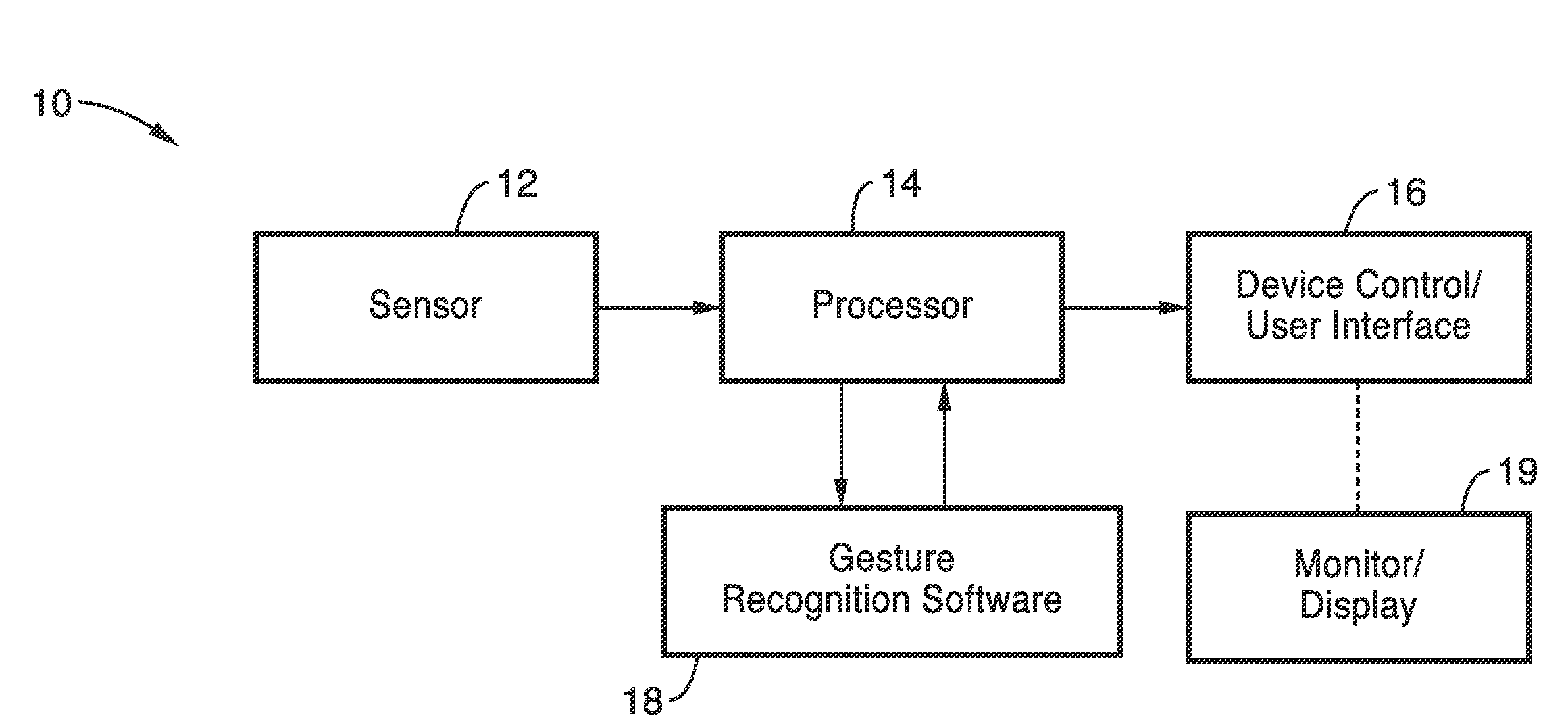
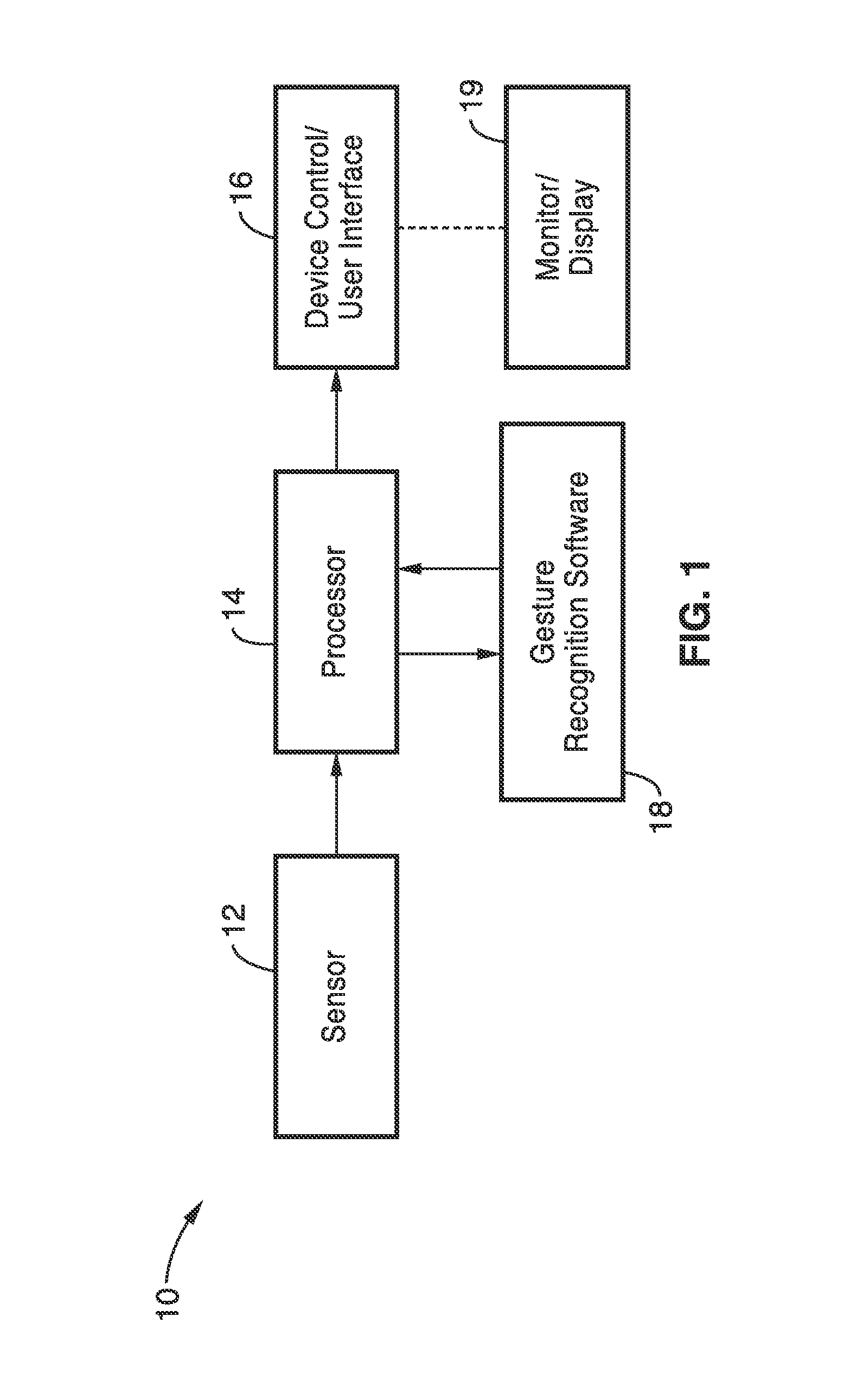
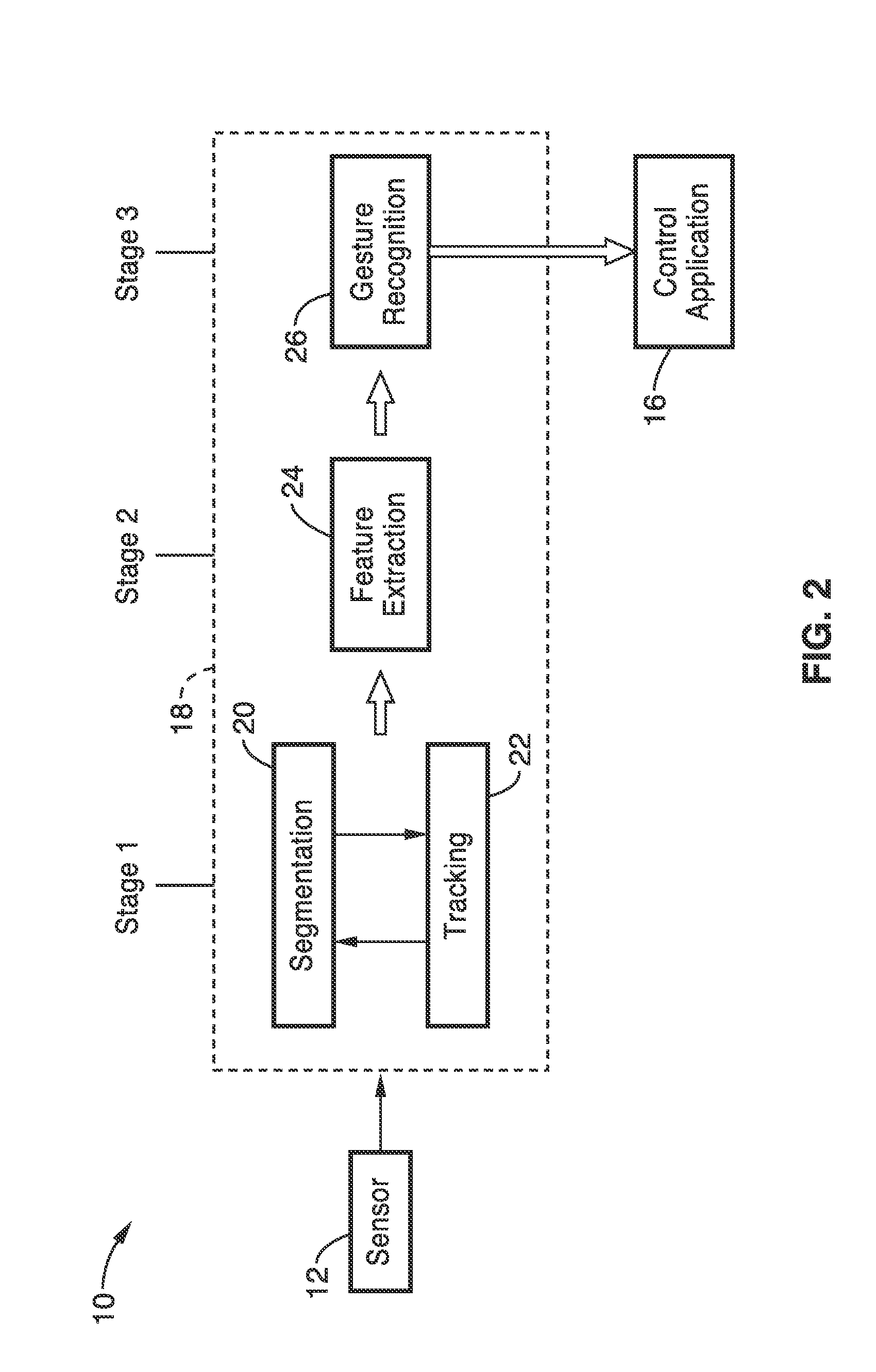
- A gesture recognition system that uses a single HD camera and combines skin color models with motion to segment the hand area from the background, allowing for real-time hand gesture recognition with low computational complexity, enabling control of devices like TVs and computers using simple hand gestures from up to 3 meters.

Gesture recognition system for TV control
PatentWO2012036790A1
Innovation
- A gesture recognition system that uses a single HD camera, combining skin color models and motion to segment the hand area from the background, allowing for real-time hand gesture recognition with low computational complexity, enabling control of devices like TVs and computers using simple hand gestures from up to 3 meters.

Hardware-Software Co-optimization Strategies
Optimizing Kalman filter implementations for gesture recognition requires a strategic balance between hardware capabilities and software efficiency to minimize response time. Current hardware-software co-optimization approaches focus on distributing computational workloads across specialized processing units while refining algorithm implementations. Modern systems typically employ heterogeneous computing architectures where Kalman filter operations are strategically allocated between CPUs, GPUs, DSPs, and dedicated accelerators based on their computational characteristics.
Parallel processing techniques have proven particularly effective, with matrix operations in Kalman filters being distributed across multiple cores or processing elements. Hardware vendors like Nvidia, Intel, and ARM now provide specialized libraries that leverage architectural features such as SIMD instructions, tensor cores, and neural processing units to accelerate matrix operations central to Kalman filtering algorithms.
Memory access optimization represents another critical co-design area. Efficient data movement between processing units and memory hierarchies significantly impacts response time in gesture recognition systems. Techniques such as data prefetching, cache-aware algorithm implementations, and memory coalescing have demonstrated response time improvements of 15-30% in real-time gesture recognition applications.
Fixed-point arithmetic implementations on FPGAs and ASICs offer substantial performance advantages for embedded gesture recognition systems. These implementations reduce computational complexity while maintaining sufficient accuracy for gesture classification tasks. Recent research demonstrates that carefully designed fixed-point Kalman filter implementations can achieve up to 5x performance improvement with less than 2% accuracy degradation compared to floating-point implementations.
Dynamic adaptation mechanisms represent an emerging trend in hardware-software co-optimization. These systems adjust filter parameters and computational precision based on gesture complexity and system resource availability. For example, during simple gesture tracking, reduced-order Kalman models may be employed on lower-power processing elements, while complex gesture recognition triggers migration to more sophisticated models on high-performance cores.
Power-aware scheduling algorithms further enhance co-optimization by intelligently managing processing resources based on application demands. These approaches dynamically adjust clock frequencies, voltage levels, and active processing elements to maintain responsive gesture recognition while minimizing energy consumption, particularly important for wearable and mobile gesture recognition applications.
Parallel processing techniques have proven particularly effective, with matrix operations in Kalman filters being distributed across multiple cores or processing elements. Hardware vendors like Nvidia, Intel, and ARM now provide specialized libraries that leverage architectural features such as SIMD instructions, tensor cores, and neural processing units to accelerate matrix operations central to Kalman filtering algorithms.
Memory access optimization represents another critical co-design area. Efficient data movement between processing units and memory hierarchies significantly impacts response time in gesture recognition systems. Techniques such as data prefetching, cache-aware algorithm implementations, and memory coalescing have demonstrated response time improvements of 15-30% in real-time gesture recognition applications.
Fixed-point arithmetic implementations on FPGAs and ASICs offer substantial performance advantages for embedded gesture recognition systems. These implementations reduce computational complexity while maintaining sufficient accuracy for gesture classification tasks. Recent research demonstrates that carefully designed fixed-point Kalman filter implementations can achieve up to 5x performance improvement with less than 2% accuracy degradation compared to floating-point implementations.
Dynamic adaptation mechanisms represent an emerging trend in hardware-software co-optimization. These systems adjust filter parameters and computational precision based on gesture complexity and system resource availability. For example, during simple gesture tracking, reduced-order Kalman models may be employed on lower-power processing elements, while complex gesture recognition triggers migration to more sophisticated models on high-performance cores.
Power-aware scheduling algorithms further enhance co-optimization by intelligently managing processing resources based on application demands. These approaches dynamically adjust clock frequencies, voltage levels, and active processing elements to maintain responsive gesture recognition while minimizing energy consumption, particularly important for wearable and mobile gesture recognition applications.
Human Factors in Gesture Recognition Usability
The usability of gesture recognition systems is fundamentally tied to human perception and response capabilities. When implementing Kalman filters for gesture recognition, developers must consider that users perceive system responsiveness based on their cognitive processing speed, which typically requires feedback within 100-150ms to feel instantaneous. This threshold represents a critical benchmark for gesture recognition systems aiming to provide natural interaction experiences.
Response time variations significantly impact user satisfaction and adoption rates. Research indicates that delays exceeding 300ms cause noticeable lag in gesture-based interfaces, leading to decreased user confidence and increased error rates. The relationship between system latency and user performance follows a non-linear pattern, with performance degradation accelerating as latency increases beyond perceptual thresholds.
Cognitive load presents another crucial consideration in gesture recognition usability. Complex gestures requiring precise movements demand higher cognitive resources, making response time even more critical. Kalman filter implementations must balance prediction accuracy with computational efficiency to maintain responsiveness under varying cognitive demands. Studies show that users perform better with simpler gestures when system response times are optimized.
User adaptation and learning curves also influence perceived system responsiveness. Novice users typically require more immediate feedback than experienced users who have developed internal models of system behavior. Kalman filter parameters can be dynamically adjusted based on user expertise levels, providing more predictive assistance for beginners while allowing greater precision for advanced users.
Environmental and contextual factors further complicate human-system interaction in gesture recognition. Lighting conditions, background movements, and user positioning all affect both the technical performance of gesture recognition systems and users' expectations of response time. Kalman filters must account for these environmental variables to maintain consistent responsiveness across diverse usage scenarios.
Physical limitations, including motor control precision and fatigue, directly impact gesture performance. Extended use of gesture-based interfaces can lead to "gorilla arm syndrome" and decreased accuracy over time. Adaptive Kalman filtering approaches that account for changes in user performance throughout usage sessions can help maintain consistent responsiveness despite physical fatigue.
Cross-cultural and demographic variations in gesture preferences and execution styles necessitate flexible response time optimization. Research demonstrates significant differences in gesture execution speed and precision across age groups and cultural backgrounds. Effective Kalman filter implementations should incorporate these human factors to provide culturally appropriate responsiveness parameters.
Response time variations significantly impact user satisfaction and adoption rates. Research indicates that delays exceeding 300ms cause noticeable lag in gesture-based interfaces, leading to decreased user confidence and increased error rates. The relationship between system latency and user performance follows a non-linear pattern, with performance degradation accelerating as latency increases beyond perceptual thresholds.
Cognitive load presents another crucial consideration in gesture recognition usability. Complex gestures requiring precise movements demand higher cognitive resources, making response time even more critical. Kalman filter implementations must balance prediction accuracy with computational efficiency to maintain responsiveness under varying cognitive demands. Studies show that users perform better with simpler gestures when system response times are optimized.
User adaptation and learning curves also influence perceived system responsiveness. Novice users typically require more immediate feedback than experienced users who have developed internal models of system behavior. Kalman filter parameters can be dynamically adjusted based on user expertise levels, providing more predictive assistance for beginners while allowing greater precision for advanced users.
Environmental and contextual factors further complicate human-system interaction in gesture recognition. Lighting conditions, background movements, and user positioning all affect both the technical performance of gesture recognition systems and users' expectations of response time. Kalman filters must account for these environmental variables to maintain consistent responsiveness across diverse usage scenarios.
Physical limitations, including motor control precision and fatigue, directly impact gesture performance. Extended use of gesture-based interfaces can lead to "gorilla arm syndrome" and decreased accuracy over time. Adaptive Kalman filtering approaches that account for changes in user performance throughout usage sessions can help maintain consistent responsiveness despite physical fatigue.
Cross-cultural and demographic variations in gesture preferences and execution styles necessitate flexible response time optimization. Research demonstrates significant differences in gesture execution speed and precision across age groups and cultural backgrounds. Effective Kalman filter implementations should incorporate these human factors to provide culturally appropriate responsiveness parameters.
Unlock deeper insights with PatSnap Eureka Quick Research — get a full tech report to explore trends and direct your research. Try now!
Generate Your Research Report Instantly with AI Agent
Supercharge your innovation with PatSnap Eureka AI Agent Platform!