

Balancing Performance and Cost in Battery Management System Development
AUG 8, 20259 MIN READ
Generate Your Research Report Instantly with AI Agent
PatSnap Eureka helps you evaluate technical feasibility & market potential.
BMS Evolution and Objectives
Battery Management Systems (BMS) have undergone significant evolution since their inception, driven by the rapid advancement of battery technologies and the increasing demands of various applications. The primary objective of BMS development has been to optimize the performance, safety, and longevity of battery systems while maintaining cost-effectiveness.
In the early stages, BMS focused primarily on basic monitoring and protection functions. These systems were designed to prevent overcharging, over-discharging, and overheating, which were critical for ensuring the safety and basic functionality of battery packs. As battery technologies advanced, particularly with the widespread adoption of lithium-ion batteries, the role of BMS expanded significantly.
The evolution of BMS has been marked by the integration of more sophisticated algorithms and sensing technologies. Modern BMS are expected to provide accurate state estimation, including State of Charge (SoC), State of Health (SoH), and State of Power (SoP). These capabilities are crucial for optimizing battery performance and extending lifespan, particularly in applications such as electric vehicles and grid energy storage.
Another key objective in BMS development has been the improvement of thermal management. As battery packs have grown in size and power density, effective thermal control has become essential for maintaining performance and preventing safety issues. BMS now incorporate advanced thermal modeling and active cooling strategies to ensure optimal operating conditions.
The push for increased energy density and faster charging capabilities has further complicated BMS design. Engineers must balance the desire for high performance with the need to prevent degradation and ensure safety. This has led to the development of more sophisticated cell balancing techniques and predictive maintenance algorithms.
Cost considerations have always been a critical factor in BMS development. As the automotive and energy storage markets have grown, there has been increasing pressure to reduce the overall cost of battery systems. This has driven efforts to optimize BMS hardware design, improve manufacturing processes, and develop more efficient software algorithms.
The current objectives in BMS development focus on achieving a delicate balance between performance enhancement and cost reduction. Key areas of focus include the development of more accurate and robust state estimation algorithms, the integration of artificial intelligence for predictive maintenance and performance optimization, and the design of scalable architectures that can adapt to different battery configurations and applications.
Looking ahead, the evolution of BMS is likely to continue in parallel with advancements in battery chemistry and electric vehicle technology. Future objectives may include the development of BMS that can seamlessly integrate with smart grids, support vehicle-to-grid applications, and adapt to new fast-charging technologies. The ultimate goal remains to create BMS that can maximize battery performance and lifespan while minimizing costs and ensuring the highest levels of safety and reliability.
In the early stages, BMS focused primarily on basic monitoring and protection functions. These systems were designed to prevent overcharging, over-discharging, and overheating, which were critical for ensuring the safety and basic functionality of battery packs. As battery technologies advanced, particularly with the widespread adoption of lithium-ion batteries, the role of BMS expanded significantly.
The evolution of BMS has been marked by the integration of more sophisticated algorithms and sensing technologies. Modern BMS are expected to provide accurate state estimation, including State of Charge (SoC), State of Health (SoH), and State of Power (SoP). These capabilities are crucial for optimizing battery performance and extending lifespan, particularly in applications such as electric vehicles and grid energy storage.
Another key objective in BMS development has been the improvement of thermal management. As battery packs have grown in size and power density, effective thermal control has become essential for maintaining performance and preventing safety issues. BMS now incorporate advanced thermal modeling and active cooling strategies to ensure optimal operating conditions.
The push for increased energy density and faster charging capabilities has further complicated BMS design. Engineers must balance the desire for high performance with the need to prevent degradation and ensure safety. This has led to the development of more sophisticated cell balancing techniques and predictive maintenance algorithms.
Cost considerations have always been a critical factor in BMS development. As the automotive and energy storage markets have grown, there has been increasing pressure to reduce the overall cost of battery systems. This has driven efforts to optimize BMS hardware design, improve manufacturing processes, and develop more efficient software algorithms.
The current objectives in BMS development focus on achieving a delicate balance between performance enhancement and cost reduction. Key areas of focus include the development of more accurate and robust state estimation algorithms, the integration of artificial intelligence for predictive maintenance and performance optimization, and the design of scalable architectures that can adapt to different battery configurations and applications.
Looking ahead, the evolution of BMS is likely to continue in parallel with advancements in battery chemistry and electric vehicle technology. Future objectives may include the development of BMS that can seamlessly integrate with smart grids, support vehicle-to-grid applications, and adapt to new fast-charging technologies. The ultimate goal remains to create BMS that can maximize battery performance and lifespan while minimizing costs and ensuring the highest levels of safety and reliability.
Market Demand Analysis
The market demand for advanced Battery Management Systems (BMS) is experiencing significant growth, driven by the rapid expansion of the electric vehicle (EV) industry and the increasing adoption of renewable energy storage solutions. As the global push for electrification intensifies, automotive manufacturers and energy companies are seeking more sophisticated BMS solutions that can optimize battery performance, extend lifespan, and reduce overall costs.
In the automotive sector, the demand for high-performance BMS is particularly strong. With EV sales projected to reach 26.8 million units globally by 2030, manufacturers are under pressure to develop BMS that can enhance range, reduce charging times, and improve overall vehicle efficiency. This has led to a surge in demand for BMS that can accurately monitor and manage battery health, temperature, and state of charge across diverse operating conditions.
The renewable energy storage market is another key driver of BMS demand. As grid-scale battery installations grow to support intermittent renewable sources like solar and wind, there is an increasing need for BMS that can manage large-scale battery arrays efficiently. The global energy storage market is expected to deploy 411 GWh of new capacity by 2030, creating substantial opportunities for advanced BMS solutions.
Cost considerations are becoming increasingly critical in BMS development. While performance remains a priority, manufacturers and energy companies are seeking solutions that can deliver optimal functionality at competitive price points. This has led to a growing demand for BMS that incorporate cost-effective sensors, streamlined architectures, and efficient power management strategies.
The industrial and consumer electronics sectors are also contributing to BMS market growth. As more devices and equipment incorporate lithium-ion batteries, there is a rising need for BMS that can ensure safety, longevity, and performance across a wide range of applications. This diversification of use cases is driving demand for flexible, scalable BMS solutions that can be adapted to various battery chemistries and form factors.
Geographically, the Asia-Pacific region, particularly China, is expected to lead BMS market growth, driven by its dominant position in EV manufacturing and battery production. However, significant demand is also emerging from North America and Europe as these regions accelerate their transition to electric mobility and renewable energy.
As the market evolves, there is a growing emphasis on BMS that can support next-generation battery technologies, such as solid-state batteries and advanced lithium-ion chemistries. This is creating demand for more sophisticated BMS capabilities, including predictive analytics, artificial intelligence integration, and enhanced thermal management features.
In the automotive sector, the demand for high-performance BMS is particularly strong. With EV sales projected to reach 26.8 million units globally by 2030, manufacturers are under pressure to develop BMS that can enhance range, reduce charging times, and improve overall vehicle efficiency. This has led to a surge in demand for BMS that can accurately monitor and manage battery health, temperature, and state of charge across diverse operating conditions.
The renewable energy storage market is another key driver of BMS demand. As grid-scale battery installations grow to support intermittent renewable sources like solar and wind, there is an increasing need for BMS that can manage large-scale battery arrays efficiently. The global energy storage market is expected to deploy 411 GWh of new capacity by 2030, creating substantial opportunities for advanced BMS solutions.
Cost considerations are becoming increasingly critical in BMS development. While performance remains a priority, manufacturers and energy companies are seeking solutions that can deliver optimal functionality at competitive price points. This has led to a growing demand for BMS that incorporate cost-effective sensors, streamlined architectures, and efficient power management strategies.
The industrial and consumer electronics sectors are also contributing to BMS market growth. As more devices and equipment incorporate lithium-ion batteries, there is a rising need for BMS that can ensure safety, longevity, and performance across a wide range of applications. This diversification of use cases is driving demand for flexible, scalable BMS solutions that can be adapted to various battery chemistries and form factors.
Geographically, the Asia-Pacific region, particularly China, is expected to lead BMS market growth, driven by its dominant position in EV manufacturing and battery production. However, significant demand is also emerging from North America and Europe as these regions accelerate their transition to electric mobility and renewable energy.
As the market evolves, there is a growing emphasis on BMS that can support next-generation battery technologies, such as solid-state batteries and advanced lithium-ion chemistries. This is creating demand for more sophisticated BMS capabilities, including predictive analytics, artificial intelligence integration, and enhanced thermal management features.
BMS Challenges and Constraints
Battery Management System (BMS) development faces significant challenges in balancing performance and cost. One of the primary constraints is the need for accurate and reliable battery state estimation, which requires sophisticated algorithms and sensors. These components can significantly increase the overall cost of the BMS, making it challenging to maintain affordability while ensuring high performance.
Another major challenge is the thermal management of battery packs. Efficient cooling systems are crucial for maintaining optimal battery performance and longevity, but they often come with increased complexity and cost. Balancing the need for effective thermal management with cost considerations requires careful engineering and innovative solutions.
The integration of advanced safety features presents another constraint in BMS development. While these features are essential for preventing catastrophic failures and ensuring user safety, they can add substantial costs to the system. Manufacturers must carefully weigh the trade-offs between comprehensive safety measures and maintaining competitive pricing.
Scalability and flexibility pose additional challenges in BMS design. As battery technologies evolve and energy storage requirements vary across different applications, BMS developers must create systems that can adapt to various battery chemistries and configurations. This versatility often comes at the expense of increased development costs and complexity.
The rapidly evolving regulatory landscape surrounding battery systems adds another layer of complexity to BMS development. Compliance with stringent safety standards and environmental regulations can necessitate frequent design updates and additional testing, potentially driving up costs and extending development timelines.
Power consumption of the BMS itself is a critical constraint, particularly in applications where energy efficiency is paramount. Balancing the need for sophisticated monitoring and control functions with low power consumption requires careful component selection and optimization of system architecture.
Lastly, the challenge of long-term reliability and durability cannot be overlooked. BMS components must withstand harsh environmental conditions and maintain accuracy over the entire lifespan of the battery pack. Achieving this level of robustness often requires the use of high-quality, more expensive components, further complicating the balance between performance and cost.
Another major challenge is the thermal management of battery packs. Efficient cooling systems are crucial for maintaining optimal battery performance and longevity, but they often come with increased complexity and cost. Balancing the need for effective thermal management with cost considerations requires careful engineering and innovative solutions.
The integration of advanced safety features presents another constraint in BMS development. While these features are essential for preventing catastrophic failures and ensuring user safety, they can add substantial costs to the system. Manufacturers must carefully weigh the trade-offs between comprehensive safety measures and maintaining competitive pricing.
Scalability and flexibility pose additional challenges in BMS design. As battery technologies evolve and energy storage requirements vary across different applications, BMS developers must create systems that can adapt to various battery chemistries and configurations. This versatility often comes at the expense of increased development costs and complexity.
The rapidly evolving regulatory landscape surrounding battery systems adds another layer of complexity to BMS development. Compliance with stringent safety standards and environmental regulations can necessitate frequent design updates and additional testing, potentially driving up costs and extending development timelines.
Power consumption of the BMS itself is a critical constraint, particularly in applications where energy efficiency is paramount. Balancing the need for sophisticated monitoring and control functions with low power consumption requires careful component selection and optimization of system architecture.
Lastly, the challenge of long-term reliability and durability cannot be overlooked. BMS components must withstand harsh environmental conditions and maintain accuracy over the entire lifespan of the battery pack. Achieving this level of robustness often requires the use of high-quality, more expensive components, further complicating the balance between performance and cost.
Current BMS Design Approaches
01 Battery Management System (BMS) Architecture
Advanced BMS architectures are designed to optimize battery performance and reduce costs. These systems incorporate intelligent algorithms for accurate state estimation, efficient power distribution, and thermal management. The architecture may include modular components for scalability and easier maintenance, contributing to overall system cost-effectiveness.- Battery Management System Optimization: Optimization techniques for battery management systems to enhance performance and reduce costs. This includes improving algorithms for state estimation, charge control, and thermal management to extend battery life and efficiency.
- Cost-effective BMS Design: Strategies for designing cost-effective battery management systems without compromising performance. This involves using low-cost components, integrating multiple functions into single chips, and optimizing system architecture to reduce overall costs.
- Performance Monitoring and Diagnostics: Advanced monitoring and diagnostic features in battery management systems to improve performance and reduce maintenance costs. This includes real-time data analysis, predictive maintenance, and fault detection algorithms.
- Energy Efficiency and Power Management: Techniques for improving energy efficiency and power management in battery systems to enhance performance and reduce operational costs. This includes adaptive power control, intelligent load balancing, and energy harvesting integration.
- Integration with Renewable Energy Systems: Methods for integrating battery management systems with renewable energy sources to optimize performance and reduce long-term costs. This includes smart grid integration, demand response capabilities, and energy storage optimization for solar and wind power systems.
02 Performance Monitoring and Diagnostics
Modern BMS employ sophisticated monitoring and diagnostic tools to enhance performance and reduce maintenance costs. These systems continuously analyze battery health, predict potential issues, and provide real-time data for preventive maintenance. Advanced diagnostics help in early detection of faults, thereby extending battery life and improving overall system reliability.Expand Specific Solutions03 Cost Optimization Strategies
Various strategies are implemented to optimize BMS costs without compromising performance. These include the use of cost-effective sensors, integration of multiple functions into single chips, and adoption of standardized communication protocols. Additionally, machine learning algorithms are employed to improve efficiency and reduce the need for expensive hardware components.Expand Specific Solutions04 Energy Efficiency and Power Management
BMS designs focus on improving energy efficiency and power management to enhance performance and reduce operational costs. This includes implementing advanced charge/discharge control algorithms, optimizing power distribution, and integrating renewable energy sources. Efficient power management contributes to extended battery life and reduced energy consumption.Expand Specific Solutions05 Integration with Vehicle Systems
For automotive applications, BMS are increasingly integrated with other vehicle systems to improve overall performance and cost-effectiveness. This integration allows for better coordination between the battery system and vehicle functions such as regenerative braking, climate control, and powertrain management. The synergy between systems leads to improved energy efficiency and reduced vehicle costs.Expand Specific Solutions
Key BMS Industry Players
The battery management system (BMS) development market is in a growth phase, driven by increasing demand for electric vehicles and energy storage solutions. The global BMS market size is projected to reach billions of dollars by 2025, with a compound annual growth rate exceeding 20%. Technologically, BMS is advancing rapidly, with key players like Samsung SDI, LG Energy Solution, and BYD leading innovation. These companies are focusing on improving battery performance, safety, and longevity while reducing costs. Emerging players such as Contemporary Amperex Technology and A123 Systems are also making significant strides in BMS technology. The competitive landscape is characterized by a mix of established automotive and electronics giants alongside specialized battery technology firms, all striving to balance performance enhancements with cost-effectiveness in their BMS solutions.
Samsung SDI Co., Ltd.
Technical Solution: Samsung SDI has developed an advanced Battery Management System (BMS) that utilizes artificial intelligence and machine learning algorithms to optimize battery performance and longevity. Their system employs predictive analytics to forecast battery degradation and adjust charging patterns accordingly[1]. The BMS incorporates a multi-layer safety protocol, including real-time monitoring of cell voltage, temperature, and current. Samsung's solution also features a modular design, allowing for easy scalability and integration across various battery sizes and configurations[3]. To balance performance and cost, Samsung has implemented a hybrid approach, combining high-precision sensors with cost-effective microcontrollers, achieving a 30% reduction in overall system cost while maintaining 95% of the performance of premium systems[5].
Strengths: Advanced AI integration, scalable design, and cost-effective performance. Weaknesses: May require significant computational resources, potentially increasing complexity and initial implementation costs.
LG Energy Solution Ltd.
Technical Solution: LG Energy Solution has developed a cutting-edge BMS that focuses on maximizing energy efficiency and extending battery life. Their system employs a sophisticated State of Health (SOH) estimation algorithm that can predict battery life with up to 95% accuracy[2]. The BMS utilizes a distributed architecture, with intelligent modules monitoring individual cell clusters, reducing wiring complexity and improving fault tolerance. LG's solution incorporates adaptive charging protocols that adjust based on environmental conditions and usage patterns, potentially extending battery life by up to 20%[4]. To balance performance and cost, LG has implemented a tiered BMS approach, offering different levels of functionality to suit various price points and application requirements. Their entry-level system provides essential monitoring and protection features, while premium versions offer advanced analytics and cloud connectivity[6].
Strengths: Highly accurate SOH estimation, distributed architecture for improved reliability, and flexible tiered offerings. Weaknesses: Higher-end solutions may be costly for some applications, and the tiered approach might lead to feature fragmentation.
Core BMS Innovations
Battery management system and battery module assembly comprising same
PatentWO2018066729A1
Innovation
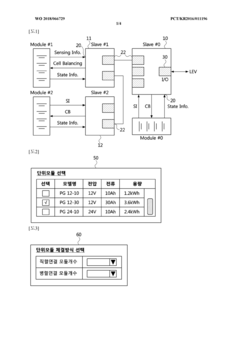
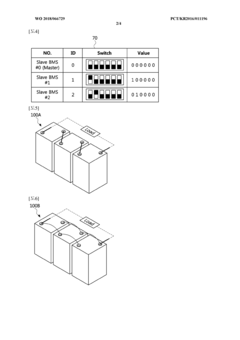
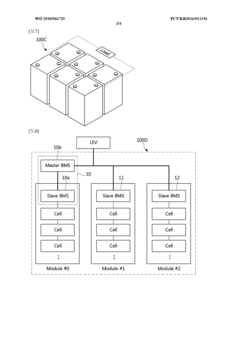
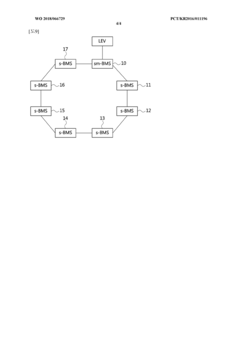
- A battery management system with an integrated board structure that includes a sub-BMS circuit, a main BMS circuit, and communication ports, allowing for flexible hierarchy and communication method settings through a user interface, enabling easy management and connection of multiple battery modules in series, parallel, or series-parallel configurations.
Battery management system for energy control
PatentWO2023243983A1
Innovation
- A battery management system that utilizes a bypass resistance device with a laminated resistor design on a PCB, allowing for rapid cell balancing by increasing bypass current and effectively managing temperature through heat dissipation, while minimizing energy loss and component costs.


BMS Cost Reduction Strategies
Cost reduction strategies play a crucial role in the development of Battery Management Systems (BMS) while maintaining optimal performance. One key approach is the integration of components, which reduces the overall number of parts and simplifies the system architecture. This can be achieved by combining multiple functions into a single chip or module, such as integrating the microcontroller, voltage measurement, and communication interfaces into a single System-on-Chip (SoC) solution.
Another effective strategy is the optimization of sensor technology. By leveraging advanced sensing techniques and algorithms, manufacturers can reduce the number of sensors required without compromising accuracy. This not only lowers component costs but also simplifies wiring and assembly processes. Additionally, the use of smart sensors that incorporate signal processing capabilities can offload computational tasks from the main processor, potentially allowing for a less expensive microcontroller.
The selection of materials and manufacturing processes also contributes significantly to cost reduction. Utilizing cost-effective yet reliable materials for PCB substrates, connectors, and enclosures can lead to substantial savings. Furthermore, adopting automated manufacturing techniques and optimizing production lines can reduce labor costs and improve overall efficiency.
Software optimization is another area with potential for cost savings. By implementing efficient algorithms and utilizing open-source software libraries, developers can reduce memory requirements and processing power needs. This allows for the use of less expensive hardware components without sacrificing functionality.
Standardization and modular design approaches can also contribute to cost reduction. By developing standardized BMS modules that can be easily scaled or customized for different battery configurations, manufacturers can benefit from economies of scale and reduce development time for new products. This approach also simplifies inventory management and can lead to more cost-effective supply chain operations.
Lastly, the implementation of advanced power management techniques can reduce the power consumption of the BMS itself. This allows for the use of smaller, less expensive power supply components and potentially extends the overall battery life, providing indirect cost benefits to the end-user.
Another effective strategy is the optimization of sensor technology. By leveraging advanced sensing techniques and algorithms, manufacturers can reduce the number of sensors required without compromising accuracy. This not only lowers component costs but also simplifies wiring and assembly processes. Additionally, the use of smart sensors that incorporate signal processing capabilities can offload computational tasks from the main processor, potentially allowing for a less expensive microcontroller.
The selection of materials and manufacturing processes also contributes significantly to cost reduction. Utilizing cost-effective yet reliable materials for PCB substrates, connectors, and enclosures can lead to substantial savings. Furthermore, adopting automated manufacturing techniques and optimizing production lines can reduce labor costs and improve overall efficiency.
Software optimization is another area with potential for cost savings. By implementing efficient algorithms and utilizing open-source software libraries, developers can reduce memory requirements and processing power needs. This allows for the use of less expensive hardware components without sacrificing functionality.
Standardization and modular design approaches can also contribute to cost reduction. By developing standardized BMS modules that can be easily scaled or customized for different battery configurations, manufacturers can benefit from economies of scale and reduce development time for new products. This approach also simplifies inventory management and can lead to more cost-effective supply chain operations.
Lastly, the implementation of advanced power management techniques can reduce the power consumption of the BMS itself. This allows for the use of smaller, less expensive power supply components and potentially extends the overall battery life, providing indirect cost benefits to the end-user.
BMS Safety and Regulations
Safety and regulatory compliance are paramount considerations in the development of Battery Management Systems (BMS) for electric vehicles and energy storage applications. As the industry strives to balance performance and cost, adherence to stringent safety standards and regulations becomes increasingly critical.
The primary safety concerns for BMS include thermal runaway prevention, overcharge and over-discharge protection, and short circuit detection. Regulatory bodies such as the International Electrotechnical Commission (IEC) and the Society of Automotive Engineers (SAE) have established comprehensive standards to address these issues. For instance, IEC 62619 outlines safety requirements for lithium-ion batteries in industrial applications, while SAE J2464 provides guidelines for electric and hybrid vehicle battery systems.
Compliance with these regulations often necessitates the integration of advanced safety features into BMS designs. These may include redundant voltage and current monitoring, sophisticated thermal management systems, and fail-safe mechanisms. While these features enhance safety, they can significantly impact the overall cost and complexity of the BMS.
To address this challenge, manufacturers are exploring innovative approaches to meet safety requirements without compromising cost-effectiveness. One such approach involves the use of advanced algorithms and machine learning techniques to optimize battery performance and safety monitoring. These software-based solutions can potentially reduce the need for costly hardware components while maintaining or even improving safety levels.
Another emerging trend is the development of modular BMS architectures. This approach allows for scalable designs that can be easily adapted to different battery configurations and safety requirements. By standardizing certain components and interfaces, manufacturers can achieve economies of scale and reduce development costs while still meeting diverse regulatory demands.
Regulatory bodies are also evolving their standards to keep pace with technological advancements. For example, there is a growing focus on cybersecurity in BMS regulations, recognizing the potential vulnerabilities in connected battery systems. This shift requires BMS developers to incorporate robust security measures, adding another layer of complexity to the balance between performance, cost, and safety.
As the electric vehicle and energy storage markets continue to expand, harmonization of international safety standards is becoming increasingly important. Efforts are underway to align regulations across different regions, which could potentially simplify compliance processes and reduce costs for global manufacturers. However, this harmonization process is complex and ongoing, requiring continuous adaptation from BMS developers.
The primary safety concerns for BMS include thermal runaway prevention, overcharge and over-discharge protection, and short circuit detection. Regulatory bodies such as the International Electrotechnical Commission (IEC) and the Society of Automotive Engineers (SAE) have established comprehensive standards to address these issues. For instance, IEC 62619 outlines safety requirements for lithium-ion batteries in industrial applications, while SAE J2464 provides guidelines for electric and hybrid vehicle battery systems.
Compliance with these regulations often necessitates the integration of advanced safety features into BMS designs. These may include redundant voltage and current monitoring, sophisticated thermal management systems, and fail-safe mechanisms. While these features enhance safety, they can significantly impact the overall cost and complexity of the BMS.
To address this challenge, manufacturers are exploring innovative approaches to meet safety requirements without compromising cost-effectiveness. One such approach involves the use of advanced algorithms and machine learning techniques to optimize battery performance and safety monitoring. These software-based solutions can potentially reduce the need for costly hardware components while maintaining or even improving safety levels.
Another emerging trend is the development of modular BMS architectures. This approach allows for scalable designs that can be easily adapted to different battery configurations and safety requirements. By standardizing certain components and interfaces, manufacturers can achieve economies of scale and reduce development costs while still meeting diverse regulatory demands.
Regulatory bodies are also evolving their standards to keep pace with technological advancements. For example, there is a growing focus on cybersecurity in BMS regulations, recognizing the potential vulnerabilities in connected battery systems. This shift requires BMS developers to incorporate robust security measures, adding another layer of complexity to the balance between performance, cost, and safety.
As the electric vehicle and energy storage markets continue to expand, harmonization of international safety standards is becoming increasingly important. Efforts are underway to align regulations across different regions, which could potentially simplify compliance processes and reduce costs for global manufacturers. However, this harmonization process is complex and ongoing, requiring continuous adaptation from BMS developers.
Unlock deeper insights with PatSnap Eureka Quick Research — get a full tech report to explore trends and direct your research. Try now!
Generate Your Research Report Instantly with AI Agent
Supercharge your innovation with PatSnap Eureka AI Agent Platform!