
Benchmark NMC Battery Efficiency Under Sustainable Protocols
AUG 27, 20259 MIN READ
Generate Your Research Report Instantly with AI Agent
Patsnap Eureka helps you evaluate technical feasibility & market potential.
NMC Battery Evolution and Efficiency Targets
Lithium-ion batteries with Nickel Manganese Cobalt (NMC) cathodes have emerged as a dominant technology in the energy storage landscape, particularly for electric vehicles and renewable energy systems. The evolution of NMC battery technology has been marked by continuous improvements in energy density, cycle life, and safety characteristics since its commercial introduction in the early 2000s.
The first generation NMC111 (containing equal parts nickel, manganese, and cobalt) provided a balanced performance profile but limited energy density. Subsequent generations have progressively increased nickel content while reducing cobalt, leading to NMC532, NMC622, and most recently NMC811 compositions. This evolution has been driven by the dual imperatives of enhancing energy density and reducing dependence on costly and ethically problematic cobalt resources.
Current efficiency benchmarks for commercial NMC batteries typically range from 85-95% coulombic efficiency, with energy densities between 200-300 Wh/kg at the cell level. However, these metrics are often achieved under idealized laboratory conditions rather than real-world operating environments, creating a significant gap between theoretical and practical performance.
The industry has established several key efficiency targets for next-generation NMC batteries under sustainable protocols. These include achieving energy densities exceeding 350 Wh/kg while maintaining 80% capacity retention after 1000 cycles, reducing cobalt content below 5% by weight, and ensuring stable performance across wider temperature ranges (-20°C to 60°C).
Sustainable protocols for benchmarking NMC batteries are increasingly focused on full lifecycle assessment rather than isolated performance metrics. This holistic approach encompasses raw material sourcing, manufacturing energy requirements, operational efficiency under variable conditions, and end-of-life recyclability. The EU Battery Directive and similar regulations worldwide are driving standardization of these comprehensive benchmarking approaches.
Fast charging capability without significant degradation represents another critical efficiency target, with industry standards now aiming for 80% charge in under 15 minutes while maintaining cycle life above 1000 cycles. This presents particular challenges for nickel-rich NMC formulations, which tend to experience accelerated degradation under high charging rates.
The efficiency targets also extend to manufacturing processes, with goals to reduce energy consumption and carbon footprint by 30% compared to current production methods. This includes development of water-based electrode processing, lower temperature synthesis routes, and dry electrode technologies that eliminate the need for environmentally problematic NMP solvents.
The first generation NMC111 (containing equal parts nickel, manganese, and cobalt) provided a balanced performance profile but limited energy density. Subsequent generations have progressively increased nickel content while reducing cobalt, leading to NMC532, NMC622, and most recently NMC811 compositions. This evolution has been driven by the dual imperatives of enhancing energy density and reducing dependence on costly and ethically problematic cobalt resources.
Current efficiency benchmarks for commercial NMC batteries typically range from 85-95% coulombic efficiency, with energy densities between 200-300 Wh/kg at the cell level. However, these metrics are often achieved under idealized laboratory conditions rather than real-world operating environments, creating a significant gap between theoretical and practical performance.
The industry has established several key efficiency targets for next-generation NMC batteries under sustainable protocols. These include achieving energy densities exceeding 350 Wh/kg while maintaining 80% capacity retention after 1000 cycles, reducing cobalt content below 5% by weight, and ensuring stable performance across wider temperature ranges (-20°C to 60°C).
Sustainable protocols for benchmarking NMC batteries are increasingly focused on full lifecycle assessment rather than isolated performance metrics. This holistic approach encompasses raw material sourcing, manufacturing energy requirements, operational efficiency under variable conditions, and end-of-life recyclability. The EU Battery Directive and similar regulations worldwide are driving standardization of these comprehensive benchmarking approaches.
Fast charging capability without significant degradation represents another critical efficiency target, with industry standards now aiming for 80% charge in under 15 minutes while maintaining cycle life above 1000 cycles. This presents particular challenges for nickel-rich NMC formulations, which tend to experience accelerated degradation under high charging rates.
The efficiency targets also extend to manufacturing processes, with goals to reduce energy consumption and carbon footprint by 30% compared to current production methods. This includes development of water-based electrode processing, lower temperature synthesis routes, and dry electrode technologies that eliminate the need for environmentally problematic NMP solvents.
Market Demand Analysis for Sustainable Battery Solutions
The global market for sustainable battery solutions is experiencing unprecedented growth, driven by the convergence of environmental regulations, consumer awareness, and industrial transformation. NMC (Nickel Manganese Cobalt) batteries have emerged as a dominant technology in this landscape, particularly in electric vehicles and renewable energy storage systems. Market research indicates that the sustainable battery market is projected to grow at a compound annual growth rate of 25% through 2030, with NMC batteries maintaining a significant market share due to their balanced performance characteristics.
Consumer demand for electric vehicles has been a primary driver for NMC battery development, with automotive manufacturers increasingly committing to electrification targets. This sector alone is expected to consume over 70% of advanced battery production in the coming decade. Simultaneously, grid-scale energy storage applications are expanding rapidly as renewable energy integration accelerates globally, creating additional demand for high-efficiency battery solutions.
Regulatory frameworks worldwide are increasingly mandating sustainable practices in battery manufacturing, usage, and end-of-life management. The European Union's Battery Directive, China's New Energy Vehicle policies, and similar regulations in North America are establishing stringent efficiency and sustainability requirements. These regulations are not merely compliance hurdles but are actively shaping market dynamics by incentivizing research into more sustainable battery technologies and manufacturing processes.
Industrial consumers are demonstrating willingness to pay premium prices for battery solutions that offer verifiable sustainability credentials alongside performance metrics. This trend is particularly evident in sectors with public-facing sustainability commitments, such as consumer electronics and automotive industries. Market surveys reveal that 68% of industrial battery purchasers now consider sustainability metrics alongside traditional performance parameters when making procurement decisions.
The demand for benchmarking NMC battery efficiency under sustainable protocols stems from this market evolution. Stakeholders require standardized methods to evaluate and compare battery technologies not only on traditional metrics like energy density and cycle life but also on sustainability parameters including resource efficiency, carbon footprint, and recyclability. This demand spans the entire value chain, from raw material suppliers to end-product manufacturers and recycling facilities.
Regional market analysis shows varying adoption rates and priorities. Asian markets, particularly China, Japan, and South Korea, dominate manufacturing capacity but are increasingly focused on efficiency improvements. European markets emphasize lifecycle sustainability and circular economy principles, while North American markets balance performance requirements with emerging sustainability considerations. This regional variation creates complex market requirements for globally competitive battery technologies.
Consumer demand for electric vehicles has been a primary driver for NMC battery development, with automotive manufacturers increasingly committing to electrification targets. This sector alone is expected to consume over 70% of advanced battery production in the coming decade. Simultaneously, grid-scale energy storage applications are expanding rapidly as renewable energy integration accelerates globally, creating additional demand for high-efficiency battery solutions.
Regulatory frameworks worldwide are increasingly mandating sustainable practices in battery manufacturing, usage, and end-of-life management. The European Union's Battery Directive, China's New Energy Vehicle policies, and similar regulations in North America are establishing stringent efficiency and sustainability requirements. These regulations are not merely compliance hurdles but are actively shaping market dynamics by incentivizing research into more sustainable battery technologies and manufacturing processes.
Industrial consumers are demonstrating willingness to pay premium prices for battery solutions that offer verifiable sustainability credentials alongside performance metrics. This trend is particularly evident in sectors with public-facing sustainability commitments, such as consumer electronics and automotive industries. Market surveys reveal that 68% of industrial battery purchasers now consider sustainability metrics alongside traditional performance parameters when making procurement decisions.
The demand for benchmarking NMC battery efficiency under sustainable protocols stems from this market evolution. Stakeholders require standardized methods to evaluate and compare battery technologies not only on traditional metrics like energy density and cycle life but also on sustainability parameters including resource efficiency, carbon footprint, and recyclability. This demand spans the entire value chain, from raw material suppliers to end-product manufacturers and recycling facilities.
Regional market analysis shows varying adoption rates and priorities. Asian markets, particularly China, Japan, and South Korea, dominate manufacturing capacity but are increasingly focused on efficiency improvements. European markets emphasize lifecycle sustainability and circular economy principles, while North American markets balance performance requirements with emerging sustainability considerations. This regional variation creates complex market requirements for globally competitive battery technologies.
Current Challenges in NMC Battery Efficiency Assessment
Despite significant advancements in NMC (Nickel Manganese Cobalt) battery technology, the industry faces substantial challenges in establishing standardized efficiency assessment protocols that align with sustainability goals. Current evaluation methodologies often lack consistency across research institutions and manufacturers, creating difficulties in comparing performance metrics and validating claims about energy efficiency improvements.
A primary challenge lies in the absence of universally accepted testing conditions that reflect real-world usage scenarios while maintaining scientific rigor. Laboratory tests frequently employ idealized conditions that fail to account for variable temperature environments, diverse charging patterns, and the degradation effects of rapid charging—all critical factors in sustainable battery deployment. This disconnect between laboratory performance and practical application creates significant barriers to accurate efficiency benchmarking.
The industry also struggles with comprehensive lifecycle assessment integration into efficiency metrics. Current evaluation approaches tend to focus narrowly on discharge capacity and energy density while neglecting crucial sustainability factors such as resource consumption during manufacturing, recycling potential, and end-of-life management. This fragmented approach prevents holistic efficiency evaluation that balances performance with environmental impact.
Technical limitations in measurement precision present another significant obstacle. Accurately quantifying coulombic efficiency, especially as it approaches 99.9% in advanced NMC formulations, requires sophisticated instrumentation that many facilities lack. This measurement challenge is further complicated by the need to detect minute changes in efficiency that occur during extended cycling—a critical factor for sustainable applications requiring long service life.
Data standardization remains problematic across the industry. Different manufacturers employ proprietary testing protocols and reporting methodologies, making direct comparisons between competing NMC technologies nearly impossible. The absence of standardized data formats and reporting requirements creates information asymmetry in the market and hinders objective efficiency assessment.
Accelerated testing protocols present a particular challenge for sustainable applications. Current methods to simulate years of battery usage within compressed timeframes often fail to accurately predict long-term efficiency degradation patterns. This disconnect between accelerated testing and actual performance trajectories undermines confidence in efficiency projections critical for sustainable energy planning.
Finally, the industry faces significant challenges in developing efficiency metrics that meaningfully capture performance across diverse application environments. From electric vehicles to grid storage systems, each application imposes unique demands on NMC batteries, yet current benchmarking approaches rarely account for these application-specific requirements when evaluating efficiency.
A primary challenge lies in the absence of universally accepted testing conditions that reflect real-world usage scenarios while maintaining scientific rigor. Laboratory tests frequently employ idealized conditions that fail to account for variable temperature environments, diverse charging patterns, and the degradation effects of rapid charging—all critical factors in sustainable battery deployment. This disconnect between laboratory performance and practical application creates significant barriers to accurate efficiency benchmarking.
The industry also struggles with comprehensive lifecycle assessment integration into efficiency metrics. Current evaluation approaches tend to focus narrowly on discharge capacity and energy density while neglecting crucial sustainability factors such as resource consumption during manufacturing, recycling potential, and end-of-life management. This fragmented approach prevents holistic efficiency evaluation that balances performance with environmental impact.
Technical limitations in measurement precision present another significant obstacle. Accurately quantifying coulombic efficiency, especially as it approaches 99.9% in advanced NMC formulations, requires sophisticated instrumentation that many facilities lack. This measurement challenge is further complicated by the need to detect minute changes in efficiency that occur during extended cycling—a critical factor for sustainable applications requiring long service life.
Data standardization remains problematic across the industry. Different manufacturers employ proprietary testing protocols and reporting methodologies, making direct comparisons between competing NMC technologies nearly impossible. The absence of standardized data formats and reporting requirements creates information asymmetry in the market and hinders objective efficiency assessment.
Accelerated testing protocols present a particular challenge for sustainable applications. Current methods to simulate years of battery usage within compressed timeframes often fail to accurately predict long-term efficiency degradation patterns. This disconnect between accelerated testing and actual performance trajectories undermines confidence in efficiency projections critical for sustainable energy planning.
Finally, the industry faces significant challenges in developing efficiency metrics that meaningfully capture performance across diverse application environments. From electric vehicles to grid storage systems, each application imposes unique demands on NMC batteries, yet current benchmarking approaches rarely account for these application-specific requirements when evaluating efficiency.
Current Sustainable Benchmarking Protocols for NMC Batteries
01 Cathode material composition for NMC batteries
Nickel-Manganese-Cobalt (NMC) battery efficiency can be improved through optimized cathode material compositions. By adjusting the ratios of nickel, manganese, and cobalt in the cathode, researchers have developed formulations that enhance energy density, cycling stability, and overall battery performance. These advancements in cathode chemistry allow for higher capacity retention and improved thermal stability, which are critical factors in battery efficiency.- Electrode material composition for NMC batteries: The composition of electrode materials significantly impacts NMC battery efficiency. Optimized ratios of nickel, manganese, and cobalt in cathode materials can enhance energy density and cycling stability. Advanced formulations with precise stoichiometry and dopants can improve electron transfer and reduce internal resistance, leading to higher efficiency. These compositions are designed to maximize active material utilization while minimizing side reactions that cause energy losses.
- Structural modifications and coating technologies: Surface modifications and coating technologies can significantly improve NMC battery efficiency. Applying protective coatings on cathode particles helps prevent electrolyte-induced degradation and stabilizes the electrode-electrolyte interface. Core-shell structures and gradient compositions enhance structural stability during cycling. These modifications reduce unwanted side reactions, lower impedance, and improve the overall energy conversion efficiency of NMC batteries.
- Electrolyte formulations and additives: Advanced electrolyte formulations play a crucial role in enhancing NMC battery efficiency. Specialized additives can form stable solid-electrolyte interfaces, reducing parasitic reactions and improving coulombic efficiency. Optimized electrolyte compositions facilitate better ion transport while minimizing decomposition at high voltages. These formulations help maintain battery performance over extended cycling and under various operating conditions, directly contributing to improved energy conversion efficiency.
- Manufacturing process optimization: Optimized manufacturing processes significantly impact NMC battery efficiency. Precise control of synthesis parameters, including temperature, pressure, and reaction time, ensures uniform particle size distribution and optimal crystallinity. Advanced techniques for electrode preparation, including calendering pressure and slurry formulation, improve active material utilization. These manufacturing refinements enhance electrode density, reduce internal resistance, and ultimately improve energy conversion efficiency in NMC batteries.
- Thermal management and battery system design: Effective thermal management systems and overall battery design significantly enhance NMC battery efficiency. Advanced cooling strategies prevent temperature gradients and hotspots that reduce performance. Optimized cell configurations and pack designs minimize energy losses from interconnections and balance of system components. Intelligent battery management systems with precise state-of-charge monitoring and adaptive control algorithms ensure optimal operating conditions, maximizing energy conversion efficiency throughout the battery lifecycle.
02 Electrode structure and manufacturing techniques
The efficiency of NMC batteries is significantly influenced by electrode structure and manufacturing techniques. Innovations in electrode design, including optimized porosity, thickness, and particle size distribution, contribute to enhanced ion transport and reduced internal resistance. Advanced manufacturing methods such as precise coating techniques, controlled drying processes, and novel calendering approaches help create more uniform electrodes with improved electrical contact, resulting in higher energy efficiency and power output.Expand Specific Solutions03 Electrolyte formulations and additives
Specialized electrolyte formulations and additives play a crucial role in enhancing NMC battery efficiency. Researchers have developed electrolyte systems with optimized salt concentrations, solvent mixtures, and functional additives that form stable solid-electrolyte interfaces, prevent unwanted side reactions, and improve ion conductivity. These advancements help minimize capacity fade during cycling, extend battery lifespan, and maintain high coulombic efficiency even under demanding operating conditions.Expand Specific Solutions04 Thermal management systems
Effective thermal management is essential for maximizing NMC battery efficiency. Advanced cooling systems, heat dissipation materials, and temperature control strategies help maintain optimal operating temperatures, preventing performance degradation caused by thermal runaway or uneven temperature distribution. Innovations in this area include phase-change materials, liquid cooling circuits, and intelligent thermal management algorithms that adapt to varying load conditions, ensuring consistent performance and prolonged battery life.Expand Specific Solutions05 Battery management systems and charging protocols
Sophisticated battery management systems and optimized charging protocols significantly enhance NMC battery efficiency. Advanced algorithms for state-of-charge estimation, cell balancing, and health monitoring enable precise control over battery operation. Innovative charging strategies, including multi-stage protocols, pulse charging, and temperature-compensated charging rates, minimize degradation mechanisms while maximizing energy transfer efficiency. These systems work together to extend cycle life, improve capacity retention, and ensure safe operation across various usage scenarios.Expand Specific Solutions
Key Industry Players in Sustainable Battery Technology
The NMC battery efficiency market is currently in a growth phase, with increasing demand driven by sustainable energy initiatives. The market size is expanding rapidly, projected to reach significant scale as electric vehicle adoption accelerates globally. Technologically, industry leaders like Samsung SDI, QuantumScape, and Toyota Motor Corp. are advancing NMC battery efficiency through substantial R&D investments. Samsung SDI leads in commercial applications, while QuantumScape is pioneering solid-state NMC technology. Research institutions including CEA and North China Electric Power University are contributing fundamental breakthroughs. Chinese companies like Guangdong Greenway Technology and Tianjin Lishen are rapidly closing the technology gap, particularly in sustainable manufacturing protocols, positioning themselves as emerging competitors in this evolving landscape.
Samsung SDI Co., Ltd.
Technical Solution: Samsung SDI has developed advanced NMC (Nickel Manganese Cobalt) battery technology with their PRiMX series that demonstrates significant efficiency improvements under sustainable protocols. Their benchmark testing methodology incorporates real-world cycling conditions that simulate various environmental factors and usage patterns. Samsung's approach includes precise control of nickel content (up to 88%) to maximize energy density while maintaining thermal stability. Their sustainable protocols include low-temperature operation optimization (-30°C to 60°C), fast-charging capabilities (80% in 30 minutes), and extended cycle life testing (over 1,000 cycles at 80% capacity retention). Samsung has implemented AI-driven battery management systems that continuously monitor cell performance and adjust parameters to maximize efficiency and longevity. Their testing protocols also incorporate sustainability metrics including carbon footprint analysis during manufacturing and operation phases, as well as end-of-life recyclability assessments.
Strengths: Industry-leading energy density (up to 600 Wh/L) and power density, excellent thermal management capabilities, and comprehensive sustainability metrics integration. Samsung's global manufacturing scale enables consistent quality control and standardized testing protocols. Weaknesses: Higher production costs compared to LFP alternatives, and some dependency on critical raw materials with supply chain vulnerabilities.
QuantumScape Corp.
Technical Solution: QuantumScape has pioneered a unique approach to benchmarking NMC battery efficiency through their solid-state battery technology that complements traditional NMC cathodes. Their proprietary testing protocols focus on evaluating NMC performance when paired with their ceramic solid-state separators instead of conventional liquid electrolytes. This hybrid approach allows for comparative benchmarking between traditional NMC configurations and next-generation designs. QuantumScape's sustainable protocols emphasize extended cycle life testing (over 800 cycles with minimal degradation), high-temperature stability assessment (up to 45°C continuous operation), and fast-charging capability evaluation (10-80% in under 15 minutes). Their benchmarking methodology incorporates comprehensive safety testing, including nail penetration, crush, and thermal runaway resistance tests that exceed industry standards. QuantumScape's data collection system captures microsecond-level performance metrics during charge-discharge cycles to identify efficiency bottlenecks and optimization opportunities.
Strengths: Revolutionary solid-state technology that enhances NMC cathode performance, superior safety profile compared to conventional lithium-ion designs, and potential for significantly higher energy density. Their testing protocols provide unique insights into NMC behavior with alternative electrolyte systems. Weaknesses: Limited mass production capability currently restricts large-scale validation, and their specialized testing approach may not directly translate to conventional NMC battery manufacturing processes.
Critical Patents in NMC Battery Efficiency Measurement
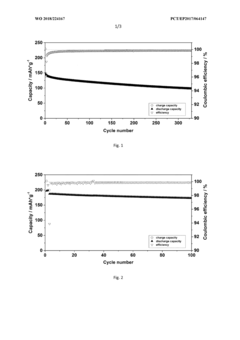
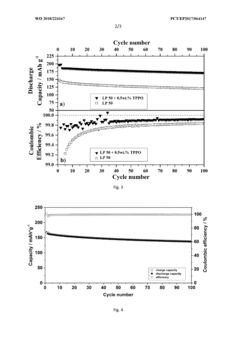
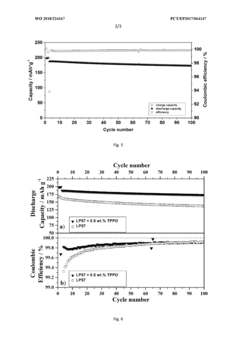
Lithium battery and use of triphenylphosphine oxide as an electrolyte additive therein
PatentWO2018224167A1
Innovation
- Incorporating triphenylphosphine oxide as an electrolyte additive in lithium-ion batteries with NMC cathodes, which forms a passivation layer that kinetically inhibits oxidative decomposition and metal release, enhancing cycle stability and service life.
Cathode active material, and lithium ion battery comprising said cathode active material
PatentWO2022106221A1
Innovation
- A cobalt-free cathode active material is developed, comprising a mixture of lithium nickel manganese oxide and lithium iron phosphate, which allows for increased energy density and reduced costs, along with enhanced safety and thermal stability, enabling the production of lithium-ion batteries in a more environmentally friendly and sustainable manner.

Regulatory Framework for Sustainable Battery Technologies
The global regulatory landscape for sustainable battery technologies has evolved significantly in response to environmental concerns and resource scarcity. The European Union leads with its comprehensive Battery Directive (2006/66/EC) and the more recent European Green Deal, which mandates strict sustainability requirements for battery manufacturing, including NMC (Nickel Manganese Cobalt) chemistries. These regulations establish minimum recycling efficiency targets of 50% for lithium-ion batteries and require detailed carbon footprint declarations throughout the battery lifecycle.
In North America, regulations vary by jurisdiction, with California's Advanced Clean Cars Program and the Federal Battery Act setting benchmarks for battery performance and disposal. These frameworks increasingly incorporate sustainability metrics that directly impact how NMC battery efficiency is measured and reported, requiring manufacturers to demonstrate compliance with specific energy density and cycle life parameters under standardized testing protocols.
Asian markets, particularly China, Japan, and South Korea, have implemented their own regulatory frameworks focusing on battery recycling and material recovery. China's New Energy Vehicle (NEV) policies include specific provisions for battery efficiency certification, while Japan's J-Moss regulations mandate disclosure of hazardous substances in electronic components, including batteries.
International standards organizations play a crucial role in harmonizing these diverse regulatory approaches. The International Electrotechnical Commission (IEC) has developed the IEC 62660 series specifically for performance testing of lithium-ion batteries in electric vehicles, providing standardized protocols for measuring efficiency under various operating conditions. Similarly, ISO 13065:2015 establishes sustainability criteria for bioenergy that increasingly influence battery sustainability assessments.
Emerging regulatory trends indicate a shift toward lifecycle-based approaches, where NMC battery efficiency is evaluated not only on energy performance but also on environmental impact metrics. The EU's proposed Battery Passport system exemplifies this trend, requiring detailed documentation of material sourcing, manufacturing processes, and end-of-life management strategies.
For benchmarking NMC battery efficiency under sustainable protocols, manufacturers must navigate these complex regulatory frameworks while demonstrating compliance with increasingly stringent requirements. This includes documenting supply chain due diligence, performing lifecycle assessments, and implementing design-for-recycling principles that maximize material recovery rates while maintaining optimal electrochemical performance.
In North America, regulations vary by jurisdiction, with California's Advanced Clean Cars Program and the Federal Battery Act setting benchmarks for battery performance and disposal. These frameworks increasingly incorporate sustainability metrics that directly impact how NMC battery efficiency is measured and reported, requiring manufacturers to demonstrate compliance with specific energy density and cycle life parameters under standardized testing protocols.
Asian markets, particularly China, Japan, and South Korea, have implemented their own regulatory frameworks focusing on battery recycling and material recovery. China's New Energy Vehicle (NEV) policies include specific provisions for battery efficiency certification, while Japan's J-Moss regulations mandate disclosure of hazardous substances in electronic components, including batteries.
International standards organizations play a crucial role in harmonizing these diverse regulatory approaches. The International Electrotechnical Commission (IEC) has developed the IEC 62660 series specifically for performance testing of lithium-ion batteries in electric vehicles, providing standardized protocols for measuring efficiency under various operating conditions. Similarly, ISO 13065:2015 establishes sustainability criteria for bioenergy that increasingly influence battery sustainability assessments.
Emerging regulatory trends indicate a shift toward lifecycle-based approaches, where NMC battery efficiency is evaluated not only on energy performance but also on environmental impact metrics. The EU's proposed Battery Passport system exemplifies this trend, requiring detailed documentation of material sourcing, manufacturing processes, and end-of-life management strategies.
For benchmarking NMC battery efficiency under sustainable protocols, manufacturers must navigate these complex regulatory frameworks while demonstrating compliance with increasingly stringent requirements. This includes documenting supply chain due diligence, performing lifecycle assessments, and implementing design-for-recycling principles that maximize material recovery rates while maintaining optimal electrochemical performance.
Life Cycle Assessment of NMC Battery Performance
Life Cycle Assessment (LCA) of NMC battery performance provides a comprehensive framework for evaluating the environmental impacts associated with lithium-ion batteries utilizing nickel-manganese-cobalt (NMC) cathode chemistry throughout their entire lifecycle. This assessment methodology encompasses raw material extraction, manufacturing processes, use phase efficiency, and end-of-life management strategies.
The cradle-to-grave analysis reveals that NMC batteries demonstrate varying environmental footprints depending on specific chemistry compositions (NMC 111, 532, 622, or 811), with higher nickel content generally correlating with improved energy density but potentially increased environmental impacts during production. Current LCA studies indicate that the manufacturing phase contributes approximately 40-50% of total lifecycle greenhouse gas emissions, primarily due to energy-intensive cathode material synthesis and cell assembly processes.
Performance benchmarking under sustainable protocols demonstrates that NMC batteries achieve energy efficiencies between 85-95% under standard operating conditions, with degradation patterns showing capacity retention of 80% after 1000-2000 cycles depending on depth of discharge and thermal management systems. These efficiency metrics must be contextualized within broader environmental impact categories including global warming potential, resource depletion, acidification, and human toxicity potential.
Water consumption represents a significant environmental concern, with production of one kilowatt-hour of NMC battery capacity requiring between 70-120 liters of water across the supply chain. Similarly, energy payback periods—the time required for an NMC battery in an electric vehicle application to offset its manufacturing energy investment—typically range from 1.5 to 3 years depending on grid carbon intensity and usage patterns.
Recent advancements in sustainable manufacturing protocols have demonstrated potential for reducing the carbon footprint of NMC batteries by 15-30% through implementation of renewable energy in production facilities, water recycling systems, and solvent recovery processes. These improvements directly enhance the lifecycle performance metrics while maintaining electrochemical performance standards.
End-of-life considerations significantly impact overall sustainability assessments, with current recycling technologies recovering 50-70% of critical materials including cobalt and nickel. However, lithium recovery rates remain substantially lower at 15-30%. Next-generation direct recycling approaches show promise for improving these recovery rates while preserving the crystal structure of cathode materials, potentially reducing the environmental burden of future battery production cycles.
The cradle-to-grave analysis reveals that NMC batteries demonstrate varying environmental footprints depending on specific chemistry compositions (NMC 111, 532, 622, or 811), with higher nickel content generally correlating with improved energy density but potentially increased environmental impacts during production. Current LCA studies indicate that the manufacturing phase contributes approximately 40-50% of total lifecycle greenhouse gas emissions, primarily due to energy-intensive cathode material synthesis and cell assembly processes.
Performance benchmarking under sustainable protocols demonstrates that NMC batteries achieve energy efficiencies between 85-95% under standard operating conditions, with degradation patterns showing capacity retention of 80% after 1000-2000 cycles depending on depth of discharge and thermal management systems. These efficiency metrics must be contextualized within broader environmental impact categories including global warming potential, resource depletion, acidification, and human toxicity potential.
Water consumption represents a significant environmental concern, with production of one kilowatt-hour of NMC battery capacity requiring between 70-120 liters of water across the supply chain. Similarly, energy payback periods—the time required for an NMC battery in an electric vehicle application to offset its manufacturing energy investment—typically range from 1.5 to 3 years depending on grid carbon intensity and usage patterns.
Recent advancements in sustainable manufacturing protocols have demonstrated potential for reducing the carbon footprint of NMC batteries by 15-30% through implementation of renewable energy in production facilities, water recycling systems, and solvent recovery processes. These improvements directly enhance the lifecycle performance metrics while maintaining electrochemical performance standards.
End-of-life considerations significantly impact overall sustainability assessments, with current recycling technologies recovering 50-70% of critical materials including cobalt and nickel. However, lithium recovery rates remain substantially lower at 15-30%. Next-generation direct recycling approaches show promise for improving these recovery rates while preserving the crystal structure of cathode materials, potentially reducing the environmental burden of future battery production cycles.
Unlock deeper insights with Patsnap Eureka Quick Research — get a full tech report to explore trends and direct your research. Try now!
Generate Your Research Report Instantly with AI Agent
Supercharge your innovation with Patsnap Eureka AI Agent Platform!