

Brain-Computer Interfaces vs Neural Implants: Performance Metrics
JUN 23, 20269 MIN READ
Generate Your Research Report Instantly with AI Agent
Patsnap Eureka helps you evaluate technical feasibility & market potential.
BCI and Neural Implant Technology Background and Objectives
Brain-Computer Interfaces (BCIs) and neural implants represent two interconnected yet distinct technological paradigms that have evolved from decades of neuroscience research and biomedical engineering innovation. BCIs encompass a broader category of systems designed to establish direct communication pathways between the brain and external devices, enabling the translation of neural signals into actionable commands for computers, prosthetics, or other assistive technologies. Neural implants, as a subset of BCI technology, specifically refer to surgically implanted devices that interface directly with neural tissue to record, stimulate, or modulate brain activity.
The historical development of these technologies traces back to the 1970s when early pioneers began exploring the possibility of recording neural signals for therapeutic applications. Initial breakthroughs in microelectrode technology and signal processing laid the foundation for modern BCI systems. The field gained significant momentum in the 1990s with advances in computational power and machine learning algorithms, enabling more sophisticated interpretation of neural patterns.
Contemporary BCI systems operate through multiple modalities, including invasive approaches that require surgical implantation of electrodes directly into brain tissue, semi-invasive methods utilizing electrocorticography (ECoG) arrays placed on the brain surface, and non-invasive techniques employing external sensors to detect neural activity through electroencephalography (EEG) or functional magnetic resonance imaging (fMRI). Neural implants specifically focus on the invasive category, offering superior signal quality and spatial resolution at the cost of increased surgical complexity and potential complications.
The primary technological objectives driving current research and development efforts center on achieving reliable, high-bandwidth communication between neural circuits and artificial systems. Key performance metrics include signal acquisition fidelity, decoding accuracy, response latency, device longevity, and biocompatibility. Researchers aim to develop systems capable of real-time interpretation of complex motor intentions, sensory feedback integration, and bidirectional communication that can restore lost neurological functions.
Clinical applications span a diverse range of neurological conditions, from spinal cord injuries and amputations to neurodegenerative diseases such as Parkinson's disease and epilepsy. The ultimate goal involves creating seamless human-machine interfaces that can restore mobility, communication, and sensory perception while maintaining long-term stability and safety profiles suitable for widespread clinical deployment.
Market Demand for Brain-Computer Interface Solutions
The global brain-computer interface market is experiencing unprecedented growth driven by multiple converging factors across healthcare, consumer technology, and research sectors. Healthcare applications represent the largest demand segment, with neurological disorders affecting millions worldwide creating substantial market pressure for innovative treatment solutions. Paralysis, epilepsy, depression, and neurodegenerative diseases like Parkinson's and Alzheimer's are driving healthcare providers to seek advanced BCI technologies that can restore motor function, provide therapeutic interventions, and improve patient quality of life.
Medical device manufacturers are increasingly investing in BCI solutions as traditional treatment methods reach their limitations. The aging global population intensifies this demand, as age-related neurological conditions become more prevalent. Hospitals and rehabilitation centers are actively seeking BCI systems that can offer measurable performance improvements over conventional therapies, particularly in motor rehabilitation and cognitive enhancement applications.
The consumer electronics sector presents another significant demand driver, with technology companies exploring BCI applications for gaming, virtual reality, and human-computer interaction. Early adopters in gaming communities are showing strong interest in direct neural control interfaces that promise more immersive experiences. This consumer interest is creating market pull for less invasive BCI solutions that can deliver acceptable performance metrics without surgical procedures.
Research institutions and academic medical centers constitute a critical demand segment, requiring BCI platforms for clinical trials and experimental studies. These organizations need systems with robust performance measurement capabilities to validate therapeutic efficacy and advance scientific understanding of neural interfaces. Government funding for neurotechnology research is amplifying this institutional demand.
Industrial applications are emerging as an unexpected demand source, with manufacturing and logistics companies investigating BCI solutions for hands-free operation in complex environments. Military and defense sectors are also exploring BCI technologies for enhanced human-machine integration in critical operations.
The demand landscape reveals a clear preference for solutions that demonstrate superior performance metrics in signal acquisition, processing speed, and user adaptation. Market participants consistently prioritize systems offering quantifiable improvements in accuracy, response time, and long-term stability. This performance-focused demand is shaping product development priorities across the entire BCI ecosystem, influencing both invasive neural implant technologies and non-invasive interface solutions.
Current BCI Performance Limitations and Technical Challenges
Current brain-computer interface systems face significant performance limitations that constrain their practical applications and widespread adoption. Signal acquisition represents one of the most fundamental challenges, as neural signals are inherently weak and susceptible to various forms of interference. Non-invasive BCIs typically achieve signal-to-noise ratios between 10-20 dB, while invasive systems can reach 30-40 dB, yet both fall short of optimal performance thresholds required for reliable real-time applications.
Temporal resolution constraints severely impact BCI responsiveness, with most systems operating at sampling rates between 250-1000 Hz. This limitation creates latency issues ranging from 100-500 milliseconds between neural intention and system response, making natural interaction difficult for users. The delay becomes particularly problematic in applications requiring precise timing, such as prosthetic limb control or real-time communication systems.
Spatial resolution presents another critical bottleneck, especially for non-invasive approaches. EEG-based systems can only distinguish between broad cortical regions, limiting the granularity of control commands. Even advanced invasive arrays with hundreds of electrodes struggle to capture the full complexity of neural networks, often missing crucial signal components that could enhance performance accuracy.
Signal degradation over time poses substantial challenges for long-term BCI deployment. Invasive electrodes experience tissue scarring and inflammatory responses that progressively reduce signal quality, with some studies showing 50-80% signal degradation within the first year of implantation. This degradation necessitates frequent recalibration and limits the practical lifespan of implanted devices.
Decoding accuracy remains inconsistent across different users and sessions, with classification accuracies typically ranging from 70-90% for simple tasks. Complex multi-class problems often achieve lower performance rates, creating reliability concerns for critical applications. Individual variability in neural patterns requires extensive personalization, making standardized solutions difficult to implement.
Power consumption and heat generation in implantable systems create additional technical constraints. Current neural implants require careful thermal management to prevent tissue damage, limiting processing capabilities and battery life. Wireless power transmission efficiency remains below 10% in most implementations, restricting the computational resources available for real-time signal processing and machine learning algorithms.
Existing Performance Measurement Solutions for Neural Interfaces
01 Signal Processing and Data Acquisition Methods
Advanced signal processing techniques are employed to capture and interpret neural signals from brain-computer interfaces. These methods focus on improving the quality of data acquisition, filtering noise, and enhancing the accuracy of neural signal interpretation. The techniques include digital signal processing algorithms, adaptive filtering methods, and real-time data processing capabilities that are essential for effective brain-computer communication.- Signal processing and data acquisition methods for neural interfaces: Advanced signal processing techniques are employed to capture, filter, and interpret neural signals from brain-computer interfaces. These methods focus on improving signal-to-noise ratio, reducing artifacts, and enhancing the quality of neural data acquisition. The techniques include digital filtering, amplification systems, and real-time processing algorithms that enable more accurate interpretation of neural activity patterns.
- Performance evaluation metrics and benchmarking standards: Standardized metrics and evaluation frameworks are developed to assess the performance of brain-computer interfaces and neural implants. These metrics include accuracy rates, response times, bandwidth measurements, and reliability assessments. The benchmarking standards provide consistent methods for comparing different neural interface systems and measuring their effectiveness in various applications.
- Electrode design and neural signal recording optimization: Specialized electrode configurations and materials are designed to optimize neural signal recording and stimulation capabilities. These innovations focus on improving biocompatibility, reducing tissue damage, and enhancing long-term stability of neural implants. The designs incorporate advanced materials and geometries that maximize signal quality while minimizing inflammatory responses.
- Wireless communication and power management systems: Wireless technologies are integrated into neural implants to enable remote monitoring, data transmission, and power delivery. These systems eliminate the need for physical connections while maintaining reliable communication between implanted devices and external systems. Power management solutions ensure efficient energy usage and extended operational life of neural implants.
- Adaptive algorithms and machine learning integration: Machine learning algorithms and adaptive control systems are implemented to improve the performance and user experience of brain-computer interfaces. These systems learn from user patterns, adapt to changing neural signals over time, and provide personalized calibration. The algorithms enhance decoding accuracy and reduce the need for frequent recalibration of neural interface systems.
02 Neural Electrode Design and Implant Architecture
The physical design and architecture of neural implants play a crucial role in performance metrics. This includes the development of biocompatible electrode arrays, microelectrode configurations, and implant structures that maximize signal capture while minimizing tissue damage. The focus is on creating stable, long-term interfaces between electronic devices and neural tissue.Expand Specific Solutions03 Performance Evaluation and Calibration Systems
Comprehensive evaluation frameworks are developed to assess the effectiveness and reliability of brain-computer interfaces. These systems measure various performance parameters including signal-to-noise ratios, response accuracy, latency, and long-term stability. Calibration protocols ensure consistent performance across different users and operating conditions.Expand Specific Solutions04 Wireless Communication and Power Management
Wireless technologies enable untethered operation of neural implants, incorporating efficient power management systems and reliable data transmission protocols. These solutions address the challenges of powering implanted devices while maintaining continuous communication with external systems. Energy harvesting techniques and low-power circuit designs are key components of these systems.Expand Specific Solutions05 Machine Learning and Adaptive Algorithms
Intelligent algorithms and machine learning techniques are integrated to improve the adaptability and performance of brain-computer interfaces. These systems learn from user patterns, adapt to changing neural signals over time, and optimize performance through continuous learning. The algorithms focus on pattern recognition, signal classification, and predictive modeling for enhanced user experience.Expand Specific Solutions
Leading BCI and Neural Implant Companies Analysis
The brain-computer interface and neural implant sector represents a rapidly evolving technological landscape currently in its early commercialization phase, with significant growth potential driven by increasing neurological disorder prevalence and advancing computational capabilities. The market demonstrates substantial investment momentum, particularly in medical applications for paralysis, epilepsy, and neurodegenerative diseases. Technology maturity varies considerably across players, with Neuralink Corp. leading in invasive neural implant development through their high-precision thread-based systems, while Precision Neuroscience Corp. focuses on minimally invasive cortical interfaces. ClearPoint Neuro, Inc. provides established surgical navigation platforms supporting various neuro-interventions. Academic institutions including Stanford University, Caltech, University of California systems, and international research centers from China, Japan, and Europe contribute foundational research in signal processing, biocompatibility, and neural decoding algorithms. The competitive landscape spans from venture-backed startups pursuing breakthrough technologies to established medical device companies and research institutions developing next-generation performance metrics and safety standards.
Neuralink Corp.
Technical Solution: Neuralink has developed the N1 chip system with 1,024 electrodes capable of recording from thousands of neurons simultaneously. Their Link device achieves wireless data transmission at 1 Mbps with real-time neural signal processing. The system demonstrates high-resolution neural recording with 20 kHz sampling rate per channel and sub-millisecond latency for motor control applications. Their robotic surgical system enables precise electrode placement with 10-micron accuracy, significantly reducing tissue damage compared to traditional methods. The company has achieved successful demonstrations of cursor control and typing applications with paralyzed patients, showing typing speeds up to 90 characters per minute through thought alone.
Strengths: Industry-leading electrode density and wireless capabilities, robust surgical automation, strong clinical trial progress. Weaknesses: Limited long-term biocompatibility data, high manufacturing costs, regulatory approval challenges.
Board of Trustees of the Leland Stanford Junior University
Technical Solution: Stanford University has developed advanced neural decoding algorithms and signal processing techniques for brain-computer interfaces through their Neural Prosthetics Systems Laboratory. Their research focuses on high-performance decoding methods that achieve cursor control velocities up to 7.8 bits per second and typing speeds of 90 characters per minute using intracortical microelectrode arrays. The team has pioneered machine learning approaches for neural signal decoding, including Kalman filters and recurrent neural networks that adapt to changing neural signals over time. Their BrainGate collaboration has demonstrated long-term stability of neural recordings over multiple years, with some participants maintaining system performance for over 5 years post-implantation. Stanford's research emphasizes both invasive and non-invasive approaches, including high-density EEG systems for external BCI control.
Strengths: Leading research in neural decoding algorithms, extensive clinical trial experience, strong academic partnerships, innovative machine learning approaches. Weaknesses: Primarily research-focused rather than commercial products, limited manufacturing capabilities, longer development timelines.
Core Performance Metrics Innovation in BCI Systems
High density neural implants for brain-machine interfaces
PatentWO2020018571A1
Innovation
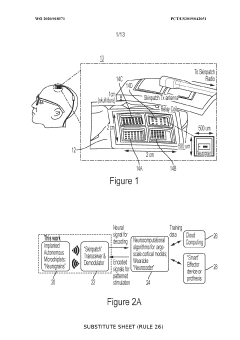
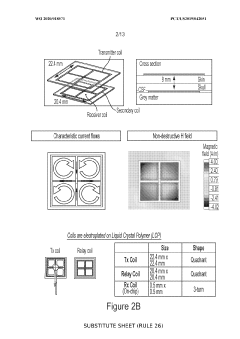
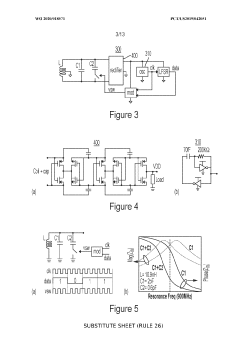
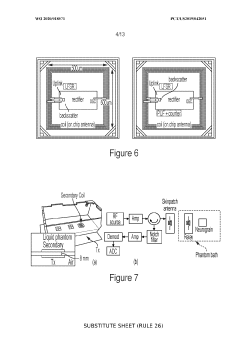
- A distributed sensor system utilizing CMOS untethered microelectronic chiplets, or neurograins, that form a network of individual neural interfacing nodes in the cortex for active recording and electrical stimulation, coupled with an epidermal skinpatch and external devices for wireless communication and power transfer, enabling high-density neural interfaces.
Systems and Methods for Simulating Brain-Computer Interfaces
PatentPendingUS20250209296A1
Innovation
- A computational framework using deep learning techniques and artificial intelligence agents simulates neural activity and user interaction, enabling rapid prototyping and optimization of BCIs by testing decoder algorithms in a simulated environment without live subjects.


FDA Regulatory Framework for Neural Implant Devices
The FDA regulatory framework for neural implant devices represents a comprehensive and evolving system designed to ensure the safety and efficacy of brain-computer interfaces and neural implants before they reach patients. This framework operates under the medical device classification system, where most neural implants fall under Class II or Class III categories, requiring either 510(k) premarket notification or Premarket Approval (PMA) depending on their risk profile and intended use.
Neural implants intended for therapeutic applications, such as deep brain stimulation devices for Parkinson's disease or cochlear implants, typically undergo the PMA pathway due to their high-risk classification. This process demands extensive clinical trials demonstrating safety and effectiveness, often requiring multi-phase studies spanning several years. The FDA evaluates performance metrics including device reliability, biocompatibility, signal quality, and long-term stability as critical components of the approval process.
For brain-computer interfaces designed for communication or motor control restoration, the regulatory pathway becomes more complex due to the novel nature of these technologies. The FDA has established specific guidance documents addressing software validation, cybersecurity considerations, and human factors engineering requirements. Performance metrics such as decoding accuracy, response latency, and system robustness must be thoroughly documented and validated through rigorous testing protocols.
The regulatory framework also encompasses post-market surveillance requirements, mandating manufacturers to monitor device performance continuously and report adverse events. This includes tracking long-term performance degradation, infection rates, and device failures that could impact patient safety. The FDA's breakthrough device designation program has accelerated review timelines for innovative neural technologies that address unmet medical needs.
Recent regulatory developments have focused on establishing standardized testing methodologies for neural interface performance evaluation. The FDA collaborates with international regulatory bodies and standards organizations to harmonize approval processes while maintaining rigorous safety standards. This evolving framework continues to adapt to emerging technologies, balancing innovation acceleration with patient protection through evidence-based regulatory science approaches.
Safety and Biocompatibility Standards for Neural Interfaces
Safety and biocompatibility standards for neural interfaces represent critical regulatory frameworks that govern the development and deployment of both brain-computer interfaces and neural implants. These standards encompass comprehensive guidelines addressing material compatibility, tissue response evaluation, and long-term safety protocols that directly impact performance metrics assessment methodologies.
The International Organization for Standardization (ISO) 10993 series provides foundational biocompatibility testing requirements specifically adapted for neural interface applications. These standards mandate rigorous evaluation of cytotoxicity, sensitization, and irritation responses, establishing baseline safety thresholds that influence device design parameters and ultimately affect signal acquisition capabilities and processing accuracy.
Regulatory bodies including the FDA and European Medicines Agency have developed specialized guidance documents for neural interface devices, emphasizing the critical relationship between biocompatibility and sustained performance. The FDA's guidance on implantable brain-computer interface devices specifically addresses how material degradation and inflammatory responses can compromise signal quality over extended operational periods.
Current biocompatibility assessment protocols require comprehensive evaluation of neural tissue integration, including glial scar formation analysis, neuronal viability studies, and chronic inflammatory response monitoring. These evaluations directly correlate with performance sustainability, as excessive tissue reactions can significantly degrade signal-to-noise ratios and reduce effective electrode functionality over time.
Emerging safety standards are incorporating advanced biocompatibility metrics such as impedance stability monitoring, chronic recording quality assessment, and adaptive biocompatibility testing protocols. These evolving standards recognize that traditional biocompatibility evaluation methods may not adequately capture the complex interactions between neural tissue and sophisticated interface technologies.
The integration of safety and biocompatibility standards with performance metrics evaluation represents a paradigm shift toward holistic device assessment, where safety compliance and functional performance are evaluated as interconnected parameters rather than independent criteria, ensuring both therapeutic efficacy and patient safety in neural interface applications.
Unlock deeper insights with Patsnap Eureka Quick Research — get a full tech report to explore trends and direct your research. Try now!
Generate Your Research Report Instantly with AI Agent
Supercharge your innovation with Patsnap Eureka AI Agent Platform!