

Coil Whine Research: Technology Directions and Developments
AUG 13, 20259 MIN READ
Generate Your Research Report Instantly with AI Agent
PatSnap Eureka helps you evaluate technical feasibility & market potential.
Coil Whine Origins and Research Objectives
Coil whine, a phenomenon characterized by high-frequency noise emanating from electronic components, has been a persistent challenge in the electronics industry for decades. This acoustic issue primarily originates from the vibration of electromagnetic coils and other magnetic elements within devices, particularly under varying electrical loads. The history of coil whine can be traced back to the early days of electronic equipment, becoming more prominent with the advent of switched-mode power supplies and high-performance computing systems.
As electronic devices have become increasingly compact and powerful, the prevalence and impact of coil whine have grown significantly. This has led to a renewed focus on understanding and mitigating this issue across various sectors, including consumer electronics, automotive systems, and industrial equipment. The primary objective of coil whine research is to develop comprehensive solutions that can effectively reduce or eliminate this unwanted noise while maintaining optimal device performance and efficiency.
Current research efforts are multifaceted, addressing both the fundamental causes of coil whine and exploring innovative mitigation strategies. Key areas of investigation include the analysis of material properties, the optimization of component design, and the development of advanced manufacturing techniques. Researchers are also exploring the potential of active noise cancellation technologies and novel circuit designs to counteract coil whine at its source.
The technological evolution in this field has seen a shift from purely mechanical solutions, such as damping materials and structural modifications, to more sophisticated approaches involving electronic control and smart materials. This transition reflects the growing complexity of modern electronic systems and the need for more integrated and adaptable solutions to combat coil whine across a wide range of applications and operating conditions.
As the demand for quieter, more efficient electronic devices continues to rise, the importance of coil whine research has become increasingly apparent. Industry leaders and academic institutions are investing significant resources in this area, recognizing its potential to enhance user experience, improve product reliability, and meet stringent noise regulations. The ultimate goal is to develop a new generation of electronic components and systems that can operate silently without compromising on performance or energy efficiency.
As electronic devices have become increasingly compact and powerful, the prevalence and impact of coil whine have grown significantly. This has led to a renewed focus on understanding and mitigating this issue across various sectors, including consumer electronics, automotive systems, and industrial equipment. The primary objective of coil whine research is to develop comprehensive solutions that can effectively reduce or eliminate this unwanted noise while maintaining optimal device performance and efficiency.
Current research efforts are multifaceted, addressing both the fundamental causes of coil whine and exploring innovative mitigation strategies. Key areas of investigation include the analysis of material properties, the optimization of component design, and the development of advanced manufacturing techniques. Researchers are also exploring the potential of active noise cancellation technologies and novel circuit designs to counteract coil whine at its source.
The technological evolution in this field has seen a shift from purely mechanical solutions, such as damping materials and structural modifications, to more sophisticated approaches involving electronic control and smart materials. This transition reflects the growing complexity of modern electronic systems and the need for more integrated and adaptable solutions to combat coil whine across a wide range of applications and operating conditions.
As the demand for quieter, more efficient electronic devices continues to rise, the importance of coil whine research has become increasingly apparent. Industry leaders and academic institutions are investing significant resources in this area, recognizing its potential to enhance user experience, improve product reliability, and meet stringent noise regulations. The ultimate goal is to develop a new generation of electronic components and systems that can operate silently without compromising on performance or energy efficiency.
Market Impact of Coil Whine on Electronics
Coil whine has emerged as a significant concern in the electronics industry, impacting both manufacturers and consumers. This high-frequency noise, produced by electromagnetic components in electronic devices, has far-reaching consequences on market dynamics and consumer behavior. The prevalence of coil whine in various electronic products, from computers and graphics cards to power supplies and household appliances, has led to increased customer dissatisfaction and product returns.
The market impact of coil whine is particularly pronounced in the high-performance computing and gaming sectors. Gaming enthusiasts and professional users, who often invest in premium hardware, are especially sensitive to this issue. The presence of coil whine in high-end graphics cards and power supplies has resulted in negative reviews, brand reputation damage, and decreased sales for affected manufacturers. This has forced companies to allocate significant resources to research and development, aiming to mitigate or eliminate coil whine in their products.
In the consumer electronics market, coil whine has become a differentiating factor in product quality perception. Devices with minimal or no audible coil whine are increasingly marketed as premium features, commanding higher prices and consumer preference. This trend has led to a shift in manufacturing priorities, with companies investing in advanced materials and design techniques to reduce electromagnetic noise.
The impact extends beyond individual product sales to affect entire product lines and brand reputations. Companies that consistently produce devices with noticeable coil whine risk losing market share to competitors who have successfully addressed this issue. This has resulted in a competitive landscape where addressing coil whine has become a key factor in product development and marketing strategies.
The automotive industry, particularly in the electric vehicle (EV) sector, has also felt the market impact of coil whine. As EVs rely heavily on power electronics, the presence of coil whine can significantly affect the perceived quality and comfort of these vehicles. Manufacturers are now focusing on developing silent powertrains and electronics to maintain a competitive edge in this rapidly growing market segment.
The increased awareness of coil whine among consumers has led to changes in purchasing behavior. Online forums and product reviews frequently discuss coil whine, influencing potential buyers' decisions. This has resulted in a more informed and discerning customer base, putting pressure on manufacturers to improve their products or risk losing sales.
In response to these market pressures, a new sub-industry focused on coil whine reduction technologies has emerged. Companies specializing in electromagnetic shielding, advanced materials for electronic components, and noise-canceling technologies have seen increased demand for their products and services. This has created new opportunities for innovation and market growth within the electronics industry.
The market impact of coil whine is particularly pronounced in the high-performance computing and gaming sectors. Gaming enthusiasts and professional users, who often invest in premium hardware, are especially sensitive to this issue. The presence of coil whine in high-end graphics cards and power supplies has resulted in negative reviews, brand reputation damage, and decreased sales for affected manufacturers. This has forced companies to allocate significant resources to research and development, aiming to mitigate or eliminate coil whine in their products.
In the consumer electronics market, coil whine has become a differentiating factor in product quality perception. Devices with minimal or no audible coil whine are increasingly marketed as premium features, commanding higher prices and consumer preference. This trend has led to a shift in manufacturing priorities, with companies investing in advanced materials and design techniques to reduce electromagnetic noise.
The impact extends beyond individual product sales to affect entire product lines and brand reputations. Companies that consistently produce devices with noticeable coil whine risk losing market share to competitors who have successfully addressed this issue. This has resulted in a competitive landscape where addressing coil whine has become a key factor in product development and marketing strategies.
The automotive industry, particularly in the electric vehicle (EV) sector, has also felt the market impact of coil whine. As EVs rely heavily on power electronics, the presence of coil whine can significantly affect the perceived quality and comfort of these vehicles. Manufacturers are now focusing on developing silent powertrains and electronics to maintain a competitive edge in this rapidly growing market segment.
The increased awareness of coil whine among consumers has led to changes in purchasing behavior. Online forums and product reviews frequently discuss coil whine, influencing potential buyers' decisions. This has resulted in a more informed and discerning customer base, putting pressure on manufacturers to improve their products or risk losing sales.
In response to these market pressures, a new sub-industry focused on coil whine reduction technologies has emerged. Companies specializing in electromagnetic shielding, advanced materials for electronic components, and noise-canceling technologies have seen increased demand for their products and services. This has created new opportunities for innovation and market growth within the electronics industry.
Current Challenges in Coil Whine Mitigation
Coil whine remains a persistent challenge in electronic devices, particularly in power supplies, graphics cards, and other high-frequency switching components. Despite advancements in electronic design, the issue continues to plague manufacturers and consumers alike. One of the primary difficulties in mitigating coil whine lies in its multifaceted nature, involving complex interactions between electrical, mechanical, and acoustic phenomena.
A significant challenge is the trade-off between performance and noise reduction. As electronic devices become more powerful and efficient, they often require higher switching frequencies, which can exacerbate coil whine. Engineers must balance the need for improved performance with the demand for quieter operation, a task that becomes increasingly difficult as devices shrink in size and increase in complexity.
The variability of coil whine across individual units presents another hurdle. Even within the same product line, some devices may exhibit noticeable coil whine while others remain silent. This inconsistency makes it challenging to implement universal solutions and complicates quality control processes.
Material limitations also pose a significant obstacle. While advancements in magnetic core materials and winding techniques have shown promise, finding cost-effective materials that can effectively dampen vibrations without compromising electrical performance remains a challenge. The search for ideal materials that combine excellent magnetic properties with superior acoustic damping characteristics continues to be a focus of research and development efforts.
Another critical challenge is the lack of standardized testing and measurement protocols for coil whine. The subjective nature of human hearing and the variability in environmental conditions make it difficult to establish consistent benchmarks for acceptable noise levels. This absence of standardization hampers the development of industry-wide solutions and complicates the process of comparing different mitigation techniques.
The miniaturization trend in electronics further compounds the coil whine problem. As devices become smaller, there is less space for implementing traditional noise reduction techniques such as physical barriers or damping materials. This constraint forces engineers to seek innovative solutions that can be integrated into increasingly compact designs without compromising functionality or thermal management.
Lastly, the economic considerations of coil whine mitigation present a significant challenge. Implementing advanced noise reduction techniques often increases production costs, which can be difficult to justify in competitive markets where price is a crucial factor. Manufacturers must carefully weigh the benefits of noise reduction against the potential impact on product pricing and market competitiveness.
A significant challenge is the trade-off between performance and noise reduction. As electronic devices become more powerful and efficient, they often require higher switching frequencies, which can exacerbate coil whine. Engineers must balance the need for improved performance with the demand for quieter operation, a task that becomes increasingly difficult as devices shrink in size and increase in complexity.
The variability of coil whine across individual units presents another hurdle. Even within the same product line, some devices may exhibit noticeable coil whine while others remain silent. This inconsistency makes it challenging to implement universal solutions and complicates quality control processes.
Material limitations also pose a significant obstacle. While advancements in magnetic core materials and winding techniques have shown promise, finding cost-effective materials that can effectively dampen vibrations without compromising electrical performance remains a challenge. The search for ideal materials that combine excellent magnetic properties with superior acoustic damping characteristics continues to be a focus of research and development efforts.
Another critical challenge is the lack of standardized testing and measurement protocols for coil whine. The subjective nature of human hearing and the variability in environmental conditions make it difficult to establish consistent benchmarks for acceptable noise levels. This absence of standardization hampers the development of industry-wide solutions and complicates the process of comparing different mitigation techniques.
The miniaturization trend in electronics further compounds the coil whine problem. As devices become smaller, there is less space for implementing traditional noise reduction techniques such as physical barriers or damping materials. This constraint forces engineers to seek innovative solutions that can be integrated into increasingly compact designs without compromising functionality or thermal management.
Lastly, the economic considerations of coil whine mitigation present a significant challenge. Implementing advanced noise reduction techniques often increases production costs, which can be difficult to justify in competitive markets where price is a crucial factor. Manufacturers must carefully weigh the benefits of noise reduction against the potential impact on product pricing and market competitiveness.
Existing Coil Whine Suppression Methods
01 Noise reduction techniques for electronic devices
Various methods are employed to reduce coil whine noise in electronic devices, including improved circuit design, component selection, and isolation techniques. These approaches aim to minimize electromagnetic interference and vibrations that cause the characteristic high-pitched sound associated with coil whine.- Noise reduction techniques for electronic devices: Various methods are employed to reduce coil whine noise in electronic devices. These techniques include using specialized materials, optimizing circuit design, and implementing noise cancellation technologies. By addressing the root causes of coil whine, such as electromagnetic vibrations, these approaches aim to minimize or eliminate the audible noise produced by electronic components.
- Magnetic field shielding for coil whine reduction: Magnetic field shielding is utilized to mitigate coil whine noise. This involves the use of materials and structures that can contain or redirect magnetic fields generated by coils and transformers. By reducing the interaction between these fields and surrounding components, the likelihood of coil whine occurrence is decreased, resulting in quieter operation of electronic devices.
- Acoustic dampening solutions for coil whine: Acoustic dampening materials and designs are implemented to absorb and dissipate the vibrations causing coil whine. This approach focuses on preventing the propagation of sound waves generated by vibrating components. By incorporating sound-absorbing materials or structures within the device, the audible noise from coil whine can be significantly reduced.
- Frequency modulation to minimize coil whine: Frequency modulation techniques are applied to electronic circuits to spread the energy of coil whine across a wider frequency spectrum. This approach can make the noise less noticeable to human ears by shifting it outside the most sensitive auditory range. By carefully controlling the operating frequencies of components prone to coil whine, the perceived noise can be reduced.
- Active noise control for coil whine suppression: Active noise control systems are developed to counteract coil whine in real-time. These systems use microphones to detect the noise and generate anti-noise signals to cancel out the unwanted sound. By continuously monitoring and adapting to the coil whine, active noise control can provide dynamic suppression of the noise in various operating conditions.
02 Magnetic core materials and coil designs
Advancements in magnetic core materials and coil designs help mitigate coil whine noise. This includes the use of specialized alloys, core shapes, and winding techniques that reduce magnetic flux leakage and minimize mechanical vibrations in transformers and inductors.Expand Specific Solutions03 Acoustic dampening and isolation methods
Implementing acoustic dampening materials and isolation methods can significantly reduce the transmission of coil whine noise. This involves using specialized foams, rubbers, or other vibration-absorbing materials to encapsulate or isolate noise-generating components within electronic devices.Expand Specific Solutions04 Power supply and voltage regulation optimization
Optimizing power supply designs and voltage regulation circuits can help minimize coil whine noise. This includes implementing advanced switching techniques, improved filtering, and more stable voltage control to reduce electrical stress on components prone to generating audible noise.Expand Specific Solutions05 Detection and measurement of coil whine
Developing methods for detecting and measuring coil whine noise is crucial for addressing the issue. This involves using specialized acoustic sensors, signal processing techniques, and analysis tools to identify the sources and characteristics of coil whine in electronic devices, enabling more targeted noise reduction strategies.Expand Specific Solutions
Key Players in Coil Whine Research
The coil whine research field is currently in a growth phase, with increasing market demand driven by the need for quieter electronic devices. The global market size for coil whine reduction technologies is expanding, particularly in consumer electronics, automotive, and industrial sectors. While the technology is maturing, there is still room for innovation. Key players like Toyota Motor Corp., TDK Corp., and Murata Manufacturing Co. Ltd. are investing heavily in R&D to develop advanced solutions. Companies such as DENSO Corp. and Taiyo Yuden Co., Ltd. are also making significant contributions, focusing on noise reduction in automotive and electronic applications. The competitive landscape is characterized by a mix of established electronics giants and specialized component manufacturers, all vying for technological leadership in this niche but growing field.
TDK Corp.
Technical Solution: TDK Corp. has developed advanced noise suppression technologies for coil whine reduction in electronic devices. Their approach involves the use of specialized magnetic materials and innovative coil designs to minimize electromagnetic interference. TDK's solution includes the implementation of multi-layer shielding techniques and the integration of noise-cancelling components directly into the coil structure. They have also pioneered the use of advanced ferrite materials with high permeability and low core losses, which significantly reduce the occurrence of coil whine in power supplies and other electronic systems[1][3]. Additionally, TDK has introduced active noise control solutions that can detect and counteract coil whine in real-time, providing a more comprehensive approach to this issue[5].
Strengths: Extensive experience in magnetic materials, comprehensive approach combining passive and active noise reduction techniques. Weaknesses: Potentially higher cost due to advanced materials and complex designs, may require significant redesign of existing systems.
Murata Manufacturing Co. Ltd.
Technical Solution: Murata Manufacturing Co. Ltd. has focused on developing innovative coil designs and materials to address coil whine issues. Their approach includes the use of advanced ceramic materials with superior electromagnetic properties to reduce vibrations that cause coil whine. Murata has also developed specialized winding techniques that minimize the mechanical stress on coils during operation, thereby reducing the likelihood of audible noise. Their research has led to the creation of hybrid coil structures that combine different materials to optimize both electrical performance and noise reduction[2]. Furthermore, Murata has invested in the development of advanced simulation tools that allow for precise modeling of coil behavior under various operating conditions, enabling more effective noise mitigation strategies[4].
Strengths: Strong expertise in ceramic materials and advanced coil design, comprehensive simulation capabilities for optimized solutions. Weaknesses: Solutions may be more tailored to specific applications, potentially limiting broad applicability across all electronic devices.
Innovative Approaches to Coil Whine Elimination
Coil component and fabrication method of the same
PatentInactiveUS7427909B2
Innovation
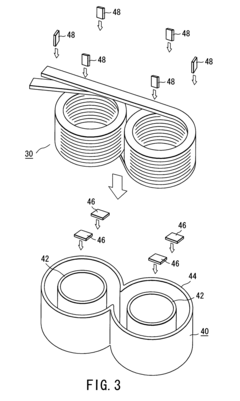
- A coil component design featuring a coil-containing insulator enclosure made of epoxy resin, embedded within a magnetic core composed of a mixture of resin and magnetic powder, which provides enhanced structural integrity and noise suppression.



Acoustic Standards and Regulations
Acoustic standards and regulations play a crucial role in addressing coil whine issues in electronic devices. These standards establish acceptable noise levels and measurement methodologies, ensuring consistent evaluation across industries. The International Electrotechnical Commission (IEC) has developed several standards relevant to coil whine, including IEC 60076-10 for power transformers and IEC 62368-1 for audio/video equipment.
In the United States, the Occupational Safety and Health Administration (OSHA) sets permissible noise exposure limits in workplace environments, which indirectly influence the design of electronic equipment to minimize noise emissions. The Environmental Protection Agency (EPA) also provides guidelines for community noise levels, which can impact the development of consumer electronics.
The European Union has implemented the Machinery Directive 2006/42/EC, which includes noise emission requirements for various types of equipment. This directive is complemented by specific standards such as EN ISO 11201 for measuring emission sound pressure levels at workstations. These regulations have led to increased focus on noise reduction techniques in electronic design.
In the automotive industry, SAE International has established standards like SAE J1030 for vehicle interior noise measurement, which can be applicable to coil whine in electric vehicles. Similarly, the Automotive Electronics Council (AEC) provides guidelines for electronic component qualification, including acoustic performance requirements.
For consumer electronics, the ENERGY STAR program, while primarily focused on energy efficiency, also includes noise level criteria for certain product categories. This has encouraged manufacturers to address coil whine issues in their designs to meet certification requirements.
The International Organization for Standardization (ISO) has developed ISO 7779 for measuring noise emitted by information technology and telecommunications equipment. This standard is widely used in the IT industry and has implications for addressing coil whine in computer components and peripherals.
As the awareness of noise pollution increases, many countries are implementing stricter acoustic regulations. For instance, China's GB/T 18801 standard sets noise limits for household appliances, influencing the global supply chain and product development strategies.
These standards and regulations continue to evolve, driven by advancements in measurement technologies and increasing consumer expectations for quieter electronic devices. Compliance with these standards not only ensures legal and regulatory adherence but also contributes to improved product quality and user satisfaction.
In the United States, the Occupational Safety and Health Administration (OSHA) sets permissible noise exposure limits in workplace environments, which indirectly influence the design of electronic equipment to minimize noise emissions. The Environmental Protection Agency (EPA) also provides guidelines for community noise levels, which can impact the development of consumer electronics.
The European Union has implemented the Machinery Directive 2006/42/EC, which includes noise emission requirements for various types of equipment. This directive is complemented by specific standards such as EN ISO 11201 for measuring emission sound pressure levels at workstations. These regulations have led to increased focus on noise reduction techniques in electronic design.
In the automotive industry, SAE International has established standards like SAE J1030 for vehicle interior noise measurement, which can be applicable to coil whine in electric vehicles. Similarly, the Automotive Electronics Council (AEC) provides guidelines for electronic component qualification, including acoustic performance requirements.
For consumer electronics, the ENERGY STAR program, while primarily focused on energy efficiency, also includes noise level criteria for certain product categories. This has encouraged manufacturers to address coil whine issues in their designs to meet certification requirements.
The International Organization for Standardization (ISO) has developed ISO 7779 for measuring noise emitted by information technology and telecommunications equipment. This standard is widely used in the IT industry and has implications for addressing coil whine in computer components and peripherals.
As the awareness of noise pollution increases, many countries are implementing stricter acoustic regulations. For instance, China's GB/T 18801 standard sets noise limits for household appliances, influencing the global supply chain and product development strategies.
These standards and regulations continue to evolve, driven by advancements in measurement technologies and increasing consumer expectations for quieter electronic devices. Compliance with these standards not only ensures legal and regulatory adherence but also contributes to improved product quality and user satisfaction.
Environmental Impact of Coil Whine Solutions
The environmental impact of coil whine solutions is an increasingly important consideration in the development and implementation of noise reduction technologies. As electronic devices become more prevalent in our daily lives, the cumulative effect of coil whine on the environment cannot be overlooked. Traditional methods of addressing coil whine, such as encapsulation or damping materials, often involve the use of synthetic materials that may have long-term environmental consequences.
Recent research has focused on developing more eco-friendly solutions to mitigate coil whine. One promising approach involves the use of biodegradable materials for vibration damping. These materials, derived from renewable resources, offer comparable performance to conventional synthetic options while significantly reducing the environmental footprint of electronic devices. Additionally, advancements in circuit design and component selection have led to intrinsically quieter systems, reducing the need for additional noise suppression measures and their associated environmental impact.
The manufacturing processes for coil whine reduction technologies are also under scrutiny. Energy-efficient production methods and the use of recycled materials in the fabrication of noise-reducing components are becoming more common. This shift not only addresses the immediate issue of coil whine but also contributes to the overall sustainability of electronic device production.
Furthermore, the disposal and recycling of electronic devices with coil whine mitigation technologies present unique challenges. As these devices reach the end of their lifecycle, proper recycling techniques must be developed to handle the specialized materials used in noise reduction. This has led to increased collaboration between electronics manufacturers and recycling facilities to establish effective protocols for the safe and environmentally responsible disposal of these components.
The energy efficiency of coil whine solutions is another critical environmental factor. While some noise reduction techniques may increase power consumption, innovative approaches are being developed to minimize this impact. For instance, active noise cancellation systems are being optimized to operate with minimal energy overhead, balancing the need for quiet operation with energy conservation goals.
As regulations around electronic waste and energy efficiency become more stringent, the environmental impact of coil whine solutions is likely to play a more significant role in product design and marketing. Manufacturers are increasingly recognizing the value of environmentally friendly noise reduction technologies as a differentiator in the competitive electronics market. This trend is driving further research into sustainable materials and processes for coil whine mitigation, promising a future where electronic devices can be both quiet and environmentally responsible.
Recent research has focused on developing more eco-friendly solutions to mitigate coil whine. One promising approach involves the use of biodegradable materials for vibration damping. These materials, derived from renewable resources, offer comparable performance to conventional synthetic options while significantly reducing the environmental footprint of electronic devices. Additionally, advancements in circuit design and component selection have led to intrinsically quieter systems, reducing the need for additional noise suppression measures and their associated environmental impact.
The manufacturing processes for coil whine reduction technologies are also under scrutiny. Energy-efficient production methods and the use of recycled materials in the fabrication of noise-reducing components are becoming more common. This shift not only addresses the immediate issue of coil whine but also contributes to the overall sustainability of electronic device production.
Furthermore, the disposal and recycling of electronic devices with coil whine mitigation technologies present unique challenges. As these devices reach the end of their lifecycle, proper recycling techniques must be developed to handle the specialized materials used in noise reduction. This has led to increased collaboration between electronics manufacturers and recycling facilities to establish effective protocols for the safe and environmentally responsible disposal of these components.
The energy efficiency of coil whine solutions is another critical environmental factor. While some noise reduction techniques may increase power consumption, innovative approaches are being developed to minimize this impact. For instance, active noise cancellation systems are being optimized to operate with minimal energy overhead, balancing the need for quiet operation with energy conservation goals.
As regulations around electronic waste and energy efficiency become more stringent, the environmental impact of coil whine solutions is likely to play a more significant role in product design and marketing. Manufacturers are increasingly recognizing the value of environmentally friendly noise reduction technologies as a differentiator in the competitive electronics market. This trend is driving further research into sustainable materials and processes for coil whine mitigation, promising a future where electronic devices can be both quiet and environmentally responsible.
Unlock deeper insights with PatSnap Eureka Quick Research — get a full tech report to explore trends and direct your research. Try now!
Generate Your Research Report Instantly with AI Agent
Supercharge your innovation with PatSnap Eureka AI Agent Platform!